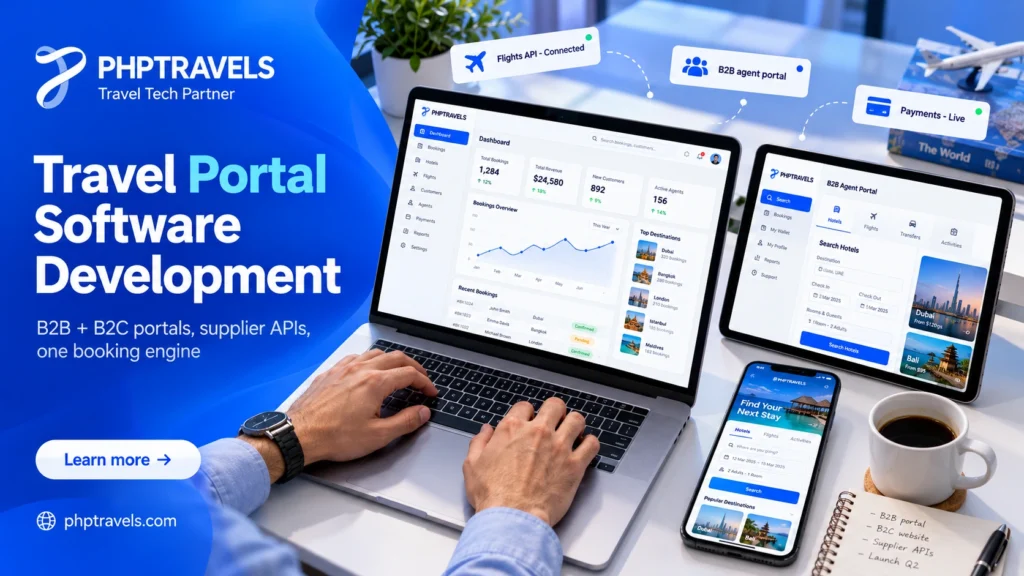
Travel portal software development is the work of building, or choosing and customising, one platform where customers and agents can search, compare and book flights, hotels, tours, cars and transfers, then pay online. A modern portal ties a booking engine, supplier APIs, payments, markups and a back office together, so a travel business sells its own products under its own brand instead of renting a storefront from someone else.
This guide explains how a travel portal is put together: the difference between B2C travel portal, B2B travel portal and white label travel portal models, the features that matter, how XML and JSON supplier integrations work, what the cost of travel portal development depends on, and how to decide between a custom build and a ready platform. PHPTRAVELS has built travel portal development tooling for twelve years, and more than 4,800 agencies now run on it, so the advice below comes from real deployments.
Key takeaways
- A travel portal is more than a website: it is a booking engine, supplier connections, payments, markup rules and a back office working as one system.
- Decide the model first: B2C for direct customers, B2B for sub-agents and resellers, or both on one core.
- Supplier APIs (flights, hotels, tours, cars) are the heart of the build, and you need your own supplier contracts and credentials.
- Building from scratch usually takes months; a licensed platform lets you launch in a fraction of that time and still own the code and your margins.
- Budget for supplier fees, payment gateway fees, hosting and ongoing operations, not only the software.
In this guide
- What Is Travel Portal Software Development
- Types of Travel Portals: B2C, B2B and White Label
- Core Features of a Travel Portal Software
- Travel Booking Engine and Supplier API Integration
- Payments, Markups and Multi-Currency Billing
- Travel CRM, Back Office and Inventory Management
- Mobile Apps, Cloud Hosting, Security and AI-Ready Design
- Cost of Travel Portal Development and How to Choose a Partner
- FAQs About Travel Portal Software Development
- Get Your Travel Portal Live
What Is Travel Portal Software Development
Travel portal software development covers everything needed to put a bookable travel business online: the customer-facing storefront, an agent or admin dashboard, the booking engine that talks to suppliers, the payment layer and the reporting behind it. The finished product is often called online travel portal software, a travel agency portal or OTA software, depending on who sells through it.

In practice there are three ways to get one. You can build from scratch with your own developers, license a ready platform and customise it, or start from a white-label service that hosts everything for you. The trade-offs between these paths are covered in API-based vs white-label travel portals, and early-stage founders will also find the ways to start an online travel portal guide useful.
What the portal does for the business is simple to state. It centralises real-time availability and pricing from every supplier, applies your markups automatically, takes payment, confirms bookings instantly and gives your team one place to manage them. Agencies that move from emailing suppliers and re-keying bookings to a single portal cut manual errors and answer customers faster.
Types of Travel Portals: B2C, B2B and White Label
Choosing the portal model is the first real decision, because it shapes the features, the supplier contracts and the pricing logic you need.
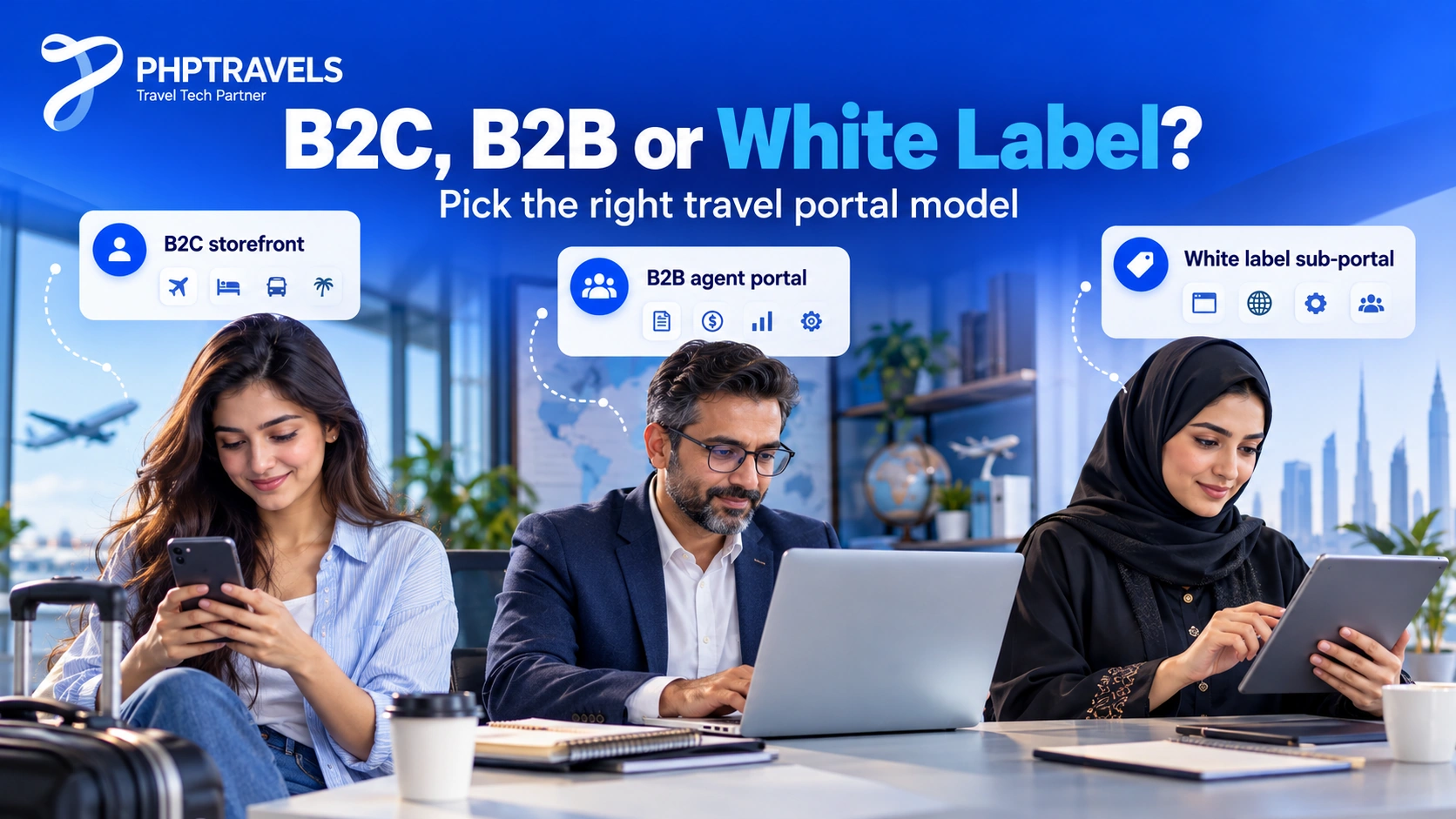
B2C travel portal
A B2C portal sells directly to travellers. It prioritises fast search, mobile-friendly pages, clear pricing and a short checkout. PHPTRAVELS ships a ready B2C travel portal storefront, and the technical layout is explained in the B2C travel portal architecture guide.
B2B travel portal
A B2B portal serves sub-agents, resellers and corporate buyers. It adds agent registration and approval, wallet or credit limits, agent-level markups and commissions, and net rates that customers never see. See the B2B travel portal overview, the B2B portal architecture breakdown and the B2B travel portal software guide for the details.
White label travel portal
A white label travel portal is a portal you brand and resell. Your logo, domain, colours and currencies sit on top of a shared platform. PHPTRAVELS supports white-label sub-portals, and how white label travel portals are structured for resellers is covered in its own post. If you are comparing options for starting an agency, TravelBookingPortal lists the booking-software features agencies usually compare first.
Many businesses run B2C and B2B together on one core, so retail customers and agents see different prices from the same inventory.
Core Features of a Travel Portal Software
Whatever model you choose, a production-ready travel portal needs a common set of features. Use this list when you evaluate a vendor or write a development brief.
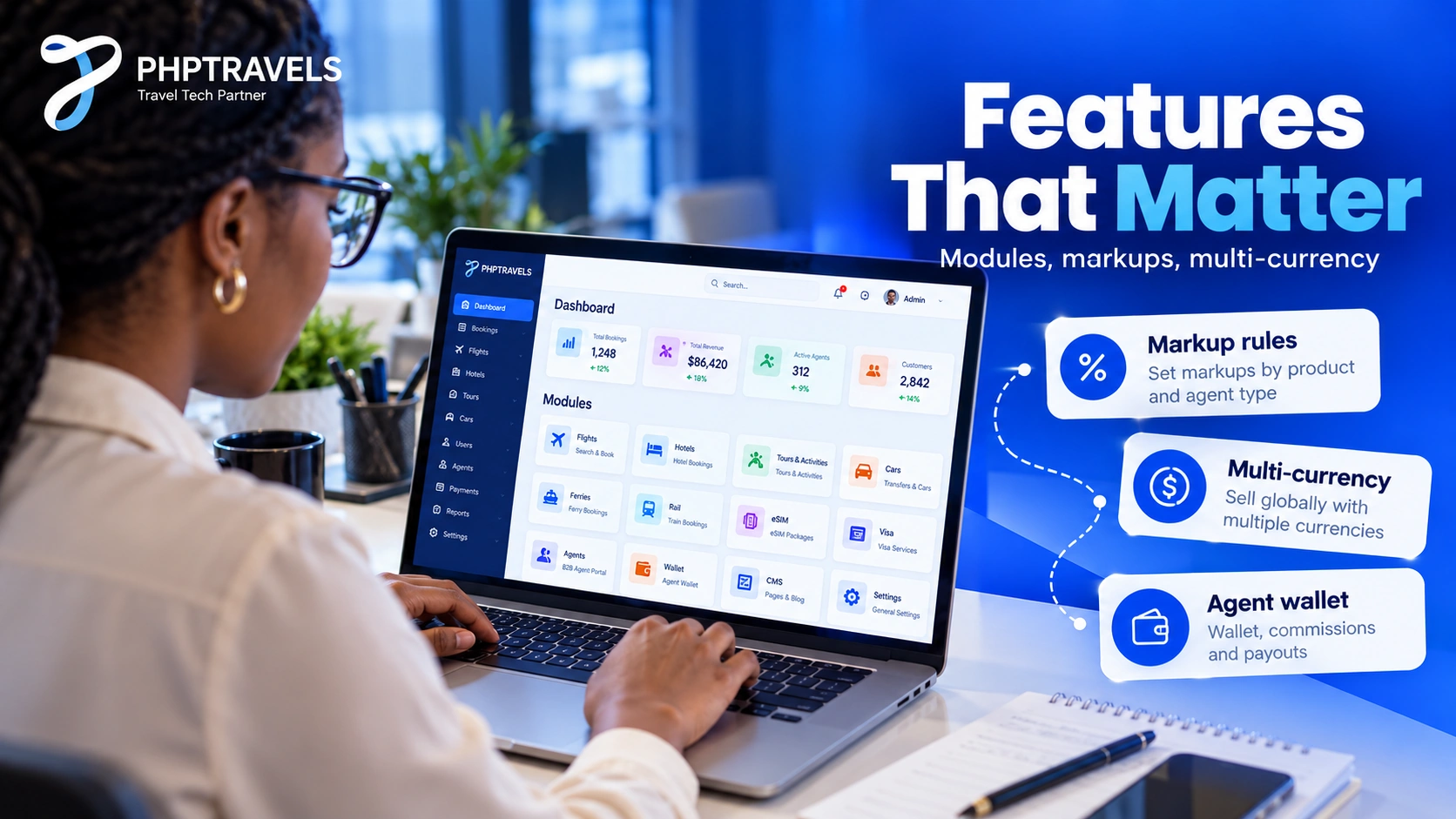
- Multi-module booking: flights, stays, tours, cars, transfers, rail, ferries, eSIM, visa and insurance, enabled independently so you only launch what you sell. See the full list on the features page.
- Real-time search and availability from connected suppliers, with caching to keep search fast.
- Markup and commission rules by product, supplier, agent group or customer type. The mechanics are explained in travel markup management software.
- Multi-currency and multi-language support, so you can sell across regions. Read about multi-currency travel booking and multilingual travel booking software.
- Agent portal controls: sub-agent onboarding, wallet or credit, statements and sales reports, as described in the travel agency agent portal guide.
- Manual inventory for contracted hotels, tours and packages that do not come from an API (manual inventory for tour operators).
- Dynamic packaging that combines flight, hotel and extras into one booking flow. See dynamic packaging software.
- Admin and reporting: booking management, vouchers, email notifications, content and SEO controls.
A feature is only useful if your team will actually use it, so start with the modules that match your first suppliers and add the rest later.
Travel Booking Engine and Supplier API Integration
The booking engine is the part of the portal that talks to suppliers. It sends search requests, receives availability and prices, re-checks the price before booking, creates the reservation and returns a confirmation. Its quality decides how fast search feels and how many bookings fail.

GDS, direct APIs and aggregators
For flights, a portal typically connects to a GDS such as Amadeus, Sabre or Travelport, or to API aggregators and direct sources such as Duffel, Mystifly and PKFare. If you are working out which route suits you, IATA.co explains flight API options for selling flights, and the flights API integration guide walks through the technical side. PHPTRAVELS also publishes pages on its flights API and hotels API integrations.
XML and JSON integration
Suppliers expose their inventory through XML or JSON (REST) APIs. A good integration normalises these different formats into one internal structure, so adding a new supplier does not mean rewriting the storefront. It also handles authentication, timeouts, retries and rate limits. Two concepts worth understanding early are booking revalidation (re-pricing right before payment) and supplier failover (switching or degrading gracefully when one API is slow).
Hotels, tours and cars
Stays can come from bedbanks such as Hotelbeds or RateHawk, or be combined from several sources as in a multi-supplier hotel booking engine. Tours and activities come from sources such as Viator and Tiqets, and cars from providers such as CarTrawler. Check the live integrations page before assuming a supplier is supported, and remember that you need your own contract and credentials with each one. The guide to getting flights and hotels APIs explains how access works.
Payments, Markups and Multi-Currency Billing
A portal earns money in the gap between supplier cost and selling price, so payments and markups must be right from day one.
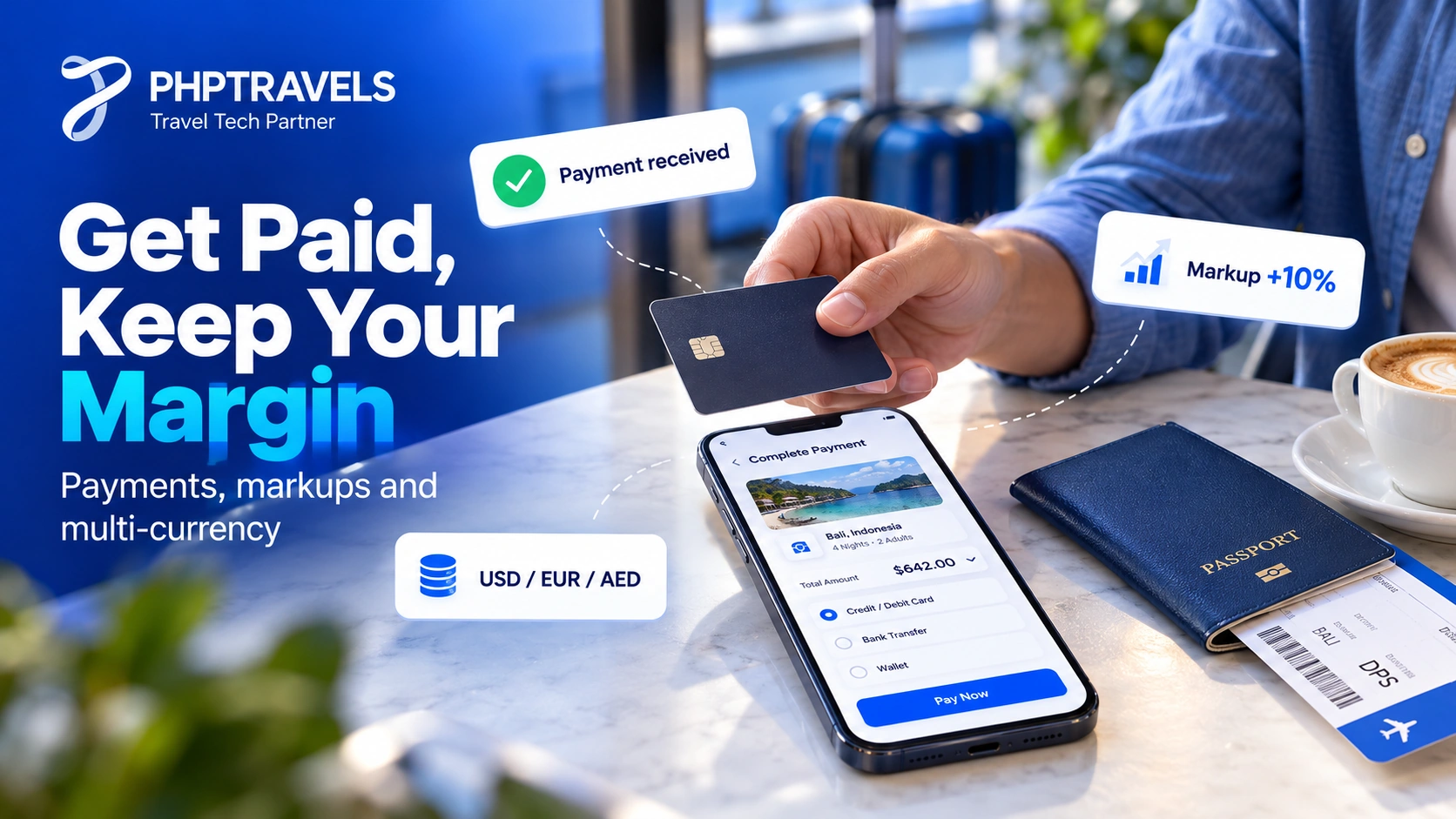
- Payment gateways: PHPTRAVELS connects to gateways including Stripe, PayPal, Adyen, Cashfree, Paystack, Flutterwave and MyFatoorah, plus bank transfer, pay-later and wallet balance. Money goes to your own gateway accounts. Choosing one is covered in how to choose a payment gateway for a travel agency.
- Markups: set fixed or percentage markups per product, supplier and agent level, so your retail price and agent price both protect your margin.
- Commissions and B2B payments: sub-agent commissions, credit limits and settlement are discussed in travel agency commission management and B2B travel payments.
- Multi-currency: show prices in the customer’s currency while settling in yours, with exchange rates you control.
Card data is handled by your payment gateway, not stored in your portal, which keeps your security burden lower. Always test the full flow, including refunds and failed payments, before launch.
Travel CRM, Back Office and Inventory Management
Once bookings start arriving, the back office decides how smoothly the business runs. Staff need to see every booking, change or cancel it, issue vouchers, track supplier payables and report on sales by agent, product and period.

Look for a back office that handles booking status, customer records, supplier invoices, agent statements and commission reports in one place. The travel agency back office software article shows what a complete setup includes. If you want a dedicated lead and invoice workflow on top, Travel CRM System covers CRM for travel agencies, and PHPTRAVELS keeps booking data in a form a CRM can use.
Inventory management matters most when you mix API and contracted stock. Keep direct-contract hotels and tours in the portal itself, using manual entry or room mapping to avoid duplicates, and let supplier APIs fill in the rest. Larger agencies with several offices should also look at multi-branch travel agency software.
Mobile Apps, Cloud Hosting, Security and AI-Ready Design
Most travellers now search on a phone, so a portal needs a fast responsive site and, for many brands, native apps. PHPTRAVELS offers native Android and iOS apps that share inventory with the web portal. The technology page and requirements page list the stack and server needs: PHP 8.2+, MySQL or MariaDB and Composer, on a VPS or cloud server rather than basic shared hosting.

Cloud, scalability and uptime
Search traffic is spiky, and supplier APIs can be slow. Design for caching, queueing and horizontal scaling so a busy sale day does not slow checkout. PHPTRAVELS reports 99.9% uptime on managed hosting, and you can also self-host your own code, as explained in self-hosted travel booking software.
Security basics
Use HTTPS everywhere, role-based admin access, strong password and two-step policies, regular backups and updates, and a payment gateway that keeps card data off your servers. Log supplier requests so you can audit disputes.
Preparing for AI
AI is already changing how travellers search and how agents sell. A portal built on clean APIs is easier to connect to AI assistants, as discussed in MCP and AI travel booking software. For wider context on AI in travel, see Travels Tech on AI for travel.
Cost of Travel Portal Development and How to Choose a Partner
The cost of travel portal development depends on scope: number of modules, supplier integrations, payment gateways, mobile apps and how much custom work you need. A custom build from zero means paying a team for months of design, API work and testing, plus ongoing maintenance. A licensed platform turns most of that into a known one-time price.

PHPTRAVELS publishes its building blocks in USD, and they should always be confirmed on the live pricing configurator: each supplier API is $1,000, a B2C portal is $400, B2B is $500, B2C plus B2B is $1,000, Android is $3,500, iOS is $5,000, and each payment gateway is $250. For example, four suppliers plus a B2C portal plus Stripe and PayPal comes to $4,900. Supplier fees, gateway transaction fees, hosting (unless managed), domain and marketing are separate.
How to choose a travel portal development company
- Ask which modules and suppliers are supported today, and check the integrations list yourself.
- Confirm who owns the source code, the customer data and the supplier contracts.
- Compare one-time licensing with per-booking fees at your expected volume. The comparison page and travel software alternatives guide help with this.
- Look at real examples on the case studies page and test the live demo.
- Be honest about fit: if you want a zero-effort SaaS or have no plan for supplier contracts, a ready platform may not suit you.
Get Your Travel Portal Live
Travel portal software development does not have to mean a year-long project. Pick your model, line up your supplier contracts and payment accounts, and start from a platform that already includes the booking engine, B2C and B2B portals and back office. When you are ready, book a PHPTRAVELS demo to see it working, or estimate your price on the configurator and compare it with your build plans.