

A booking revalidation travel API gives the commit path a fresh check of price, availability, and bookable conditions before payment.
Thursday 14:40. A traveler has already chosen a fare, filled passenger names, and opened the payment form. Your OTA still shows the same total they clicked five minutes ago. Then the book call returns: class gone, total up $47, or the hotel rate plan no longer bookable.
Nothing “mysterious” happened. Search returned a point-in-time offer. Checkout tried to sell it as a guaranteed retail price. Between those two moments, airline inventory, bedbank allotments, taxes, and branded-fare rules kept moving.
This guide is for OTA founders, agency technical leads, and consolidators who connect GDS, NDC, bedbank, or aggregator APIs and need booking revalidation on the path from selected result to paid ticket — not another lecture on shopping volume. If your pain is supplier shopping waste, read look-to-book ratio for travel APIs. If a feed is dark, start with travel API failover and supplier redundancy. If the traveler already paid and you are fighting fraud or chargebacks, see travel booking payment security.
What a booking revalidation travel API actually means
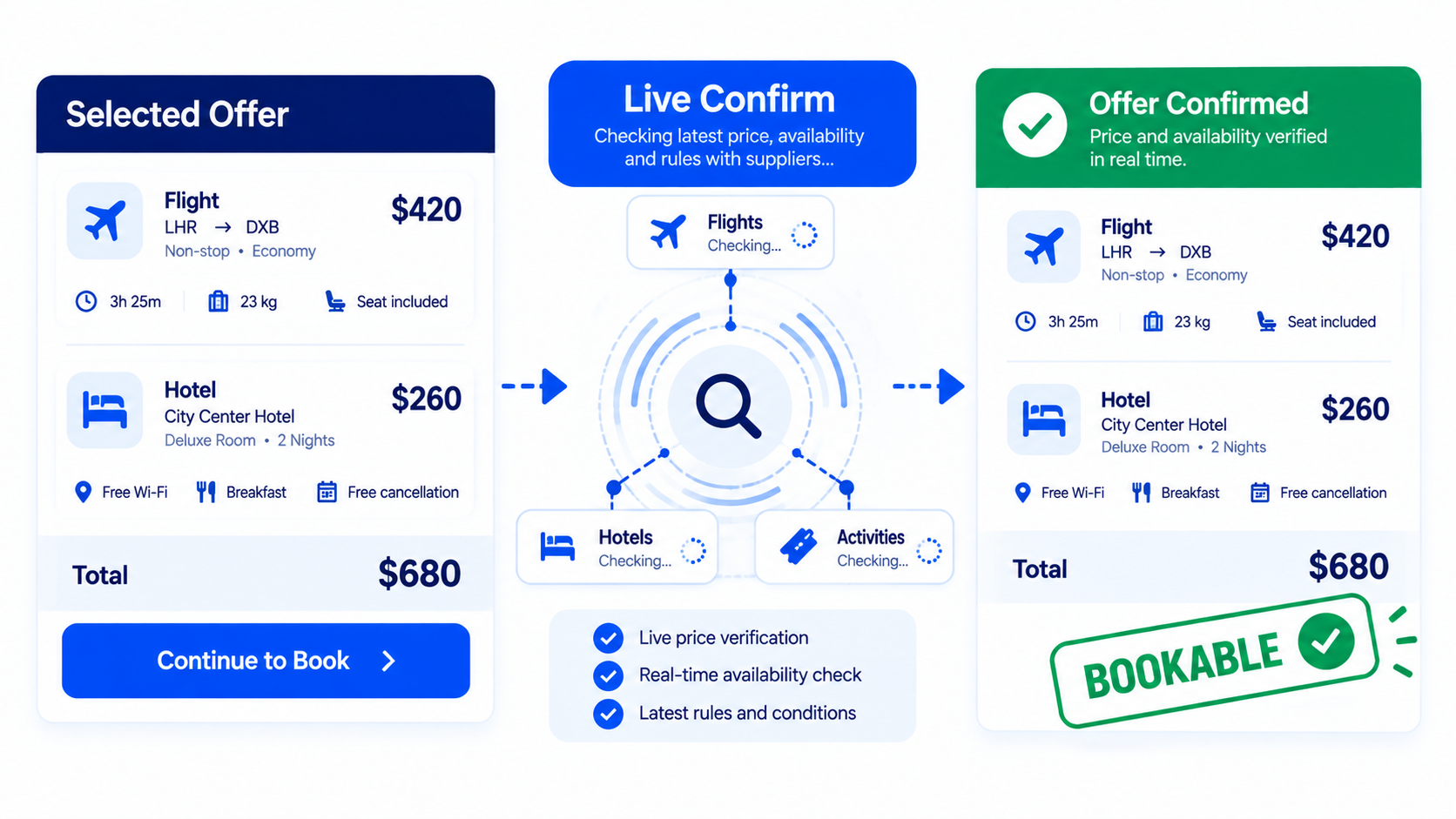
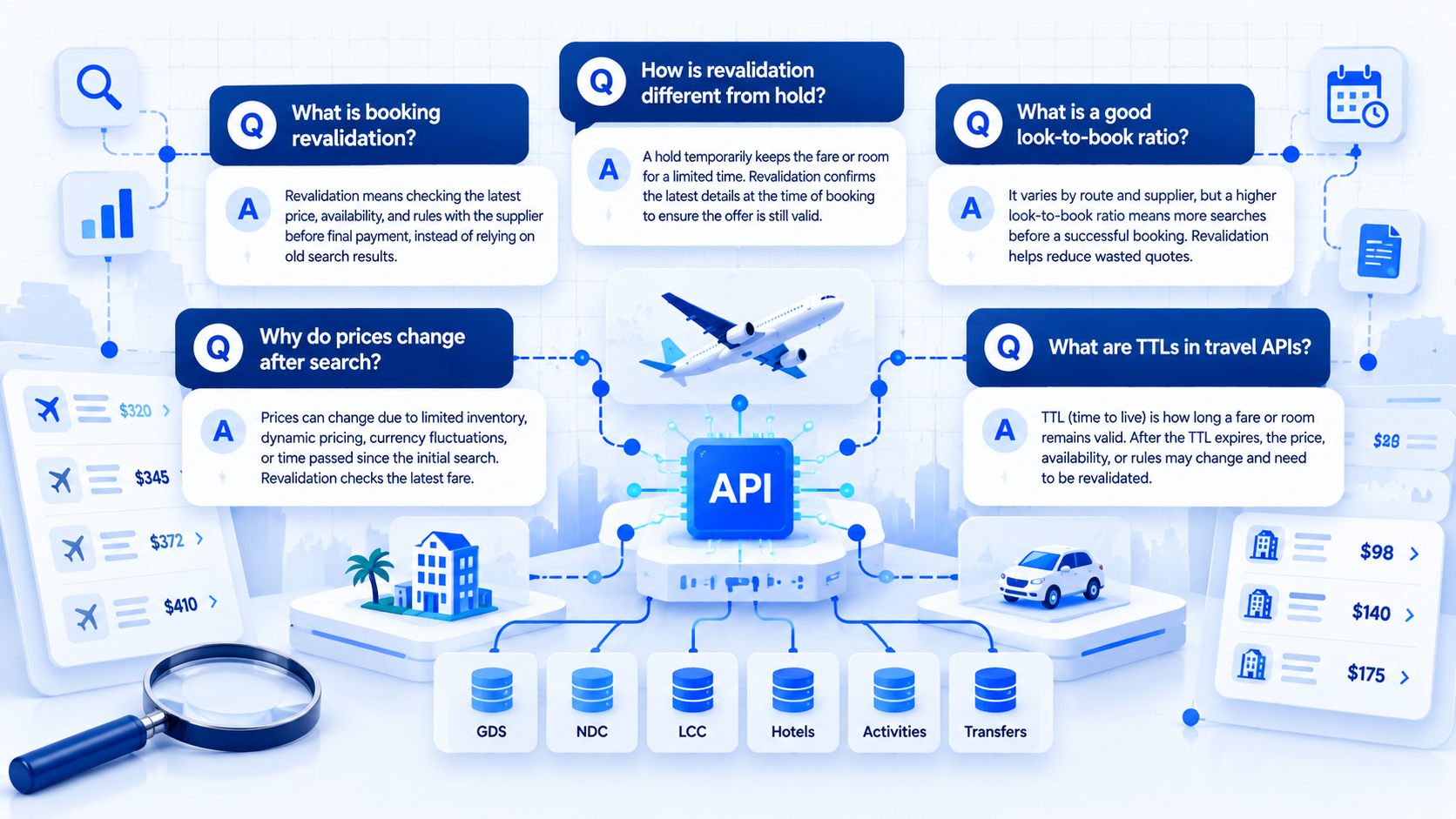
Booking revalidation (also called fare revalidation, price check, offer price confirmation, or “verify before book”) is the step where your stack asks the supplier — for the exact selected offer — whether price, availability, and bookable conditions still hold before you take payment or issue the ticket.
In plain language:
The traveler picked this product. Is it still sellable at this total, right now, on the supplier we will actually book?
Revalidation is not a second full shopping search across the market. It is a narrow, live confirmation of the commit candidate. Major distribution APIs expose this pattern explicitly:
- Amadeus Flight Offers Price confirms availability and final price (including taxes and fees) for offers returned by search — before create-order.
- Sabre Revalidate Itinerary revalidates availability and price of a selected air offer without holding inventory; Sabre’s Flight Check API converts cached itineraries into bookable offers for checkout (ATPCO and NDC paths).
- Travelport AirPrice confirms pricing on search results and is required before booking for many low-cost carriers.
What revalidation should return (conceptually):
| Signal | Why it matters |
|---|---|
| Same price / new price / unpriceable | Do you still have a retail total you can honor? |
| Available / waitlist / sold out | Can you still sell the cabin, rate, or allotment? |
| Fare basis / brand / inclusions drift | Did baggage, refundability, or branded fare change under the same flight? |
| Ticketing / payment time limits | How long can you hold this commit before TTL kills it? |
| Booking requirements | Docs, FOPs, or passenger data still needed before order |
If your checkout skips this step and books from a cached search payload, you are gambling that the offer survived the traveler’s form-fill time.
Why prices and seats die between search and payment

Volatility between search and ticket is normal distribution behavior, not a bug unique to your OTA.
1. Inventory is shared and contested. The last three seats in a booking class can disappear while a traveler types a middle name. Revalidation is how you discover that before charging a card.
2. Price guarantees are time-boxed — and not the same as inventory guarantees. In IATA’s modern offer model, an Offer Item can carry a Price Guarantee Time Limit. When it expires, the price may no longer be guaranteed; the seller should re-shop or reprice into a new Offer. Critically, a price guarantee does not guarantee related inventory (IATA AIDM Offer Item; time-limits discussion).
3. Unticketed stored fares are not forever. Airline agency policies commonly state that auto-quoted fares stored but not ticketed remain subject to price change, and that missed ticketing time limits (TTL) can cancel segments automatically (example: Lufthansa Group booking & ticketing policy). Your “held quote” in the UI is not a ticket.
4. Taxes, surcharges, and merchant FX move independently of base fare. A “same itinerary” can still produce a different grand total after tax recompute or currency refresh.
5. Hotels and packages have their own clocks. Bedbank rate plans, stop-sell flags, and package component failures (flight OK, hotel gone) create the same cliff with different error codes.
6. Caches make search fast — and checkout fragile — if you treat indicative results as bookable. Exploration can be cached. Commitment cannot pretend a five-minute-old offer is still a contract.
None of this means you should disable search caching. It means you must separate exploration from commitment, then revalidate on the commit path.
Revalidation is not look-to-book (and not failover)
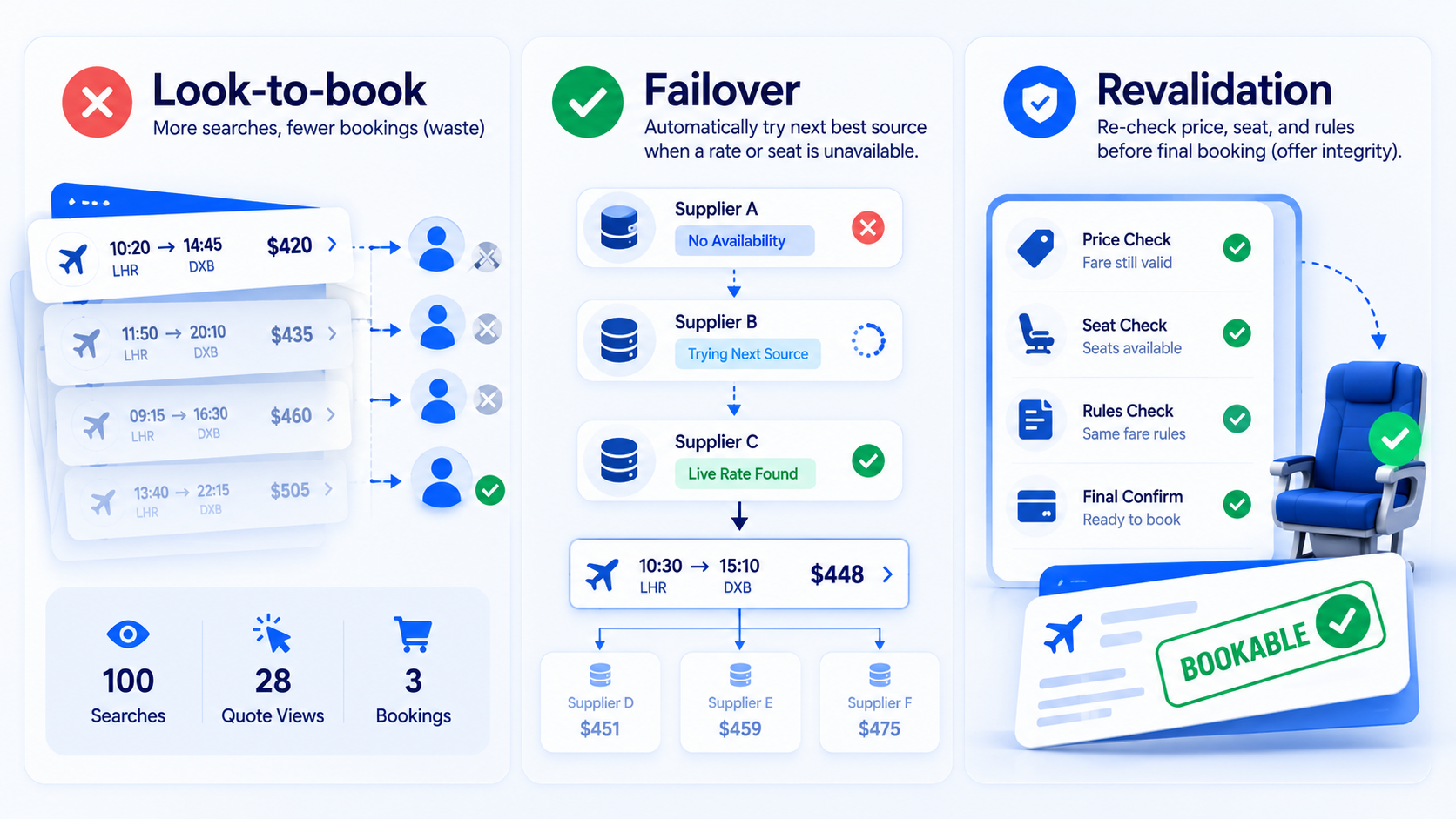
Teams often collapse three different failures into one “API problem.” They are not the same job.
| Problem | What broke | Typical symptom | Primary fix |
|---|---|---|---|
| Look-to-book waste | Too many shopping calls per sale | Rate limits, supplier pushback, slow calendars | Cap fan-out, tiered cache, bot filters (L2B guide) |
| Supplier failover | Feed timeout, auth fail, or outage | Empty results, 5xx storms | Redundancy, timeouts, graceful degrade (failover guide) |
| Booking revalidation | Selected offer no longer valid at commit | Price-up, sold-out, brand drift at checkout | Live price/availability check before pay/ticket |
You can have excellent L2B and still burn conversion if every “cheap” cached look becomes a false promise at payment. A booking revalidation travel API protects the commit path; it is not a substitute for shopping controls. You can have perfect failover and still sell a dead fare if checkout never revalidates the winner. Revalidation is book-path integrity, not shopping economics and not uptime engineering.
The commit-path workflow that stops mid-checkout cliffs

Use a strict sequence. A booking revalidation travel API should keep these stages in order; name them in your own architecture however you like — keep the order.
1. Select (search / shop)
Return ranked offers. Label what is indicative vs bookable if your UI mixes ranges and firm totals. Store a durable offer identity (supplier offer id, packed itinerary + fare basis, NDC offerItemID, hotel rate key — whatever the supplier contract uses), not only a pretty display price.
2. Revalidate (mandatory before money)
When the traveler enters checkout — or immediately before payment authorization — call the supplier’s price/availability confirmation for that offer:
- Air: Flight Offers Price / Revalidate / Flight Check / AirPrice-class APIs
- Hotel: supplier rate verify / prebook / bookability check per that bedbank’s model
- Packages: revalidate each bookable component that can fail independently
Do this on the same supplier credentials and POS you will book with. Revalidating on supplier A and booking on supplier B is how you invent phantom availability.
3. Present the truth
Three honest outcomes:
- Confirmed — show the locked total, inclusions, and remaining time limit.
- Changed — show old vs new total (and what changed: base, tax, brand) and require explicit accept.
- Unavailable — offer nearest alternatives from a controlled re-shop, not a silent substitute.
Never auto-accept a higher price into a charged payment intent without consent.
4. Hold / order (only after a fresh confirmation)
Create the reservation, order, or prebook using the revalidated payload, not the original search blob. Respect supplier-session and offer TTLs; if the traveler stalls past the guarantee window, revalidate again before ticket.
5. Pay, then ticket / confirm
Payment and ticketing have their own failure modes (payment security). Sequence matters: do not ticket on a stale priced offer, and do not leave paid-but-unticketed PNRs sitting past TTL without ops alarms.
6. Observe
Track at least:
- Revalidation attempt rate (should be ~100% of paid attempts)
- Price-change rate at revalidation
- Sold-out rate at revalidation
- Median minutes from select → revalidate → pay
- Support tickets tagged “price I saw”
If price-change rate climbs, your search cache TTL or indicative labeling is wrong — not your payment gateway.
Hotels, packages, and multi-supplier quirks
Air gets most of the documentation attention. Your conversion cliffs often hide elsewhere.
Hotels. Many bedbanks expose a verify/prebook step that returns the bookable rate, cancellation policy, and remaining allotment for a selected rate key. Skipping it after a multi-supplier search is how travelers book the “wrong” room type or a rate that was only an index hit. Content identity problems are separate — see hotel room mapping — but even a correctly mapped room still needs a fresh rate check.
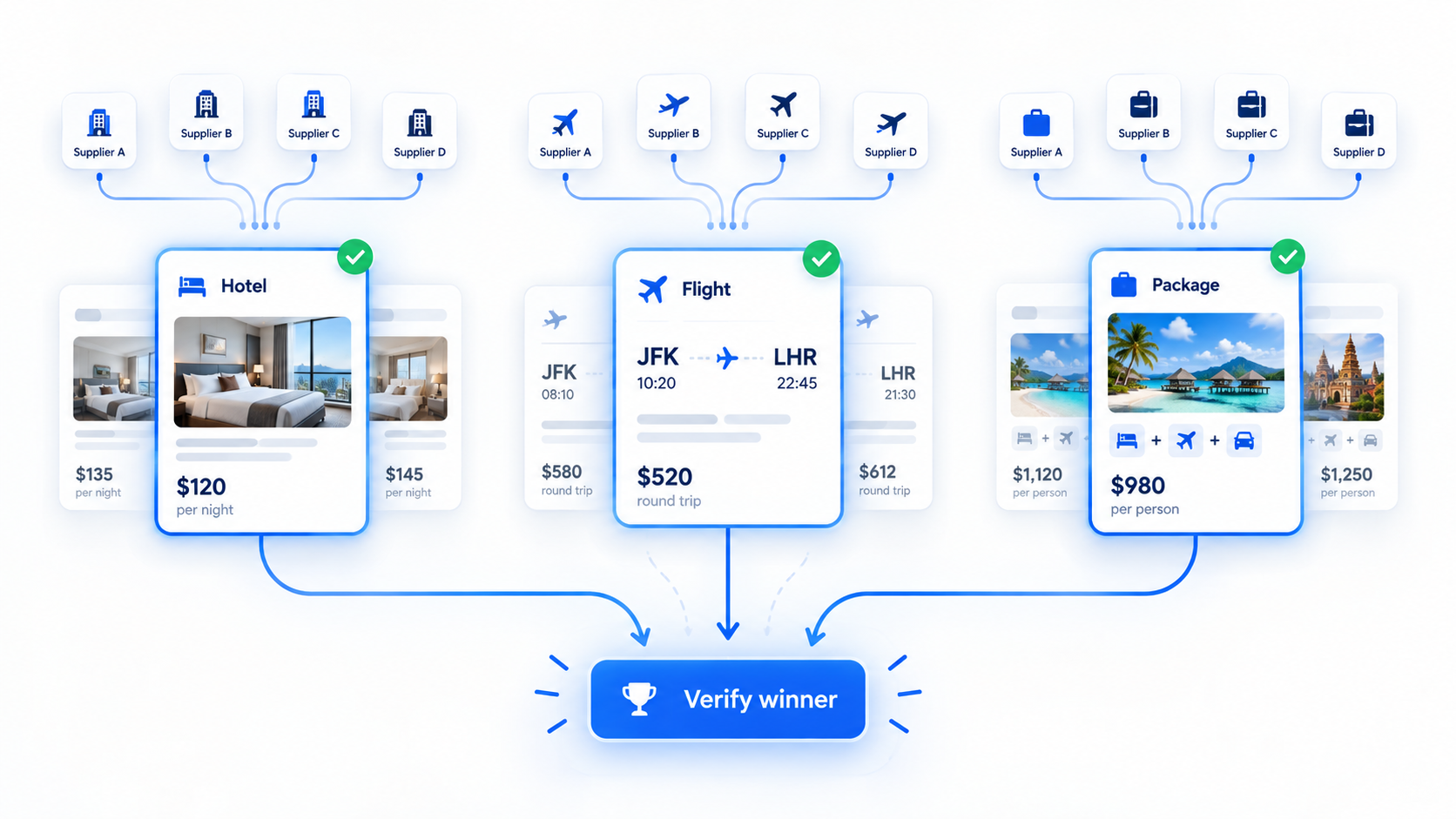
Multi-supplier winners. If search merged Hotelbeds + RateHawk + another feed, revalidate on the winning supplier’s book API. Cheapest-at-search is not cheapest-at-book if the winner’s allotment vanished.
Dynamic packages. Revalidate flight and hotel (and transfer/tour if separately reserved). Define policy for partial failure: cancel the held flight if hotel dies, or offer a rebuild — never leave orphan components without an ops path.
B2B agent portals. Agents paste WhatsApp screenshots of morning fares into afternoon bookings. Your portal should treat agent “saved quotes” like cached offers: revalidate before ticketing, or route through deliberate quote management with explicit expiry.
NDC vs EDIFACT. Offer identifiers and revalidation endpoints differ. Sabre documents separate Flight Check paths for payload (EDIFACT) vs offerItemID (NDC). Do not assume one revalidate call covers every content source in a mixed stack.
UX and ops when the offer changes at revalidation
Technical correctness without UX honesty still loses the sale — and earns a chargeback later.
Traveler-facing patterns that work:
- Show a short “confirming live price…” state; do not let the pay button enable on a stale total.
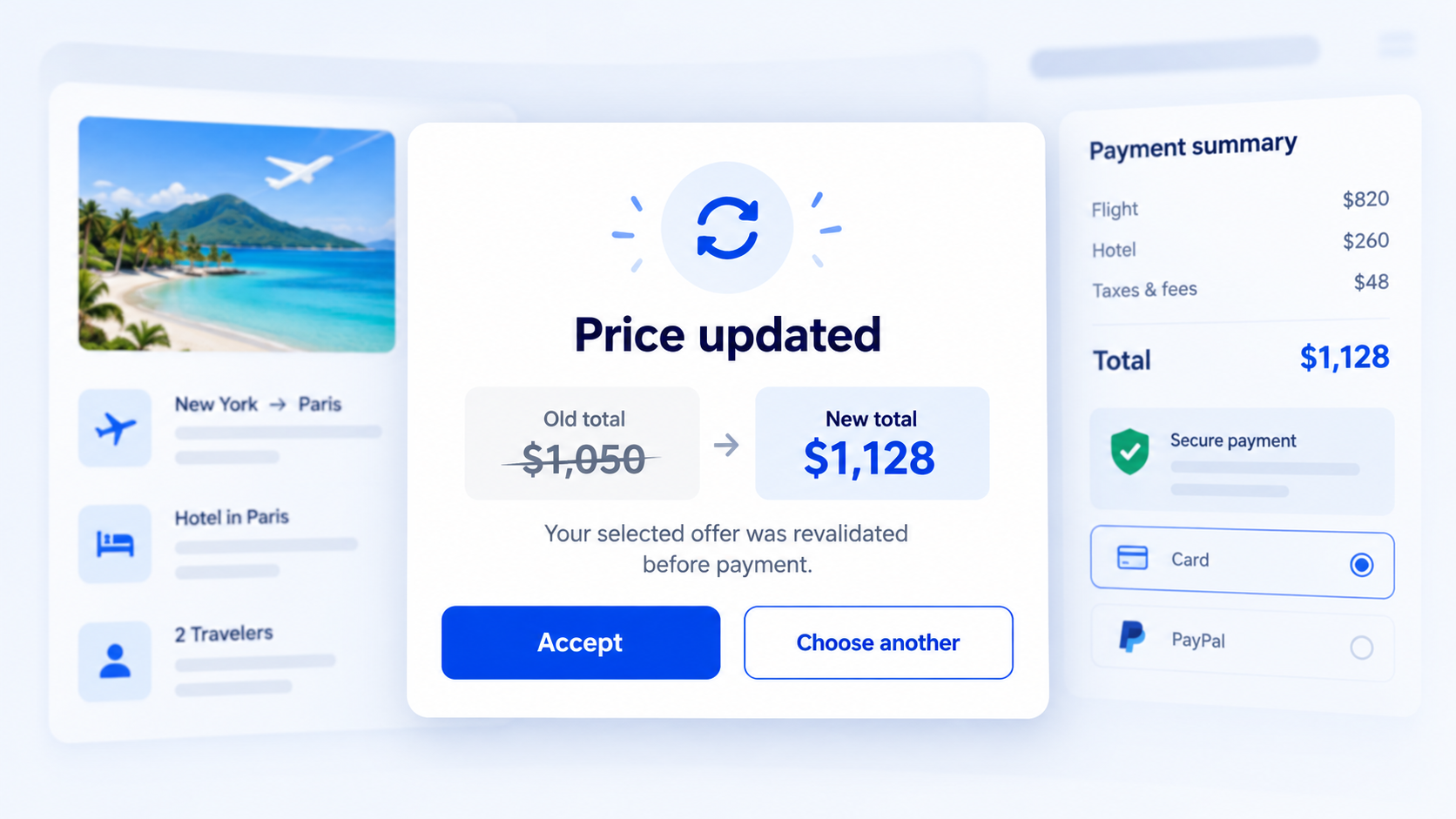
- If price rises, use a clear modal: previous total, new total, reason category (fare / tax / availability), Accept or Choose another.
- If sold out, jump to 2–3 alternatives with the same OD/dates when possible — not a blank error.
- Surface ticketing or payment deadlines when the supplier returns them (“price held until 15:12”).
Ops patterns that work:
- Alert when revalidation price-change rate exceeds a baseline for a supplier or route.
- Forbid silent upsell: agents cannot ticket a higher total without a logged customer acceptance (B2B) or traveler acceptance (B2C).
- Keep a kill switch to force revalidation even if a feature flag once skipped it for “speed.”
- Train support to distinguish “cache stale” from “payment failed” from “supplier down.”
What not to do:
- Hide a $12 increase inside “taxes recalculated” microcopy.
- Auto-swap to a different cabin or hotel and keep the old marketing name.
- Charge first, revalidate later “to reduce drop-off.” That trades conversion optics for refunds and ADMs.
Where PHPTRAVELS fits (honestly)

PHPTRAVELS is licensed travel booking software for agencies, tour operators, OTAs, and DMCs. It provides B2C storefront, B2B agent portal, back office, and connections to supplier APIs across flights, stays, tours, cars, and other modules. Buyers bring their own supplier contracts and API credentials. The software connects; it does not ship free inventory, and PHPTRAVELS is not the merchant of record for your bookings.
What that means for revalidation:
- You still need a booking platform that can run a disciplined search → select → revalidate/price-confirm → pay → confirm flow across the modules you enable — not a brochure site glued to a single cached JSON dump.
- Multi-supplier setups (see multi-supplier hotel booking engine and the live integrations list) increase the need for winner-aware revalidation; coverage without commit-path checks only multiplies cliffs.
- B2B portals with agent credit and saved quotes need the same integrity rules as B2C checkout — often with stricter audit trails.
- PHPTRAVELS does not replace airline shopping caches, GDS intelligent-shopping products, or your edge bot filters. Those remain partner- and engineering-layer choices. It also does not invent a magical “never see price changes” guarantee — distribution will keep moving.
If you are evaluating a stack, walk a live demo through a deliberate stale-offer scenario: search, wait, revalidate, then pay. Ask where the price-confirm call happens and what the UI does on change vs unavailable. Start at phptravels.com/demo and size suppliers/modules on phptravels.com/pricing (configurator figures change — confirm there).
A practical revalidation checklist for OTAs

Use this as a two-week engineering and ops pass.
Week 1 — Instrument and forbid the silent skip
- Map every paid book path (B2C, B2B, package, API) and mark where revalidation runs today
- Block production paths that book from raw search cache without a live confirm; make the booking revalidation travel API result visible in the checklist
- Log offer id, supplier, old total, new total, outcome code on every revalidation
- Baseline price-change % and sold-out % by supplier and product
Week 2 — Harden UX and TTL discipline
- Pay button disabled until revalidation succeeds or traveler accepts a change
- Explicit accept flow for price-up; no silent total mutation
- Re-run revalidation if traveler idle exceeds your policy window (aligned to supplier TTLs when known)
- Package component failure policy documented and tested
- Support macros updated for “price I saw” vs payment vs outage
Ongoing
- Review weekly: top routes/suppliers by revalidation failure
- Tune search cache TTLs using commit-path change rate, not guesswork
- Keep L2B controls and failover runbooks adjacent but separate
FAQ
Is revalidation the same as creating a PNR or hotel hold?
No. A booking revalidation travel API confirms bookability without holding inventory (Sabre documents this for Revalidate Itinerary and Flight Check). Hold/order is a later step. Some hotel flows combine verify and prebook — know your supplier’s contract.
Does revalidation hurt look-to-book?
A single confirm on a high-intent checkout is usually cheap compared with unbounded calendar shopping. Do not skip revalidation to “save looks.” Fix shopping waste with fan-out and cache policy; keep commit-path confirms.
How often should we revalidate?
At minimum: once when entering checkout, and again if the traveler pauses past your policy window or past a returned price/payment time limit. Ticket/confirm must use a still-valid priced offer.
What if the new price is lower?
Still show the truth and book the revalidated total. Quietly pocketing a drop without updating the display creates accounting and trust debt. Quietly charging a rise without consent creates chargebacks.
Can we guarantee the search price for 24 hours?
Only if your supplier contract and offer time limits actually allow it. IATA’s model separates price guarantee from inventory guarantee; airline TTLs can cancel unticketed segments. Market “guarantees” without supplier backing are marketing fiction.
Mid-checkout price cliffs are rarely a payment-processor mystery. They are what happens when a booking stack sells a search souvenir as a live contract. Put a booking revalidation travel API check on every commit path, tell the traveler the truth when the offer moves, and keep shopping economics and failover in their own lanes.
See a multi-module booking flow on the PHPTRAVELS demo, or configure suppliers and business model on pricing.