
Friday 19:40. Your hotel search suddenly returns three properties instead of three hundred. Flights still look fine. WhatsApp fills with “site is broken” screenshots. The bedbank status page is still green. Your logs show a flood of 504 Gateway Timeout on one supplier and healthy responses from another you never call in production.
That is not a content problem. That is a travel API failover problem: your booking stack treated one supplier feed as the whole market.
This guide is for OTA founders, technical leads, and agency operators who already connect GDS, NDC, bedbank, or aggregator APIs and need a practical model for supplier redundancy — so a single outage does not erase search, checkout, or confirmation. It is not another “best APIs to integrate” list. If you are still choosing hotel connections, start with PHPTRAVELS’ multi-supplier hotel booking engine controls, then come back here for what happens when those connections misbehave.
Why travel stacks fail harder than typical SaaS when one API dies
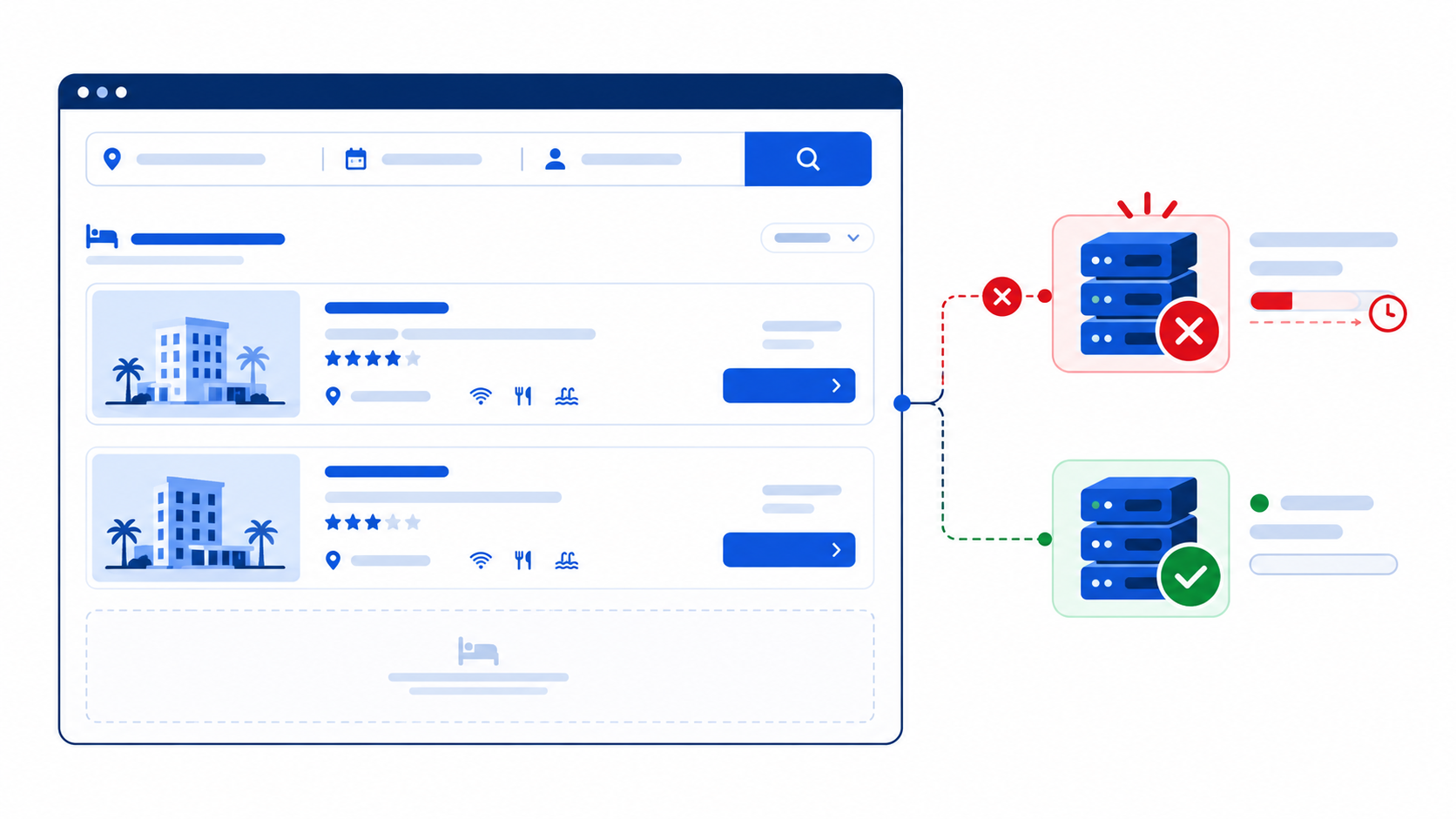
Most SaaS products talk to a database they own. Travel products talk to dozens of systems they do not control — each with its own maintenance windows, rate limits, schema quirks, and peak-hour latency.
When one feed fails, three different failures show up for guests:
- Empty or thin search — travelers assume you have no inventory.
- Stale or unbookable results — they pick a rate the supplier will reject at hold/ticket.
- Checkout cliff — search worked, but the book call times out after the card authorized.
Industry architecture write-ups treat redundant supplier connectivity with fallback at the API gateway as a baseline, not a luxury, for platforms that cannot afford silence in peak windows (ZealConnect’s booking-engine layer model is a clear practitioner framing of that Layer-1 risk).
A single GDS, single bedbank, or single flight aggregator is a single point of failure. Redundancy is not “nice for enterprise.” It is how you keep selling when one partner has a bad night.
Redundancy is a product decision, not only an ops toggle
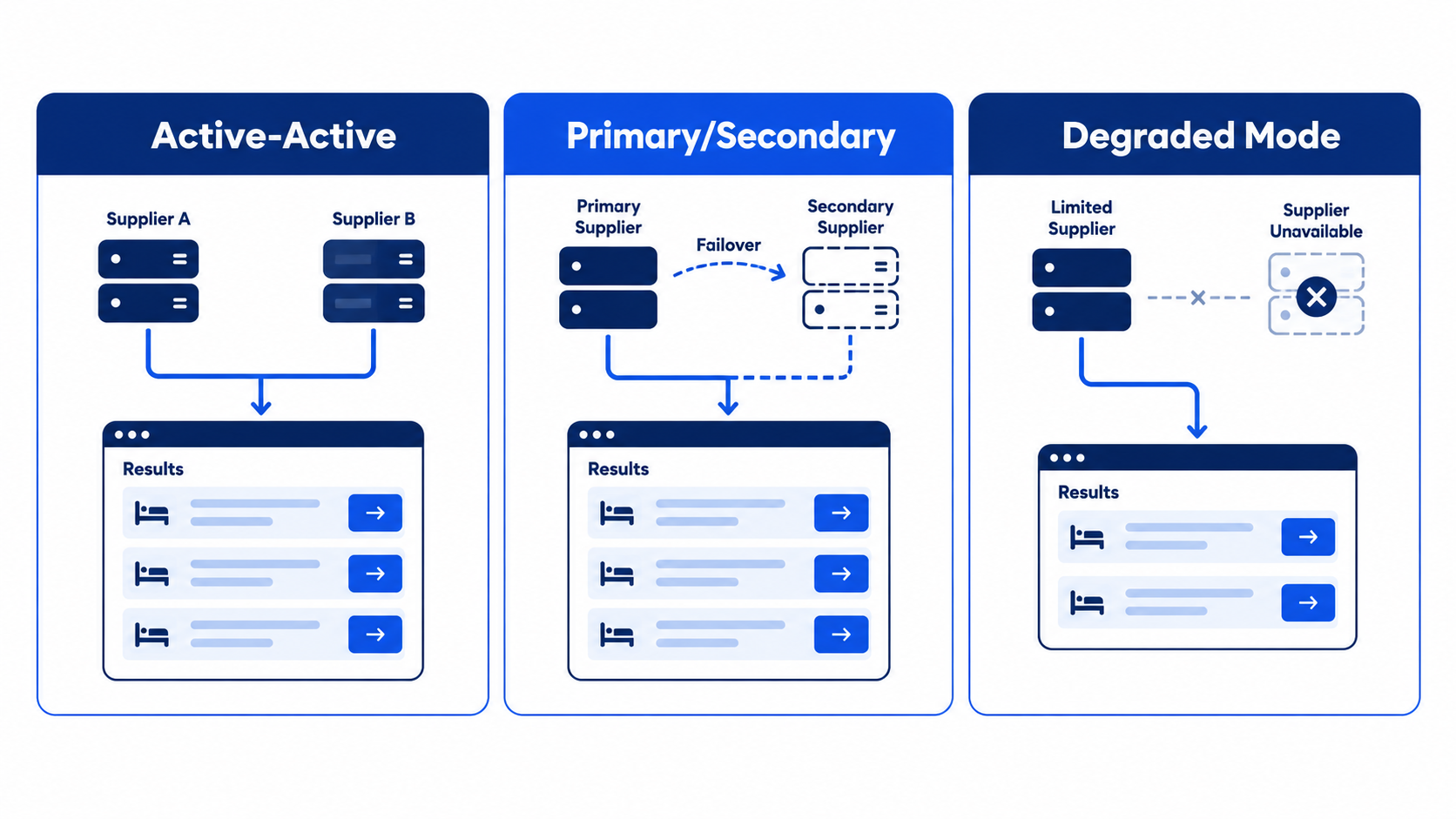
Before you buy another monitoring tool, decide *what* you are making redundant.
| Redundancy model | What it means | When it helps | Common trap |
|---|---|---|---|
| Active-active multi-supplier | Parallel search across two+ sources in the same module | Covers outages and fills inventory gaps | Duplicate listings / conflicting rates if mapping is weak |
| Primary + secondary | Prefer supplier A; fail over to B on timeout/error | Clear cost/priority rules | Secondary never tested until the outage |
| Module diversity | Flights via GDS+aggregator; hotels via two bedbanks | Isolates category risk | Ops still panics if the *book* path has no fallback |
| Cached / degraded mode | Show last-known or partial results with honesty labels | Buys time during search storms | Selling expired rates without revalidation |
You do not need every model on day one. You do need a written rule for each module you sell: *If supplier X is unhealthy, what does the traveler see in the next 60 seconds?*
Failover patterns that actually move booking success
Travel teams often say “we have failover” when they mean “we can manually switch a config flag.” Real travel API failover is a set of patterns that fire without a war room.
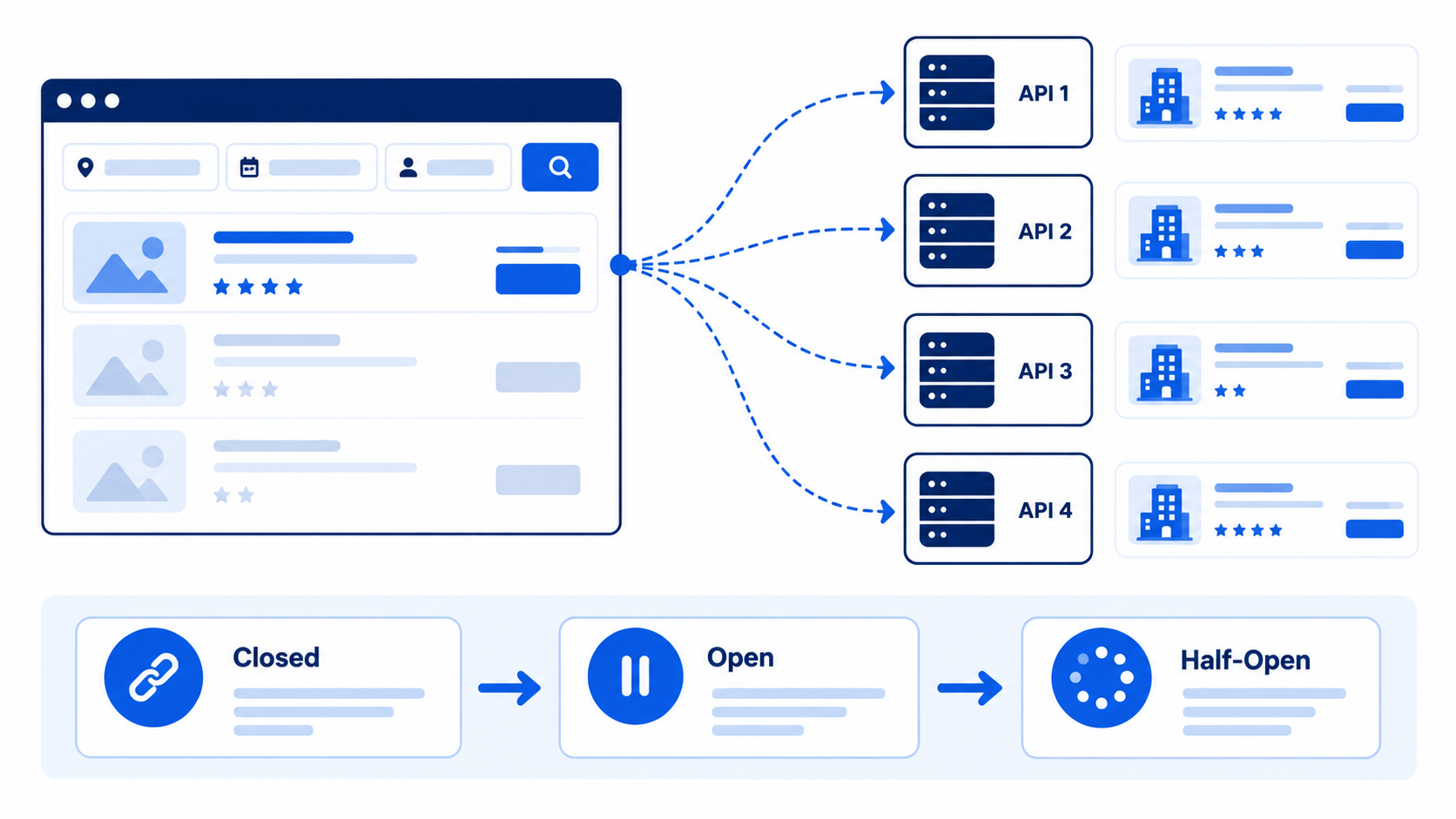
1. Parallel fan-out with per-supplier timeouts
Fire search requests concurrently. Cap wait time per supplier (for example 2–4 seconds depending on product). Return what arrived; do not block the page on the slowest feed. Scalable OTA architecture checklists repeatedly call out parallel fan-out plus aggressive timeouts so one slow partner does not stall the whole response (Teenva overview).
2. Normalize errors before you alert humans
Map supplier-specific faults into a small set: TIMEOUT, AUTH, RATE_LIMIT, PROVIDER_5XX, SCHEMA, PARTIAL. Holidu’s marketplace engineering notes the same idea: normalize provider outcomes so detection works across heterogeneous APIs (Holidu: Circuit Breakers at Scale).
3. Circuit breakers with different thresholds for search vs book
A circuit breaker stops calling a failing dependency so your system fails fast instead of waiting on doomed timeouts. Classic states: closed → open → half-open.
At travel scale, one nuance matters: search can tolerate more failure than checkout. Holidu documents differentiated thresholds (search vs checkout) and automated isolation with progressive backoff after trips, detecting unhealthy providers on the order of minutes rather than waiting for manual Looker alerts (same Holidu post). You do not need their Athena stack to adopt the principle: trip earlier on book-path errors than on search misses.
4. Degraded results with honest UX
If hotel supplier A is open-circuit, show B’s inventory and a quiet status (“Some partners temporarily unavailable — results may be limited”) rather than a hard error page. Empty states convert to competitors. Partial states convert to bookings.
5. Never “fail over” into a supplier you have never booked against
Secondary credentials that only exist in a spreadsheet are theater. Schedule weekly synthetic searches *and* a controlled test hold/cancel (where contracts allow) on every failover path.
Protect the book path harder than search
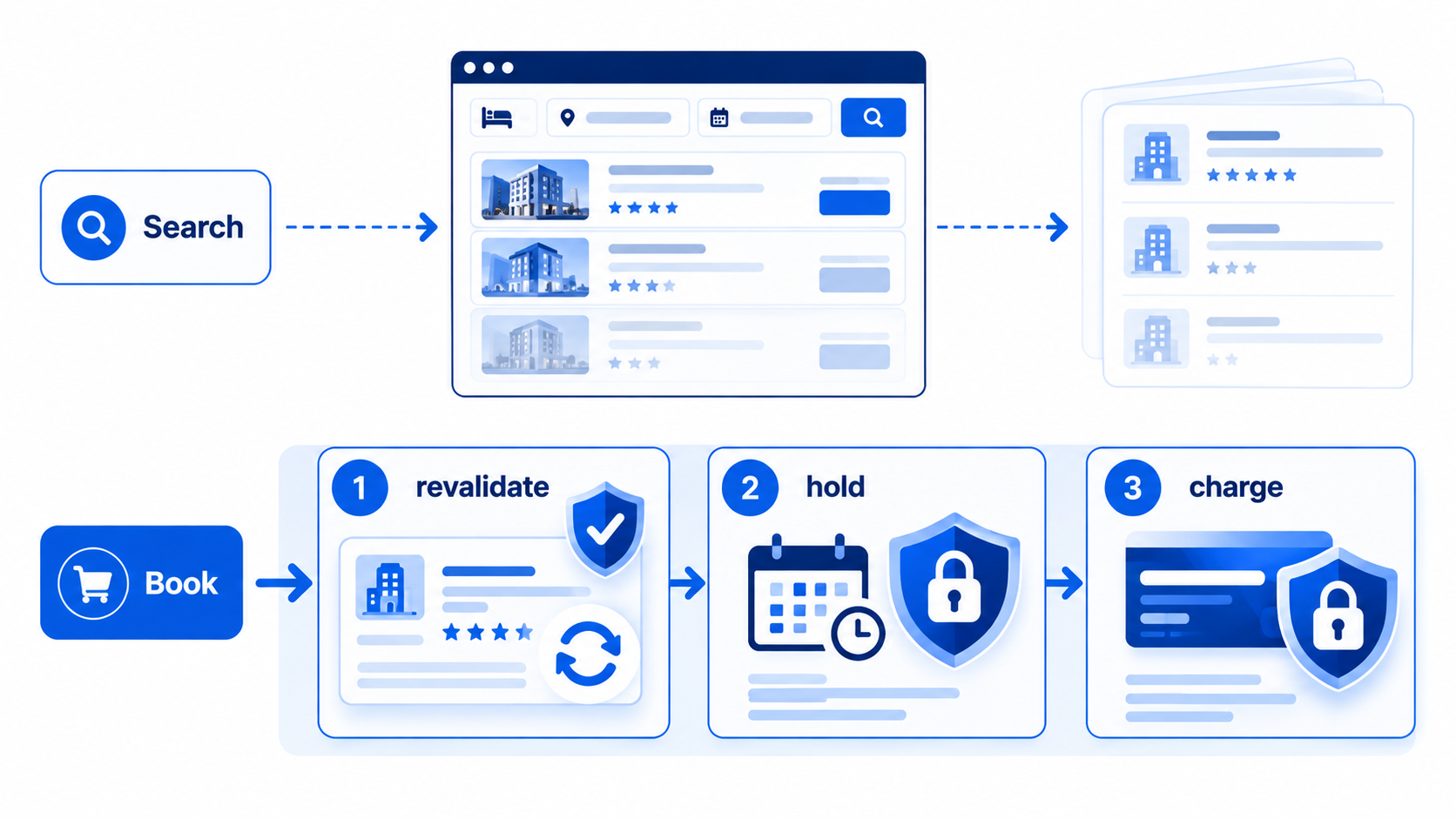
Search failures hurt SEO and brand trust. Book-path failures hurt cash, chargebacks, and supplier relations.
Practical rules OTAs use:
- Revalidate before pay. Re-price / re-check availability on the supplier you will actually book — especially if the displayed offer came from a cache or a slower mirror.
- Hold, then charge (when the product allows). Reserve inventory, collect payment, confirm; compensate (cancel hold) if payment fails. Saga-style compensating steps and idempotency keys on booking POSTs stop double tickets when clients retry after a timeout (Teenva).
- Isolate book traffic from search storms. A bedbank melting under search load should not share the exact same connection pool and rate budget as your confirmation calls.
- Treat on-request / pending supplier states as not confirmed. Issuing a guest voucher before supplier acknowledgement is how “phantom bookings” become airport disasters (ZealConnect Layer 3/5 framing).
Failover without reconciliation is how you create two systems of truth: your confirmation email and the hotel’s “we have no reservation.”
Confirmation reconciliation after partial failures
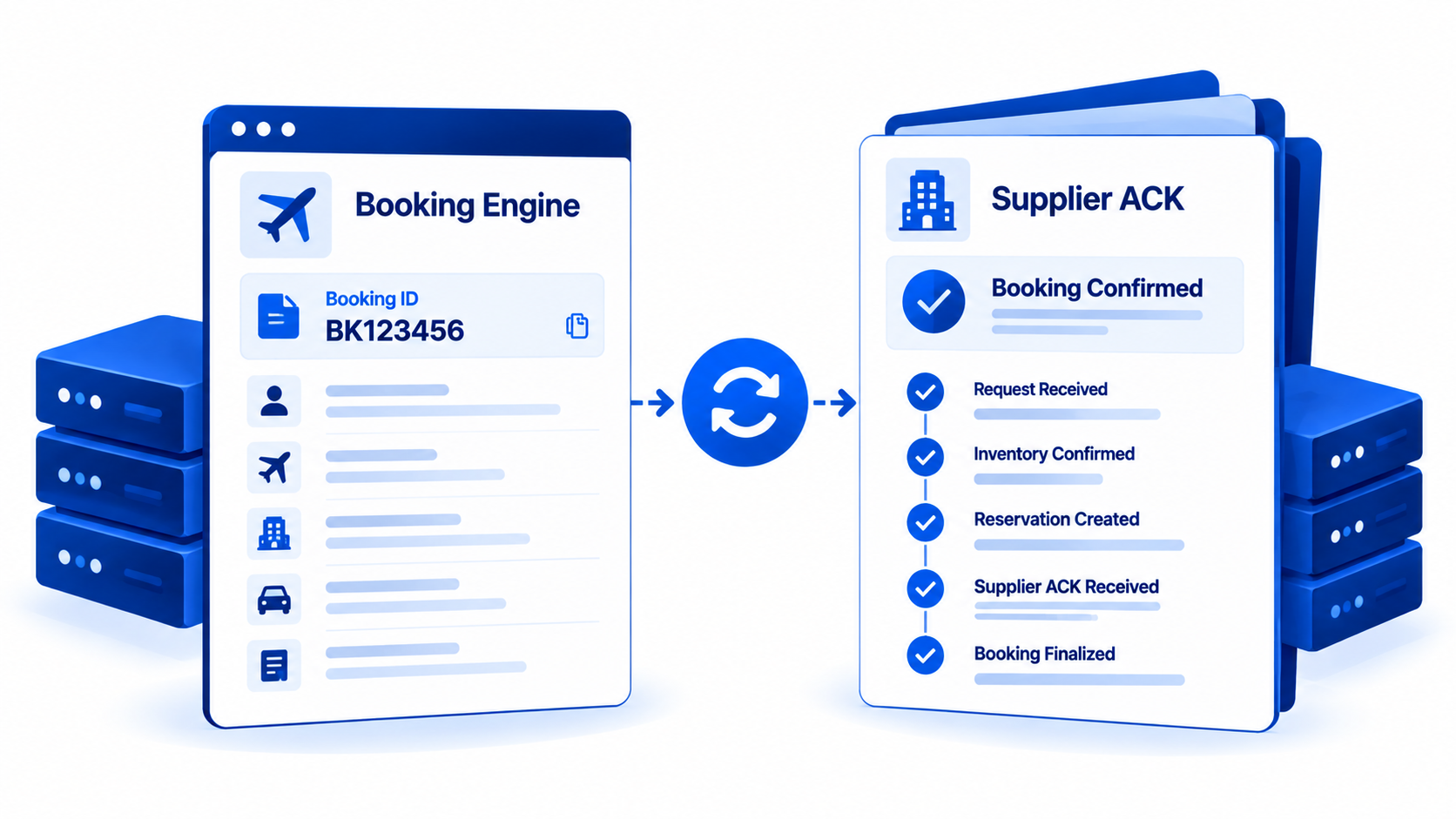
Payment cleared. Your database says booked. The supplier ACK never arrived.
Build a thin reconciliation loop:
- Store engine booking ID, supplier reference (when present), status, last attempt, next retry.
- Poll or webhook-listen for supplier acknowledgement inside a defined window.
- Auto-escalate to ops if ACK is missing before traveler impact (for hotels: well before check-in; for flights: before ticket time limits).
- Never silently retry a non-idempotent book call without a key — duplicates are worse than a delayed voucher.
This is operational architecture, not a marketing feature. Platforms that skip it discover the gap through guest complaints, not dashboards.
An ops runbook you can actually staff
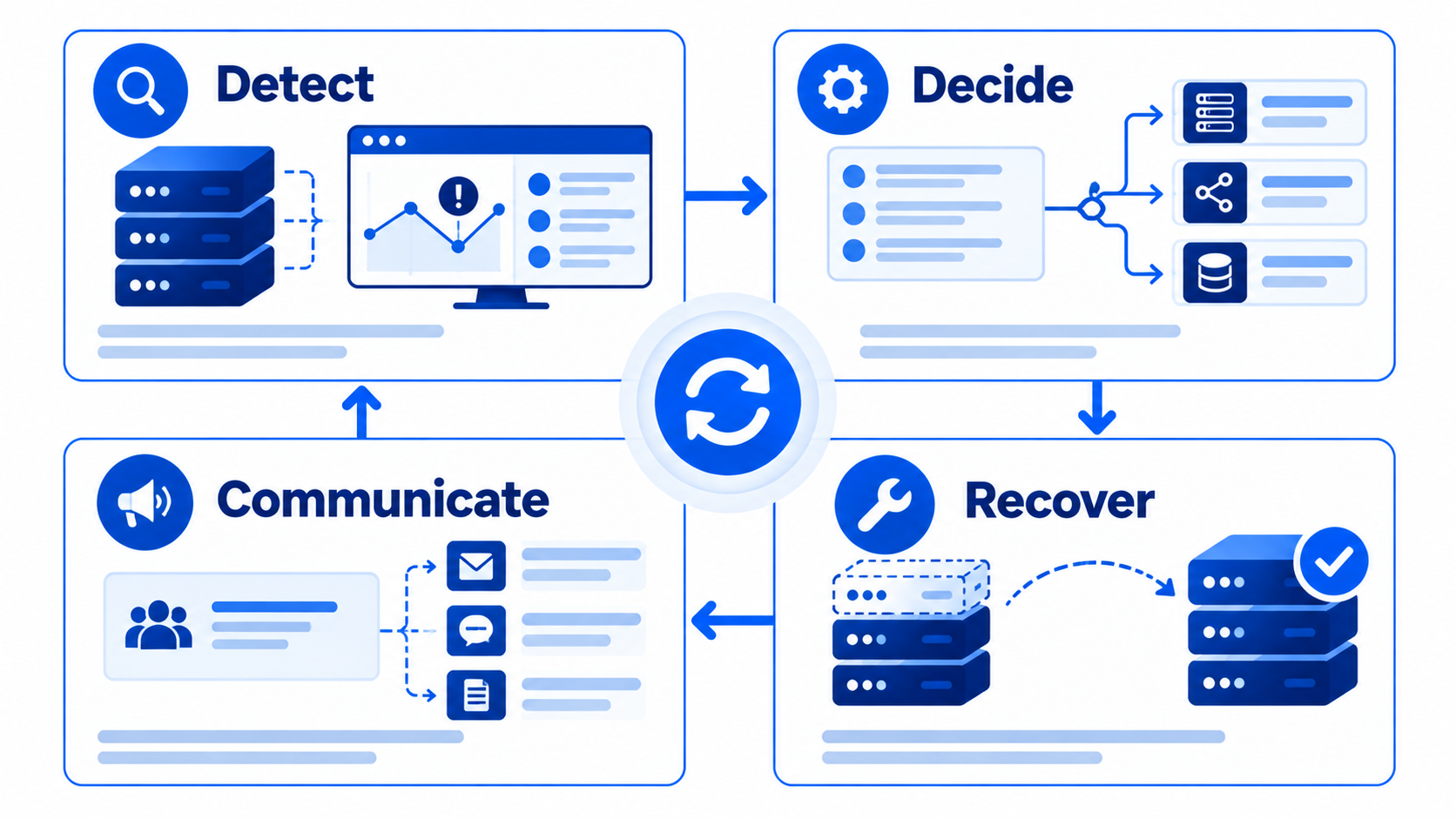
Technology without ownership still pages everyone at once. Keep a one-page runbook per module.
Detect
- Error-rate and p95 latency per supplier, split by
searchvsbook - Circuit state and time-in-state
- “Results count collapse” alerts (today’s median hotels-per-search vs baseline)
Decide
- Auto-open circuit at threshold X
- Keep secondary live; suppress primary from UI
- Message for support macros (“Partner delay — we can rebook on alternate source”)
Recover
- Half-open probe with limited traffic
- Progressive backoff if it trips again (Holidu’s escalating offline windows are a useful mental model even if your implementation is simpler)
- Post-incident: was this auth expiry, supplier change window, or your own rate-limit bug?
Communicate
- Status note for agents (B2B) and a traveler-safe banner (B2C)
- Do not invent ETA from a vendor status page that stays green while your keys return 401
Where PHPTRAVELS fits (without magical claims)
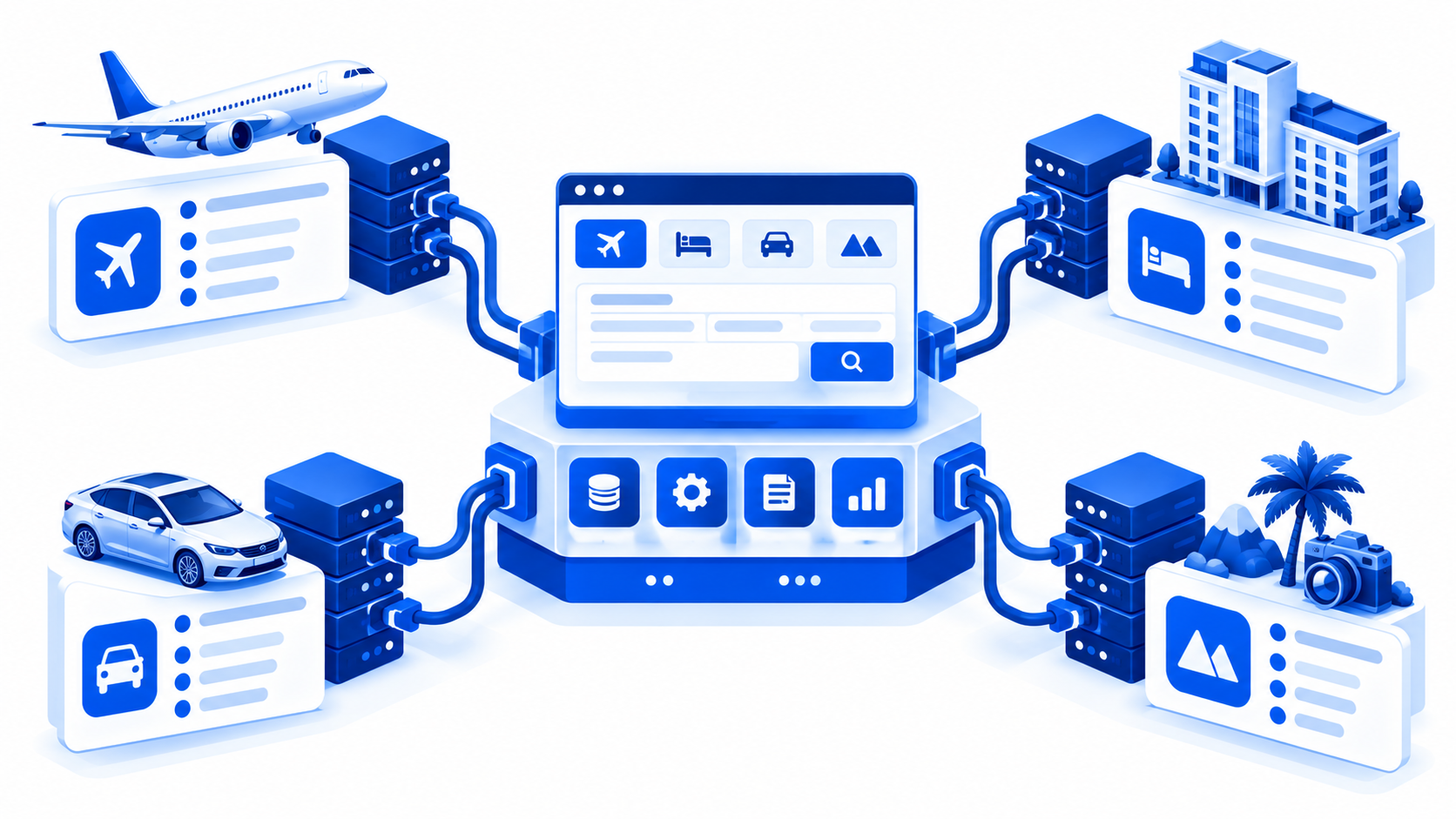
PHPTRAVELS is travel booking software agencies, tour operators, and OTAs install (or have managed) to run branded B2C and/or B2B booking — flights, stays, tours, cars, ferries, rail, eSIM, and more — with connections to supplier APIs the buyer contracts for. It is not a booking intermediary and does not take a cut of bookings. Live product detail: PHPTRAVELS SKILL.md, integrations, pricing configurator, demo.
For supplier redundancy, the honest product fit is:
- Multi-supplier connectivity in one platform — you can enable more than one supplier per module where your commercial agreements allow (for example multiple hotel or flight sources from the live integrations list). That is the commercial foundation of redundancy: something to fail over *to*.
- Modular engines — turn on only the products you sell; isolate risk by module rather than one monolith custom build.
- Your credentials, your margins — PHPTRAVELS connects; it does not grant inventory. Failover policy still needs your timeouts, monitoring, and ops ownership.
- Custom supplier work — suppliers not on the live list can be scoped as custom integrations (priced separately on the configurator — verify current figures before quoting).
What we will not claim: that buying the licence alone installs Holidu-grade automated circuit breakers, Athena detection, or a turnkey “zero-ops failover appliance.” Resilience is a shared model — platform connectivity plus your runtime policy.
If you are mapping a stack that can grow from one feed to a redundant set without a ground-up rebuild, start with a live demo and a real quote on pricing.
Practical 30-day redundancy checklist
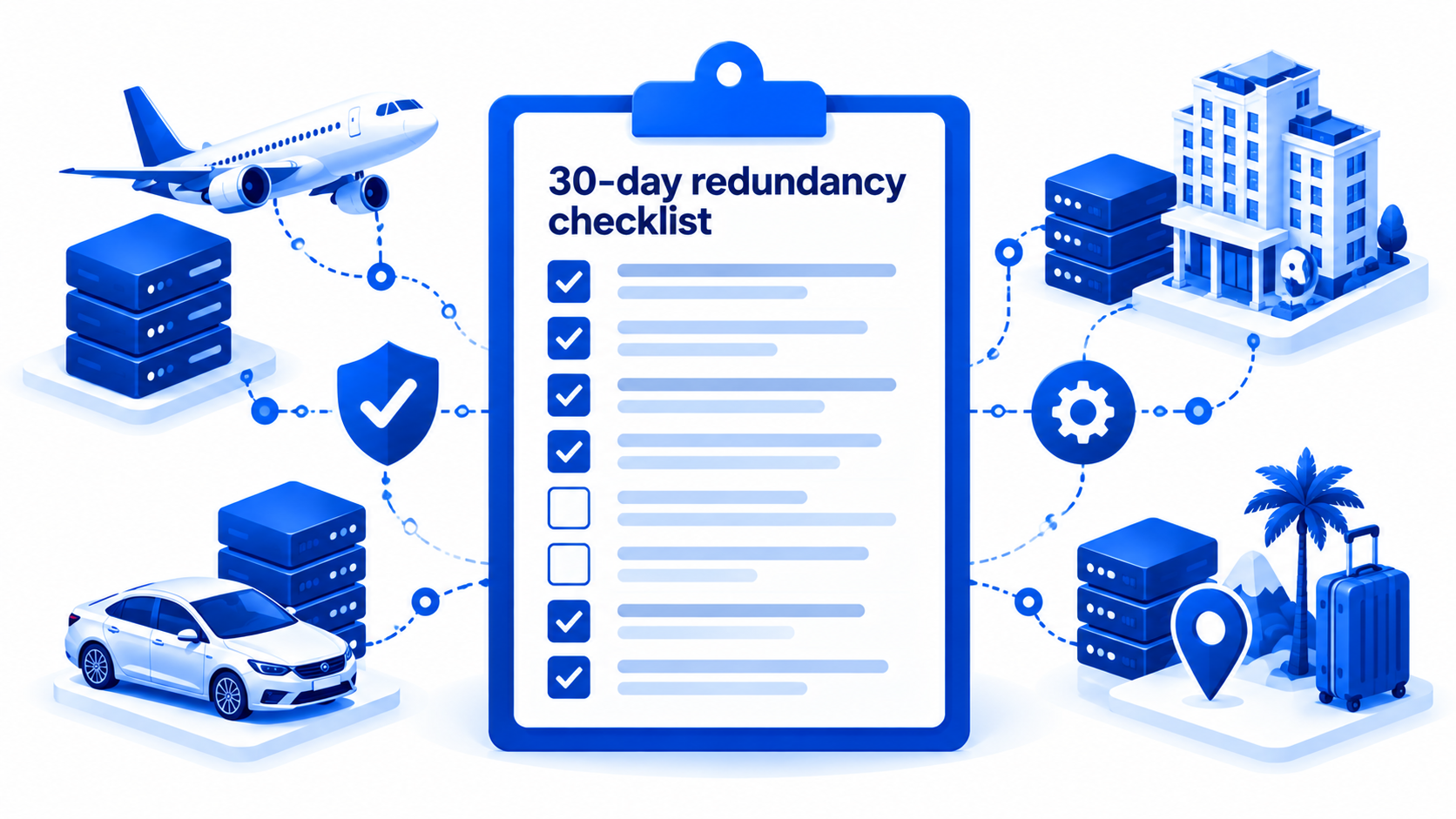
- Inventory every live supplier credential and which UI paths depend on it.
- Mark each path: search-only, book-only, or both.
- Add a second source for your top revenue module (even a narrower secondary beats none).
- Set per-supplier timeouts and stop waiting forever on search.
- Put a circuit breaker (or admin kill-switch with metrics) in front of book calls first.
- Add idempotency keys on booking create/confirm.
- Build ACK reconciliation for supplier confirmation gaps.
- Run a monthly game day: disable primary in staging and prove secondary books.
- Write traveler/agent macros before the outage, not during it.
- Review rate-limit and auth-expiry calendars with each supplier TAM.
FAQ
Is two hotel bedbanks enough redundancy?
Usually for search coverage, yes — if mapping/deduping is solid and both credentials are production-proven on the book path. Two untested secondaries are not redundancy.
Should circuit breakers live in the request path or in a batch detector?
Both work. In-memory/request-path breakers react fastest; log-based detectors (as in Holidu’s Athena design) can suit very high volume. Pick based on scale and false-positive tolerance, not fashion.
Does multi-supplier always raise look-to-book costs?
It can, if you fan out naively. Mitigate with caching where contracts allow, smarter routing (geo/product), and opening circuits so you stop paying for doomed calls.
Can PHPTRAVELS replace my need for supplier contracts?
No. You still need your own supplier agreements and API credentials. The software is the connection and booking layer.
What should we monitor first if we are a small agency?
Book-path success rate and p95 latency per supplier, plus a simple “search results collapsed” alert. Fancy dashboards can wait; silent empty search cannot.
Next step: If you want a booking platform where multi-supplier connections and modular engines are native — and you keep control of branding, credentials, and margins — book a PHPTRAVELS demo or configure a quote at phptravels.com/pricing.
Use travel API failover in seven places: search fan-out, per-supplier timeouts, normalized errors, circuit breakers, degraded results, book-path isolation, and confirmation reconciliation. A travel API failover plan that only flips a config flag is not travel API failover. Test travel API failover on the secondary supplier every week, and treat travel API failover on checkout as stricter than search. When travel API failover opens a circuit, show partial inventory instead of an empty page. Document travel API failover owners before the incident, and review travel API failover after every supplier outage.