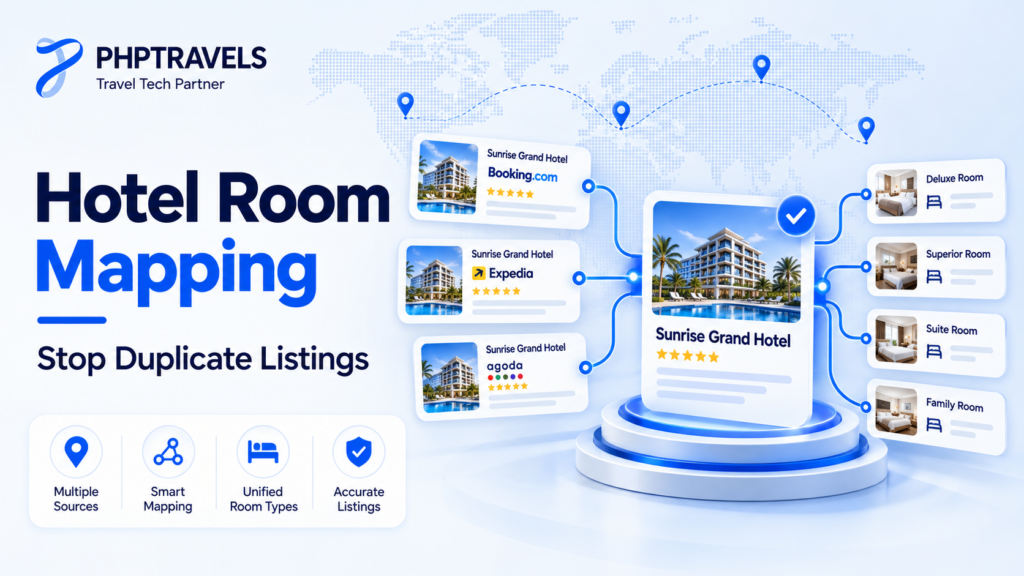
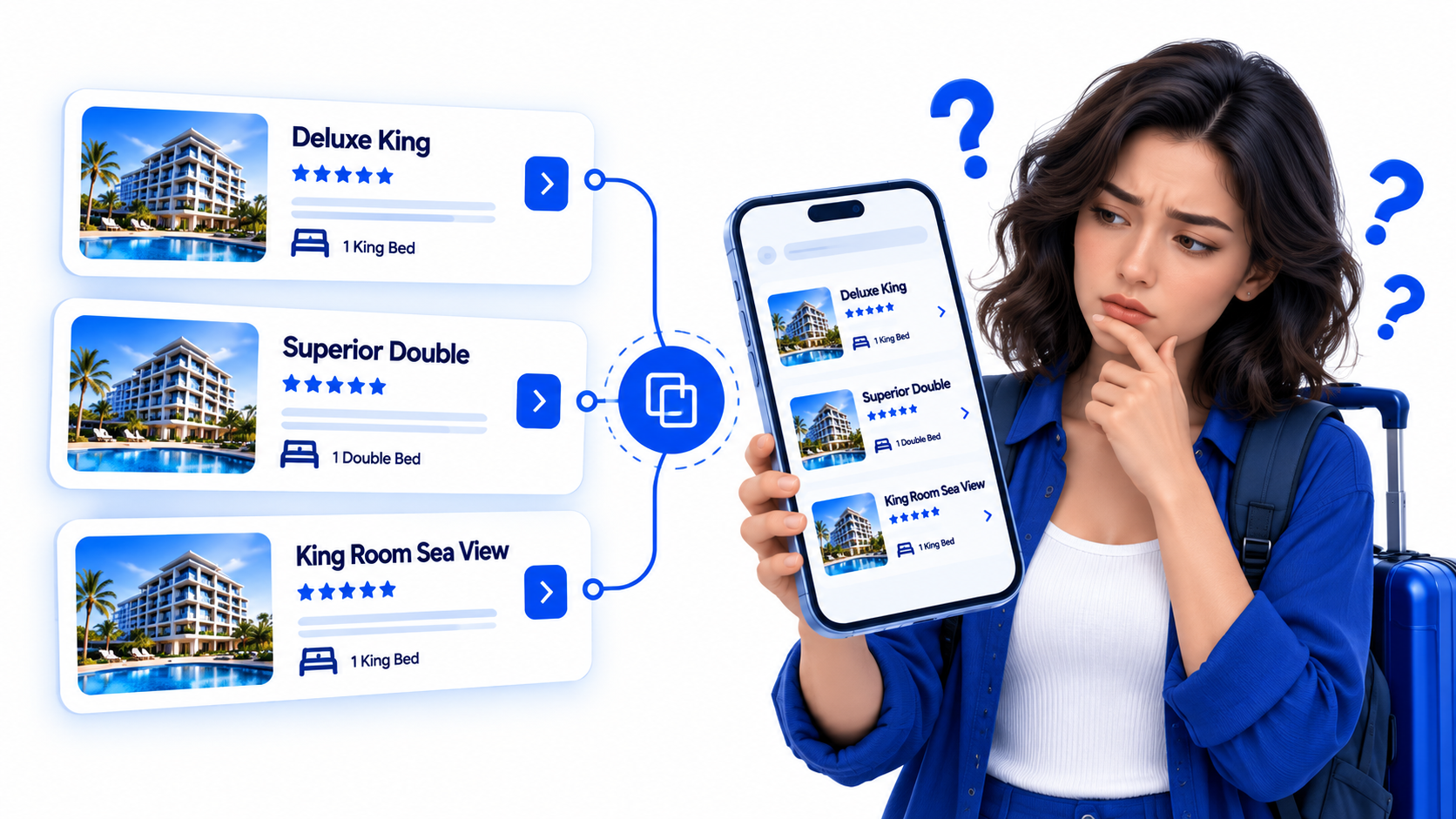
Tuesday 11:12. A traveler searching Dubai sees the same Marina hotel three times — once as “Deluxe King,” once as “King Deluxe Room,” once as “DLX KG.” They pick the cheapest card. At hold, the supplier rejects the rate: that code maps to a Twin, not a King. Your support queue fills with screenshots. Inventory was never the problem. Hotel room mapping was.
This guide is for OTA founders, agency tech leads, and hotel ops managers who already connect more than one bedbank or hotel API and need a practical mapping model — property identity, room-type catalogs, confidence scores, and book-path revalidation. It is not a “best hotel APIs” list. If you are still choosing multi-supplier hotel controls (markup, parity, failover switches), start with PHPTRAVELS’ multi-supplier hotel booking engine controls, then come back here for the content layer that makes those controls trustworthy.
Why multi-supplier hotels break without mapping
Most SaaS catalogs own their SKUs. Hotel distribution does not. Each supplier returns its own property IDs, room names, board bases, and rate codes. Industry content providers have spent years documenting the same failure mode: room names are inconsistent across channels (“Deluxe King” vs “King Deluxe” vs translated abbreviations), so travelers cannot compare offers cleanly and platforms drift toward lowest-price sorting instead of like-for-like rooms (GIATA’s room mapping overview; TTI’s summary of the room-type problem).
Without hotel room mapping you get four expensive symptoms:
- Duplicate properties on search — same hotel, three cards, eroded trust.
- Uncomparable rooms on the hotel page — guests cannot tell which offer is the same physical room.
- Wrong-room books — display name says King; supplier code is Twin or Suite.
- Ops thrash — agents manually “fix” bookings after the traveler has already paid.
Failover keeps a feed alive when an API times out (travel API failover patterns). Hotel room mapping keeps the *identity* of what you sell correct when multiple feeds are healthy.
Separate property mapping from room mapping
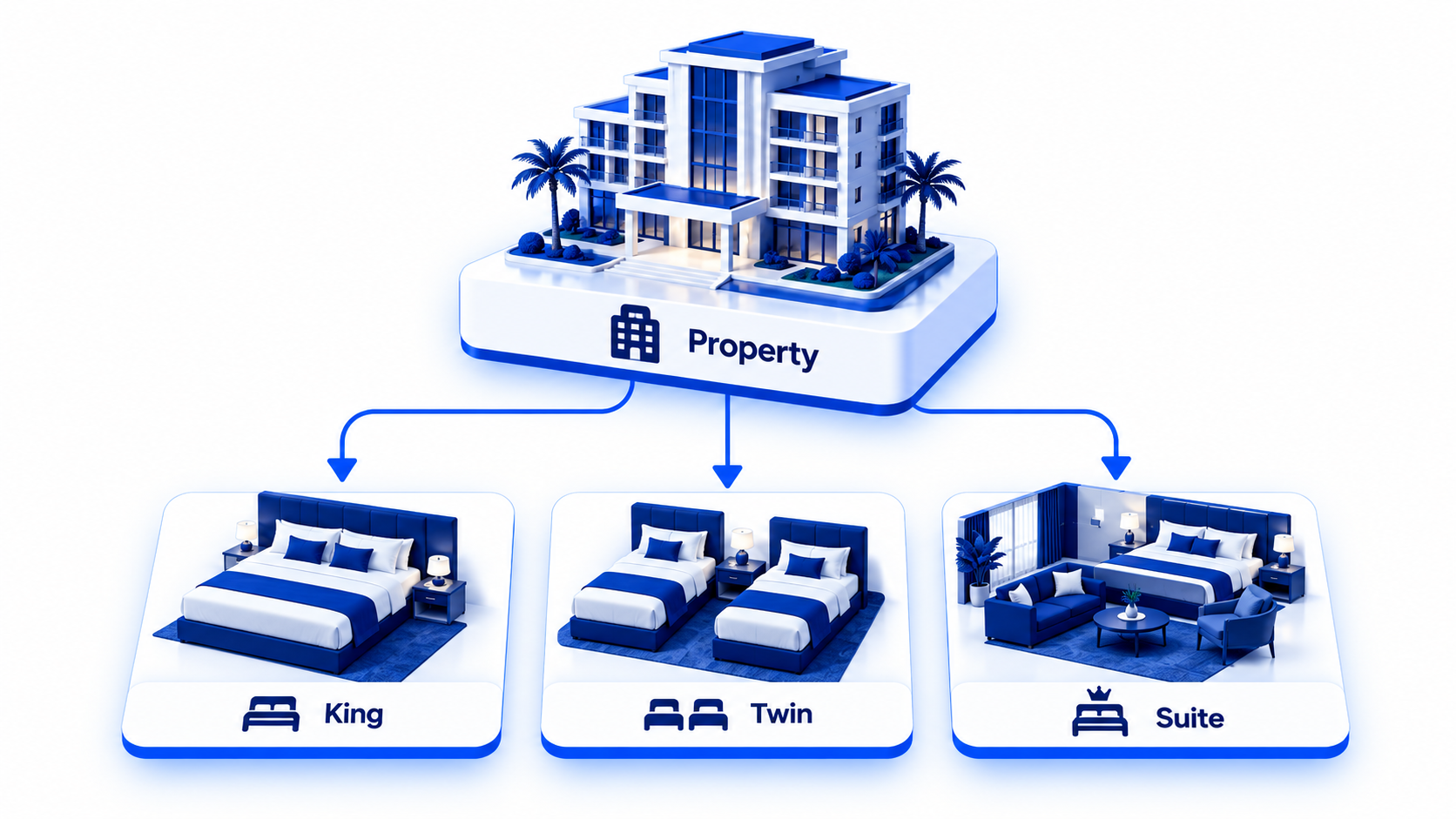
Treat hotel room mapping as two stacked problems. Mixing them is how teams ship half-fixes.
| Layer | Question it answers | Typical keys | Failure if wrong |
|---|---|---|---|
| Property mapping | Is supplier A’s hotel 88421 the same building as supplier B’s DXB-992? | Lat/long + address, star, brand chain codes, supplier multicodes / master IDs | Duplicate hotels on search |
| Room mapping | Is “Deluxe King Sea View” the same sellable room type as “DLX KG SV”? | Occupancy, bed type, view, smoking, room class, board base | Wrong room at hold / chargeback risk |
| Rate attachment | Which live rate codes belong to that mapped room today? | Supplier room code + rate plan + cancellation policy | Showing an orphaned or expired rate on the wrong card |
Property mapping is necessary but not sufficient. GIATA’s own guidance separates MultiCodes-style property identity work from dynamic room-type grouping at the point of sale (MultiCodes best practices; how RTM works). Your booking software needs both hotel room mapping layers — even if you start with a smaller destination set.
Build a master catalog, then attach supplier codes
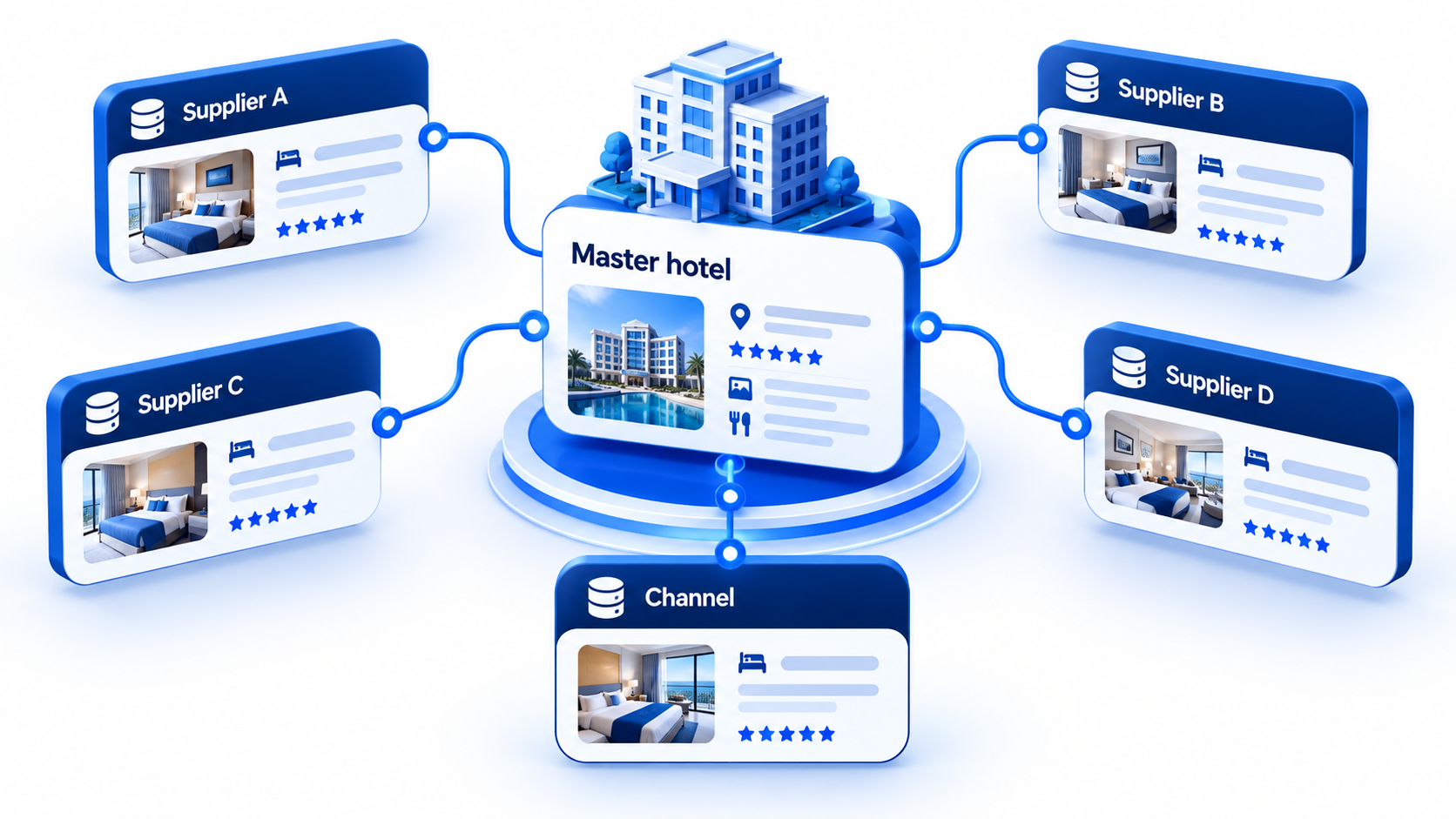
A workable hotel room mapping stack inside travel software looks like this:
- Master property record — your internal hotel ID, canonical name, geo, stars, photos, policies.
- Supplier property links — many supplier hotel IDs → one master property, with a confidence score and last-verified date.
- Master room-type catalog — human-readable room groups (e.g. Standard Twin, Deluxe King Sea View) with attributes travelers actually compare.
- Supplier room links — supplier room/rate codes → master room type, again with confidence + verifier.
- Live offer projection — at search time, group supplier offers under master rooms; book with the original supplier code (content layers should not rewrite the book payload).
That last point matters. Mature room-mapping products explicitly keep booking on the supplier’s original room type codes while standardizing only the display layer (GIATA Room Mapping). Your engine should do the same hotel room mapping job: map for clarity, book for accuracy.
Matching signals that actually move quality
Static string equality on room names will fail. Hotel room mapping needs a scored blend:
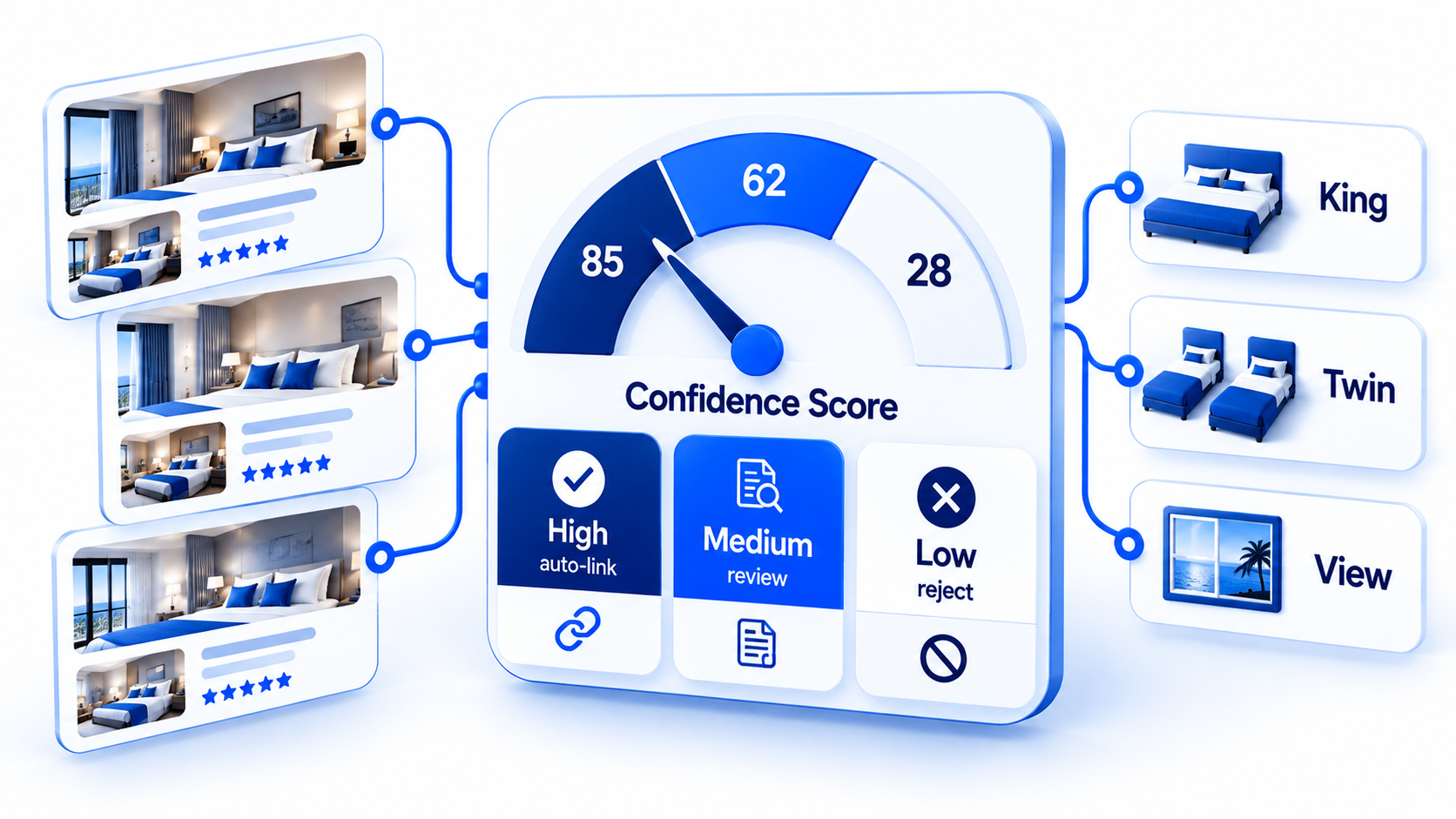
- Hard signals: same geo cluster + same brand/chain + supplier multicodes where you have them; identical occupancy; bed type enums when suppliers expose them.
- Soft signals: normalized tokens from room names (deluxe/superior/king/twin/view/balcony), board basis, smoking flag, accessible flag.
- Negative signals: conflicting occupancy, suite vs room class mismatch, apartment vs hotel product type.
- Confidence bands: auto-link above a high threshold; queue medium scores for human review; never auto-link low scores into production search.
GIATA’s public RTM materials note that room-type data is often too inconsistent for naive static matching, which is why dynamic grouping at live search exists (RTM explainer). Whether you buy a content service or build internal rules, design hotel room mapping for change: suppliers rename rooms, move properties, and add codes constantly. MultiCodes-style delta updates (daily incremental pulls) are a useful habit even if your master data is home-grown (MultiCodes deltas).
Keep humans in the loop — especially for top destinations
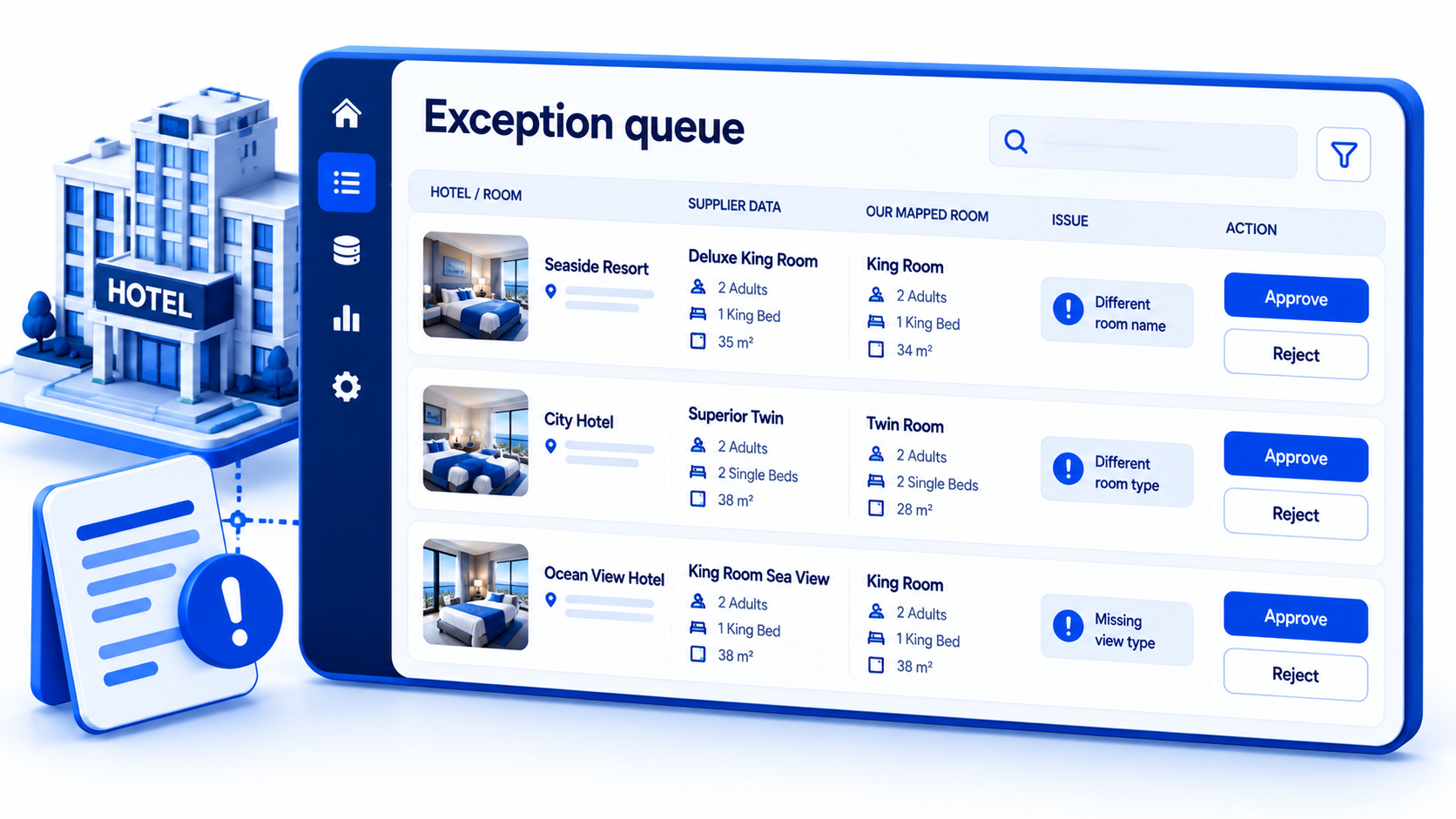
Day-one automation fantasies create silent wrong-room books. Run a hotel room mapping exception queue:
- Unmapped supplier hotels in your top 50 cities
- Medium-confidence room links with booking volume
- Traveler or agent “wrong room” tickets feeding remaps within 24 hours
- Moved/merged properties after supplier content updates
Staff the queue with hotel ops who understand product types, not only developers. Give them a UI that shows: supplier name strings, attributes, photo thumbnails if available, recent book count, and a one-click link / split / reject. Measure time-to-map the same way you measure time-to-refund.
Protect the book path harder than search display
Search can tolerate a slightly messy card. Hotel room mapping at checkout cannot.
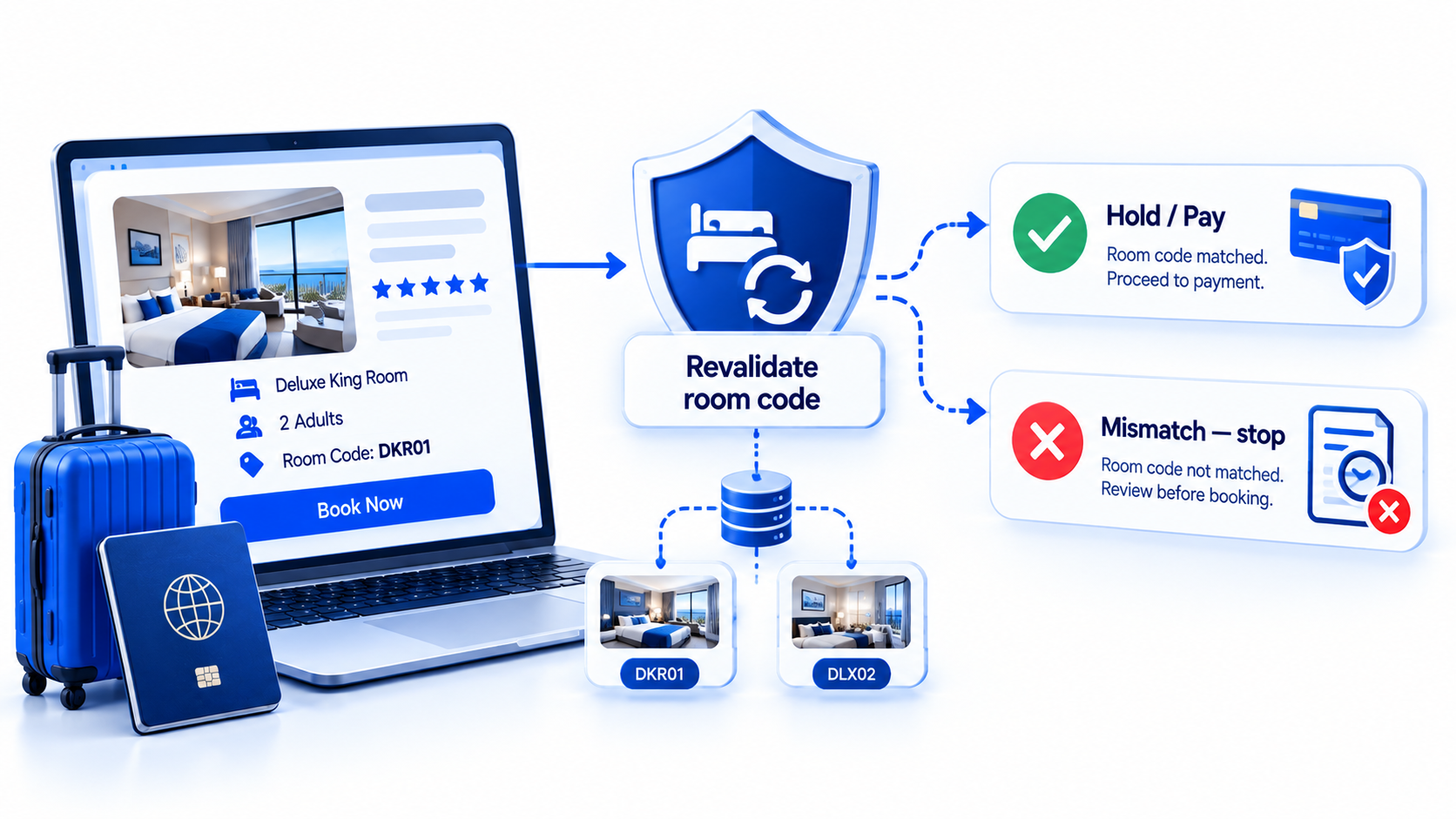
Before hold or payment:
- Revalidate the selected supplier room/rate code against live availability.
- Refuse silent substitutions — if the supplier returns a different room class, show the traveler and require confirm.
- Store both IDs on the booking: master room type (for your UI/reporting) and supplier room/rate codes (for amendments and disputes).
- Idempotent book retries — so a timeout does not create a second reservation against a remapped code (idempotent retries are part of PHPTRAVELS’ published integration guarantees).
If you already invested in supplier redundancy, remember: failover without hotel room mapping multiplies duplicates; hotel room mapping without book-path revalidation multiplies wrong rooms.

Ops metrics that prove mapping is working
Track hotel room mapping weekly, by destination and supplier:
| Metric | Healthy signal | Red flag |
|---|---|---|
| Duplicate property rate on search | Falling toward near-zero in priority cities | Same GIATA/master hotel appearing as 2+ cards |
| Unmapped offer % | Declining; backlog aging < 7 days | High book volume on unmapped codes |
| Wrong-room / “not as described” tickets | Rare; closed with remap | Rising after a new supplier go-live |
| Hold/book reject for room mismatch | Near zero after revalidation | Spikes when a supplier renames rooms |
| Human queue SLA | Top cities cleared daily | Stale medium-confidence links shipping live |
Do not celebrate “we connected five hotel APIs” until these hotel room mapping metrics move. Connectivity without mapping is inventory noise.
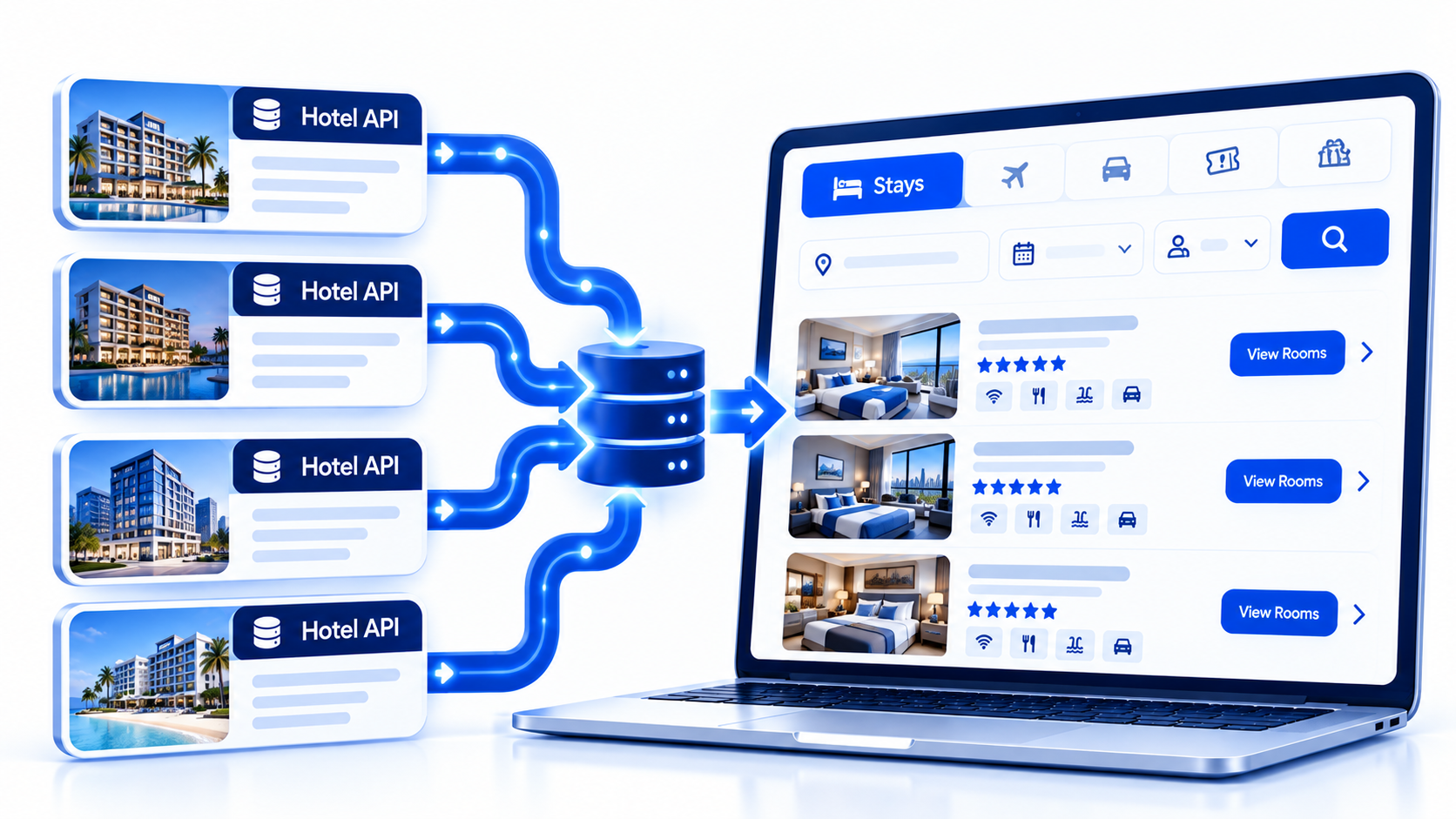
Where PHPTRAVELS fits (truthful multi-supplier Stays)
PHPTRAVELS is travel booking software with a Stays module that connects multiple hotel supplier APIs under one storefront, B2B agent portal, and back office. On the live integrations page, Stays is described as delivering live availability, rates, room mapping, and instant booking from bedbanks and related hotel feeds — with listed connectors such as Hotelbeds, RateHawk, Hotelston, TBO Holidays, Amadeus, Stuba, Agoda, and Travelport (always re-check the live list before you promise a specific supplier).
What that means in practice for hotel room mapping work:
- You can run multiple hotel feeds in one platform instead of stitching separate white-labels.
- Unified markup, currency, and booking records sit above those feeds (how integrations work).
- You still need your own supplier contracts and API credentials — PHPTRAVELS connects; it does not grant inventory.
- Content enrichment services (for example GIATA MultiCodes / RTM) are separate commercial choices. Do not assume a named third-party mapper ships inside every licence unless your order and docs say so.
- Custom supplier connectors can be scoped when a feed is missing (contact / custom integration).
If your hotel room mapping pain is “two bedbanks, three copies of every hotel, agents fixing rooms by WhatsApp,” start by consolidating Stays on one platform, then enforce property/room master data and an exception queue on top. See a working stack on the demo, then size suppliers and modules on pricing.
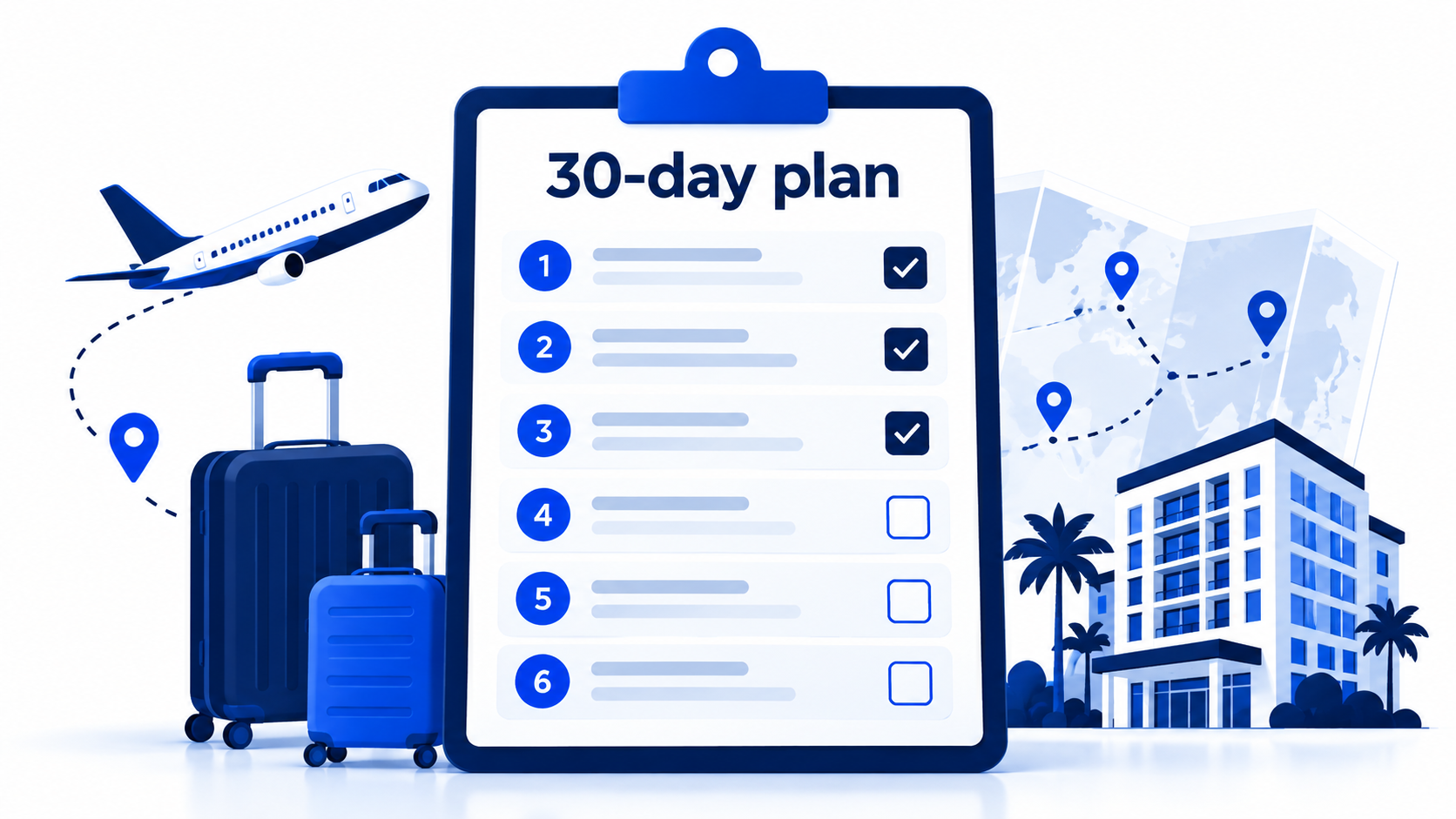
30-day hotel room mapping checklist
Use this hotel room mapping checklist before you add another bedbank.
- Pick 10 priority cities by booking volume.
- Freeze a master property schema (geo, stars, brand, photos, policies).
- Link supplier hotel IDs for those cities; quarantine duplicates from search.
- Define 15–30 master room groups with clear attributes (occupancy, bed, view, class).
- Score-map supplier room codes; auto-link only high confidence.
- Staff a daily exception queue for medium confidence + wrong-room tickets.
- Turn on pre-hold revalidation; block silent room class changes.
- Dashboard the five metrics above; review every Monday with hotel ops + eng.
- Only then add the next hotel supplier — mapping debt first, new feed second.
- Document book/amend using supplier codes, report using master rooms.
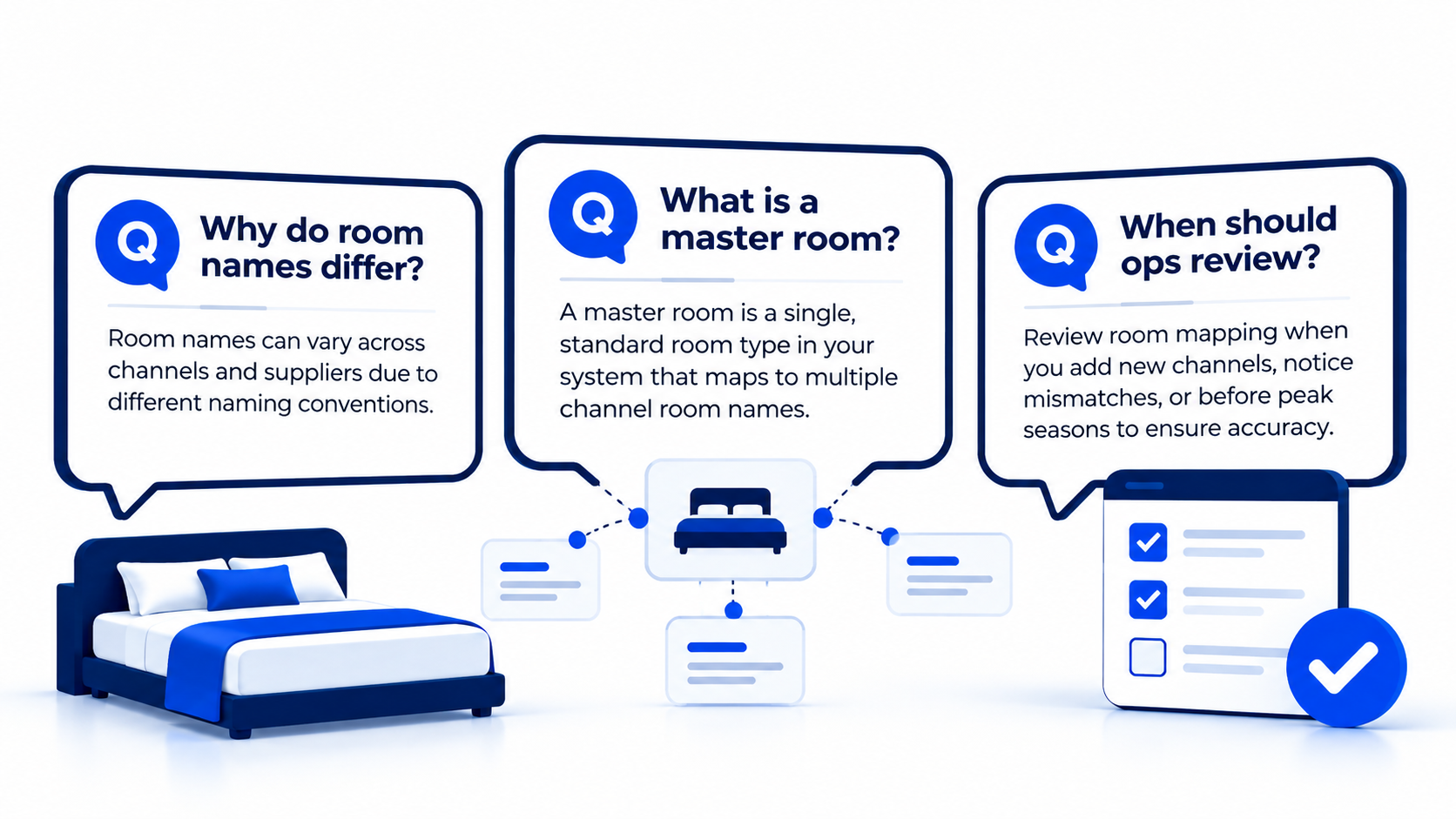
FAQ
Is hotel room mapping the same as connecting multiple hotel APIs?
No. Connecting APIs gets you offers. Hotel room mapping makes those offers refer to the same hotels and room types so travelers can compare and book safely. See also multi-supplier hotel booking engine controls.
Do we need GIATA or another content provider?
Not always on day one. Many teams start with internal master IDs for their top cities, then add a content/multicode service when catalog size or languages explode. Evaluate against your unmapped % and duplicate rate — not a vendor brochure.
Should mapping change the supplier booking code?
No. Standardize display and grouping; keep the original supplier room/rate codes on the book call and in the booking record.
How does this relate to API failover?
Failover answers “what if a feed is down?” Mapping answers “when feeds are up, are we selling the same physical room?” You want both; they solve different failures (failover guide).
Can PHPTRAVELS help if we already have Hotelbeds or RateHawk credentials?
If those connectors are on the live integrations list for your build, you enable them with your credentials inside Stays, then apply your mapping and markup rules in one back office. Confirm the exact supplier list and commercial scope before you buy.
—
Next step: If hotel room mapping gaps, duplicate hotels and wrong-room books are already costing support hours, consolidate multi-supplier Stays, enforce a master catalog, and put exceptions on a clock. Explore the PHPTRAVELS demo or configure modules on pricing.