

Tuesday 16:40. Your senior consultant pastes a “final” Maldives quote into WhatsApp — then realizes the Excel file still has last weeks bedbank net, the villa was never revalidated, and the client already forwarded v2 to three friends. Ten minutes later a cheaper rival quote lands. Nobody knows which version your team actually promised. A travel quote management software workflow keeps the promised version tied to the booking record.
Nothing is broken” in the booking engine. Flights and hotels still search fine. The leak is earlier: quotes live in inboxes, shared drives, and chat threads that do not talk to inventory, margin rules, or follow-up.
This guide is for agency owners, sales managers, tour operators, and DMC coordinators who need travel quote management software thinking — a controlled path from inquiry to priced proposal to confirmed booking — without pretending a spreadsheet is a CRM. It is not a vendor bake-off of itinerary builders. If your pain is post-booking ops, start with travel agency back office software. If sub-agents already book against credit, read the agent portal guide. If commissions are the mess, see commission management. This is where travel quote management software earns its keep.
What travel quote management software actually covers
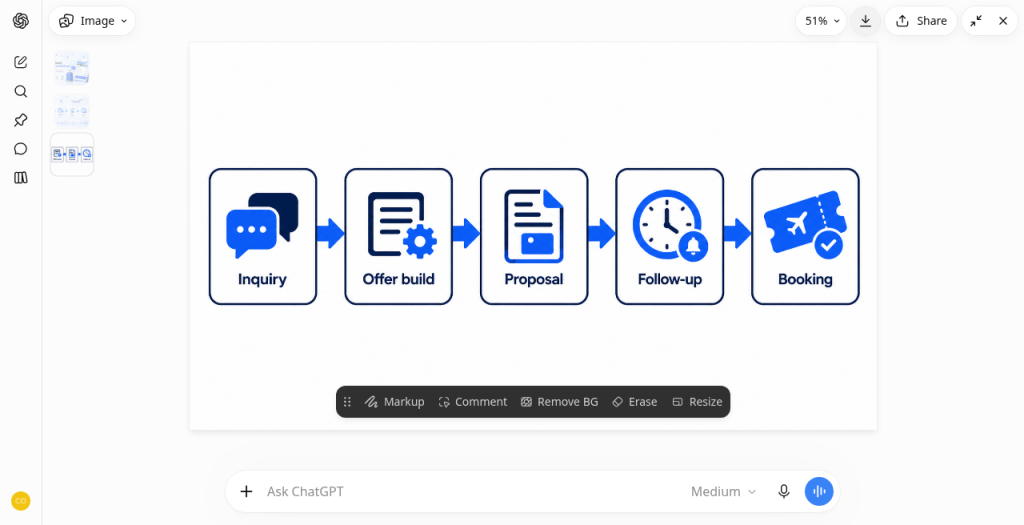
Travel quote management is the system of record for sales proposals before money moves: capture the request, build a costed offer, control versions, track follow-up, and convert an accepted quote into a real reservation.
In plain language:
Every priced offer your team sends should have an owner, a version, a margin story, an expiry, and a next action — linked to the same travelers and services you will eventually book.
A useful stack usually spans:
| Layer | Job |
|---|---|
| Inquiry capture | Normalize channel (web form, WhatsApp, email, walk-in) into one request record |
| Qualification | Dates, pax, budget band, destination constraints, decision timeline |
| Offer build | Services + supplier nets / contracted rates + taxes + markup + ancillaries |
| Proposal delivery | Branded document or portal link the client can review |
| Revision control | Swap hotel / shift dates without losing which version was sent |
| Follow-up | Scheduled touches until book, hold, or lost |
| Conversion | Deposit / payment supplier confirmation vouchers/invoices |
What quote management is not (by itself): supplier connectivity, GDS ticketing authority, accounting GL, or a finished OTA storefront. Those are adjacent systems. Confused buyers buy a pretty PDF generator and still rekey everything into the booking engine.
Why spreadsheet quoting breaks as soon as you grow
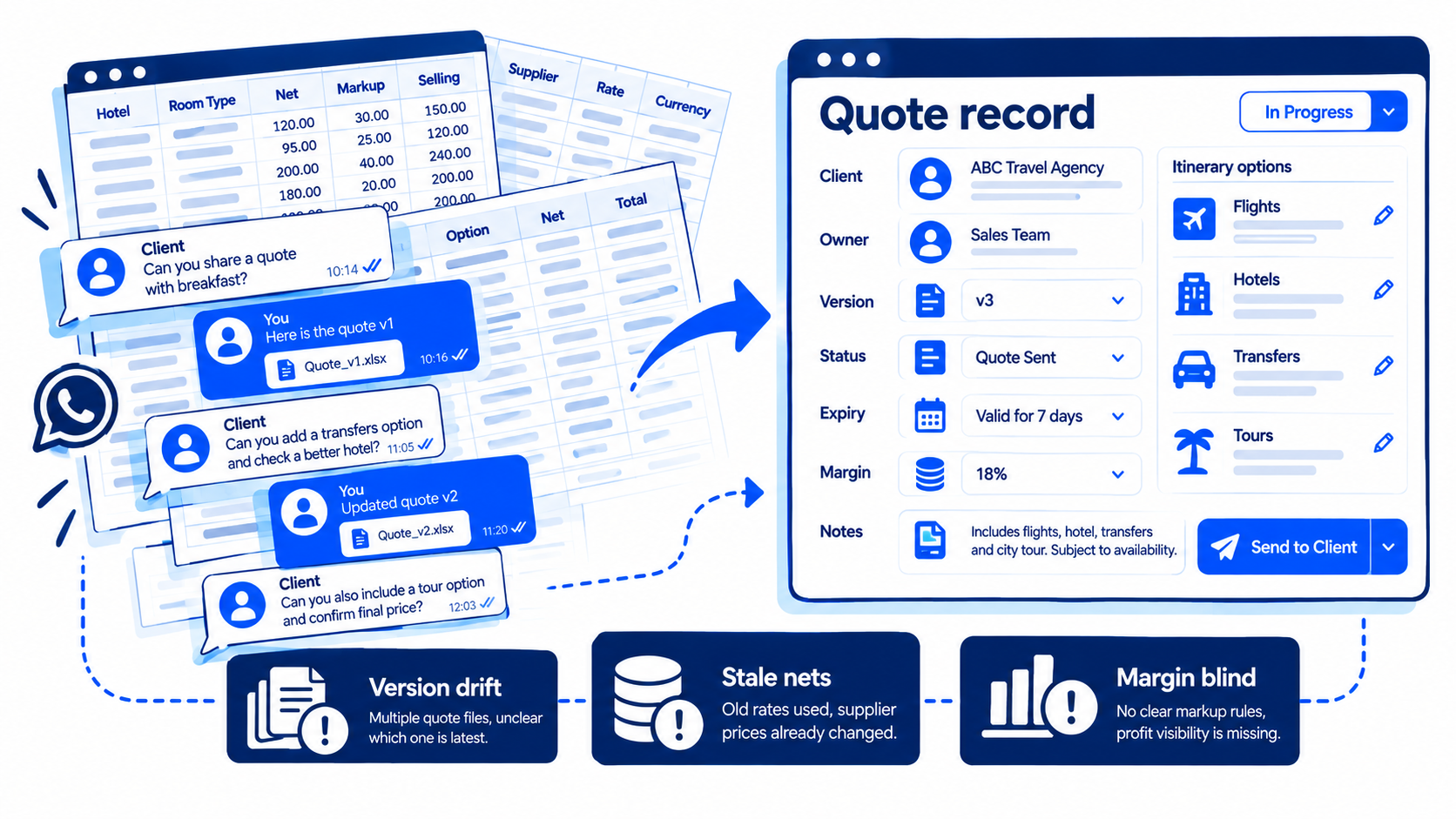
Spreadsheets and Word templates work for a solo advisor with ten active files. They fail for a desk of five once volume, suppliers, and revisions collide.
Typical failure modes:
- Version drift — “Final_FINAL_v3.xlsx” is not a system of record. Clients receive different inclusions than finance expected.
- Stale nets — Cached bedbank or airline prices age out; the quote still looks “live.” Checkout later surprises everyone.
- Margin blindness — Agents paste sell prices without a forced cost → sell → margin view. High conversion, thin (or negative) profit.
- No funnel KPIs — Leadership cannot answer quote-to-book, time-to-first-quote, or why packages die after v2.
- Channel chaos — WhatsApp holds the negotiation; email holds the PDF; the booking engine holds a different room type.
- Handoff loss — Sales closes; ops re-creates the itinerary from screenshots. Errors become refunds.
Industry sales-performance writing consistently treats quote-to-book and response speed as core agency KPIs, not vanity metrics (TravelSalesIQ on sales KPIs; TravelOperations on response and conversion). You do not need their exact benchmarks to accept the operational truth: if quoting is unstructured, conversion coaching is guesswork.
The inquiry-to-book lifecycle (with clear owners)
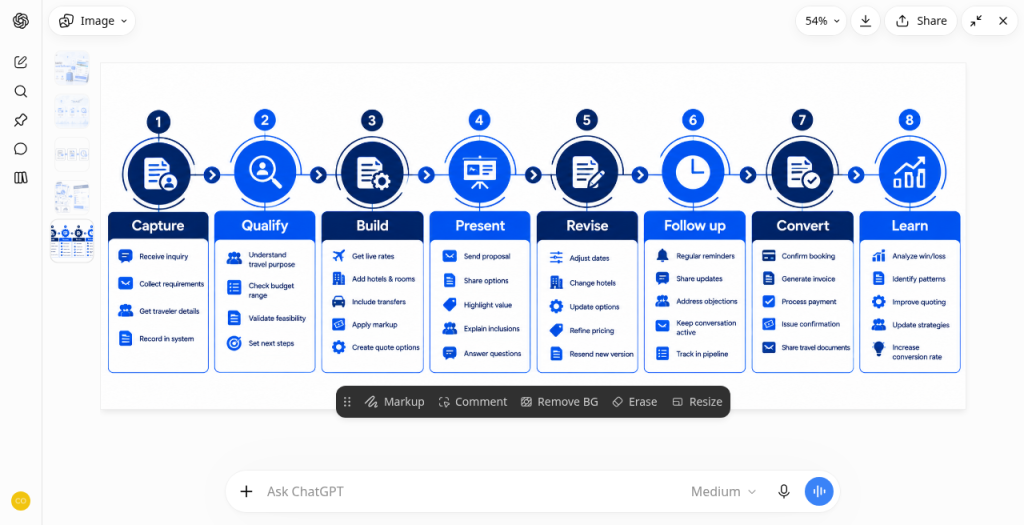
Map the work before you buy software. A practical lifecycle:
1. Capture
One intake schema: traveler names (or placeholder), dates flexibility, destinations, budget signals, party composition, source channel, assigned owner. Reject “just send something nice for Europe in summer until minimum fields exist.
2. Qualify
Decide whether this request deserves a custom quote, a packaged product, or a polite decline. Unqualified requests burn senior consultant time and inflate look-style shopping against suppliers if every inquiry triggers live multi-supplier search (look-to-book economics).
3. Build
Assemble services from live or contracted rates where possible. For tour operators with own product, pull from manual inventory rather than reinventing capacity in Excel. Apply markup rules deliberately — not “add 12% because that is what we always do.”
4. Present
Send a client-readable proposal: day-by-day or service list, inclusions/exclusions, total and payment terms, validity window, and a clear next step (pay deposit / approve / request change).
5. Revise
Track each revision as a new version linked to the same inquiry. Never silently overwrite. Note who requested the change and why (budget, dates, hotel class).
6. Follow up
Scheduled touches beat hope. Many agencies lose more revenue to missing follow-up than to “bad prices” (TravelSalesIQ conversion funnel notes).
7. Convert
When the client accepts, do not rebuild from the PDF. Convert the approved services into supplier bookings (or holds) in the booking stack, collect payment through your own gateways, and hand a clean record to ops.
8. Learn
Tag lost quotes: price, product, response time, competitor, dates unavailable, ghosted. Patterns beat anecdotes.
Controls that raise quote-to-book without buying theater
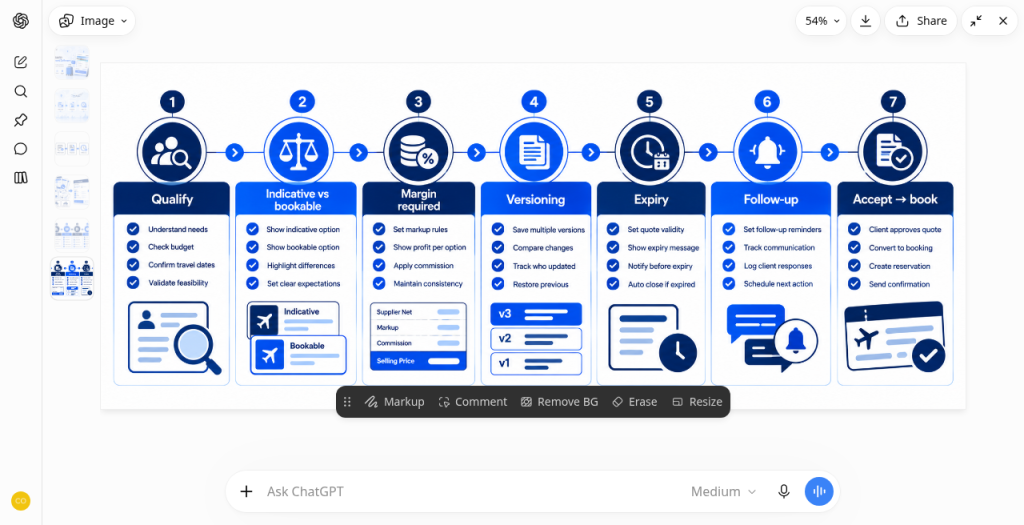
1. Force qualification before deep shopping
Custom FIT research is expensive. Gate full multi-supplier builds behind budget band, decision date, and passport/visa constraints when relevant.
2. Separate indicative ranges from bookable offers
Early conversations can use ranges. Formal quotes that clients can accept should use revalidated or contracted rates — the same discipline as preventing stale-price cliffs at OTA checkout.
3. Make margin a required field
Every line: net (or estimated net), sell, tax/fees, margin %, currency. Block “send” if margin is blank or below a desk policy floor (with manager override logged).
4. Version everything clients see
v1 / v2 / v3 with timestamps and authors. When a client says the one with the overwater villa, you must know which file that was.
5. Put expiry on every formal quote
Hotels and airfare move. A 48–72 hour validity for dynamic inventory is often more honest than a polite fiction of week-long holds you cannot actually secure.
6. Standardize follow-up cadences
Example skeleton (adapt to your market): day 0 confirm receipt; day 2–3 offer adjustments; day 7 refresh availability; day 14 close-lost or refresh. Log outcomes.
7. Tie acceptance to booking actions
Accepted quote → payment link / deposit invoice → supplier confirm → voucher. If those steps live in three tools with no shared ID, expect reconciliation pain later (accounting integration context).
KPIs worth tracking weekly
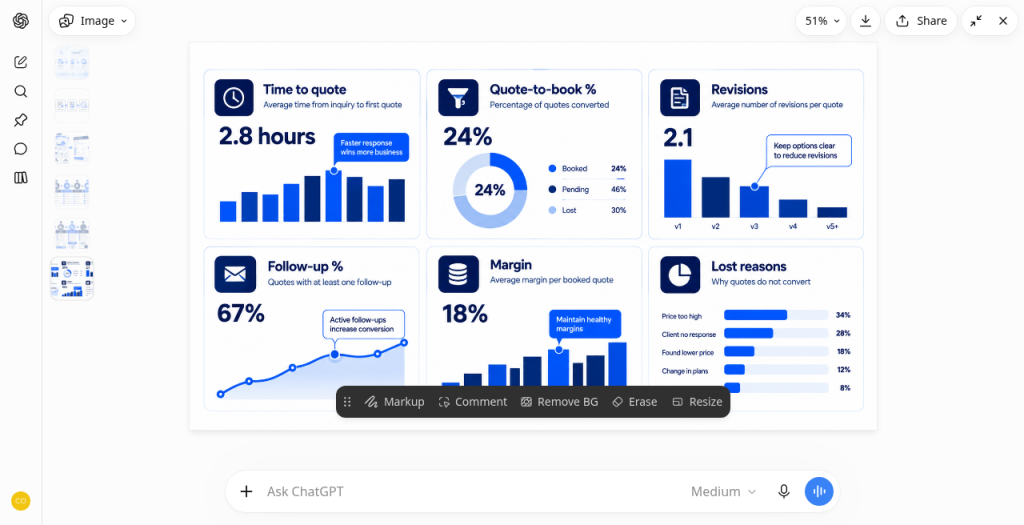
Treat published “industry averages” as directional, not universal SLAs — channel mix (FIT vs group vs corporate) changes the math.
| KPI | Why it matters | How to use it |
|---|---|---|
| Time to first quote | Speed correlates with win rates in agency surveys | Alert when desk median drifts past your SLA |
| Quote-to-book % | Core sales effectiveness | Segment by product and consultant |
| Revision count per won deal | Discovery quality | High revisions → weaker intake questions |
| Follow-up completion % | Process hygiene | Often the cheapest conversion lift |
| Gross margin on won quotes | Protects against winning unprofitably” | Review by supplier and destination |
| Lost-reason mix | Product and pricing truth | Feed contracting and packaging decisions |
TravelSalesIQ-style benchmarks often cite rough quote-to-book bands around the 30–45% region for many leisure desks and enquiry-to-book ranges that vary sharply by channel — use them as conversation starters, then replace with your trailing 90-day baseline (TravelSalesIQ KPI guide).
Where PHPTRAVELS fits (honestly)
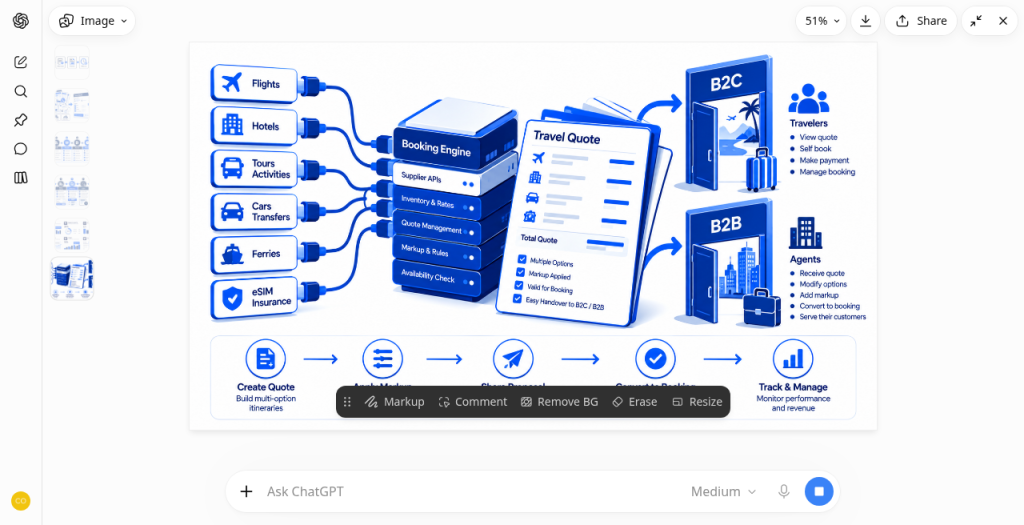
PHPTRAVELS is travel booking software — B2C storefront, B2B agent portal, back office, and supplier API connections across flights, stays, tours, cars, ferries, rail, eSIM, and more — sold as a licensed product the buyer configures. It is not a dedicated quote-CRM that promises proposal versioning, client approval portals, or automated nurture sequences out of the box. Claiming otherwise would fail product accuracy.
Where it does help quote-heavy agencies:
- Live inventory instead of fantasy Excel nets — Search and price from connected suppliers (buyer brings their own contracts and credentials). That is the difference between a brochure and a bookable offer. See integrations.
- B2B agent portal for reseller quoting/booking — Sub-agents search, book against their commercial rules and wallet/credit controls, and stop asking HQ to retype every option into chat (agent portal).
- Manual inventory for operators — Load your own tours/allotments and sell them online without waiting on a third-party API for every product (manual inventory).
- One stack from accept pay → confirm — Payment methods and gateways run through the buyer’s own merchant accounts; the platform is not a booking intermediary taking a cut of sales.
- Self-hosted / commercial licence model — Useful when you want to own deployment and extend workflows, rather than rent a closed SaaS forever. Confirm plan terms on the live pricing configurator — figures change.
Honest non-fit: if you only need a pretty itinerary PDF tool and have no plan to connect suppliers or run a real booking engine, a lighter proposal product may be enough. PHPTRAVELS is for teams building (or already running) an online booking operation around those quotes.
A 30-day quote hygiene checklist
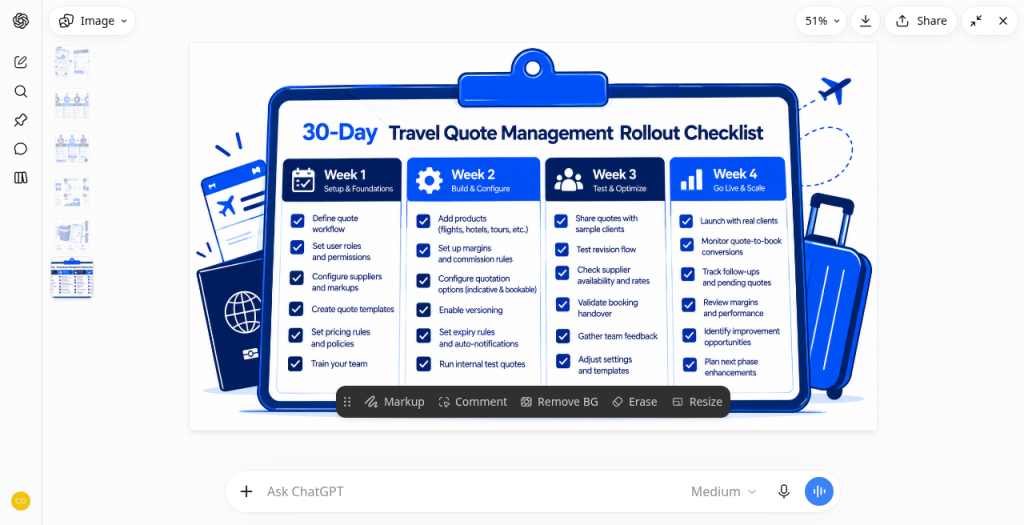
Week 1 Baseline
- Export last 50 quotes from email/Drive; tag won / lost / open
- Measure median time-to-quote and quote-to-book (even if ugly)
- List the three most common revision reasons
Week 2 — Intake + templates
- Ship a mandatory inquiry form (channel-agnostic fields)
- Create two proposal templates: short-haul package vs multi-city FIT
- Require net / sell / margin columns before send
Week 3 — Versioning + expiry
- Adopt v1/v2 naming with owner + timestamp
- Enforce quote validity windows by product type
- Add a shared “open quotes” board (tool of your choice) with next action dates
Week 4 — Convert cleanly
- Define the accept → pay → book handoff checklist
- Pilot one desk on live supplier search for formal quotes
- Review lost reasons; kill one low-yield quote type or fix its packaging
When the booking layer is the bottleneck not the PDF — evaluate a licensed platform via the demo and configure scope on pricing.
FAQ
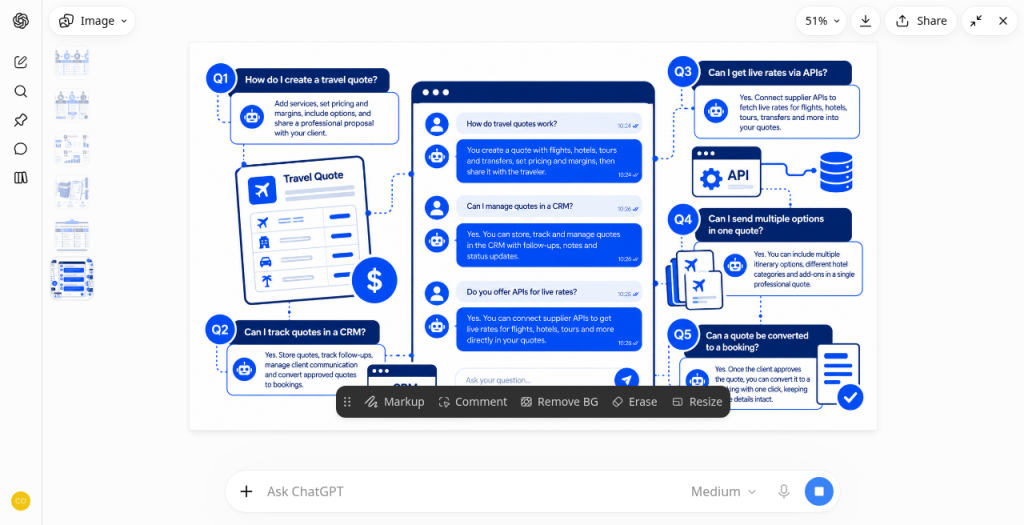
Is travel quote management the same as a travel CRM?
No. CRM tracks relationships and pipeline. Quote management specifically governs priced offers (versions, margins, expiry, conversion). Many CRMs store PDFs; fewer enforce bookable accuracy.
Do we need software if WhatsApp is how clients buy?
You still need a system of record. WhatsApp can remain the conversation channel; the quote record should live elsewhere with versioning and margin.
Should every quote use live API rates?
Not always. Early indicative ranges are fine. Formal, client-acceptable quotes for dynamic inventory should be revalidated or contracted. Static packages and allotments follow your inventory rules.
Where does PHPTRAVELS stop and a quote CRM begin?
PHPTRAVELS covers search, book, pay, vouchers, B2B agents, and back office around supplier modules. Dedicated proposal CRMs specialize in sales content and nurture. Some agencies run both; others quote from live search inside the booking stack for simpler products.
Will better quoting alone fix low conversion?
No. Weak products, slow visas, or uncompetitive contracts still lose. Better quoting removes self-inflicted loss: stale prices, missing follow-up, and margin-blind wins.
Educate the desk first. Instrument the funnel. Then connect quotes to a booking engine that can actually confirm what you sold. When you are ready to see a licensed travel booking stack with B2C, B2B, and supplier modules in one place, start with a PHPTRAVELS demo and build a real number on the pricing configurator.