

Ask a mid-size agency what “commission management” looks like on a Tuesday afternoon and you often get the same picture: three open spreadsheets, a supplier PDF nobody trusts, and a WhatsApp thread titled “agent payouts final??”. Bookings closed fine. Money ops did not.
Travel agency commission management is the discipline of knowing what you are owed, what you owe others, and why those numbers match — across suppliers, agents, currencies, and clawbacks — without rebuilding the month every time finance asks.
This guide is for agency owners, host-agency operators, franchise/multi-branch leads, and finance partners who need a clear operating model. It is not a claim that one booking engine replaces BSP/ARC settlement software or payroll. Those are different tools for different jobs.
What Travel Agency Commission Management Actually Covers

Commission management in a travel agency is not one field labeled “%. It is a lifecycle:
- Accrue — estimate what a booking should earn or pay when it is ticketed/confirmed
- Reconcile — match expected amounts to supplier statements / remittances
- Split — allocate agency share vs advisor/agent/sub-agent share under written rules
- Settle pay people and close periods on a schedule
- Dispute — handle short pays, clawbacks, cancellations, and evidence
Two definitions that agencies mix constantly (and then regret):
| Term | What it usually means | Where it lives |
|---|---|---|
| Markup | Amount you add to a base/net rate to create a sell price | Pricing / booking rules before checkout |
| Commission | Remuneration tied to a sale or distribution relationship (supplier pays you, or you pay an agent) | Post-sale money ops + contracts |
If you need sell-price governance across APIs, that is markup architecture — see PHPTRAVELS guide on travel markup management software. This article is about the other half: getting paid and paying out correctly.
Commission management also sits next to — but is not identical to — multi-branch governance (multi-branch travel agency software) and multi-supplier booking control (multi-supplier hotel booking engine). Those topics answer “how we sell.” Commission management answers “how we settle what selling created.”
Why Spreadsheets Fail Once You Have Agents and Multiple Suppliers

A realistic failure pattern:
- Supplier A remits hotel commission monthly on a CSV with cryptic property codes.
- Supplier B pays air incentives on a different cycle, sometimes net of tax, sometimes not.
- Three advisors share a booking; one left the company mid-month.
- Finance pays from last month’s “almost final” sheet while ops edits a newer copy.
- A clawback arrives 60 days later for a cancelled segment nobody tagged.
What breaks first:
| Pain | What it looks like |
|---|---|
| Missed remittance | Expected commission never appears; nobody notices until cash is thin |
| Double pay | Same advisor paid from two versions of a sheet |
| Wrong split basis | Split on gross sell vs net commission vs contribution — inconsistent by supplier |
| FX fog | Statement in USD, books in PKR/AED/EUR, nobody owns the rate source |
| No evidence trail | Dispute with supplier or agent becomes a memory contest |
| Host/sub chaos | Host agency cannot explain multi-layer payouts to sub-agencies without a week of exports |
Spreadsheets are fine for a single-desk agency with one commissionable hotel contract. They become operational debt the moment you add multiple suppliers + multiple people with a claim on the same booking.
A Practical Commission Operating Model
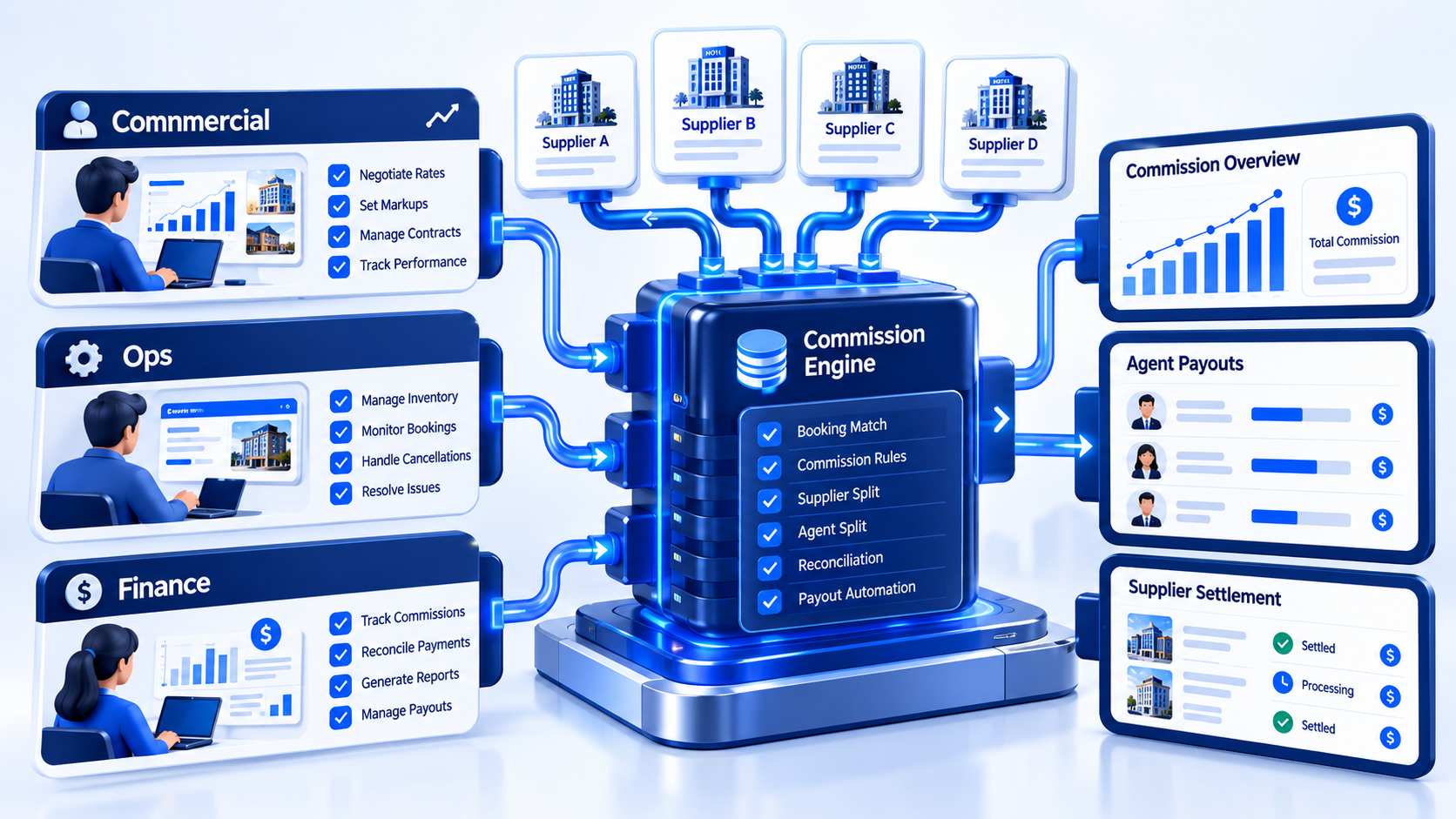
Treat commission as an operating system with owners, not a month-end surprise.
Stage 1 — Contract truth before tools
For each supplier and each agent/advisor relationship, document in one place:
- What triggers commission (ticketed, departed, paid, stayed)?
- Base for calculation (net, gross, contribution, fare component)?
- Rate / tier / override / promotional exception
- Clawback rules on cancel/refund/no-show
- Statement format and cycle
- Currency and who carries FX
If this sheet does not exist, software will only accelerate confusion.
Stage 2 — Accrual at booking time
When a booking confirms, record an expected commission event (even if the amount is estimated). Capture: booking ID, supplier, product, agent of record, expected basis, expected amount, currency, status = accrued.
Agencies that only “look at commissions when the PDF arrives spend their lives reconstructing history.
Stage 3 — Reconcile statements to bookings
Match supplier lines to booking IDs / PNRs / confirmation numbers. Flag:
- Matched
- Short / over
- Unmatched statement line
- Accrual with no statement (aging)
Do not “force match” to clear a queue. Unmatched items are the product.
Stage 4 — Apply split rules once
After (or as) remittance is confirmed, apply versioned split rules:
- Agency retain %
- Advisor / employee share
- Sub-agent / host layers if you operate that model
- Special cases (personal travel, shared credit, team desk)
Generate a statement per payee for the period. Prefer one calculation pass over hand-edited cells.
Stage 5 — Settle on a calendar
Publish a payout calendar. Pay from reconciled, approved amounts — not from chat approvals. Keep payment references linked to the statement ID.
Stage 6 — Dispute with a folder, not a thread
Every dispute needs: booking evidence, statement line, contract clause, decision, and close date. WhatsApp is not an archive.
A 30-day cleanup pattern many agencies finish:
- Week 1: freeze contract matrix (suppliers + agent agreements)
- Week 2: stop dual sheets; one accrual register per module or supplier family
- Week 3: first full reconcile cycle; age unmatched >30 days
- Week 4: first advisor statements from reconciled data only; retire “final_v7.xlsx”
Supplier Commissions vs Agent Splits (Do Not Mix the Ledgers)
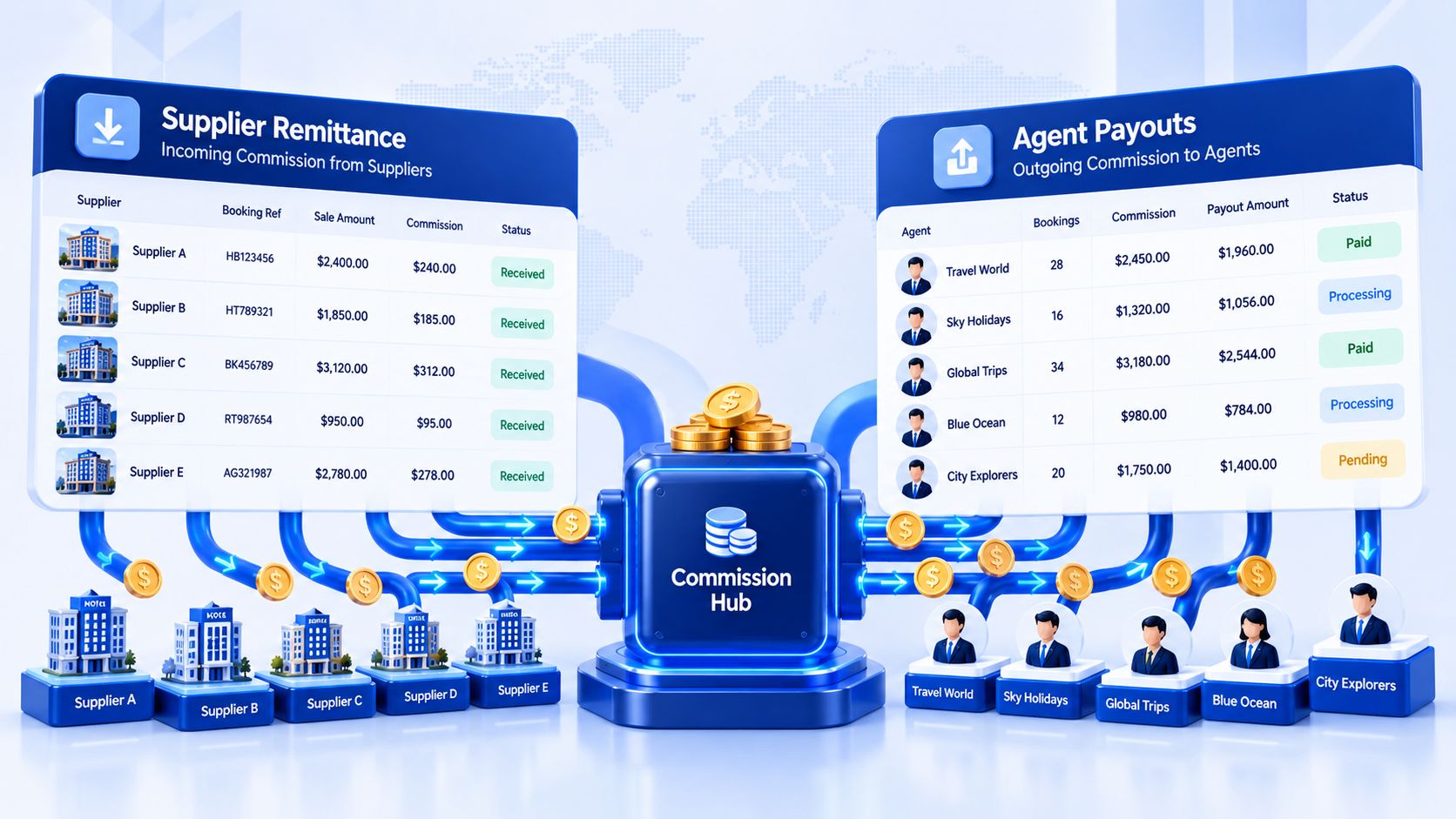
Inbound and outbound money are related but should not share one undifferentiated column called “commission.”
Supplier commission (inbound) Money or credit your agency earns because of a commercial relationship with a supplier (or consolidator). Timing often lags the booking. Statements are imperfect. Clawbacks are normal.
Agent / advisor split (outbound) Money your agency pays to people or partner desks based on your own employment or host/sub agreements. This is your policy. It should reference confirmed economics, not hope.
B2B reseller margin (channel) When you sell to a sub-agent who resells, the commercial design may be a net/wholesale price (they add their own markup) rather than a classic “commission payout.” Mixing reseller margin design with employee commission splits creates debates that no spreadsheet can settle. For channel design, see also B2B travel portal software and white-label travel booking software.
Practical rule: reconcile inbound first, then calculate outbound. Paying agents from unreconciled accruals is how host agencies fund disputes with cash.
Air distribution adds complexity. As airlines and aggregators move toward richer offer/order models under IATA’s distribution work (including NDC-related retailing), commercial incentives may not look like a single classic “commission % on a static fare.” Your commission process must start from what the commercial agreement actually says for that channel, not from nostalgia for one GDS screen. Authoritative industry context: IATA airline distribution.
Controls That Survive Audit: Rules, Evidence, Exceptions
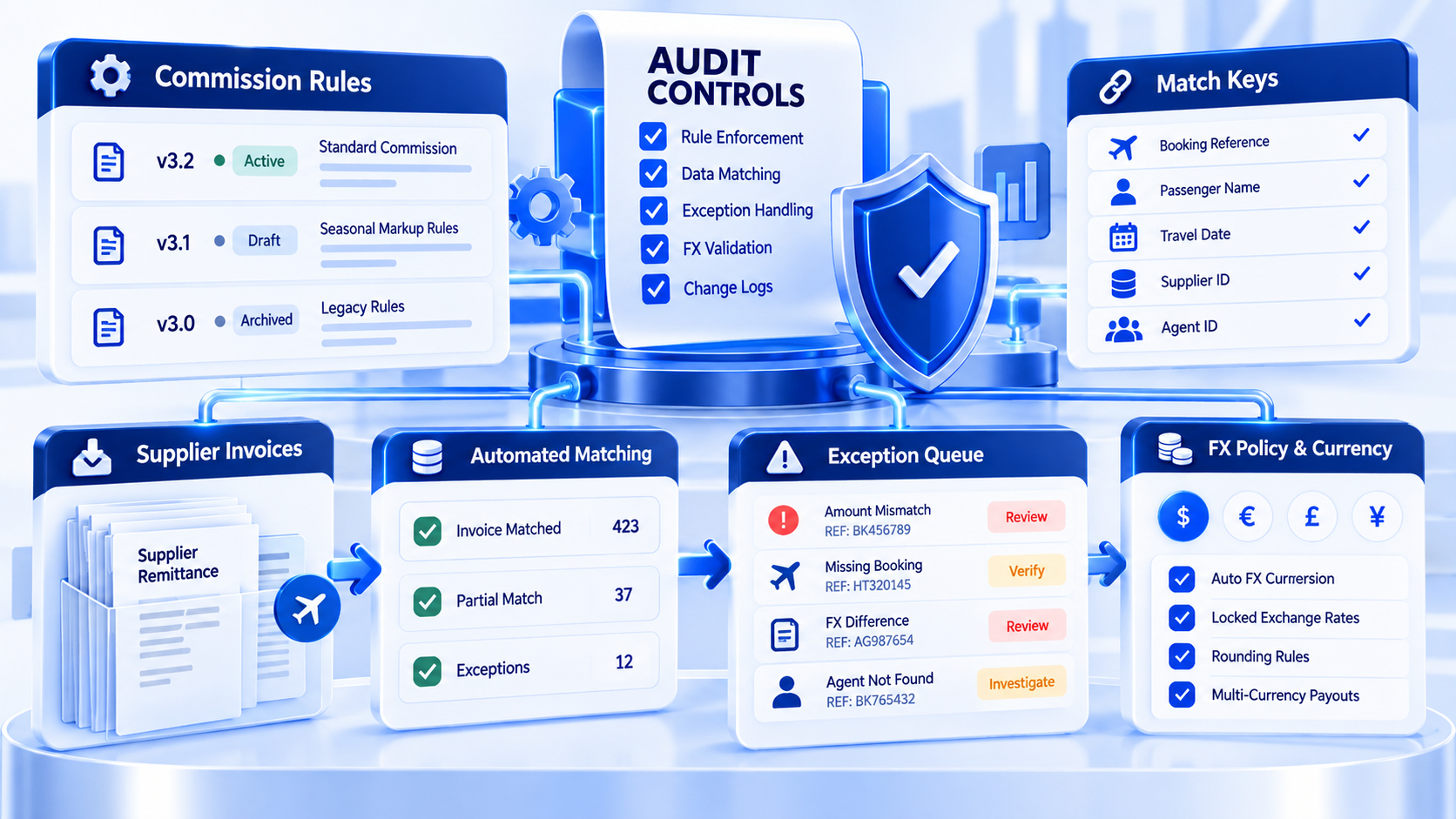
Finance and ownership care less about dashboards than about answers to four questions:
- Why was this person paid this amount?
- Which supplier remittance funded it (or which accrual risk remains)?
- Which rule version applied on the booking date?
- What changed after a refund?
Minimum control set:
- Rule versioning — effective dates; no silent overwrites
- Booking ↔ statement match key — confirmation / PNR / invoice ID documented per supplier
- Exception queue — short pays, unmatched, clawbacks, shared credit
- FX policy — rate source, timing (statement date vs pay date), owner
- Segregation — who can edit rules vs who can approve payouts
- Retention — statements, remittance proofs, and agent statements stored with the period close
If you cannot answer those four questions in under ten minutes for a random booking, you do not have commission management — you have archaeology.
Where PHPTRAVELS Fits (Honest Product Fit)
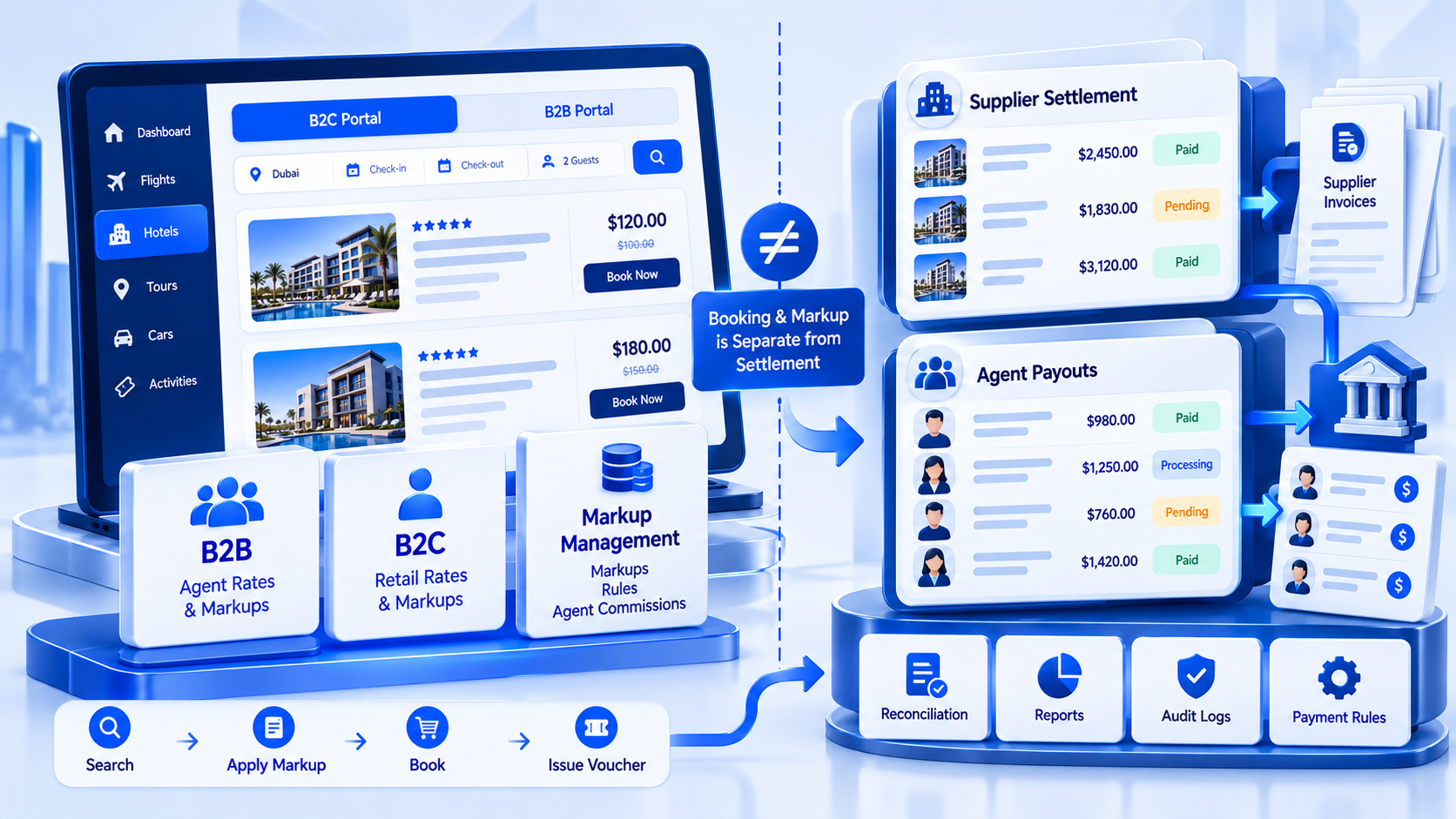
PHPTRAVELS is travel booking software for agencies, OTAs, tour operators, and similar buyers: B2C storefront and/or B2B agent portal, back office, supplier API connections, and payment-gateway handling on a self-hosted commercial licence (source included under licence terms — not MIT / unrestricted public OSS).
For commission-related operations, the honest fit is:
- Capture the commercial event — bookings across modules (flights, stays, tours, cars, and others you enable) with agent/channel context when you sell B2B or multi-desk
- Control sell-side economics — markup rules and B2B vs B2C pricing so “what we sold” is explainable (complement to, not a replacement for, commission settlement)
- Multi-currency display/pricing context — useful when markets differ; FX settlement policy remains yours
- Own your margins — PHPTRAVELS is not a booking intermediary and does not take a cut of your bookings; you own supplier contracts, credentials, payment accounts, and commercial agreements
What PHPTRAVELS is not claiming here:
- A dedicated BSP/ARC ingest + airline incentive settlement suite
- Automatic multi-layer host-agency payroll with clawback engines
- Replacement for your accountant, payroll provider, or specialist commission-reconciliation product
That honesty matters. Many agencies need both: a booking stack that keeps sales clean, and a finance process (sometimes specialist software) for remittance matching and payouts. Confusing the two creates demos that look good and month-ends that still hurt.
Buyer responsibilities stay clear: you obtain supplier contracts and API credentials; software connects — it does not grant inventory. Payment money settles to your gateway accounts.
If you want to see how B2B/B2C selling, markup controls, and multi-currency workflows behave in a licensed self-hosted stack, start with a live walkthrough at phptravels.com/demo and configure options at phptravels.com/pricing. Supplier connectivity options are listed on integrations (verify live before promising a specific supplier).
FAQ: Travel Agency Commission Management
What is travel agency commission management?
It is the operating process for accruing, reconciling, splitting, settling, and disputing commissions and agent shares tied to travel bookings — so finance can close periods without rebuilding numbers from chat threads and competing spreadsheets.
How is commission different from markup?
Markup is typically what you add to create a selling price. Commission is typically remuneration linked to a sale or distribution relationship (inbound from suppliers or outbound to agents). Agencies need both concepts; they solve different problems. See travel markup management software.
Should we pay agents from accrued or reconciled amounts?
Prefer reconciled (or explicitly approved accruals with known risk). Paying from raw accruals funds disputes when statements short-pay or clawbacks arrive.
Do we need specialist commission software if we already have a booking platform?
Maybe. A booking platform should give you clean booking and channel data. Specialist tools (or a strong internal finance process) may still be required for supplier-statement matching, multi-tier host payouts, and settlement rails. Choose based on volume, supplier statement messiness, and how many people share each booking.
Does PHPTRAVELS pay out my agents automatically?
Do not assume a full advisor-payroll / multi-layer settlement product. Use PHPTRAVELS for booking, pricing controls, and B2B/B2C operations; design payouts against your contracts and finance tools. Confirm workflows on a demo.
Does PHPTRAVELS include supplier inventory or merchant accounts?
No. You bring supplier contracts/credentials and your own payment gateway accounts. The software is the operating layer.
Is PHPTRAVELS open source / MIT?
It is licensed commercial self-hosted software with source under its commercial licence — not MIT or unrestricted public open source. Review licence terms for your plan.
Commission problems rarely announce themselves as outages. Bookings still confirm. Vouchers still send. The leak shows up as thin cash, angry advisors, and a finance close that slips a week every month.
Travel agency commission management is the decision to treat money ops with the same seriousness as search-and-book: contracts documented, accruals captured, statements matched, splits versioned, settlements calendared, disputes archived. Markup keeps sell prices sane. Commission management keeps the business liquid and explainable.
If your stack still cannot tell you which agent owns a booking or which markup rule created the sell price, fix that foundation first — then build settlement discipline on top. For a practical walkthrough of the booking side, use the demo and pricing configurator.