
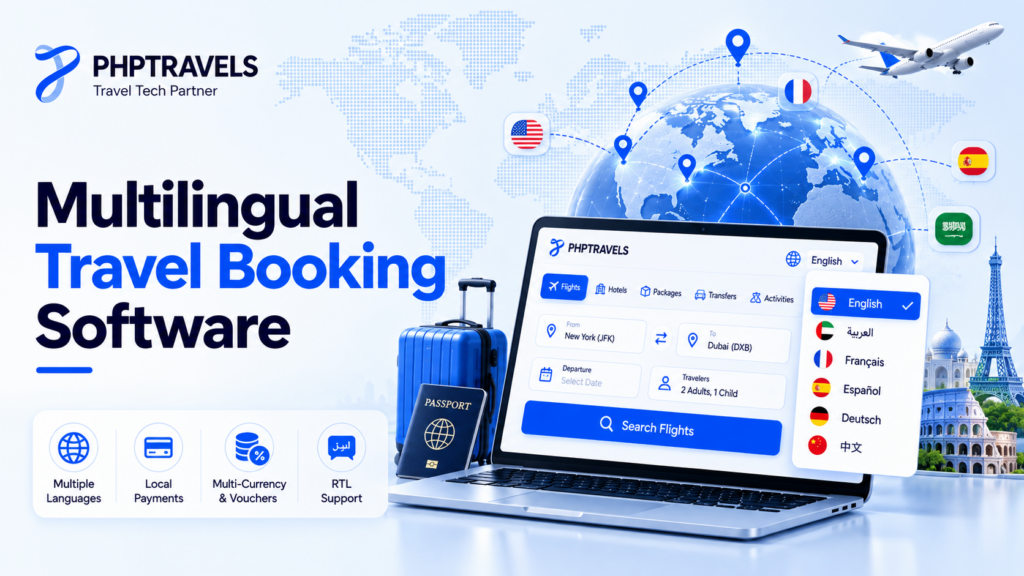
A traveler lands on your OTA in Arabic, picks a hotel in Dubai, then hits an English-only checkout with English fare rules and an English confirmation email. They do not feel “almost localized.” They feel like the booking might fail. Many abandon. Support inherits the rest.
That is why multilingual travel booking software is not a homepage language dropdown. It is a system that keeps one inventory and back office while presenting—and completing—the full booking journey in the traveler’s (or agent’s) language.
This guide is written for agencies, tour operators, and OTAs evaluating that stack: what “multilingual” must cover, where teams usually break the journey, how RTL and SEO fit, and where a licensed platform like PHPTRAVELS can help without pretending to be a translation SaaS or a free inventory source.
What multilingual travel booking software actually means

In travel tech, “multilingual” gets used for three different products:
- A marketing site translator that overlays machine-translated HTML on a brochure site.
- A CMS with language folders for destination blogs and static pages.
- Booking software that localizes search, results, passenger forms, policies, payments messaging, vouchers, invoices, and agent-portal workflows—while still talking to supplier APIs in whatever language those APIs speak.
Only the third item is multilingual travel booking software. The first two can help acquisition; they do not close the booking if checkout and post-booking documents stay in one language.
A useful definition for buyers:
Multilingual travel booking software lets you run one booking core (inventory connections, rates, availability, payments, back office) with multiple complete front-office locales—including B2C storefront and, when you sell through agents, B2B portal—without forking a separate codebase per language.
What must be localizable in practice:
| Layer | Examples | Why it matters |
|---|---|---|
| UI chrome | Menus, filters, buttons, validation errors | Trust and completion |
| Catalog copy | Hotel descriptions, tour itineraries, inclusions | Conversion and expectation-setting |
| Commercial rules | Cancellation text, fare conditions summaries | Chargebacks and disputes |
| Transactional messages | Booking emails, vouchers, invoices, SMS | Post-purchase clarity |
| Agent tools (B2B) | Credit notes, quotes, agent dashboards | Sub-agent adoption |
| Directionality | RTL layouts for Arabic / Urdu / Hebrew markets | Usability, not cosmetics |
Supplier APIs often return English (or mixed) product strings. Your software still needs a strategy for what you translate yourself versus what you display as received. Pretending the GDS or bedbank will ship perfect Arabic hotel copy is how projects stall.
Why agencies lose bookings when only the homepage is translated
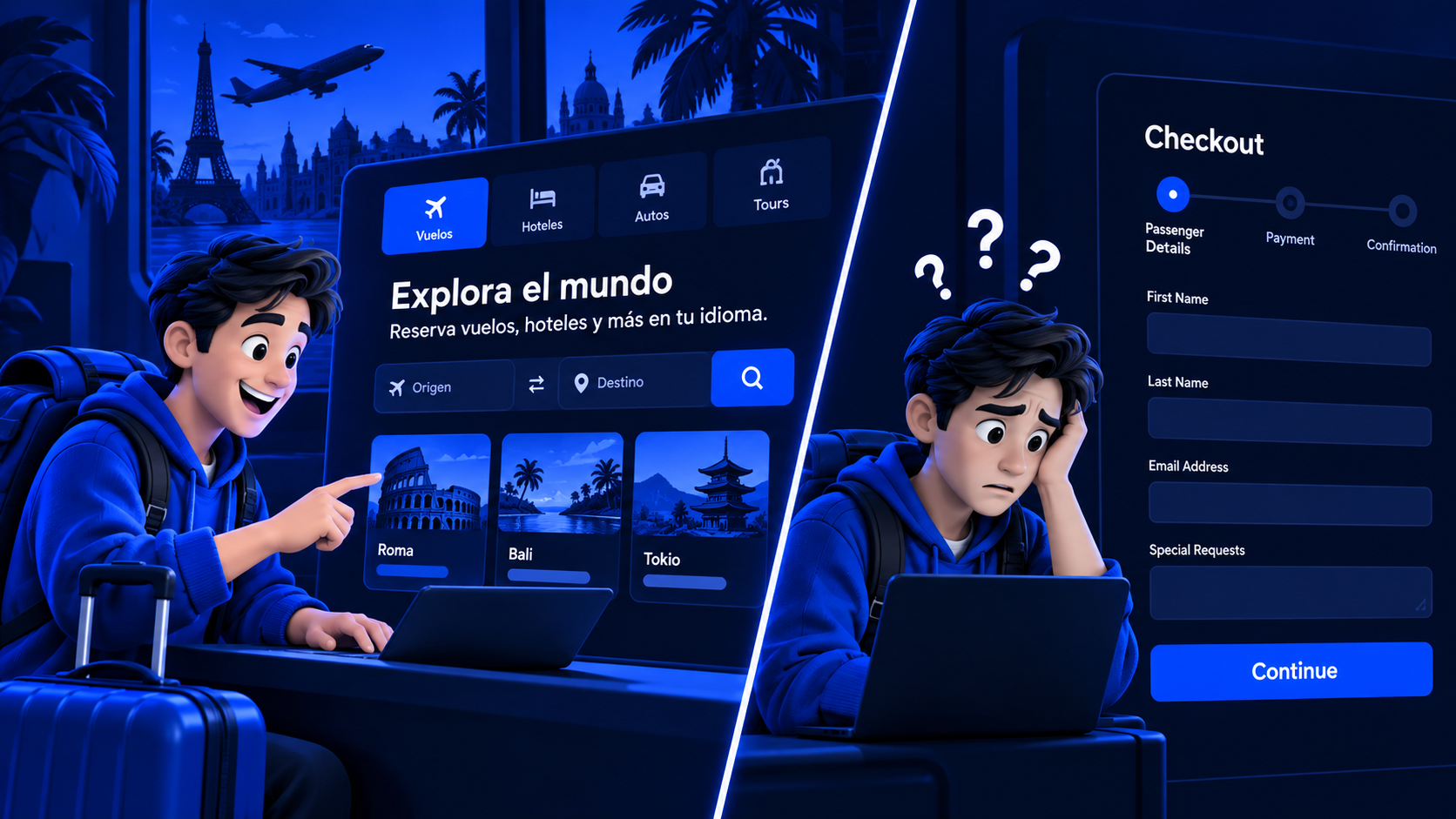
Language preference is not a soft branding preference. CSA Research’s Can’t Read, Won’t Buy – B2C study (8,709 consumers across 29 countries) reported that 76% prefer products with information in their own language, and 40% say they will never buy from websites in other languages (CSA Research media summary; Newswire write-up).
Travel purchases amplify that effect: high ticket size, complex rules, and low tolerance for ambiguity. A mixed-language funnel—localized hero, English checkout—often underperforms a consistent English funnel because it trains the traveler to expect localization that disappears at the moment of payment.
Common failure modes we see in agency stack reviews:
- Locale drops mid-funnel. Language is a cookie on page one, then forgotten on the payment return URL.
- Policies stay English. The room name is translated; cancellation terms are not.
- Emails ignore booking locale. The site was French; the voucher is English; WhatsApp support starts with confusion.
- B2B ignored. Sub-agents in a local market get an English-only portal and keep booking offline.
- RTL treated as a font change. Arabic text in an LTR form layout creates mis-clicks on date pickers and passenger forms.
If you already run multi-currency pricing, treat language as a sibling problem—not the same problem. Currency is about quote, settlement, and FX risk; language is about comprehension and trust. (For the FX side, see PHPTRAVELS’ related guide on multi-currency travel booking software—useful adjacent reading, different job-to-be-done.)
The locale persistence checklist (search → pay → voucher)
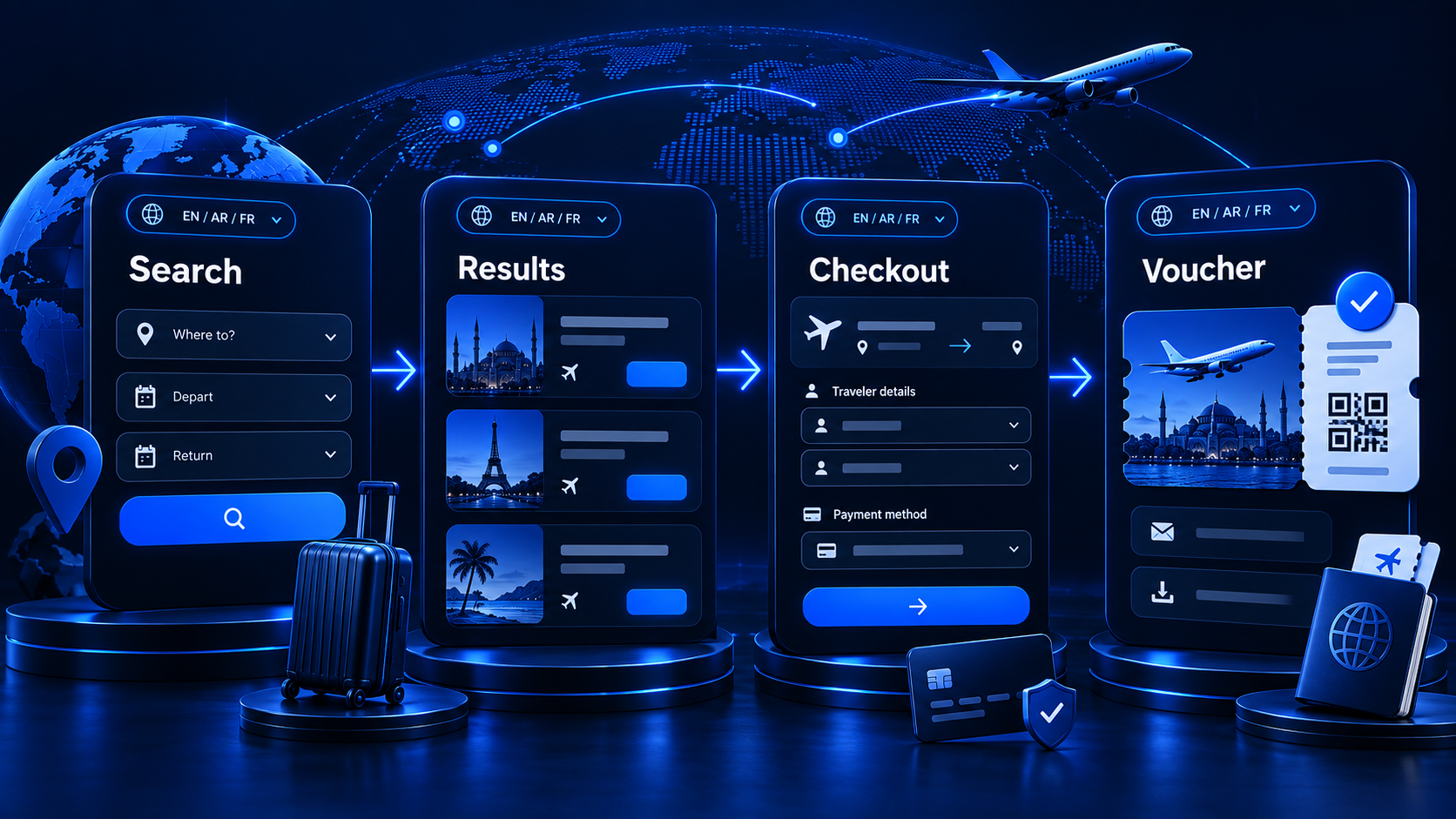
Before you buy or build, walk one live booking in each launch language with this checklist. Fail any row and you do not yet have multilingual booking software—you have a translated theme.
- Entry: Language chooser is obvious; optional Accept-Language suggestion does not force a wrong market.
- Persistence: Locale survives search, filters, hotel/tour detail, cart, login/register, and payment redirect return.
- Booking record: The chosen language is stored on the booking so ops and automations can reuse it.
- Formats: Dates, times, and number formats match the locale (DD/MM vs MM/DD mistakes create no-shows).
- Supplier strings: You know which fields are operator-translated vs raw supplier text; raw text is labeled or hidden when unsafe.
- Payments: Gateway and “payment failed” states are understandable; method names match what the traveler recognizes locally.
- Documents: Confirmation email, voucher/ticket, and invoice render in the booking language (or a documented fallback).
- Support: Agents see the booking locale in the back office so the first reply matches.
Currency note: Display currency can follow market, but settlement currency and gateway support are separate configuration. Do not hard-wire “language = currency”; a French UI can still quote EUR or USD depending on your rules.
B2B note: If you use agent credit, pay-later, or wallet balance, those labels and statements need translation too—otherwise sub-agents revert to spreadsheets.
RTL and bidirectional markets (Arabic, Urdu, Hebrew)
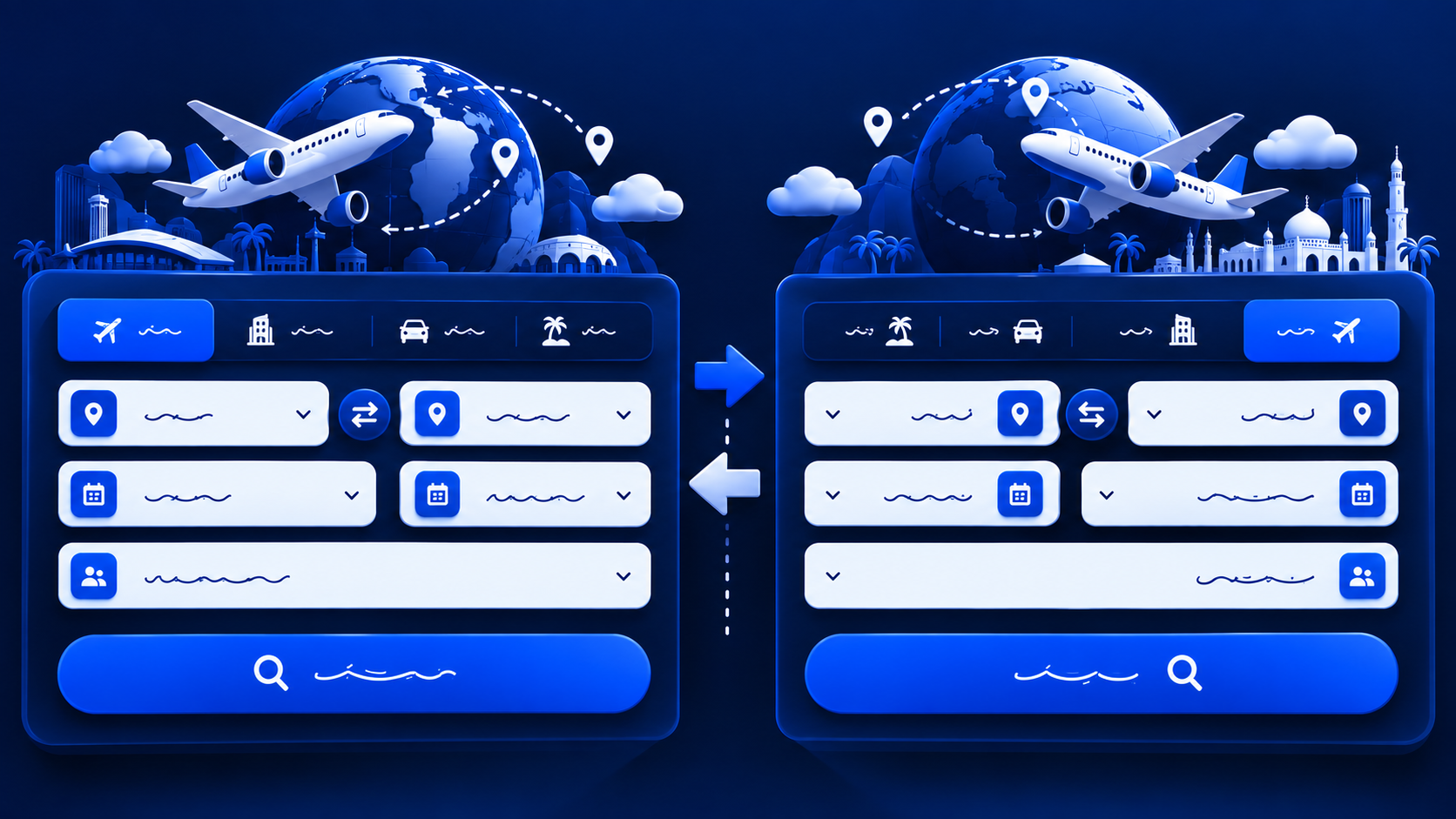
Right-to-left support is where many “multi-language” demos quietly fail. Translating strings into Arabic while leaving navigation, form alignment, and iconography in LTR produces a product that looks unfinished.
Practical RTL requirements for travel booking UI:
- Page
dir(and component-level direction where mixed content appears)—see W3C guidance ondir. - Mirrored layout for primary navigation, steppers, and checkout progress.
- Form fields and validation tooltips that do not overflow or cover the next control.
- Icons that imply direction (arrows, “back”) mirrored or replaced thoughtfully.
- Mixed strings (Arabic + Latin flight numbers / PNR codes) tested, not assumed.
PHPTRAVELS’ public positioning on pricing calls out multi-language and multi-currency with RTL and LTR compatibility. That is the right class of capability for Gulf and broader MENA launches—still verify the exact languages and themes you need on a live demo, because RTL quality is theme- and module-dependent.
SEO for multi-language travel sites without duplicate chaos

Localizing booking UI helps conversion; localizing indexable content helps acquisition. Google’s guidance on localized versions of your pages still centers on clear language/region targeting (including hreflang), consistent URLs, and avoiding sneaky redirects that trap crawlers in the wrong locale.
For travel sites specifically:
- Prefer language-prefixed paths (
/ar/,/fr/) or clear ccTLDs/subdomains—pick one strategy and stick to it. - Emit reciprocal
hreflang(andx-default) only for locales you actually publish and maintain. - Do not auto-generate thin destination pages in twenty languages with no editorial ownership; that creates duplicate-content and quality risk.
- Keep canonicals honest when two locales share near-identical thin templates.
- Remember that booking search result URLs are often noindex by design; invest SEO effort in destination, deal, and guide pages that feed the engine.
Multilingual SEO is an editorial and engineering partnership. Software that only swaps UI strings will not fix a thin-content strategy.
Operating model: who translates what, and how you ship updates
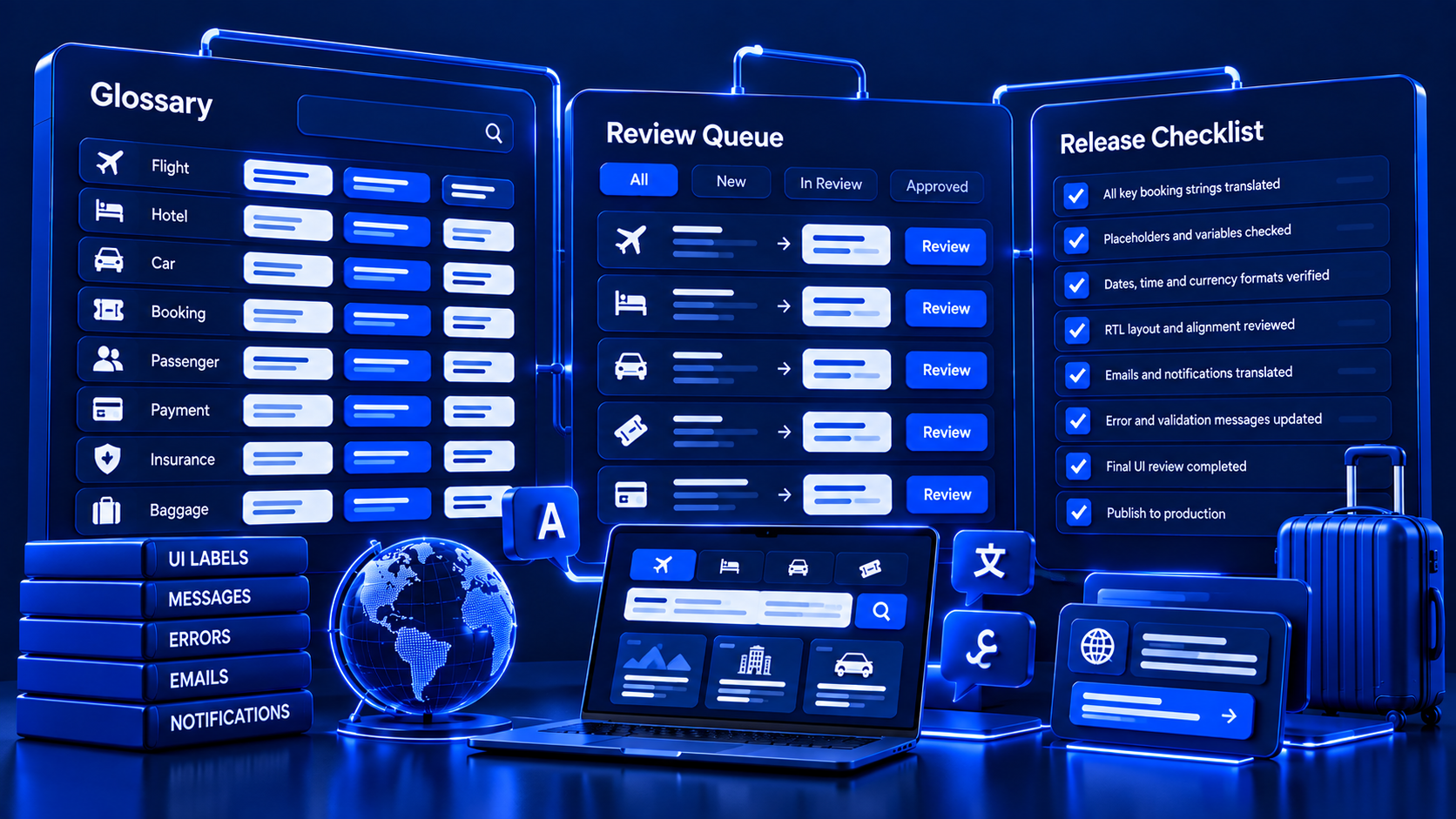
Technology fails when nobody owns the glossary. Travel has high-risk vocabulary: refundable vs non-refundable, cabin class names, allotment, no-show, schedule change, void vs refund.
A workable operating model for a mid-size agency:
- Freeze a launch set. Start with two or three languages tied to real demand—not a vanity list of twelve.
- Build a glossary. Approve translations for commercial terms before UI work begins.
- Tier the content. Tier A (checkout, fare rules summaries, emails/vouchers) gets human review. Tier B (destination fluff) can start with machine draft + light edit.
- Bind locale to releases. When you ship a platform update that adds UI strings, translation is part of QA—not a later ticket.
- Measure. Track conversion and support contact rate by booking language, not only by country IP.
Machine translation alone is a weak plan for an OTA. It can accelerate drafts; it should not be the only reviewer of cancellation language.
Where PHPTRAVELS fits (honest product fit)
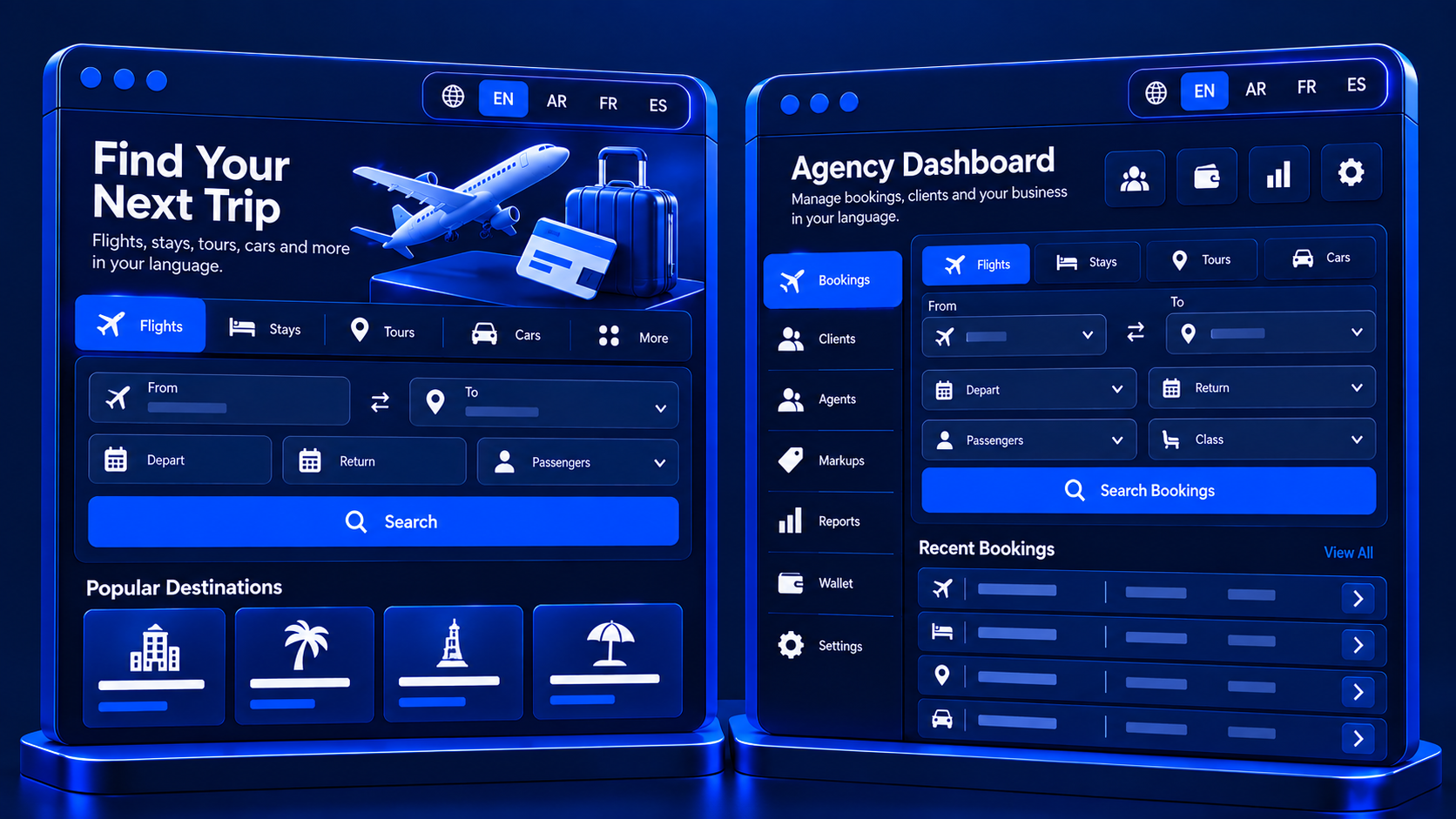
PHPTRAVELS is travel booking software: a licensed, installable (or managed) platform with booking modules (flights, stays, tours, cars, ferries, rail, eSIM, and more), supplier API connections, B2C storefront, B2B agent portal, back office, and payment handling through your gateway accounts. It is not a booking intermediary and does not take a cut of bookings. Buyers bring their own supplier contracts and API credentials—the software connects; it does not grant inventory. Details and current supplier lists live in the product skill and on integrations.
On multilingual specifically, the current product skill lists multi-language as a priced building block (published figure $500 USD one-time in the skill table—confirm on the pricing configurator because figures change). The pricing page also markets global readiness with multi-language, multi-currency, and RTL/LTR compatibility. That combination is the honest fit story:
- You want one stack for B2C and/or B2B, not a separate white-label fork per language.
- You need language capability alongside real booking modules and supplier connections.
- You accept that content quality (translations, glossary, SEO pages) is still your team’s job—the platform provides the multi-language capability; it is not a turnkey translation agency.
What not to expect from PHPTRAVELS (or any booking platform):
- Free airline/hotel inventory without your contracts
- Guaranteed automatic hreflang perfection for every custom landing page you invent
- “MIT / unrestricted public OSS” licensing language—the product ships source under a commercial licence; modification rights depend on plan (pricing FAQ)
If that matches your buying intent, start with a demo and a configured quote on pricing. If you only need a brochure site translated, a lighter CMS/translation layer may be enough—and that is a fair outcome.
A practical implementation roadmap
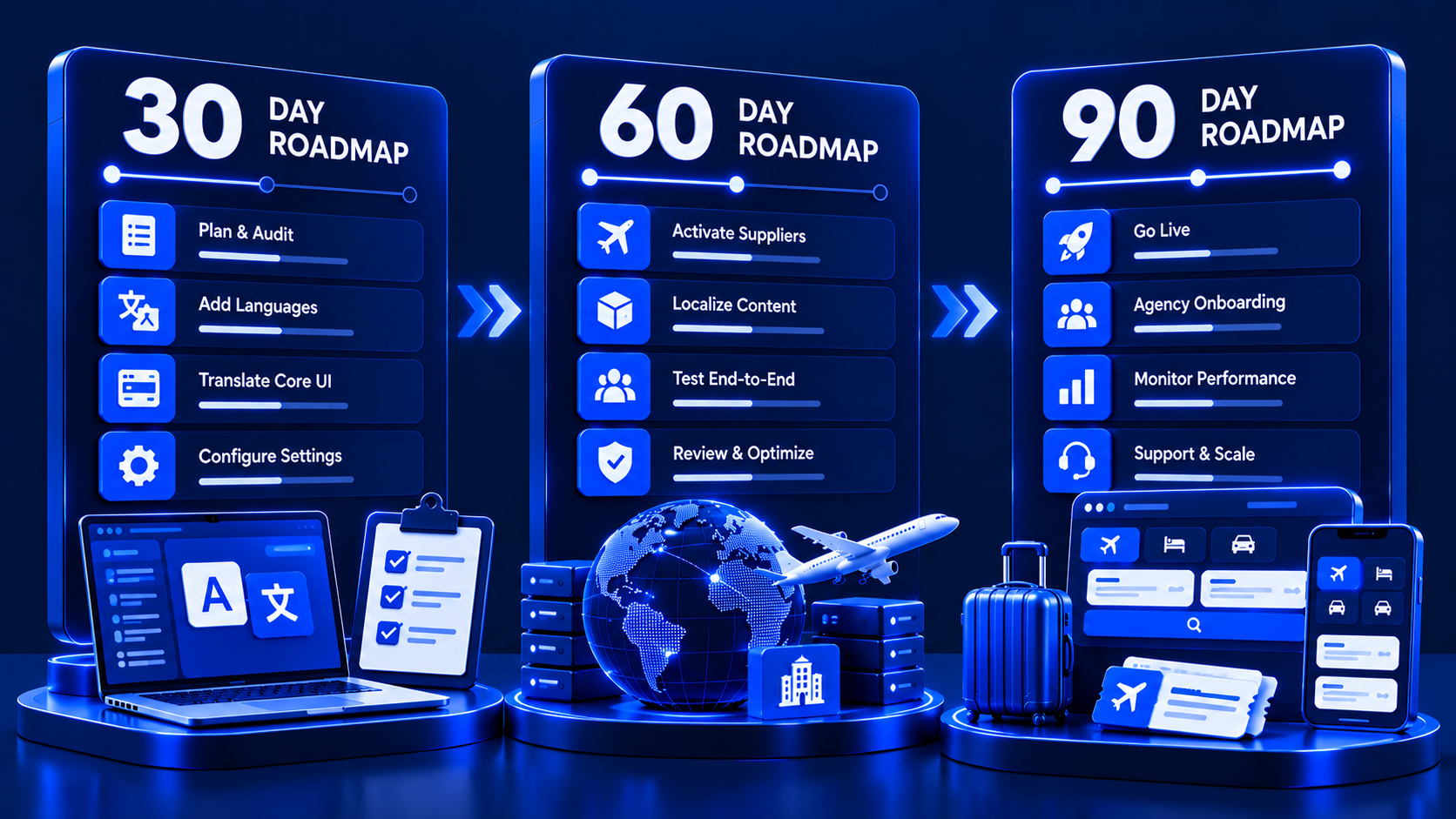
Days 1–14 — Audit and scope Pick launch languages from real traffic and sales data. Map the critical path in each language. List every email/voucher template. Decide B2C-only vs B2C+B2B for phase one.
Days 15–30 — Critical path localization Translate UI + Tier A commercial strings. Wire locale persistence through payment return. QA one full paid (or sandbox) booking per language. Fix RTL issues before marketing spend.
Days 31–60 — Documents, SEO, ops Localize vouchers/invoices. Add hreflang for the indexable pages you truly maintain. Publish the glossary. Train support to use booking locale.
Days 61–90 — Expand carefully Add the next language only when phase-one metrics look healthy. Expand catalog translations. Revisit supplier string strategy (what you overwrite vs display raw).
FAQ
Is multilingual the same as multi-currency?
No. Multilingual is comprehension and UI/content locale. Multi-currency is quote display, settlement, and FX operations. Mature platforms often offer both; they solve different failures.
Do I need a separate website per language?
Usually no. Prefer one booking core with locale-aware storefronts and clear URL strategy. Separate sites multiply supplier config, PCI surface, and reporting pain unless you have a strong multi-brand reason.
Can machine translation alone run our OTA?
It can draft. It should not be the sole owner of fare rules, cancellation text, or legal-adjacent vouchers. Budget human review for Tier A strings.
Does PHPTRAVELS include inventory in each language?
No. Inventory comes from your supplier contracts and APIs (or manual inventory you load). Language support affects how you present and complete bookings—not who supplies the rooms and seats.
Next step: If you are scoping a multi-language B2C or B2B launch on a licensed booking stack, book a PHPTRAVELS demo and configure modules on pricing. Bring your launch language list and one sample booking journey—those two artifacts make the conversation concrete.