

International travel businesses rarely operate in one currency from end to end.
A hotel may be contracted in one currency, an airline or other supplier may price in another, the customer may want to browse in a local currency, and the payment provider may settle funds into yet another currency. If those steps are treated as a simple “currency switcher” problem, the difference often appears later as an unexplained margin loss.
That is the real job of multi-currency travel booking software: not merely changing the symbol next to a price, but helping a travel business maintain a clear relationship between the price it displays, the amount it charges, the supplier cost it expects, and the amount eventually settled by its payment provider.
For an OTA, even a small mismatch can matter. The issue is not whether foreign exchange exists; international businesses cannot avoid that. The issue is whether the business knows where FX occurs, which rate is being used, when that rate is fixed, and who absorbs any difference.
A strong currency setup starts with those questions.
The FX Leak: How a Small Difference Can Cut Into OTA Margin

Consider a simplified hotel booking.
The following numbers are illustrative assumptions only. They are not current market exchange rates and are not intended to represent the pricing of any specific payment provider. For official reference rates, see the European Central Bank euro foreign exchange reference rates.
Assume:
- Supplier cost: USD 1,000
- – OTA target markup: 10%
- – Intended selling price: USD 1,100
- – Customer wants to pay in EUR
- – The booking platform uses an illustrative conversion rate of 1 USD = 0.90 EUR
The customer-facing price becomes:
USD 1,100 × 0.90 = EUR 990
At the moment the booking is priced, the expected economics are straightforward:
| Item | Amount |
| — | — |
| Supplier cost | USD 1,000 |
| Intended selling value | USD 1,100 |
| Intended gross margin | USD 100 |
| Displayed customer price | EUR 990 |
Now assume the EUR payment is later converted during settlement and, after the effective FX conversion involved in that payment path, the merchant receives the equivalent of USD 1,075.
Again, that figure is purely illustrative.
The booking economics have changed:
| Item | Amount |
| — | — |
| Supplier cost | USD 1,000 |
| Intended revenue | USD 1,100 |
| Effective settled value | USD 1,075 |
| Effective gross margin | USD 75 |
The business expected USD 100 of gross margin and effectively ended up with USD 75.
That is a 25% reduction in the expected gross margin on that booking, even though the customer paid exactly what the checkout displayed.
Nothing necessarily looks broken from the customer’s perspective. The card payment succeeds. The reservation is confirmed. The issue may only become visible when finance reconciles bookings against gateway settlements and supplier obligations.
This is the core OTA FX margin problem.
The mistake is usually not “supporting EUR.” The mistake is treating these as if they were the same thing:
- Display currency
- – Transaction currency
- – Internal pricing currency
- – Supplier currency
- – Settlement currency
They can be the same, but they do not have to be.
A booking might look like this:
Supplier cost: USD
Internal pricing: USD
Customer display: EUR
Customer charge: EUR
Gateway settlement: GBP
Merchant bank: GBP
That path contains more than one place where currency economics can change.
A well-designed multi currency booking engine should therefore make the currency path understandable. It cannot guarantee what a bank, card network, gateway or acquiring partner will ultimately charge or settle, but the travel business should at least know which amounts and currencies it is sending into that process.
Why a Single-Currency Admin Model Fails as an OTA Goes Global

Single-currency administration is attractive because it is simple.
If every supplier, customer, payment and bank account uses USD, reconciliation is relatively easy. But once a travel business expands internationally, a single-currency assumption tends to push complexity outside the booking system rather than removing it.
Suppose an OTA keeps all prices in USD.
A customer in the UK sees USD 742.
A customer in France sees USD 1,185.
A customer in the UAE sees USD 529.
The system technically works, but the customer must perform the currency conversion mentally or through another service before deciding whether the price is competitive.
That creates friction during the exact stage where customers are comparing options.
The obvious response is to add a currency selector. But visual conversion alone is not enough. A serious multi-currency setup needs to distinguish the following concepts.
Base or internal currency is the currency the business uses as a reference for pricing or reporting.
Supplier currency is the currency in which a supplier contract or rate is denominated.
Display currency is the currency shown to the visitor during search, product selection and checkout.
Transaction currency is the currency submitted to the selected payment method.
Settlement currency is the currency the merchant ultimately receives through its own payment and banking arrangements.
Those distinctions matter because an OTA is often dealing with several parties simultaneously.
A customer may want to see GBP while the supplier contract is in EUR and the OTA internally evaluates margin in USD. The payment provider may allow the customer to be charged in GBP but settle the merchant in USD.
The booking platform does not control every step in that chain.
The gateway, acquiring bank, card network, merchant account and customer bank may each have their own currency support, conversion rules and fees. Those details vary by provider, account, jurisdiction and commercial agreement.
This is why a single admin currency should not be confused with a single-currency business.
It can still be useful to have one internal reference currency. What fails is assuming that the same currency should automatically be used for customer display, payment and settlement in every market.
As an OTA grows, unclear currency rules also create operational problems:
- Customer service sees one value while finance sees another.
- – Refund amounts become difficult to explain.
- – B2B agents may calculate margins outside the platform.
- – Finance teams build manual spreadsheets to reconstruct conversions.
- – Management may evaluate profitability using booking values that do not match effective settlement values.
The objective is not to make every number identical. It is to make the relationship between the numbers explicit.
How Multi-Currency Display and Payment-Gateway Settlement Should Work
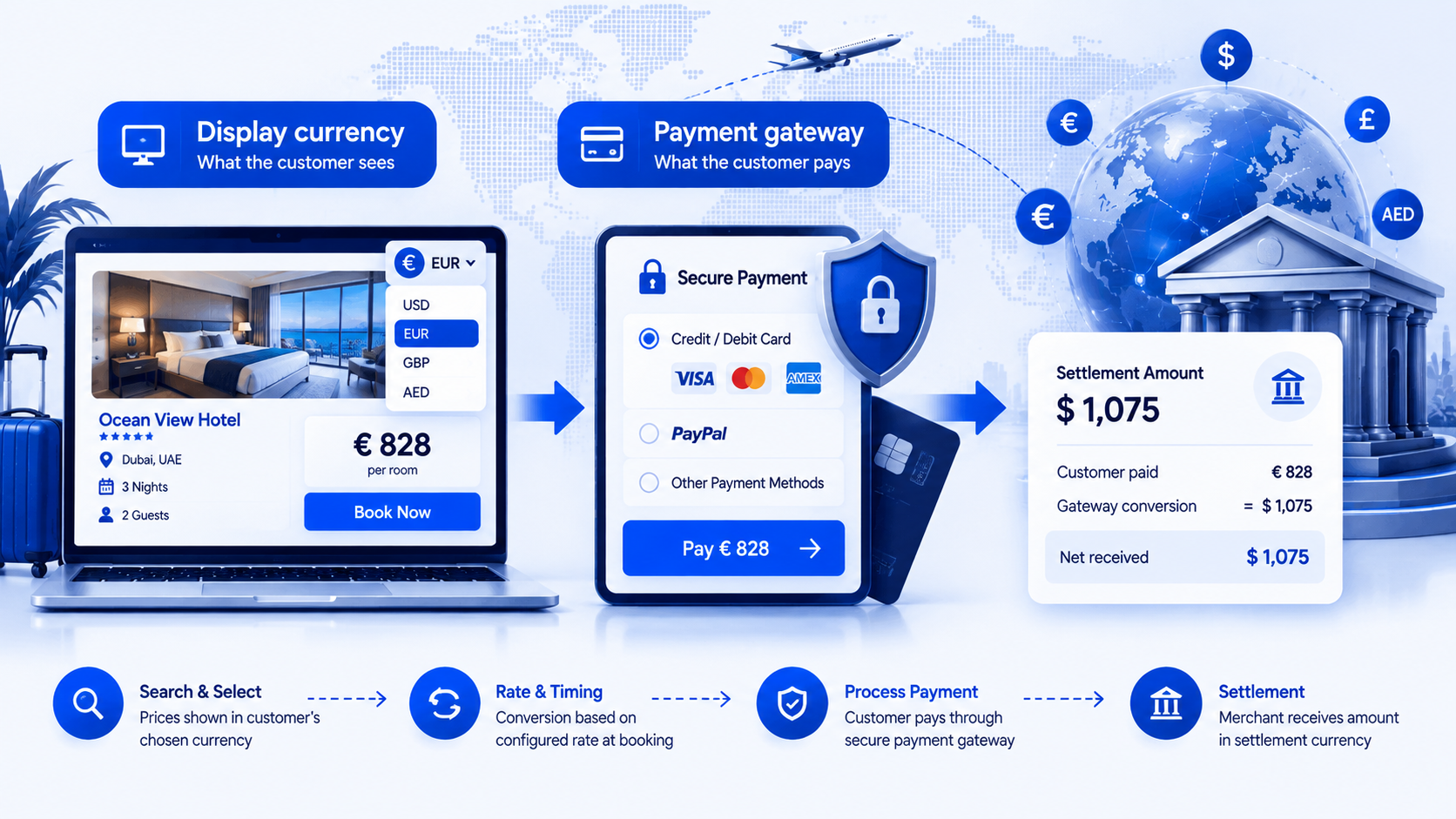
Multi-currency pricing and payment settlement should be designed together, but they should not be treated as the same process.
Imagine a travel product with an internal selling value of USD 920.
For illustration, assume the platform converts it for display using:
1 USD = 0.90 EUR
The customer sees:
USD 920 × 0.90 = EUR 828
From there, several payment models are possible.
Charge in the customer’s display currency
The customer sees EUR 828 and the gateway is asked to process EUR 828.
This is usually the easiest flow for the customer to understand because the checkout currency matches the price shown during shopping.
But the merchant still needs answers to several questions:
- Can its payment account accept EUR transactions?
- – Will the payment provider settle those funds in EUR?
- – If not, which currency will be used for settlement?
- – Where does conversion happen?
- – What fees or FX spread may apply?
- – Does the merchant need a corresponding bank account?
- – Are there country or compliance restrictions?
Those answers come from the merchant’s own payment-provider agreement and account configuration, not from the booking software alone.
Display one currency but charge another
An OTA may choose to show an indicative local-currency price but process the final transaction in its primary transaction currency.
For example:
Displayed: EUR 828
Charged: USD 920
This can simplify certain merchant arrangements, but the checkout must make the distinction clear.
Otherwise the customer may reasonably expect to be charged EUR and instead discover a USD transaction on the payment page or card statement. The customer’s bank may then perform its own conversion.
Charge and settle in the same currency
Some businesses may maintain payment and banking arrangements that allow a transaction to remain in the same currency from customer charge to merchant settlement.
For example:
Customer pays: EUR
Gateway processes: EUR
Merchant receives: EUR
That can reduce unnecessary conversion in some setups, particularly where the business also has EUR-denominated costs.
But it is not something a booking platform should promise. Whether it is possible depends on the merchant’s payment provider, account type, country, supported currencies, bank accounts and commercial terms.
PHPTRAVELS supports payment options including Stripe, PayPal, Adyen, Cashfree, Paystack, Flutterwave and MyFatoorah, among others, through the merchant’s own accounts.
That distinction matters: PHPTRAVELS is not the merchant of record. The travel business maintains its own payment-provider relationships.
Gateway availability, supported transaction currencies, fees, settlement currencies, payout rules, compliance requirements and geographic availability must therefore be confirmed directly for the buyer’s specific account and market.
A multi-currency booking system can structure the booking and payment request. It cannot guarantee the economics of the external settlement process.
A Practical Framework for Display Currency, Settlement, Rates and B2B vs B2C
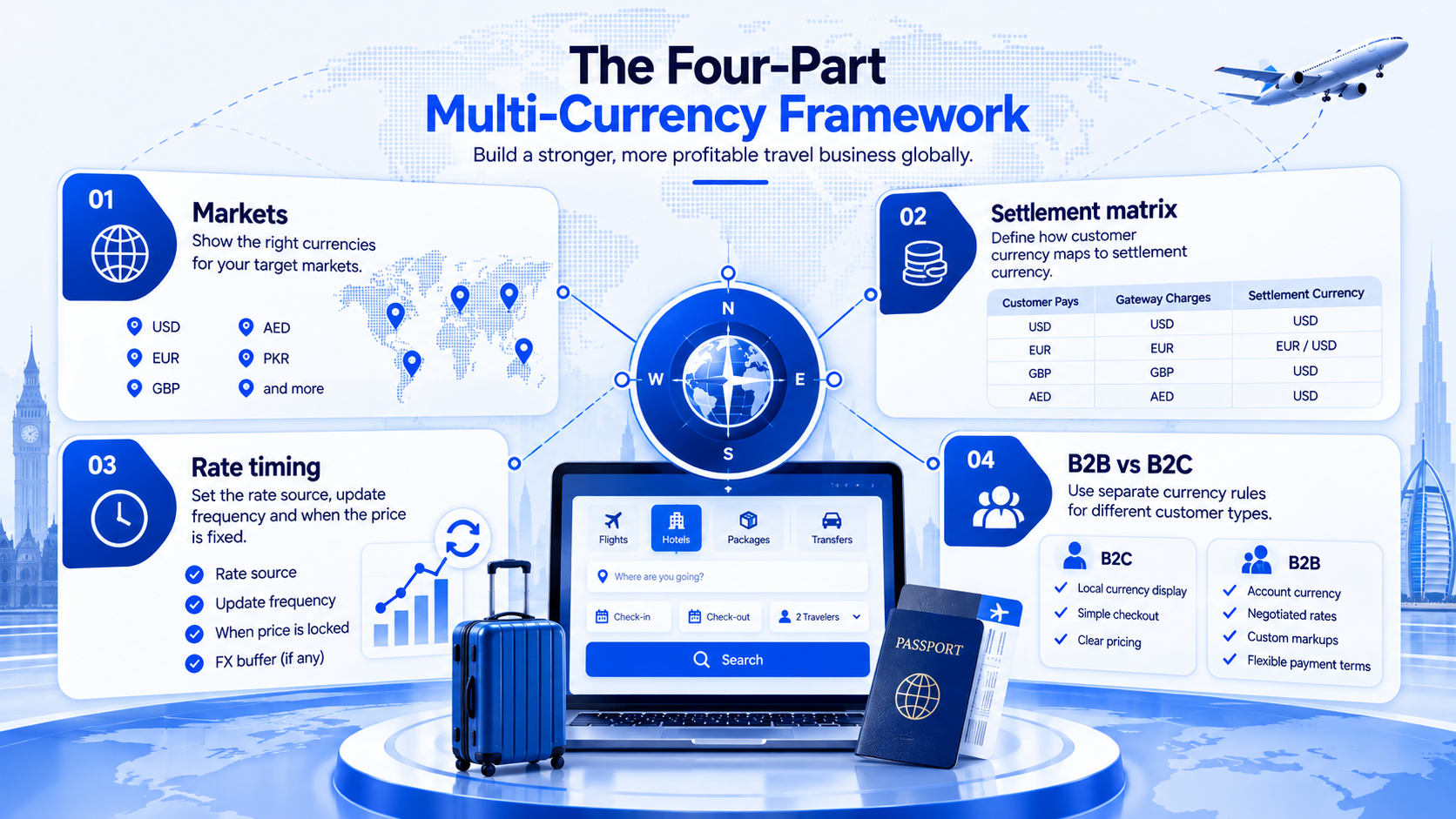
Before enabling a long list of currencies, define how your business intends to use them.
A useful framework has four parts.
1. Decide which currencies customers actually need
Do not begin with “How many currencies can the software display?”
Begin with “Which currencies matter to our customers?”
An OTA targeting the US, UK, Eurozone and UAE may decide to prioritize:
- USD
- – GBP
- – EUR
- – AED
Another agency may need a completely different mix.
Supporting currencies that have little commercial relevance creates additional testing and operational complexity without necessarily improving conversion.
For every enabled currency, test:
- Search results
- – Product pages
- – Taxes and fees
- – Markups
- – Checkout
- – Confirmation pages
- – Emails or booking documents
- – Cancellations
- – Full and partial refunds
The important point is consistency.
2. Map transaction currency to expected settlement currency
Create a simple matrix before launch.
For example:
Customer Display | Customer Charge | Expected Settlement
USD | USD | USD
EUR | EUR | EUR or merchant-account currency
GBP | GBP | Merchant-account currency
AED | AED | Merchant-account currency
The values in the third column must be confirmed against the merchant’s real payment setup.
Do not assume that because a gateway accepts a currency at checkout it will also settle the merchant in that currency.
Those are different capabilities.
The same applies to fees. A merchant may face transaction fees, cross-border fees, currency-conversion costs or other charges depending on the provider and account.
Your travel platform should not be used as a substitute for checking those commercial terms.
3. Define the exchange-rate source and timing
Currency conversion requires an explicit rate policy.
At minimum, decide:
- What rate source is used for displayed conversions?
- – How often is that rate refreshed?
- – At what point is the customer’s price fixed?
- – Is any commercial FX buffer added?
- – What happens if the supplier price changes before confirmation?
- – What exchange rate is retained with the booking for later reference?
Timing matters because travel shopping is not instantaneous.
A customer may search at 10:00, return to checkout at 10:20 and complete payment later. Meanwhile, a supplier price or the platform’s currency rate may have changed.
Your system needs a defined rule for when a displayed conversion becomes a committed selling price.
For reconciliation, it is also useful to retain the values that explain the booking calculation.
Conceptually, that might include:
Supplier cost: USD 800
Internal selling value: USD 920
Display currency: EUR
Rate used at pricing: 0.90
Displayed amount: EUR 828
Transaction currency: EUR
Transaction amount: EUR 828
That does not guarantee what the payment provider ultimately settles, but it gives finance a reliable record of what the booking engine intended.
4. Separate B2C and B2B currency policy
B2C and B2B are commercial models, not merely different login types.
A retail customer generally wants simplicity:
- Search.
- 2. See an understandable price.
- 3. Pay.
- 4. Receive confirmation.
A B2B travel relationship may involve additional rules such as negotiated rates, agent-specific markups, credit arrangements or account-based pricing.
Currency decisions should therefore be defined separately for each model.
For example, a B2C customer may browse and pay in EUR while the business evaluates margin internally in USD.
A B2B partner may instead have an agreed commercial currency used consistently across quotations and bookings.
Neither approach is universally correct.
The right policy depends on supplier agreements, agent relationships, payment arrangements and accounting practices.
The important principle is to avoid allowing each booking or agent to improvise the currency logic manually.
Where PHPTRAVELS Fits

PHPTRAVELS provides genuine multi-currency capability within licensed, self-hosted travel booking software.
It is not a free SaaS service. The software is deployed for the buyer’s travel business, while commercial relationships with payment providers and travel suppliers remain the buyer’s responsibility.
For companies evaluating multi-currency travel booking software, that separation is important.
PHPTRAVELS can provide the booking-software layer where currency presentation and booking flows are configured, but it should not be confused with the financial institutions processing or settling the payment.
Payment options include providers such as:
- Stripe
- – PayPal
- – Adyen
- – Cashfree
- – Paystack
- – Flutterwave
- – MyFatoorah
These work through the merchant’s own accounts.
Actual gateway availability can vary by country, merchant type and account. Supported currencies, transaction fees, settlement currencies, payout schedules and compliance requirements must be verified directly for the buyer’s account and target market.
The same principle applies on the supply side.
A buyer needs its own supplier contracts. PHPTRAVELS should not be treated as a promise that a particular inventory supplier, rate or commercial agreement is automatically included.
That matters when designing multi-currency operations because the supplier contract determines the real cost currency against which OTA margin must ultimately be measured.
A useful way to assess the platform is to start with your actual transaction map:
Supplier contract currency
↓
Internal booking price
↓
Customer display currency
↓
Checkout transaction currency
↓
Payment provider
↓
Merchant settlement currency
Then test that flow using your planned markets, providers and commercial agreements.
You can review the booking environment through the PHPTRAVELS demo and check current licensing information on the PHPTRAVELS pricing page.
The goal is not to find software that claims to make FX disappear. It is to use a booking system that supports a clear multi-currency customer experience while your business deliberately manages the financial relationships around it.
The Cost of Waiting—and a Multi-Currency Implementation Checklist

Currency problems tend to become more expensive with volume.
Assume, purely for illustration, that an OTA processes USD 500,000 equivalent in international booking value per month.
Now assume pricing, FX and settlement differences create an additional effective margin loss equal to 0.5% of booking value.
This is not an industry benchmark. It is simply a worked assumption.
The impact would be:
USD 500,000 × 0.5% = USD 2,500 per month
Across 12 months:
USD 2,500 × 12 = USD 30,000
The exact percentage is not the point.
Your actual number may be higher, lower or effectively zero depending on your pricing policy and financial setup.
What matters is multiplication.
A currency process that appears insignificant at 20 bookings a month can become material at 2,000 bookings a month.
There is also a hidden administrative cost.
Poor currency architecture leads to questions such as:
- Why does the booking value not match the gateway payout?
- – Which rate was used for this reservation?
- – Why did this refund differ from the original converted amount?
- – Why is finance calculating a different margin from the sales team?
- – Was FX applied by the booking platform, gateway, bank or card issuer?
- – Which amount should management use when measuring profit?
Those are not purely accounting questions. They are signs that the transaction path has not been documented clearly enough.
Before launching or expanding multi-currency sales, use this checklist:
- Define the primary internal or reference currency.
- – Document the contract currency used by each supplier relationship.
- – Choose display currencies based on real customer markets.
- – Confirm which currencies each payment account can actually process.
- – Confirm the settlement currencies available to your merchant account.
- – Check payment fees and any relevant FX or cross-border charges.
- – Identify exactly where currency conversion may occur.
- – Define the exchange-rate source used for customer-facing prices.
- – Define how frequently rates are refreshed.
- – Decide when a displayed rate becomes a committed booking price.
- – Decide whether any FX buffer is part of your commercial pricing policy.
- – Record the conversion rate used for confirmed bookings where operationally appropriate.
- – Define B2C currency rules.
- – Define B2B currency rules separately if your business operates both models.
- – Define cancellation and refund handling before launch.
- – Test full refunds.
- – Test partial refunds.
- – Test payment failures and retries.
- – Test price changes between search and booking.
- – Compare test booking values with real gateway transaction and settllllllement reports.
- – Document who in finance owns reconciliation of currency differences.
- – Recheck gateway currency availability and compliance when entering a new country or market.
The most useful test is simple: pick one real booking and ask someone in finance to explain every amount from supplier cost through customer payment to final settlement.
See the PHPTRAVELS demo and PHPTRAVELS pricing for a multi-currency travel booking software rollout.
If the path cannot be reconstructed clearly, the currency architecture still needs work.
For OTAs, multi-currency travel booking software connects local pricing with payment and settlement controls.
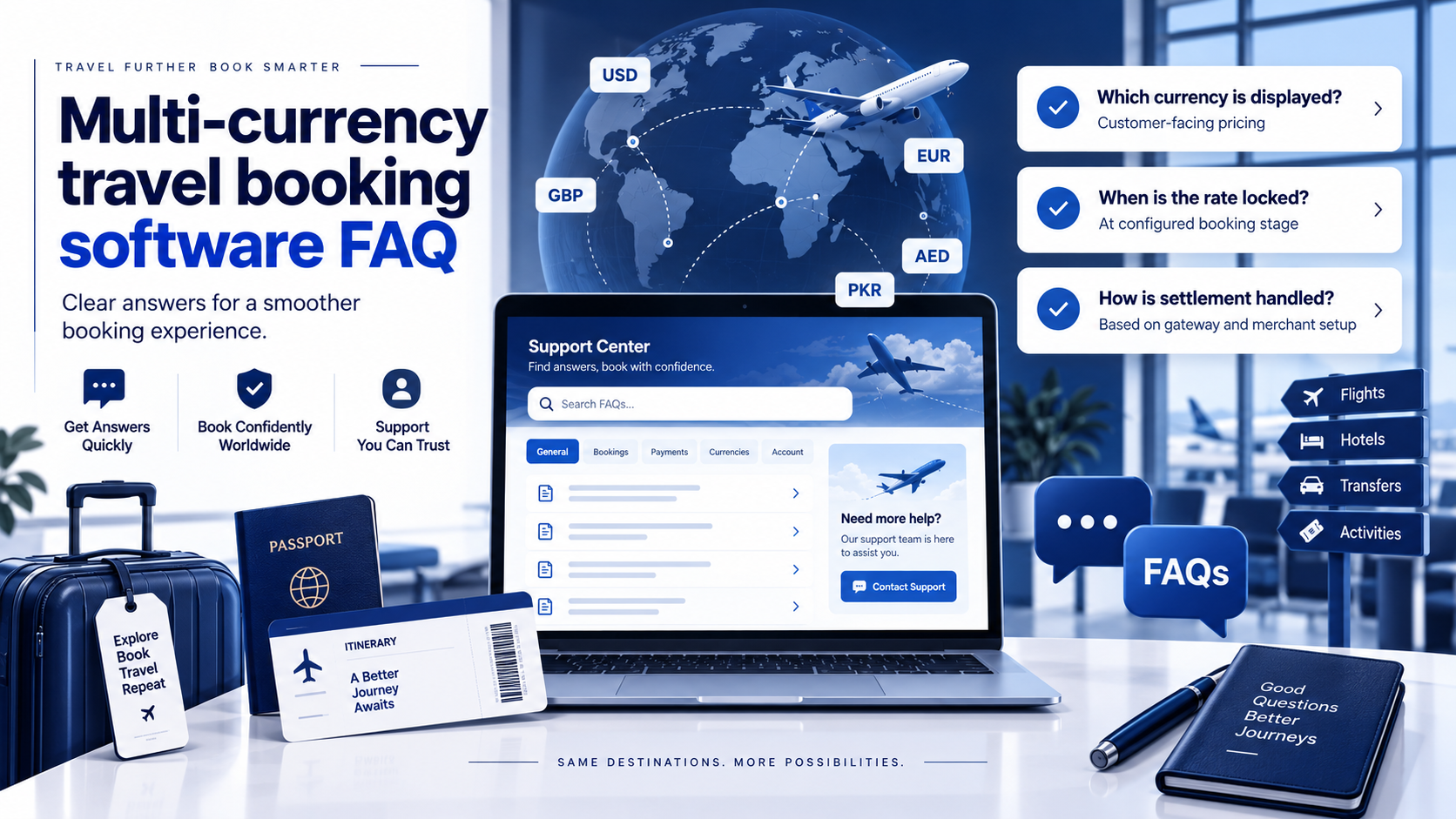
Frequently Asked Questions
What is multi-currency travel booking software?
Multi-currency travel booking software allows a travel business to present and manage booking prices across more than one currency.
A practical implementation should distinguish customer display currency from transaction, supplier and settlement currencies rather than assuming that every part of the booking uses the same currency.
Is a currency selector the same as a multi currency booking engine?
Not necessarily.
A currency selector can simply convert visible prices.
A more complete multi currency booking engine also needs a defined policy for how converted prices are calculated, when rates are updated, what amount is sent to the payment flow, and how those figures are stored for booking and reconciliation purposes.
Can multi-currency software prevent FX losses?
It can help a business control and understand its pricing process, but it cannot eliminate or guarantee external FX outcomes.
Banks, payment gateways, card networks and other financial providers may apply their own fees, conversion methods and settlement rules.
The merchant should verify those terms directly.
Should the display currency match the settlement currency?
Not always.
A customer can potentially pay in one currency while the merchant is settled in another, depending on the payment provider and merchant account.
The important point is to know that conversion exists and account for it in the commercial model.
Does PHPTRAVELS provide payment merchant accounts?
No. PHPTRAVELS works with payment options such as Stripe, PayPal, Adyen, Cashfree, Paystack, Flutterwave and MyFatoorah through the merchant’s own accounts.
Availability, currencies, fees, settlement arrangements and compliance requirements must be confirmed for the individual merchant account and market.
Does PHPTRAVELS provide supplier contracts?
The buyer needs its own supplier contracts.
Those contracts matter to currency planning because they determine the actual commercial cost and currency against which booking margin is calculated.
What should an OTA review first?
Start with one transaction from end to end:
supplier currency → internal price → display currency → transaction currency → settlement currency.
Then document which party controls each conversion.
That exercise usually reveals where the real FX exposure sits.
International travel will always involve currency complexity. The objective is not to eliminate it. It is to stop allowing FX to become an unexplained deduction from margin.
A good multi-currency setup gives customers prices they can understand while giving the travel business a clear view of how those prices relate to costs, payments and settlements.
That is where multi-currency travel booking software provides real value: not by promising a particular exchange rate or financial outcome, but by giving the booking operation a structured currency layer around which the OTA can build a deliberate pricing and payment strategy.