

Connecting more travel suppliers can increase choice, improve availability, and help an OTA compete across more markets. It can also create a less obvious problem: every new supplier introduces another pricing structure that your agency must turn into a profitable selling price. That is where travel markup management software becomes important. A modern OTA may receive flight fares from several APIs, hotel rates from multiple wholesalers, direct contracted inventory, tours from another provider, and car inventory from yet another source. Those suppliers do not necessarily return prices, taxes, fees, commissions, currencies, or commercial terms in the same way. If the agency simply applies one percentage to everything, the result may look simple in the admin panel while hiding inconsistent margins underneath. The objective is not to charge the highest markup possible. It is to build a pricing structure that is predictable, commercially sensible, and flexible enough to handle different suppliers, products, channels, agents, and markets.
The Booking Looked Profitable—Until Someone Checked the Numbers
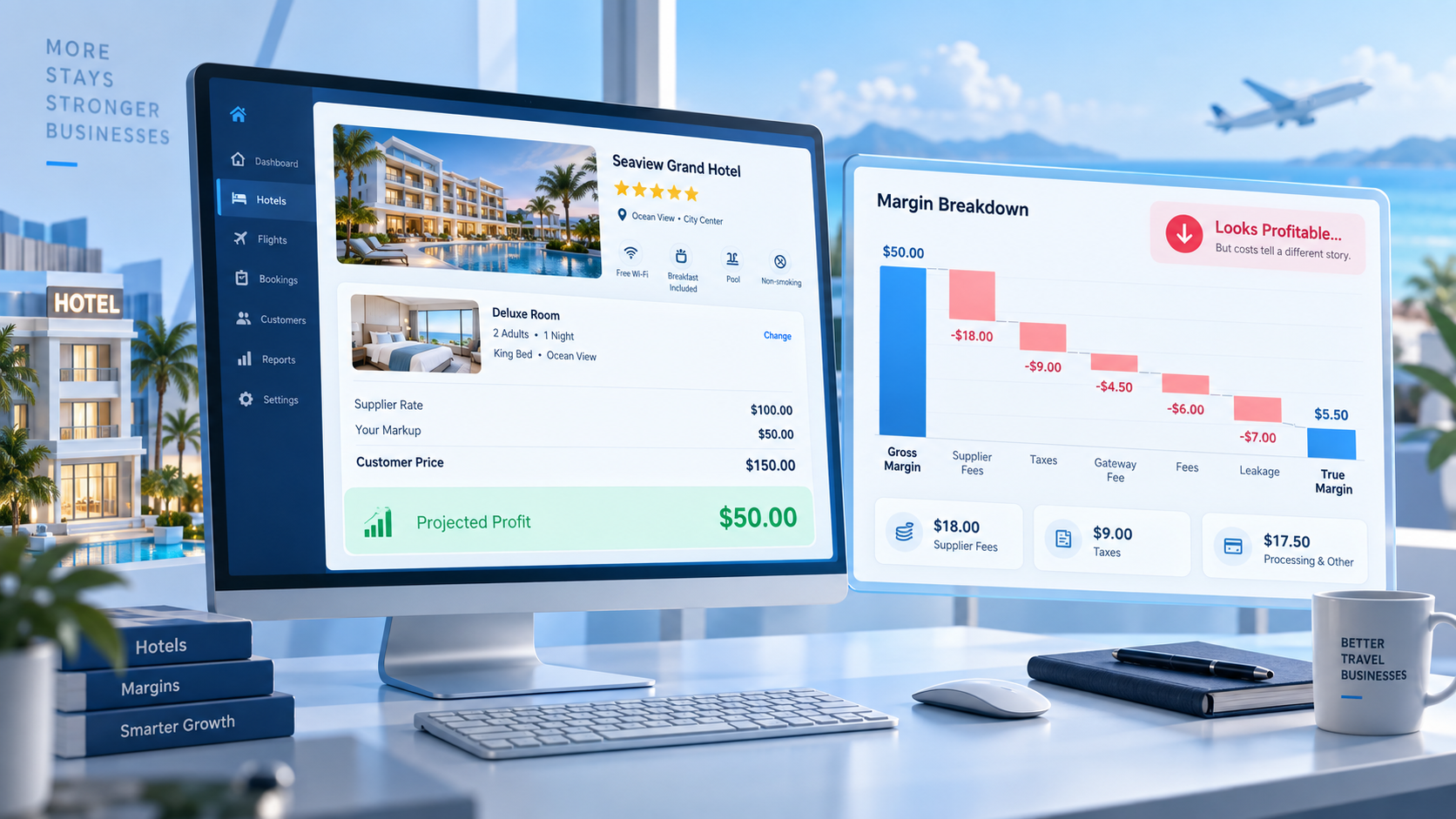
Consider a simplified hotel booking. A supplier returns a net rate of $500. The OTA applies an 8% markup and displays the hotel to the traveler for $540. At first glance, the agency appears to have created $40 of gross margin. But that number does not answer several important questions. Was the supplier rate really net, or did it include a commission structure? Are taxes included? Will the customer pay in the same currency as the supplier settlement? Is the booking being sold through the agency’s direct B2C website or through a B2B sub-agent? Does the sub-agent need its own resale margin? Will payment processing costs affect the economics of the transaction? Is a promotional discount also being applied? Now imagine that same logic across thousands of search results from several suppliers. The problem becomes larger with flights. One source may return a fare through a GDS, another through an NDC connection, and another through a consolidator or specialist flight API. Even when two options look similar to the traveler, their underlying economics may be different. The agency therefore needs to separate supplier price from selling-price logic. That is the real purpose of travel markup management software. It creates a controlled layer between the price received from a supplier and the price presented to a customer or agent. A markup should be a business rule, not an improvised number entered after a booking request arrives.
Why One Global Markup Stops Working as an OTA Grows

A small travel agency can sometimes operate with a straightforward pricing model: obtain a rate, add a margin, send the quote. An OTA operating across supplier APIs cannot rely on that approach indefinitely. The first problem is supplier diversity. A flight supplier, hotel bedbank, direct hotel contract, activity provider, and car supplier may all have different commercial structures. Applying exactly the same percentage to each source can produce very different outcomes. The second problem is channel diversity. A B2C customer buying directly from your website has a different commercial relationship with your company than a B2B travel agent who intends to resell the booking. The B2B agent may need enough room to add its own margin, while your agency still needs to protect its wholesale profit. This is why travel agency commission and markup should not automatically be treated as the same thing. A markup is generally an amount your business adds to a base or net price. A commission is generally remuneration associated with a sale or distribution relationship. Depending on the supplier and commercial model, an agency might work with one, the other, or a combination of both. The third problem is context. A pricing rule that works for a hotel booking may not make sense for a flight. A percentage that works on a short-haul fare may produce an unsuitable result on an expensive long-haul itinerary. A fixed amount that works for an economy booking may be inappropriate for a premium itinerary.
There are also competitive considerations. If your B2C flight markup makes every fare visibly more expensive than comparable channels, conversion can suffer. If your markup is too low, the agency may generate significant booking volume without enough contribution to support sales, payment, servicing, cancellations, and post-booking operations. The issue is therefore not simply, “What percentage should we add? The better question is: Which pricing rule should apply to this supplier, product, channel, customer, market, and booking context? That is the foundation of an effective OTA pricing engine.
What Is Changing in Travel Pricing and Distribution in 2026?
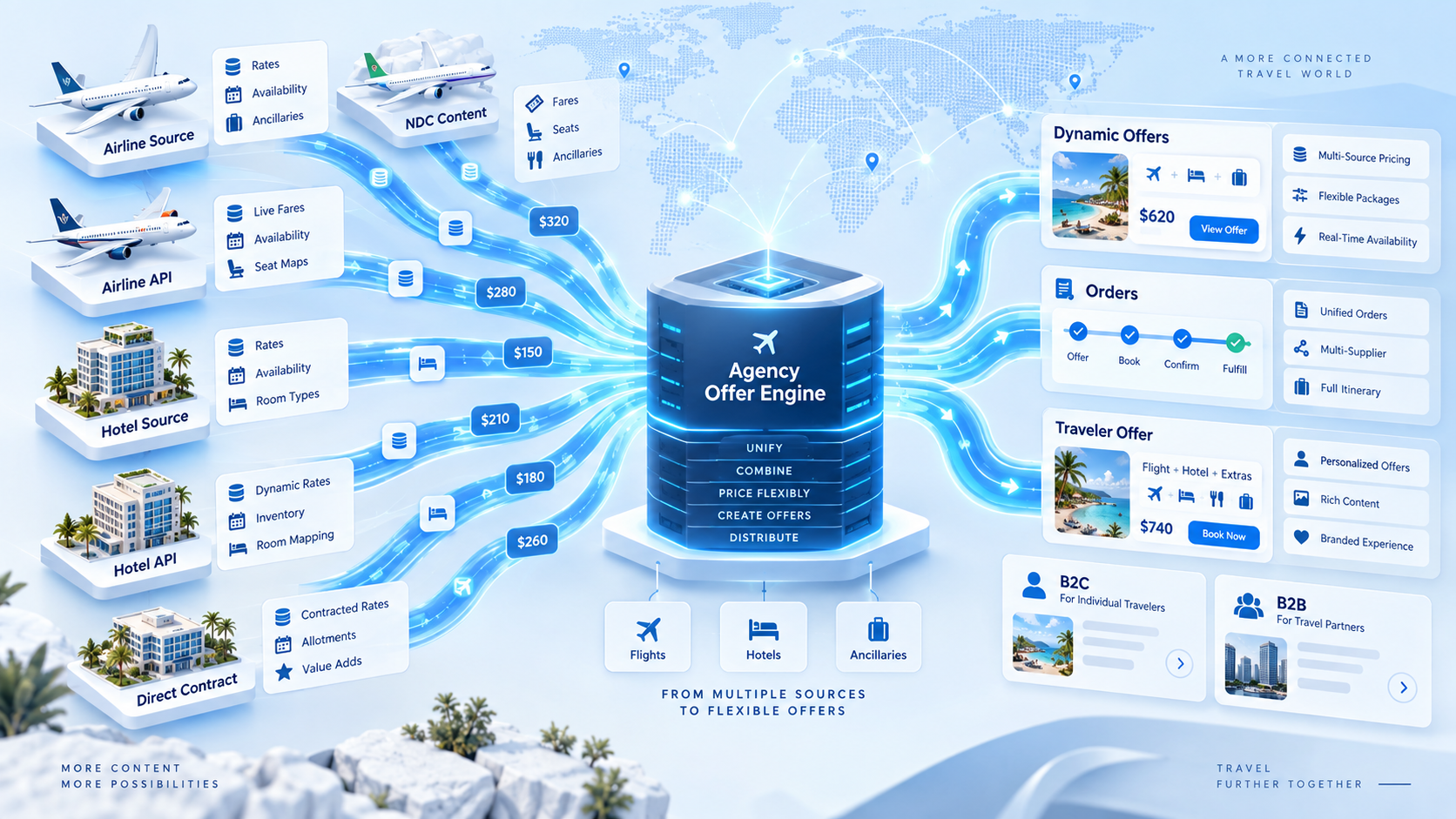
Travel distribution is moving toward a world in which offers are increasingly dynamic rather than static. In air distribution, IATA’s Modern Airline Retailing work continues to push the industry toward Offers and Orders, with NDC supporting richer and more flexible airline retailing through indirect channels. Dynamic offer creation also increases the importance of processing live pricing correctly throughout shopping and booking rather than assuming that every supplier behaves like a traditional static fare feed.
For OTAs, this means supplier connectivity is only part of the technology problem. Once an agency can search multiple sources, it still needs to decide what to sell, at what price, and under which commercial rule. At the same time, comparison is becoming easier for travelers. Search engines, metasearch, large OTAs, airline and hotel direct channels, and increasingly AI-assisted travel discovery make it easier for a customer to compare options. Recent industry analysis has consequently focused less on whether AI instantly removes OTAs from the market and more on the pressure increased comparison and new discovery channels can place on OTA economics and margins. That makes margin discipline more important, not less. There is also a growing difference between having access to inventory and retailing inventory effectively. Suppose an agency connects three flight sources. The technical achievement is being able to search and book all three. The commercial achievement is being able to normalize those results, apply the right supplier API pricing rules, preserve the economics of each channel, and still show a competitive final price.
The same principle applies to hotels. One hotel API might give your agency strong rates in Dubai while another is more competitive in London. A direct contract may outperform both for a particular property group. Your pricing layer needs enough flexibility that adding a new source does not force you to redesign the entire business model. In 2026, the competitive question is increasingly not “How many APIs have you connected? It is “How intelligently can you operate the inventory you have connected?
How to Build a Travel Markup Rule Framework That Scales
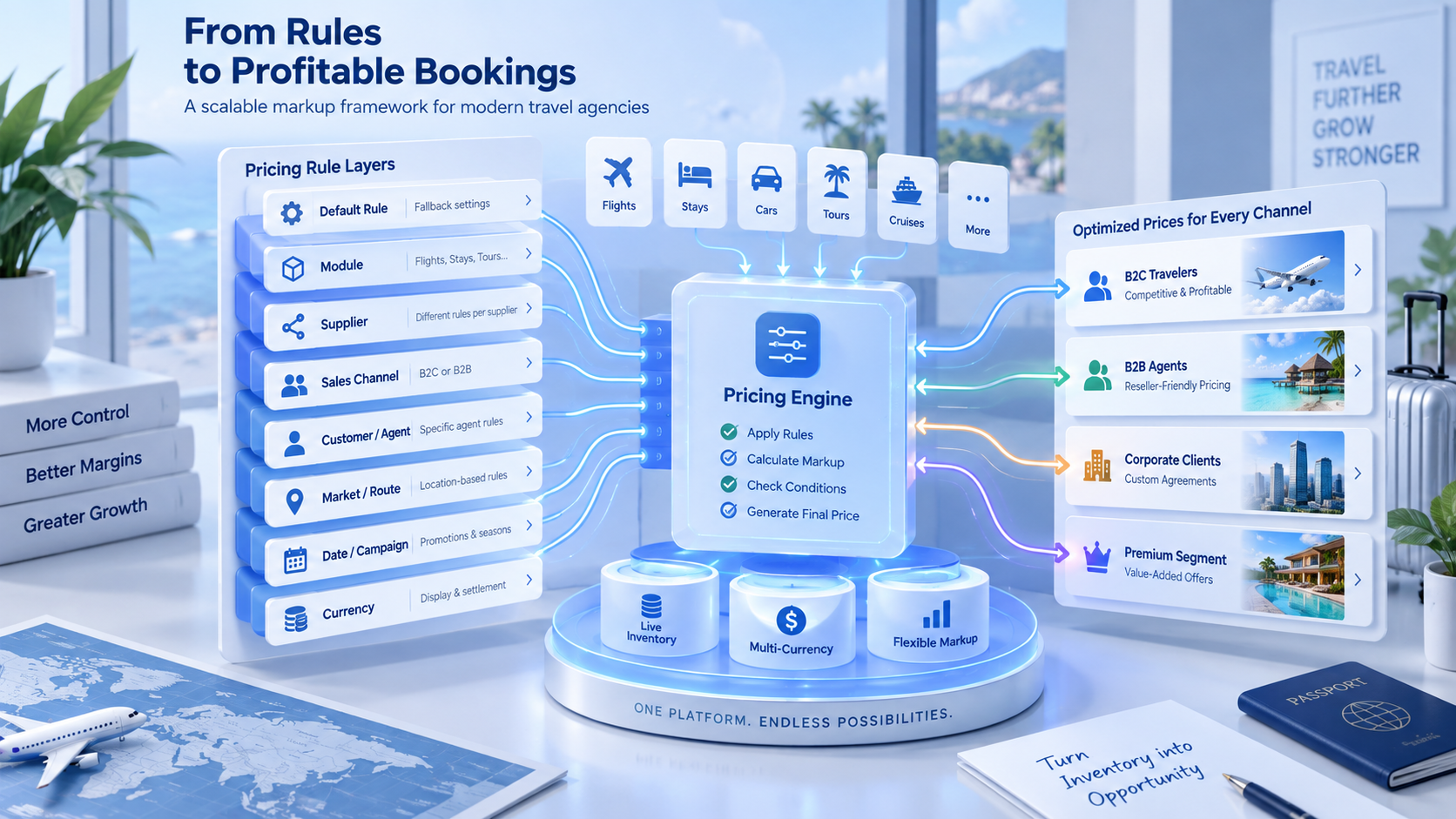
The best starting point is to stop thinking about markup as one field called “percentage. Instead, build a rule hierarchy. A practical travel booking markup framework can consider these layers: pricing layer, module, supplier, channel, customer or agent, market or route, date or campaign, and currency. The important principle is specific rules should have a clearly defined relationship with general rules. If a customer-specific rule, supplier rule, and module rule could all affect the same booking, the system and your commercial team need to know which one takes priority.
Otherwise, the OTA can accidentally stack markups or replace one rule with another without realizing it.
Start with the supplier’s real commercial price
Before adding anything, define what the incoming price represents. Do not assume every number returned by an API is economically equivalent. For each connected supplier, document whether the returned amount is net, commissionable, inclusive or exclusive of relevant taxes and fees, and whether any amount changes later in the booking process. The objective is to identify a reliable commercial base before applying markup.
Separate B2C pricing from B2B pricing
This is one of the most important rules for a hybrid travel business. In B2C, your agency controls the final customer experience. You may decide that the displayed selling price needs to account for acquisition costs, payment costs, servicing effort, competitive pricing, and expected profit. B2B is different. If your agency receives a hotel for an illustrative net cost of $100 and sells it to an agent for $108, the agent may then sell it to the traveler for $115.
Your agency’s commercial objective is not necessarily to capture the entire difference between $100 and $115. You are operating a distribution chain in which both businesses may need room to earn. Using the same B2C markup for every B2B agent can therefore make your reseller channel less competitive. A capable travel agency markup software strategy should distinguish direct customers from reseller customers instead of forcing both into one rate structure.
Use percentage and fixed markups for different situations
Neither approach is universally better. A percentage markup scales with booking value. That can work well where the economics reasonably increase with the price of the booking. A fixed markup can be useful where your desired commercial return is related more closely to the transaction than the booking value. Consider an illustrative comparison. Adding 5% to a $100 booking produces $5. Adding 5% to a $4,000 booking produces $200. That may be exactly what your strategy intends—or it may be completely wrong. The point is not that fixed pricing is better. The point is that your pricing team should consciously choose the rule rather than inheriting it accidentally from the software.
Build supplier-specific rules
Imagine an OTA using three flight sources. Supplier A performs strongly on domestic flights. Supplier B provides useful international content. Supplier C gives access to additional airline offers through another distribution model. A global 7% markup would ignore the commercial reality of those sources.
The OTA may instead decide that Supplier A needs one pricing rule, Supplier B another, while particular routes use a more specific override. The same applies to stays. A hotel API, bedbank, and direct contracted property can coexist in one platform while operating under different commercial assumptions. This is where supplier API pricing rules become much more valuable than simply having an API integration.
Treat currency as part of the calculation, not the strategy itself
Multi-currency functionality and markup management solve related but different problems. Markup answers: How much commercial value should we add? Currency answers: In what currency will we calculate or display the resulting amount? An agency selling globally might receive supplier rates in one currency while displaying prices to travelers in another. The business should therefore understand who owns the FX account, what exchange-rate process is being used, and where currency movement can affect the final economics. Do not try to solve weak margin logic by adding an arbitrary FX buffer to every booking. Define markup policy and currency policy separately, then understand where they interact.
Test complete bookings, not just search results
A pricing rule is not proven because the search page looks correct. Test the entire flow. The price should remain understandable through search, details, revalidation where applicable, checkout, payment, confirmation, invoice or voucher generation, cancellation, and refund workflows. The commercial team should also be able to answer a simple question after the booking is completed: Why was this customer charged this price? If the answer requires reconstructing several spreadsheets and manually comparing supplier responses, the pricing architecture is not mature enough.
Where PHPTRAVELS Fits Into Travel Markup Management

PHPTRAVELS is designed for travel agencies and OTAs that want to run supplier-connected booking operations on a self-hosted platform while maintaining control over their own business setup. For markup management, PHPTRAVELS supports pricing controls across B2B and B2C workflows, including fixed or percentage markup configurations and rule-based options around modules and supplier-connected selling. Its markup documentation also describes controls that can be applied according to factors such as users, suppliers, locations, routes, and dates. This matters because an agency selling flights directly to consumers may need a different commercial structure from the one used for sub-agents. The same agency may also want different markup logic for stays or other travel products.
PHPTRAVELS supports multiple travel modules, including Flights, Stays, Tours, Cars, Ferries, Rail, eSIM, Visa, Insurance, Bus, and Cruises. A typical agency does not need to launch everything at once; the relevant modules depend on its supplier relationships and business model. The platform also supports multi-currency display and pricing workflows and integration with payment gateways such as Stripe, PayPal, Adyen, Cashfree, Paystack, Flutterwave, and MyFatoorah. There is an important commercial boundary to understand. PHPTRAVELS does not provide your supplier inventory contracts or your payment merchant accounts.
Your company obtains and maintains its own supplier relationships, credentials, commercial agreements, FX arrangements, and gateway accounts. PHPTRAVELS provides the software layer through which supported integrations and booking workflows can be operated. PHPTRAVELS is also licensed self-hosted commercial software with source code included under its commercial licence. Source availability gives licensed customers the ability to work with and customize the application according to their licence terms, but PHPTRAVELS should not be confused with MIT-licensed or unrestricted open-source software. That distinction is particularly relevant for agencies evaluating long-term customization. Some businesses prefer a hosted SaaS product in which the vendor controls most of the platform. Others want a self-hosted booking application where their own technical team can work with the licensed source. The correct choice depends on your operation.
If you want to see how markup rules, multi-currency display, and B2B/B2C pricing can work inside a licensed self-hosted booking stack, start with a live walkthrough at https://phptravels.com/demo and configure options at https://phptravels.com/pricing. For a side-by-side view against other platforms, use https://phptravels.com/compare.
The Cost of Waiting Is Usually Hidden in Successful Bookings

Markup problems are dangerous because they do not always cause booking failures. The booking may complete successfully. The supplier may confirm it. The customer may receive a voucher. The transaction can therefore appear operationally perfect while being commercially weak. That is why margin leakage can remain unnoticed longer than a technical error. When an API goes offline, everyone notices. When a pricing rule quietly produces $8 less contribution than expected on thousands of transactions, the problem can hide inside apparently healthy sales. Supplier growth magnifies that risk. With one supplier, a pricing spreadsheet may feel manageable. Add several flight sources, several hotel feeds, B2B agents, multiple markets, multi-currency selling, and temporary promotions, and pricing exceptions begin multiplying.
Eventually the agency faces a choice: continue managing commercial logic manually or turn that logic into controlled system rules. This is also why travel companies should design pricing architecture before aggressively expanding supplier connectivity. Adding another API does not automatically make an OTA more profitable. It increases the amount of inventory the business must price correctly. Agencies that can answer “which supplier should we sell, through which channel, at which markup, and under which rule?” have a stronger operational foundation than agencies simply collecting integrations. If your current booking platform cannot separate B2B and B2C pricing clearly, cannot accommodate different supplier strategies, or leaves your team manually adjusting prices outside the booking workflow, this is a useful time to review the architecture.
Frequently Asked Questions About Travel Markup Management Software

What is travel markup management software?
Travel markup management software is the pricing layer that allows an agency or OTA to apply commercial rules to supplier rates before presenting selling prices to travelers or B2B agents. Instead of applying one manual percentage to every booking, the software can support different pricing strategies according to factors such as product type, supplier, sales channel, agent, destination, route, or other configured business rules. For an OTA working with several APIs, the objective is consistent and explainable selling-price control.
What is the difference between a travel markup and a commission?
A markup is typically an amount added by the seller to a base or net price. A commission is usually remuneration associated with selling a supplier’s product or operating within a distribution relationship. The exact commercial arrangement varies by supplier and contract. An agency should therefore understand the incoming supplier economics before applying additional pricing. Treating a commissionable price as though it were a pure net rate—or assuming every supplier works the same way—can distort margin calculations.
Should an OTA use the same markup for every supplier?
Usually, there is no operational reason to assume every supplier needs the same rule. Different suppliers may have different rate competitiveness, commission structures, geographic strengths, payment arrangements, servicing requirements, or contractual conditions. A better model is to establish a sensible default and then introduce more specific rules where there is a clear business reason.
The objective is not to create hundreds of complicated rules. It is to use enough segmentation to reflect the economics of the business.
Should B2B and B2C travel bookings have different markups?
They often serve different commercial purposes. A direct B2C traveler is the end customer, while a B2B travel agent may need to resell the same inventory and earn its own margin. Using an identical pricing structure for both channels can leave either your direct channel or your reseller channel poorly positioned. The agency should define its own B2B and B2C strategy according to its contracts, operating costs, reseller relationships, and target markets.
How does multi-currency affect travel markup?
Multi-currency makes it possible to calculate or display travel products in currencies appropriate to different markets, but currency conversion should not replace a proper markup policy. Your agency should understand the supplier currency, customer-facing currency, exchange-rate source, settlement process, payment-gateway currency, and who carries any FX exposure. PHPTRAVELS supports multi-currency display and pricing, but the agency remains responsible for its own FX arrangements, supplier accounts, and payment accounts.
Does PHPTRAVELS provide hotel, flight, tour, or other supplier contracts?
No. The buyer is responsible for obtaining and maintaining the supplier contracts, API credentials, commercial terms, and accounts required for the inventory it wants to sell. PHPTRAVELS provides the booking software and supports integration workflows; it does not replace the commercial relationship between the travel agency and the inventory supplier.
Does PHPTRAVELS provide payment merchant accounts?
No. PHPTRAVELS supports integration with multiple payment gateways, including providers such as Stripe, PayPal, Adyen, Cashfree, Paystack, Flutterwave, and MyFatoorah, but the agency must obtain and operate its own approved merchant or gateway account. Gateway availability, currencies, transaction pricing, settlement, compliance requirements, and account approval remain matters between the agency and the relevant payment provider.
Is PHPTRAVELS open-source software?
PHPTRAVELS is licensed commercial travel booking software that is self-hosted and includes source code under its commercial licence. It should not be described as MIT-licensed or unrestricted open-source software. Buyers should review the applicable licence terms when assessing how they intend to host, modify, and operate the platform.
The key takeaway is simple: supplier connectivity creates inventory, but pricing control creates a business. An OTA can connect excellent flight, hotel, tour, and car suppliers and still lose commercial discipline if every source is priced through the same generic rule or adjusted manually after the fact. Effective travel markup management software gives the agency a structured layer between supplier cost and customer price. It lets the business think in terms of suppliers, channels, agents, markets, currencies, and product economics rather than one global percentage. For agencies planning to scale B2C sales, build a B2B network, or add more supplier APIs in 2026, markup architecture should be treated as part of the booking platform—not as an accounting problem to solve later.
A strong travel markup management software strategy makes each pricing decision easier to explain. Travel markup management software can separate supplier cost from retail price, while travel markup management software rules keep agent and direct channels consistent. When teams review travel markup management software reports, they can see whether a markup is protecting margin or reducing conversion.
The best travel markup management software also gives commercial managers a clear way to test pricing changes before they affect customers. With travel markup management software, an OTA can model supplier fees, channel commissions, currency movements, and promotional discounts together. That makes travel markup management software a practical part of daily revenue operations rather than a one-time configuration task.
For technical context, see the IATA travel technology resources at https://www.iata.org/en/programs/ndc/.
For an OTA, travel markup management software should support supplier-specific rules, channel-specific rules, and market-specific rules. This travel markup management software approach gives finance teams a reliable audit trail. It also lets revenue teams use travel markup management software to react quickly when commissions or supplier fees change. In practice, travel markup management software turns pricing governance into a repeatable operating process. More importantly, travel markup management software creates consistency across B2B and B2C sales. A travel markup management software dashboard makes exceptions visible, and travel markup management software controls help teams protect margin without guessing.
A useful implementation checklist starts with travel markup management software ownership. The commercial team defines travel markup management software policies, finance validates travel markup management software calculations, and operations monitors travel markup management software exceptions. Product managers can document travel markup management software rules for each supplier. Sales teams can explain how travel markup management software supports agent pricing. Leadership can use travel markup management software reporting to compare channels, markets, and products. This shared language keeps travel markup management software decisions transparent and makes travel markup management software easier to govern as the OTA grows.