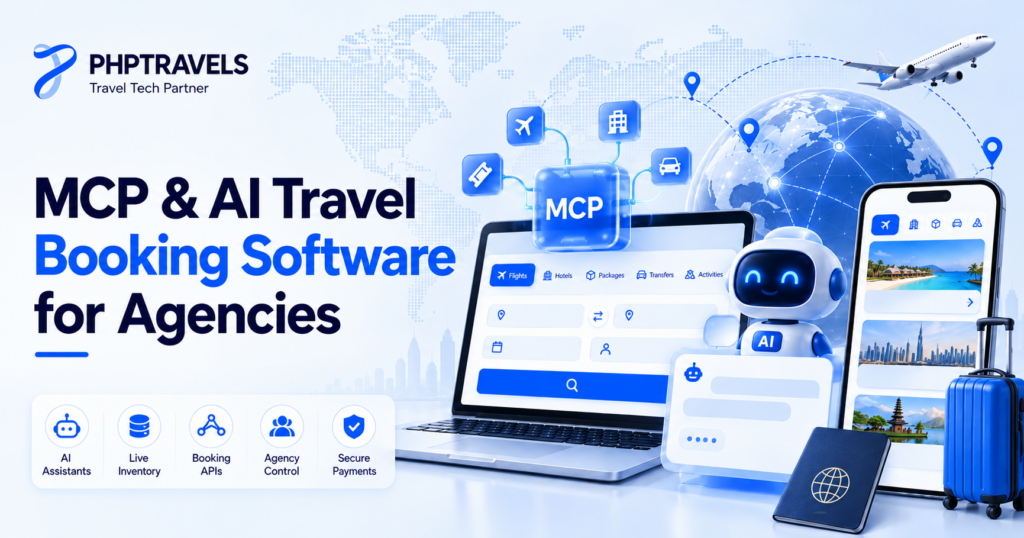
A traveler opens an AI assistant and types: “Find me a refundable hotel near Dubai Marina, add an airport transfer, and show me a morning flight from London.” The assistant understands the request instantly. The harder question comes next: can it safely connect to a real travel agency, retrieve live bookable options, respect the agency’s rules, confirm the final price, collect the right traveler information, and hand the customer to a human when something becomes complicated?
That is where AI travel booking software is heading in 2026. The competitive pressure is not simply about adding a chatbot to a website. It is about making travel-agency systems accessible to approved AI assistants without giving those assistants uncontrolled access to supplier credentials, payments, customer records, or booking actions.
Model Context Protocol, or MCP, is emerging as one way to build that connection layer. For agencies, the opportunity is significant: prepare the booking infrastructure now, and new AI interfaces can become another controlled distribution channel rather than another disconnected technology project. Agencies evaluating their booking foundation can start by exploring the PHPTRAVELS demo.

1. Travel Agencies Are Entering a New Distribution Layer
Travel agencies have adapted to multiple distribution shifts before. Customers moved from telephone enquiries to websites, from desktop search to mobile, and from traditional search engines to messaging and social platforms. AI assistants represent another interface through which a traveler may discover, compare, and eventually request travel products.
The important change is that an AI assistant can do more than display a page. It can interpret intent. A customer might ask for “a family-friendly resort with breakfast, flexible cancellation, and no more than a 45-minute airport transfer.” The assistant can translate that request into structured parameters that a booking system understands.
But understanding the request is only the first part of the transaction. The agency still needs software that can search an authorized supplier connection, return current results, preserve the selected offer, recheck availability where necessary, create the reservation, process the appropriate payment workflow, and store the booking for future servicing.
This is why agencies should avoid framing the AI discussion as “human agents versus AI.” A more useful question is: Which parts of our current workflow can an AI assistant safely initiate, and which parts must remain controlled by our booking application, suppliers, payment systems, or staff?
Agencies that answer that question early gain flexibility. They can experiment with AI interfaces while keeping their commercial rules and customer relationships inside their own technology stack. To understand the type of booking application that can sit underneath those experiences, visit PHPTRAVELS and review the platform before designing an agentic layer.
2. What Model Context Protocol Actually Does
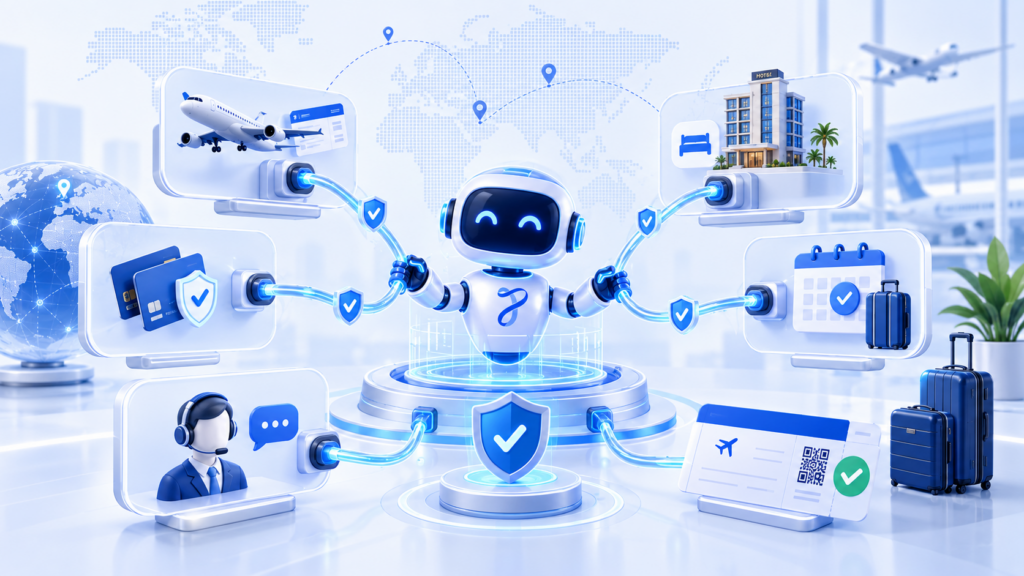
MCP is best understood as a standardized way for AI applications to discover and use external capabilities. Instead of building a completely different custom connection for every AI interface, an MCP-compatible service can describe the tools and resources an AI application is permitted to access.
For a travel agency, those tools could represent specific business actions. An MCP-enabled travel application might expose functions such as:
- Search available hotels for defined dates and occupancy.
- Search flight options through an agency’s authorized integration.
- Retrieve the current rules attached to a selected offer.
- Revalidate availability and price before booking.
- Create or retrieve a customer quotation.
- Check the status of an existing reservation.
- Request an amendment or cancellation.
- Escalate the conversation to a human agent.
MCP itself does not provide hotel rooms, airline seats, tours, transfers, or any other inventory. It is not a booking engine, GDS, payment gateway, or supplier marketplace. It is connective infrastructure that can allow an AI assistant to interact with approved capabilities provided by other systems.
That distinction matters because an impressive conversation can create the illusion that the AI is doing everything. In a well-designed architecture, the AI interprets what the traveler wants, while the travel booking application performs controlled actions against authorized supplier services.
Think of MCP as a reception desk with a strict list of allowed requests. The receptionist can understand the customer and route the request to the correct department, but the receptionist does not become the airline reservation system, hotel supplier, payment processor, or accounting database.

3. How AI Travel Booking Software Fits Into the Agency Stack
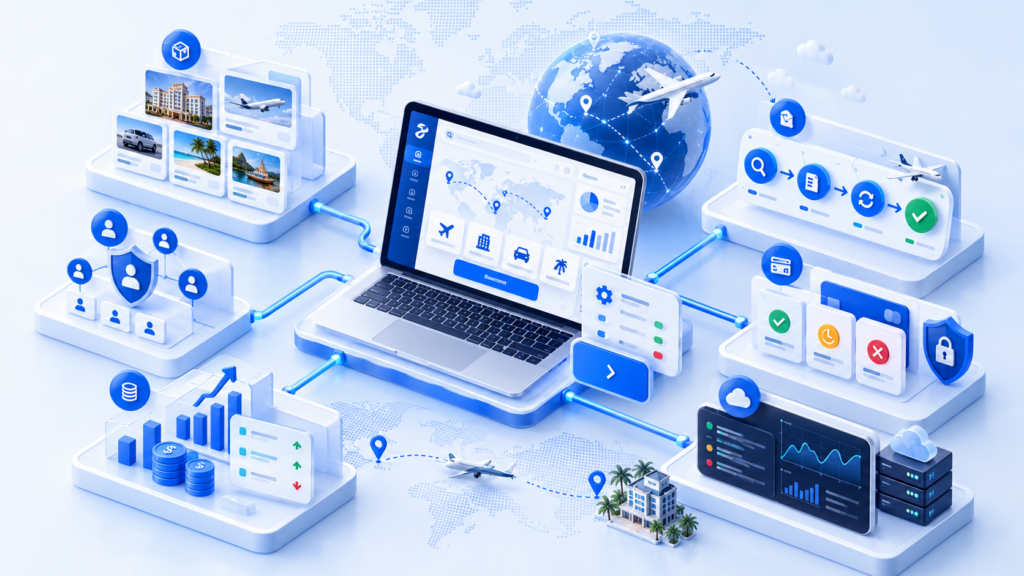
A useful AI travel booking software architecture separates conversation from transaction control.
The conversational layer might understand natural-language requests, maintain the context of the trip, explain options, summarize rules, and ask follow-up questions. The booking application should remain responsible for the structured state of the transaction: destinations, dates, passengers, supplier references, prices, booking status, payment state, and post-booking records.
The AI assistant handles intent
The customer can communicate naturally. Instead of filling ten filters, they might say, “Two adults and one child, somewhere central in Istanbul, breakfast included, free cancellation if possible.” The assistant converts that intent into parameters that a controlled hotel-search function can accept.
The booking platform handles execution
The application sends the appropriate request through the agency’s configured supplier integration. The returned inventory is structured, stored, filtered, and shown to the customer. If the traveler selects an option, the platform can perform whatever revalidation or final availability step that supplier workflow requires.
The supplier remains the source of the offer
The AI must never invent availability because an earlier result looked plausible. Real travel products can change between search and confirmation. The agency needs a reliable path back to the supplier connection before a bookable offer is treated as final.
PHPTRAVELS provides licensed travel booking software with source code included under a commercial licence. The buyer is responsible for obtaining and maintaining their own supplier contracts, credentials, APIs, and other commercial relationships. PHPTRAVELS should therefore be viewed as the agency’s booking software layer, not as a promise of supplier inventory or supplier contracts.
Agencies considering this architecture can open the PHPTRAVELS demo and follow the existing booking flow from search toward reservation management before deciding where an AI assistant should be connected.

4. A Practical Agentic Travel Booking Workflow
The easiest way to understand agentic travel is to follow a transaction from the first customer message to post-booking support.
Step 1: Understand the request
The traveler describes the trip conversationally. The AI extracts structured information such as origin, destination, dates, passengers, room occupancy, preferences, and budget.
Step 2: Search authorized inventory
The assistant invokes an approved search tool. That tool calls the travel agency’s booking application, which communicates with the agency’s own configured supplier integrations.
The AI should not have direct access to supplier passwords or unrestricted API credentials. It only receives the booking capability the agency has deliberately exposed.
Step 3: Present comparable options
The customer receives results in language that is easier to understand. The AI can summarize differences between refundable and non-refundable rates, departure times, baggage conditions, room types, or transfer options using the information returned by the booking workflow.
Step 4: Revalidate before commitment
Before creating a reservation, the selected offer should go through the required live availability or pricing check. If the price changes, the customer should see the updated amount and conditions before confirming.
Step 5: Apply agency policy
The system can enforce rules such as permitted markups, customer type, B2B access, required traveler information, booking limits, or situations that require manual approval.
Step 6: Complete payment safely
The customer proceeds through the appropriate payment flow. Sensitive payment details should remain within properly designed payment infrastructure rather than becoming ordinary AI conversation data.
Step 7: Service the booking
After confirmation, the booking remains accessible for support. An AI assistant might retrieve an itinerary or explain cancellation conditions, while more sensitive cases can be transferred to agency staff with the conversation and booking context intact.
This end-to-end view is important. A successful AI travel project is not measured by how quickly it generates recommendations. It is measured by how reliably it moves a real customer through the agency’s commercial workflow.
5. Security and Governance Matter More Than the Chat Interface
Connecting an AI assistant to real booking functions creates obvious benefits, but it also introduces new responsibilities. An agency should define access and governance before exposing transactional capabilities.
Use minimum necessary permissions
A customer assistant should receive only the functions required for the customer experience. It does not need unrestricted access to administrative settings, supplier configuration, financial reports, or every customer record.
Permissions can also differ by action. Searching inventory may be low risk. Cancelling a confirmed reservation or issuing a financial adjustment requires stronger controls.
Protect supplier credentials
Supplier API keys, tokens, account passwords, and private configuration belong on secured server-side infrastructure. They should not be embedded in prompts or exposed in browser code simply because an AI tool needs to initiate a search.
Keep an audit trail
Travel bookings involve money and customer commitments. Agencies should be able to reconstruct what happened: what the traveler requested, what offer was returned, which price was confirmed, which tool was invoked, what the supplier returned, and whether a staff member intervened.
Define human handoff rules
Autonomy should have limits. A human agent should be able to take over when a booking becomes ambiguous, a supplier response conflicts with expectations, a traveler disputes a charge, a cancellation requires judgment, or the automated workflow lacks enough confidence to continue safely.
Human handoff is not evidence that the AI system failed. It is part of a professionally governed travel operation.
6. How an Agency Can Implement MCP Step by Step
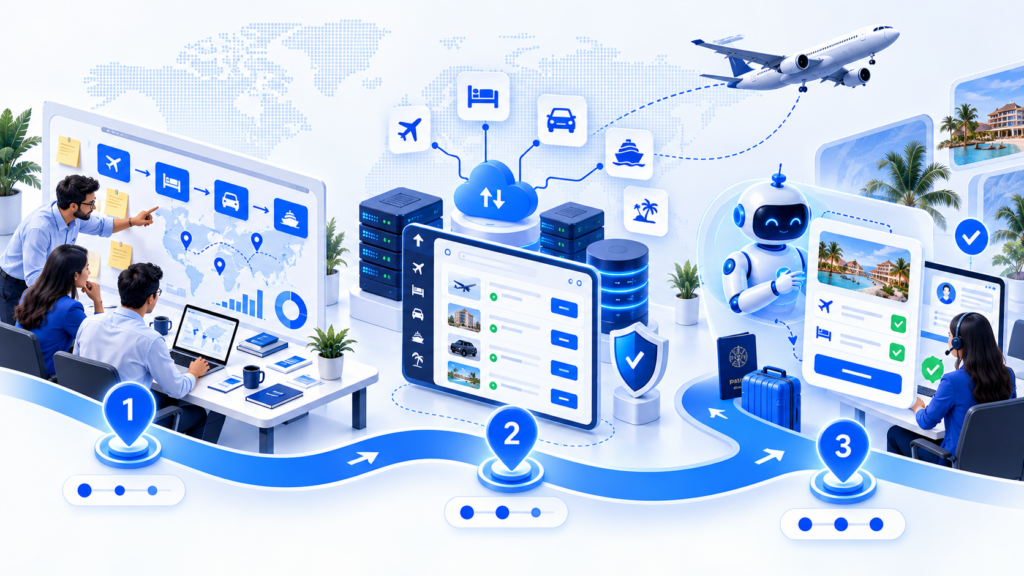
An agency does not need to expose its entire booking platform to AI on day one. A phased approach is easier to control and easier to measure.
Start with workflow mapping
Document the major steps in your existing booking journey. Identify which actions are deterministic and which require staff judgment. Search, availability checks, booking retrieval, and quotation generation may be good candidates for structured tools.
Clean up the booking layer first
If important business logic is scattered between spreadsheets, staff memory, supplier dashboards, and manual messages, adding AI will not solve the fragmentation. Build clear application workflows before trying to automate them.
Define narrow tools
Instead of exposing one powerful “manage everything” function, create small capabilities with clear inputs and outputs. A dedicated hotel-search action is easier to secure and test than unrestricted database access.
Add authentication and auth
Authentication and authorization should be built into the workflow from the beginning, not added after the AI assistant is already connected. The system should know who is making the request, what that user is allowed to access, and which actions require stronger approval. A public visitor, logged-in customer, B2B agent, staff member, and automated service should not receive the same permissions.
Travel agencies should also avoid exposing supplier credentials directly to an AI model. API keys, tokens, passwords, and private configuration belong inside secured server-side services. The AI assistant should call an approved booking function, while the application handles the supplier connection behind that function.
Keep tools narrow and predictable
Instead of creating one unrestricted tool that can “manage bookings,” define smaller actions with clear inputs and outputs. A hotel search function might accept destination, dates, occupancy, and filters. A booking retrieval function might accept an authenticated customer ID and reservation reference. A cancellation function might require additional confirmation before it can proceed.
Narrow tools are easier to test, secure, monitor, and improve. They also reduce the risk of an AI assistant performing an unintended action because the underlying function was too broad.
Design for failure before scaling
Real travel workflows fail in ordinary ways. A supplier can time out. An offer can expire. A price can change. An authentication token can become invalid. A traveler may enter incomplete passenger details. A payment can be approved while the booking response is delayed.
Agencies implementing MCP or another AI integration should test these situations deliberately. The assistant should know when to retry, when to explain that an offer has changed, and when to transfer the case to a human agent instead of guessing.
Preserve a complete audit trail
Every important action should be traceable. The agency should be able to review what the customer requested, which tool the AI called, what information the supplier returned, what amount the customer approved, and whether a staff member later changed the booking.
This auditability becomes increasingly important as automated systems move from answering questions to initiating commercial actions.
ROI and Business Impact
The strongest business case for AI is not simply having a chatbot on the website. Agencies should evaluate whether the technology reduces friction, improves response times, supports more enquiries, and helps staff spend less time on repetitive tasks.
For example, an AI assistant may collect trip requirements before a human agent becomes involved. It may retrieve an existing reservation without requiring staff to search manually. It can also summarize structured booking information and help customers understand differences between available options.
Those improvements can make an agency more efficient without removing human involvement where expertise matters most.
Useful ROI questions include:
- Are customers reaching relevant travel options faster?
- Are agents spending less time answering repetitive booking-status questions?
- Are more enquiries becoming complete quotations or bookings?
- How often does an automated workflow need manual correction?
- Can staff take over an AI-assisted conversation without asking the customer to repeat everything?
- Are servicing and post-booking processes becoming easier to manage?
Agencies should also consider the value of technical flexibility. A structured booking platform can support a website today and potentially support approved AI channels tomorrow. That can be more valuable than building a separate system for every new interface.
This is where AI travel booking software becomes a broader infrastructure decision. The return comes from connecting conversational experiences to reliable booking operations, not from AI alone.
What Agencies Should Do in 2026
The practical goal for 2026 should be readiness rather than maximum automation. Agencies do not need to make every booking autonomous. They need to make their core workflows structured enough that approved AI tools can interact with them safely.
Start by documenting your current booking process from search through servicing. Identify where supplier data enters the system, where prices are rechecked, where customers confirm a purchase, how payments are handled, and when staff intervention is required.
Next, review your supplier relationships. The agency must still maintain its own contracts, credentials, API access, and supplier relationships. Those credentials should be securely stored and reviewed regularly.
API access should be reviewed together with the commercial terms behind it. Confirm which suppliers your agency is authorized to use, what products and markets each agreement covers, and whether the intended B2C, B2B, or AI-assisted workflow is permitted. Keep supplier credentials securely on the server, document renewal and access responsibilities, and make sure every automated search or booking action remains within the agency’s own contractual rights. An MCP connection can make approved capabilities easier for an AI assistant to use, but it does not create inventory access or replace a supplier agreement.

Frequently Asked Questions
What does MCP do in a travel booking system?
Model Context Protocol provides a structured way for AI assistants to discover and call approved tools or access permitted context. In travel, those tools might search inventory, retrieve booking information, revalidate an offer, or start a servicing workflow. MCP is connective infrastructure; it is not a booking engine, GDS, payment gateway, or source of travel inventory.
Does using MCP remove the need for supplier contracts?
No. Travel agencies still need their own contracts, API credentials, accounts, and commercial relationships with the suppliers they choose to use. MCP can expose an existing authorized integration to an AI assistant, but it does not provide airline seats, hotel rooms, tours, transfers, or contractual rights to sell them.
How should agencies secure AI-assisted booking workflows?
Use strong authentication, role-based permissions, server-side credential storage, limited tool access, and clear audit logs. Sensitive supplier keys and payment information should not be placed in normal AI prompts. Agencies should also define when an automated action requires customer confirmation or human approval, especially for payments, cancellations, amendments, and other high-impact transactions.
What licence does PHPTRAVELS provide?
PHPTRAVELS is provided under a commercial licence and includes source code. Buyers are responsible for obtaining and maintaining their own supplier contracts, API credentials, and related commercial relationships. PHPTRAVELS provides the travel booking software layer; it should not be understood as providing supplier inventory or supplier agreements.
Preparing for agentic travel in 2026 starts with a dependable booking foundation, clear supplier relationships, and controlled access to real transaction workflows. Agencies can then add AI capabilities gradually without giving up operational oversight.
Ready to explore the platform? View the PHPTRAVELS demo to examine the booking workflow, then review pricing and licensing options when planning your implementation.
For standards context, consult the official Model Context Protocol documentation and IATA NDC guidance. These resources help teams designing AI travel booking software separate protocol capabilities from inventory and commercial rights.