
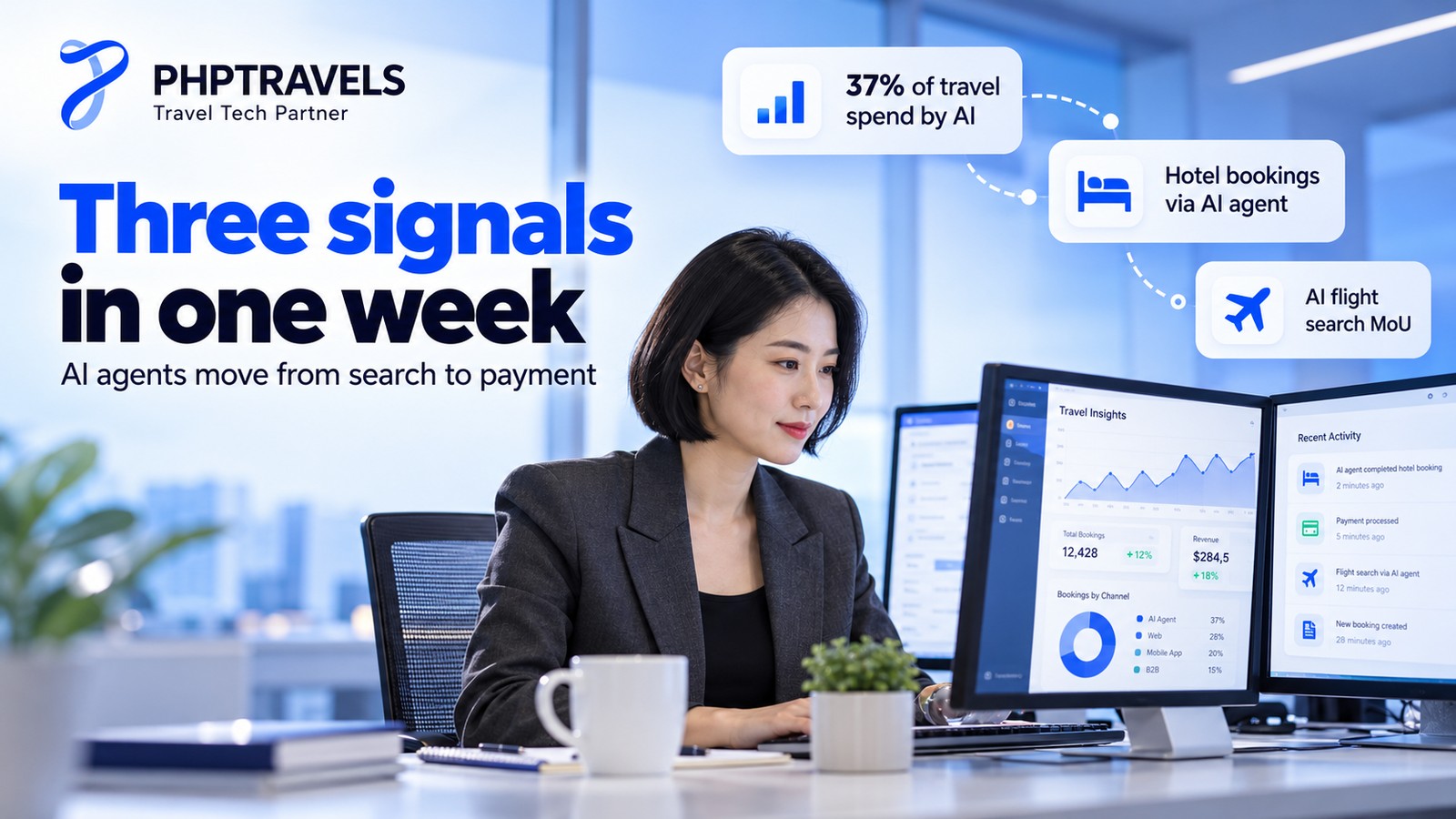
In the space of one week in October 2026, three separate announcements pointed at the same shift. A payments study said companies expect AI to manage or approve over a third of their business travel spend by 2028. Cloudbeds said hotels on its platform will be bookable through Meta’s Muse AI agent. Amadeus signed a memorandum of understanding with NVIDIA to explore travel-specific AI models for flight search. Taken together, they put agentic payments in travel on the agenda and move the question from “can an AI agent find a trip?” to “who approves it, who pays, and whose system records the booking?”
That second question is what agentic payments means: an AI agent completes or authorises a purchase inside rules a human has set. For travel agencies, OTAs, tour operators and consolidators, this is not a far-off topic. It decides whether a booking made by an agent arrives in your back office with your margin, or somewhere else. This article sets out what was announced, what the numbers say, and what an agency’s booking stack needs to be ready.
What happened this month: three signals in one week
1. Corporate buyers expect AI to approve real money. A study run by Sapio Research for virtual-card payments company Conferma in September 2026 surveyed 600 business-travel and finance decision makers in the UK, US, Australia and New Zealand. Respondents expect AI to manage or authorise an average of 37% of their business travel spend by 2028, a figure Conferma puts at about $700 billion using a GBTA estimate. 28% expect AI to handle more than half of their travel budget. In companies spending at least $6.8 million a year on travel, the expected share rises to 51%, against 27% for organisations spending under $136,000 (Conferma research release, October 2026; via Travolution, 22 October 2026).
The same study found the trust gap that matters most for sellers: 86% of executives and department heads say they trust AI to handle travel bookings and spend, but only 62% of travel, procurement and travel-management professionals do. And 97% of respondents said they had some concern about autonomous AI purchases, led by data security (59%) and the risk of errors (43%).
2. Hotels plug their own booking engines into an AI agent. Cloudbeds announced that Meta’s Muse agent will be able to pull live rates and availability for Cloudbeds properties and send the traveller to the hotel’s own Cloudbeds booking engine, where the stay is recorded as a direct booking. The integration is due in the first quarter of 2027. Cloudbeds CEO Adam Harris framed it bluntly: every time discovery moved channel (metasearch, mobile, now AI agents), the industry let someone else own the customer and charge the hotel for it (Cloudbeds press release, 20 October 2026; via Travolution, 20 October 2026).
3. The GDS layer prepares for heavier, AI-driven search. Amadeus and NVIDIA signed an MoU covering search performance, cloud efficiency and the evaluation of AI models built for travel’s specifics. Amadeus said early benchmarks on NVIDIA Hopper and Blackwell architectures were promising for response times and scale. The stated goal is to cope with more queries, more complex queries and real-time answers, while avoiding results that are unavailable or cannot be booked. Amadeus described itself as a “neutral execution layer” between travel providers, sellers and digital assistants (Amadeus via Business Wire, 21 October 2026; via Travolution, 21 October 2026).
What “agentic payments” actually means for a travel booking
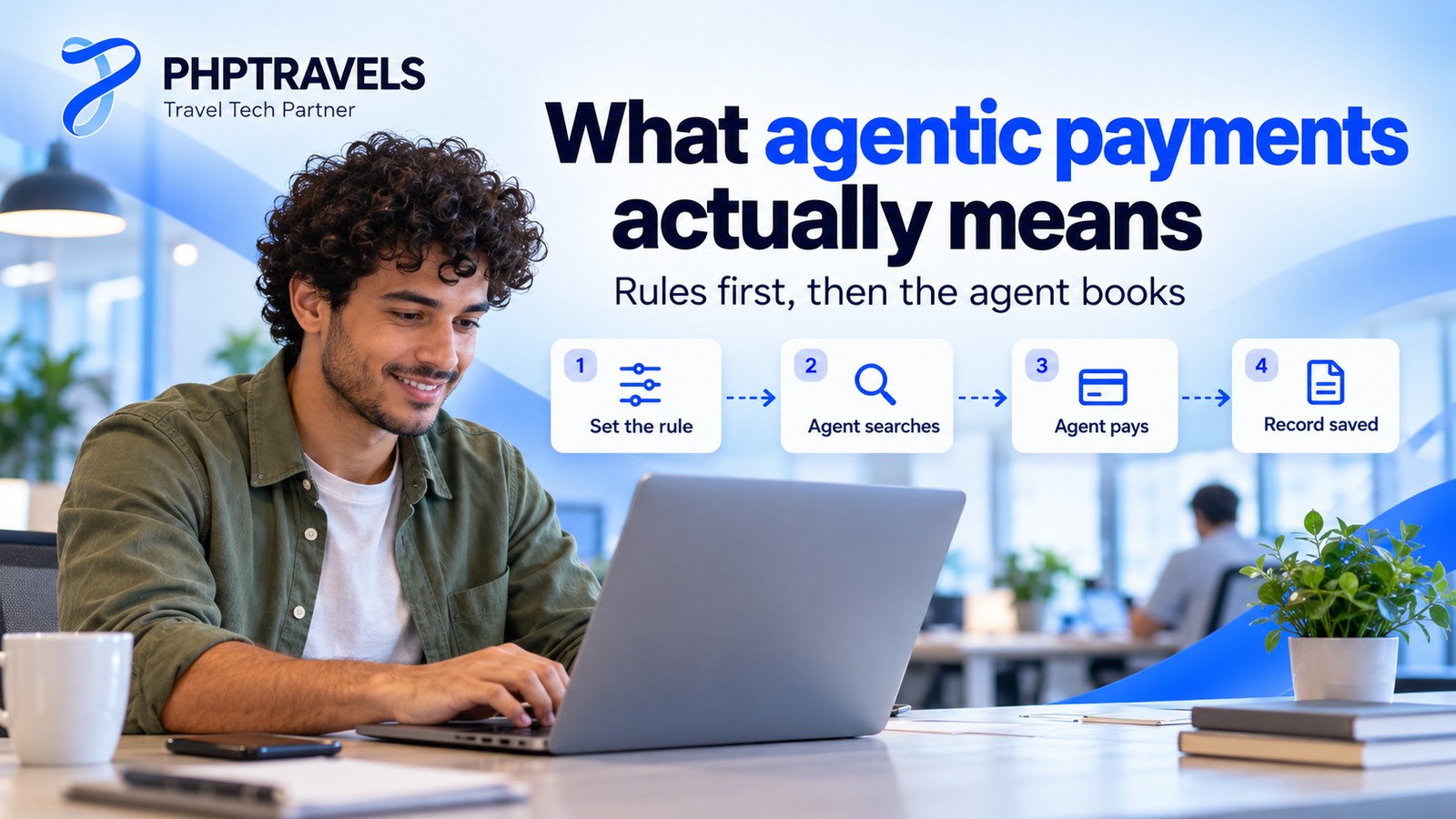
A normal online booking has a person at every decision point: they search, choose, enter card details and press pay. In an agentic flow, some of those steps are delegated. A traveller or a company sets a rule (“economy under $600, refundable, our preferred hotel chain, total trip under $1,200”) and the agent searches, picks and, within that rule, commits the payment.
For a booking business, that changes four things:
- Who is the customer at checkout. The request may come from software acting for a person, not the person typing. Your system still has to know which customer, company or sub-agent the booking belongs to.
- How spend is authorised. Rules, limits and approvals have to be enforced by your system rather than assumed from a human clicking a button. This is why virtual cards and pre-set limits keep coming up in business travel.
- What counts as a bookable answer. An agent that shows a fare or room that fails at checkout loses trust fast. That is exactly the “unavailable or cannot be booked” problem Amadeus named.
- Where the record lives. Cloudbeds’ whole pitch is that the booking lands in the hotel’s own system. For an agency, the equivalent is a booking that lands in your back office, under your brand, with your markup.
Why the trust gap is an opportunity for agencies

The most useful number in the Conferma study is not 37%. It is the gap between 86% trust among executives and 62% among the professionals who actually run travel programmes. The people closest to bookings know what goes wrong: fare rules, name mismatches, duty-of-care requirements, refunds, and invoices that do not reconcile.
That gap is where agencies and TMCs earn their place. An AI agent can search; it cannot, on its own, take responsibility for a ticket that needs reissuing or a hotel that overbooked. Companies will want AI speed with human-grade controls, and the businesses that can show audit trails, approval steps and clean reconciliation will be the ones trusted with that 37%. Our earlier look at agentic AI and travel distribution covers the search side; payments are where trust is won or lost.
The small end of the market matters too. Skift this week described the rise of one-person travel businesses, where advisors, guides and small operators run books of business that once needed a whole company, because larger firms now supply the booking, payments and software underneath them (Skift, 26 October 2026). As agents arrive, those small sellers need the same controls as a large TMC, just without the IT department.
The direct-booking lesson from Cloudbeds and Muse

The Cloudbeds move is about hotels, but the logic applies to anyone who sells travel. When a new discovery channel appears, there are two options. Either you expose your own inventory and booking flow to it in a structured way, or an intermediary does it for you and takes a share of the relationship.
For agencies and OTAs, “structured” means a few practical things:
- Clean, consistent product data: room types, fare families, cancellation terms and inclusions that a machine can read without guessing.
- Live pricing and availability from your connected suppliers rather than cached or manually updated rates.
- A checkout that can confirm and record the booking in your system, so the customer, the payment and the margin stay with you.
None of this needs an AI product of your own today. It needs a booking platform where your inventory, pricing rules and payments are already organised, so you can connect new channels as they mature. Travels Tech’s overview of how AI is changing travel distribution gives a wider view of the channels that are forming.
What your booking stack needs before AI agents spend money

Whether bookings come from a person, a corporate tool or an AI assistant, the same controls protect you. A practical checklist:
- Accounts per customer and per sub-agent. B2B bookings should sit under the right company or agent account, with its own credit, wallet or payment terms.
- Rule-based pricing. Markups and commissions applied by rules, not by hand, so an automated request gets the same price logic as a human one.
- Payment options beyond one card form. Gateways, bank transfer, pay later and wallet balances let you match how different customers want to authorise spend. See our guide to B2B travel payments.
- Payment security and fraud checks. Automated purchases raise the stakes on fraud and chargebacks. Our travel booking payment security guide covers the basics.
- Real-time supplier connections. Bookable answers depend on live availability from your flight, hotel and activity suppliers.
- A complete booking record. Every booking, payment and change in one back office, ready for invoices, refunds and audits.
Where PHPTRAVELS fits, and where it does not
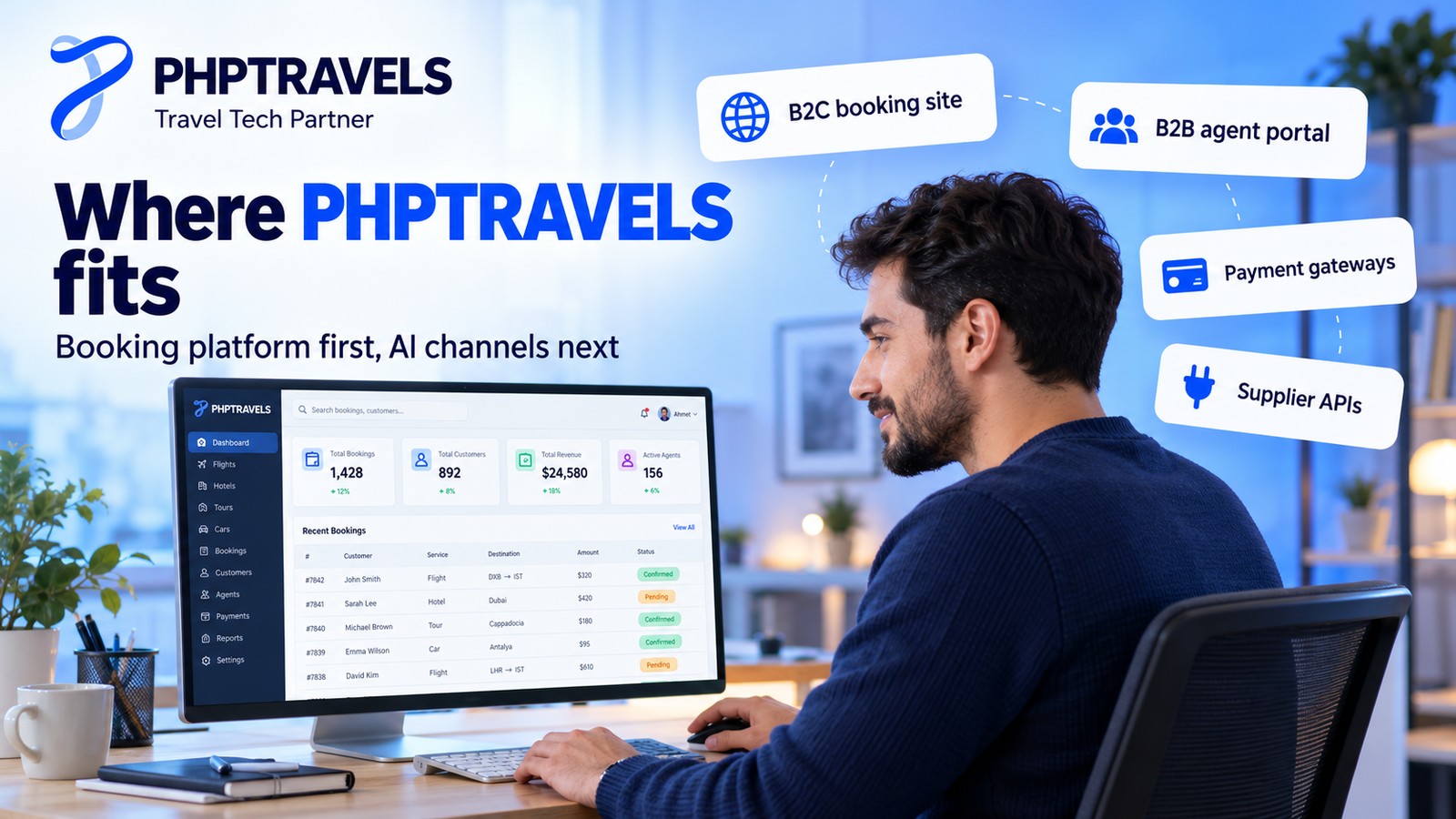
PHPTRAVELS is licensed travel booking software for agencies, tour operators, OTAs, DMCs and travel startups. It is not an AI agent, and it does not currently sell an AI-agent booking channel or agentic-payments product. What it gives you is the layer underneath that the checklist above depends on:
- B2C, B2B or both: a customer-facing storefront, a B2B agent portal and a back office, with markup rules, multi-currency, multi-language and white-label sub-portals.
- Your own suppliers: you bring your supplier API contracts and credentials and connect them through PHPTRAVELS’ integrations (40+ listed, check the live page for your suppliers). Unsupported suppliers can be added as custom integrations, priced separately.
- Your own payment accounts: gateways such as Stripe, PayPal and Adyen, plus bank transfer, pay later and wallet balance. Money goes to your gateway accounts, not to PHPTRAVELS.
- Your own platform: self-hosted with source code under a commercial licence, or managed hosting. PHPTRAVELS is not a booking intermediary and does not take a cut of your bookings.
The catch is honest: you still need supplier contracts, payment accounts and people to run operations. But when AI channels mature, a business that owns its inventory, pricing and booking records is in a far better position to connect to them than one renting a storefront. To see how the booking flow and back office work, try the PHPTRAVELS demo or build a quote on the pricing page.
What to watch next
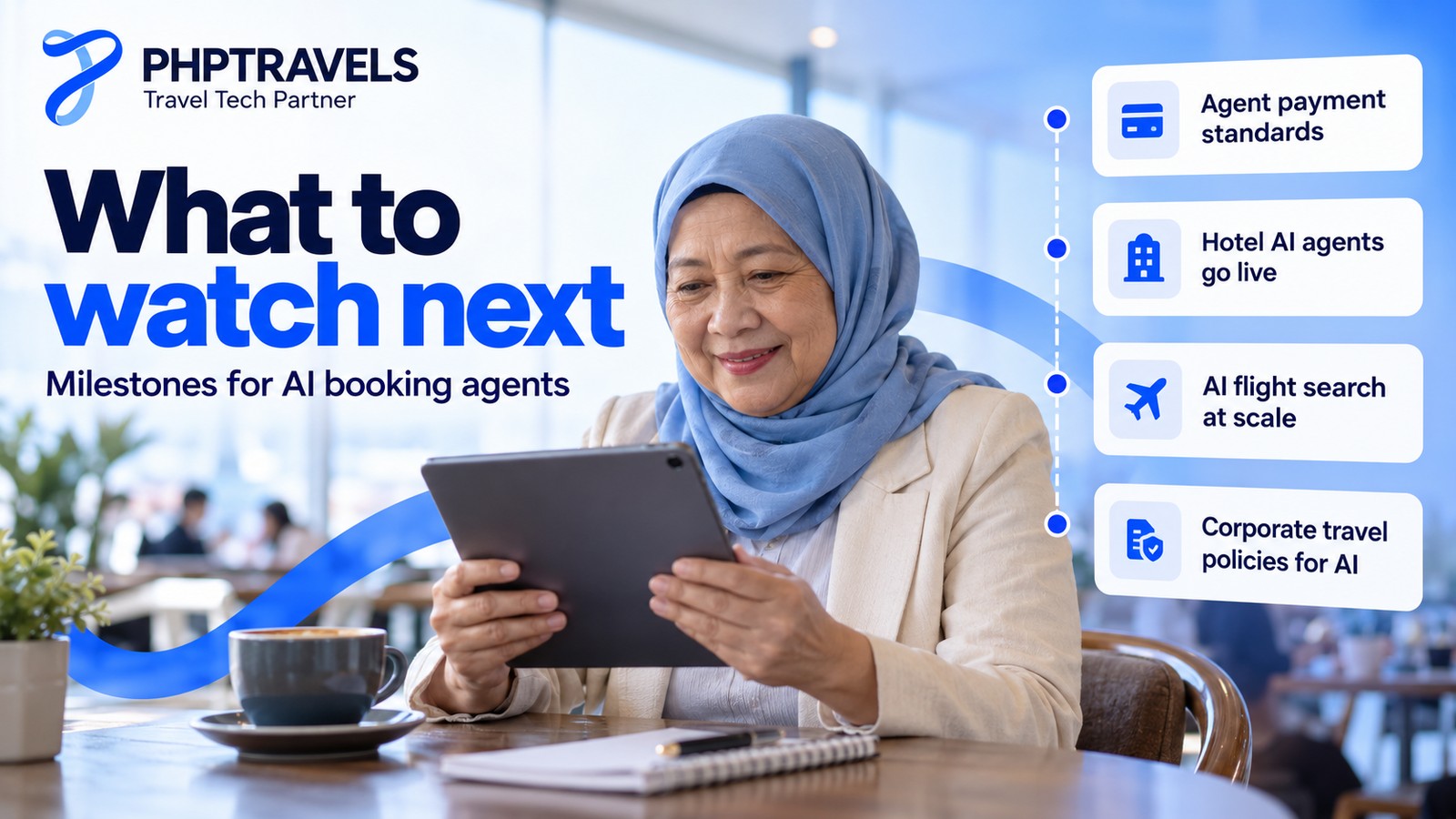
- Q1 2027: the planned go-live of Cloudbeds’ Muse integration, and whether other hotel and agency platforms follow with direct-booking hooks for AI agents.
- Amadeus and NVIDIA: whether the MoU leads to travel-specific models or faster bookable search for sellers on Amadeus.
- Corporate policy tools: how companies turn the 81% “we have a policy or guardrail” answer from the Conferma study into real spending limits that agents must respect.
- Standards: how AI agent connections sit alongside NDC and GDS distribution. Our piece on MCP and travel booking software explains one of the emerging connection methods.
Frequently asked questions
What are agentic payments in travel?
Agentic payments are purchases that an AI agent completes or authorises on someone’s behalf, inside limits a person or company has set, such as a budget, a fare class or a preferred supplier. In travel, they apply to flights, hotels and other services booked by an AI assistant.
How much travel spend could AI agents control?
In a September 2026 survey of 600 decision makers for Conferma, respondents expected AI to manage or authorise an average of 37% of business travel spend by 2028, rising to 51% in the largest travel spenders.
Will AI agents replace travel agencies?
The same research shows a trust gap: 97% of respondents had concerns about autonomous AI purchases. Agencies that offer controls, approvals, servicing and clean records are well placed to handle AI-driven demand rather than be replaced by it.
Does PHPTRAVELS include an AI booking agent?
No. PHPTRAVELS is licensed booking software with B2C and B2B portals, supplier integrations, markup rules and payment gateways that you own. It provides the booking and payment foundation; it does not market an AI agent or agentic-payments feature.
What should an agency do first?
Get inventory, pricing rules, customer accounts and payments into one system with live supplier connections and full booking records. That is what any future AI channel will need to connect to.