
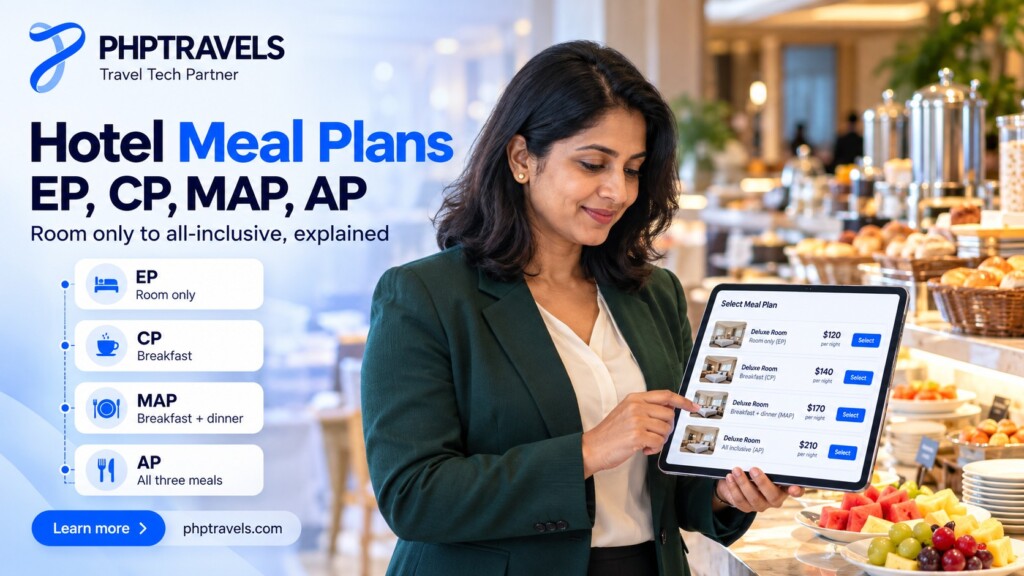
Hotel meal plans tell a guest which meals are included in the room price: none, breakfast only, breakfast plus one main meal, all three meals, or meals with drinks and snacks on top. The same deal goes by different names depending on where you trade. An Indian hotel tariff says EP, CP, MAP or AP. A European resort says room only, bed and breakfast, half board or full board. A supplier API sends a short code such as RO, BB or HB, and a channel manager may send a number.
That naming mess causes real problems: guests who expected dinner, agents comparing a breakfast rate with a room-only rate, and vouchers that do not match what the hotel sold. This guide explains each plan, maps the Indian, American and European names onto each other, shows how meal plans change the price, and covers what agencies should check before a traveller pays.
- EP / room only: the room with no meals.
- CP / bed and breakfast: the room plus breakfast.
- MAP / half board: the room, breakfast and one main meal (usually dinner, but check).
- AP / full board: the room and three meals a day.
- All-inclusive: meals plus drinks, with the exact scope set by each hotel.
What are hotel meal plans?
A meal plan (also called the board basis or board type) is the part of a hotel rate that says which meals the guest gets for the price. It is not a separate product. It is one of the attributes that make a rate what it is, next to the room type, the occupancy, the cancellation policy and the payment terms. Two rates for the same deluxe double on the same night are different rates if one includes breakfast and the other does not.
Hotels publish meal plans on tariff sheets and rate plans, bedbanks pass them on in their APIs, and booking engines show them next to each room. Each of those systems was built in a different market, so the names drift, and that is where most meal-plan mistakes start.
Why the names differ by region
The letter codes EP, CP, MAP and AP come from old American hotel-keeping terms. Dictionaries still define them that way: the European plan is a fixed rate that covers lodging and service but not meals, the American plan covers the room and all meals, and the modified American plan covers the room, breakfast and one other meal, usually dinner. They are still everyday language in India, where hotel tariffs, state tourism corporations and hotel-management courses use them as standard.
In the UK and most of Europe the same ideas are called room only, bed and breakfast, half board and full board. Cambridge Dictionary defines half board as a hotel room combined with breakfast and another meal, either in the evening or in the middle of the day, and notes that the US equivalent is the modified American plan. Supplier systems then add their own short codes on top.
Types of meal plans in hotels: EP, CP, MAP, AP and the rest
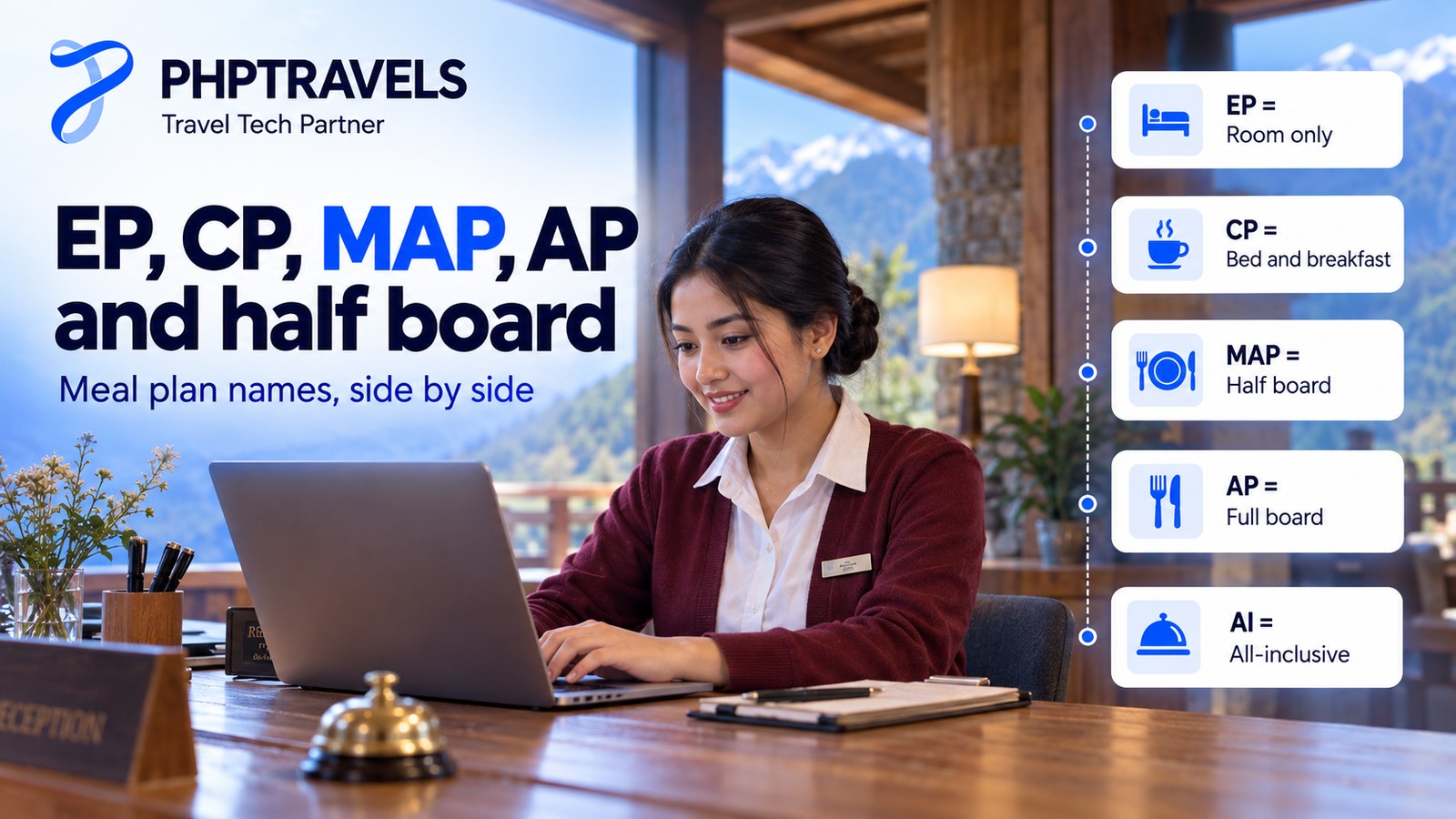
The table below lines up the regional names for hotel meal plans, the codes you will meet in distribution systems, and what each plan normally includes. The numeric codes are from the OpenTravel Meal Plan Type (MPT) list, as published in Booking.com’s connectivity documentation, which also shows which meals each code maps to on that platform.
| Indian / US term | International term | Common supplier code | OpenTravel MPT code | Meals included |
|---|---|---|---|---|
| EP (European Plan) | Room only | RO | 14 (Room only), 8 (European plan) | None |
| CP (Continental Plan) | Bed and breakfast | BB | 3 (Bed & breakfast); 6 is continental breakfast | Breakfast |
| MAP (Modified American Plan) | Half board | HB | 12 (Half board/modified American plan) | Breakfast + one main meal |
| AP (American Plan) | Full board | FB | 10 (Full board), 2 (American) | Breakfast, lunch and dinner |
| – | All-inclusive | AI | 1 (All inclusive) | Meals plus drinks; scope set by the hotel |
| – | Self catering | SC | 15 (Self catering) | None; the unit has cooking facilities |
The two-letter codes come from the same world: the OpenTravel package schema’s MealPlan element gives AI, BB, FB, HB, RO and SC as example codes. Each supplier still publishes its own list, so map from the supplier’s documentation rather than assuming.
EP plan in hotel: European Plan (room only)
The EP plan in a hotel is the room on its own. Taxes and service may be included or extra depending on the tariff, but no meals are. EP is the base rate from which most hotels build every other plan, which is why tariff sheets and contracts often quote the EP price first and add meal supplements to it. It suits business travellers, short city stays and guests who want to eat out.
CP plan: Continental Plan (bed and breakfast)
CP means the room plus breakfast. In India “CP” simply means breakfast is included, whatever the breakfast looks like. In Europe “continental breakfast” traditionally means a light cold breakfast (bread, pastries, coffee), and the OpenTravel list keeps separate codes for bed and breakfast, buffet breakfast, continental breakfast, English breakfast and full breakfast. If the type of breakfast matters to the guest, say which one it is.
MAP plan in hotel: Modified American Plan (half board)
The MAP plan in a hotel is the room plus breakfast and one main meal. This is the plan with the most room for confusion. The government-run Rajasthan Tourism Development Corporation publishes its hotel tariffs as “MAP Plan (Room + Breakfast + Either Lunch or Dinner)”, which is common practice in India. Booking.com’s code list, by contrast, maps half board (code 12) to breakfast and dinner. A guest who books “MAP” for a day of sightseeing may expect lunch; a European half-board guest will almost always expect dinner. Confirm which main meal is included and write it on the booking.
AP plan in hotel: American Plan (full board)
The AP plan in a hotel covers the room plus breakfast, lunch and dinner. It is common at remote resorts, wildlife lodges, pilgrimage hotels and tour packages where there is nowhere else to eat. Full board covers meals, not a drinks package: unless the hotel says otherwise, expect drinks beyond the basics to be charged.
All-inclusive and the less common plans
All-inclusive goes beyond full board. Cambridge defines an all-inclusive holiday or hotel as one where the meals and drinks are included in the price, but each hotel decides which drinks, which restaurants, what hours and which activities are covered. You will also meet self catering (apartments with a kitchen), dinner, bed and breakfast (another name for half board with dinner), and codes such as “Bermuda” that, on Booking.com’s mapping, resolve to breakfast.
Half board vs full board vs all-inclusive: what is actually included
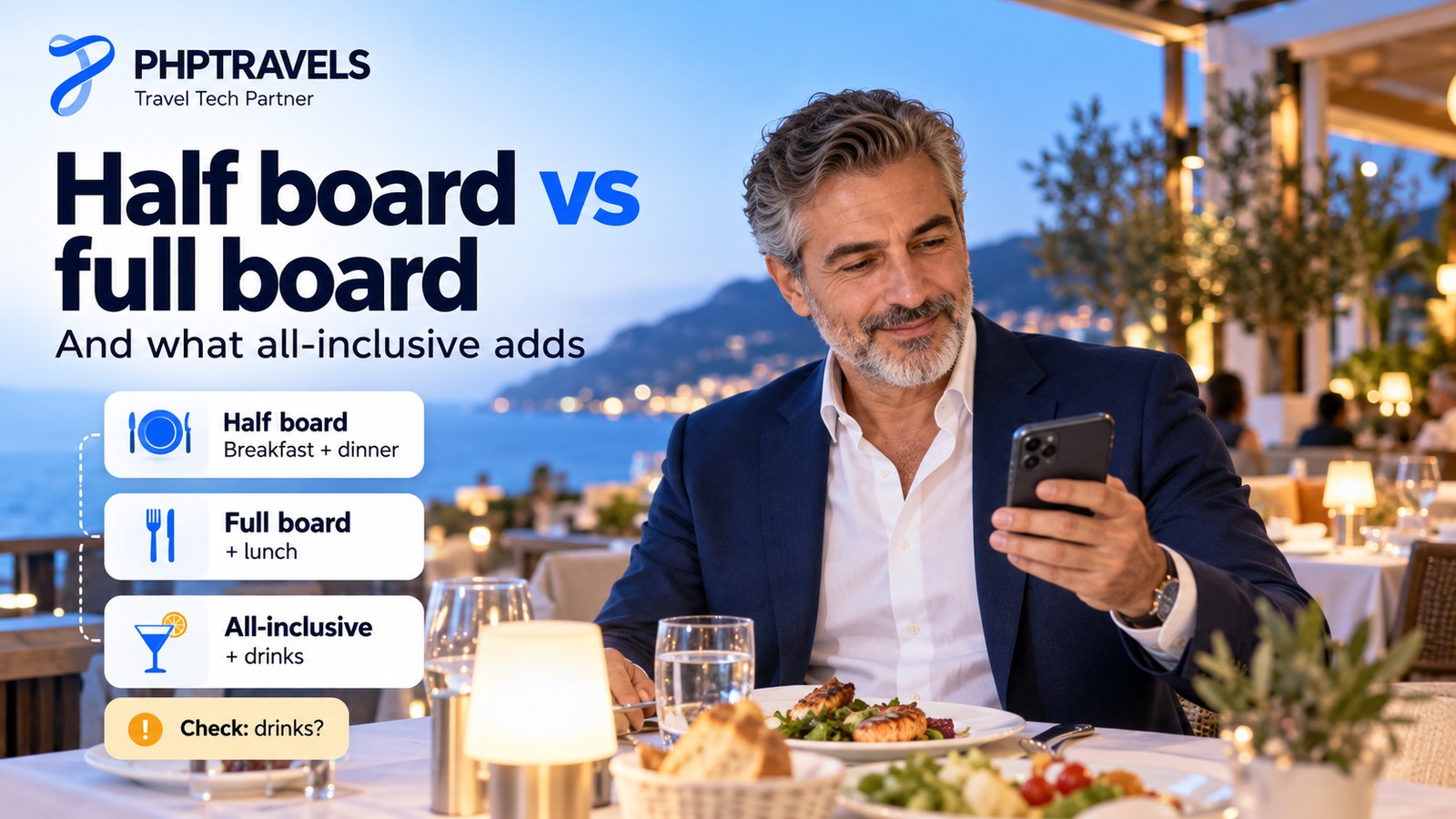
Most searches about meal plans are really one question: “what will I get to eat, and what will I still pay for?” The definitions above answer the first half. The second half depends on details that the plan name alone does not tell you.
| Question | Half board (MAP) | Full board (AP) | All-inclusive |
|---|---|---|---|
| Breakfast | Yes | Yes | Yes |
| Lunch | Only if lunch is the chosen main meal | Yes | Yes |
| Dinner | Usually (check, see MAP above) | Yes | Yes |
| Drinks with meals | Often extra | Often extra | Included, within the hotel’s list |
| Snacks between meals | No | No | Often, at set times and outlets |
| A la carte restaurants | Often a set menu or buffet only | Often a set menu or buffet only | Some outlets may need a booking or a supplement |
What does half board mean in a hotel?
Half board means the room price includes breakfast and one main meal each day, in most hotels dinner. If you are booking half board, check four things: which meal is the main one, whether it is a buffet or a fixed menu, whether drinks are included at that meal, and whether the plan starts with dinner on the arrival day or breakfast on the first morning. A three-night half-board stay normally includes three breakfasts and three dinners, but hotels count it differently, and a late arrival can mean a missed meal with no refund.
Half board vs full board
The only formal difference is lunch. Full board adds it; half board does not. In practice, full board suits guests who stay on site all day (remote resorts, safaris, pilgrimages, conferences). Half board suits guests who are out sightseeing during the day and want an evening meal at the hotel.
When all-inclusive is worth it
All-inclusive makes sense when the guest would otherwise buy most meals and several drinks a day at the hotel, when there are few places to eat nearby, or when a family wants a fixed budget. It is weaker value for travellers who want to try local restaurants. Read the hotel’s own description first: there is no single industry definition of which drinks or outlets count.
How meal plans change the room price

Hotel meal plans are usually priced as a supplement on top of the room-only rate, charged per person per night. Children are often charged a reduced supplement, and infants nothing. That means the gap between plans grows with the number of guests, which matters when you compare offers.
A worked example
Take a resort that sells a double room at an EP (room only) rate of $120 a night. Its supplements are $12 per adult for breakfast, $20 for lunch and $25 for dinner, with children aged 6 to 11 charged half. A family of two adults and one child aged 8 stays four nights. These are illustrative numbers, not a real hotel’s prices.
| Plan | Per night | 4 nights | Difference from EP |
|---|---|---|---|
| EP (room only) | $120.00 | $480.00 | – |
| CP (bed and breakfast) | $120 + 2 x $12 + $6 = $150.00 | $600.00 | +$120.00 |
| MAP (breakfast + dinner) | $150 + 2 x $25 + $12.50 = $212.50 | $850.00 | +$370.00 |
| AP (all three meals) | $212.50 + 2 x $20 + $10 = $262.50 | $1,050.00 | +$570.00 |
Three lessons come out of that table. First, for this family the meal plan more than doubles the room cost between EP and AP, so a “cheaper hotel” on room only can easily cost more once meals are added. Second, if your agency adds a percentage markup, it applies to the meals too: a 10% markup earns $48 on the EP stay and $105 on the AP stay. Third, child ages and the number of guests change the answer, so meal-plan prices should always be calculated for the actual party, never per room alone.
How suppliers build board prices
Bedbanks follow the same logic in their contracts. Hotelbeds’ documentation on calculating board supplements and discounts describes a base price for the contract’s base board, then a supplement or discount per day for the board the customer requests, applied either per passenger or once per service. It also notes a rule that explains a common “not available” result: if the requested board is different from the base board and there is no valid supplement record for even one day of the stay, the whole valuation is discarded and that board cannot be sold for those dates.
For agencies this has two practical effects. A half-board rate can disappear for a date range while the room-only rate is still on sale. And the cheapest supplier for room only is not always the cheapest for half board, because each supplier has its own supplements. That is also why it is worth knowing what the hotel’s public price is before you mark anything up; our guide to the rack rate and other hotel rate types explains how public, net and commissionable prices relate.
Meal plan codes in hotel distribution and APIs
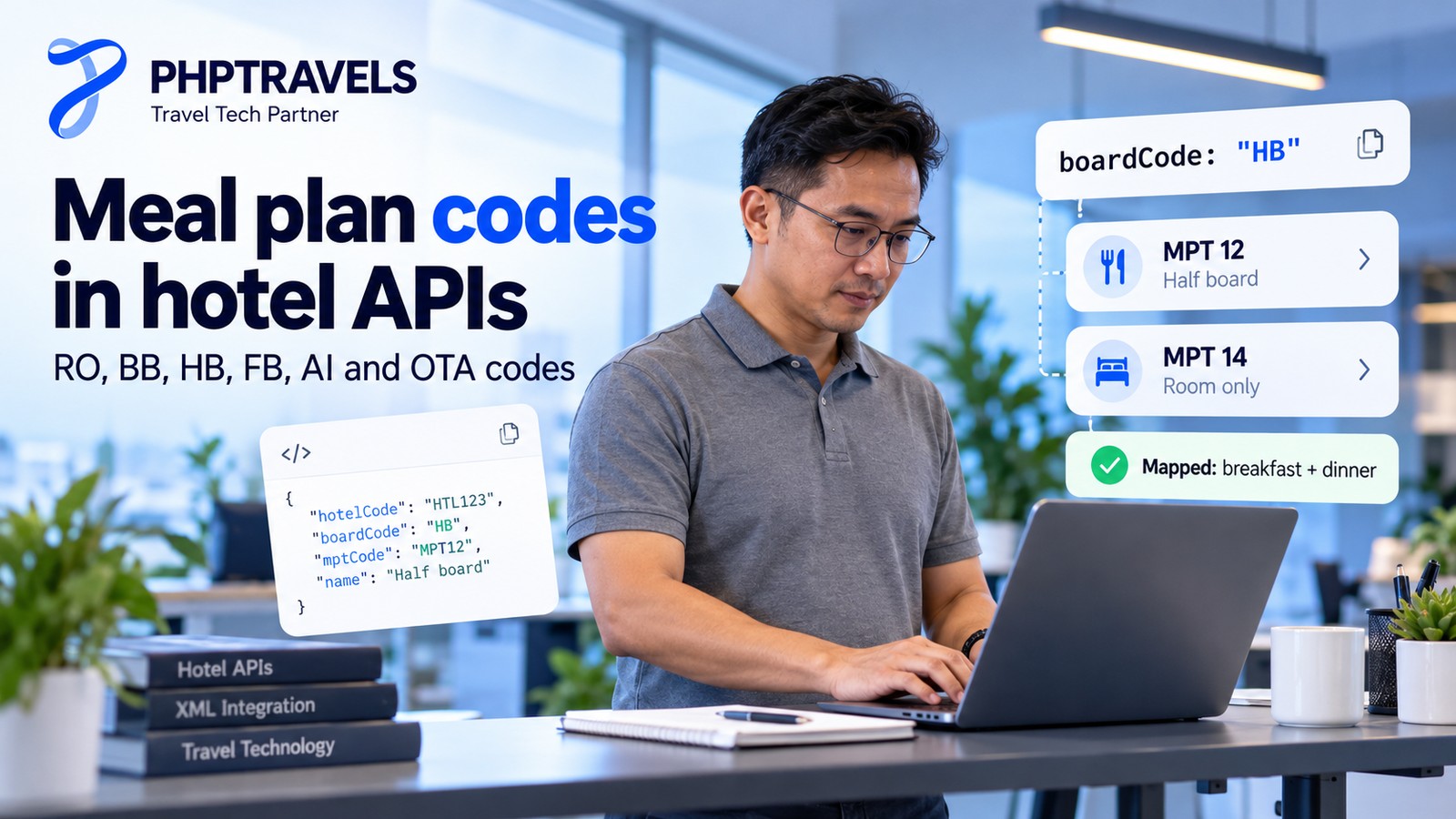
Behind every booking page, meal plans move between systems as codes. Understanding them is how you avoid selling breakfast that the hotel never confirmed.
OpenTravel meal plan codes
Channel managers and many hotel systems use the OpenTravel MPT codes shown in the table above. Booking.com’s list adds separate codes for breakfast (19), lunch (21) and dinner (22) and translates each plan into them: half board becomes breakfast and dinner, full board all three, and the European plan no meals.
Supplier board codes
Bedbank APIs usually return a short board code on each rate. Hotelbeds’ Content API includes a list of board types with their descriptions, and its booking responses carry the board code on each rate, so a booking engine needs that list loaded to turn a code into words a traveller understands. Other suppliers use their own codes and sometimes their own names for the same plan, which is why meal plan is one of the fields every hotel API integration has to normalise.
Mapping meal plans across suppliers
When several suppliers sell the same hotel, the board is part of what decides whether two offers are really the same product. A room-only offer and a breakfast offer for the same room are not duplicates, and showing only the cheaper one would hide a real choice from the guest. Engines that merge offers do it on hotel, room type, board and cancellation policy together; Travel Booking Panel’s hotels module, for example, describes matching identical rooms on exactly those fields before showing the best rate. Our article on hotel room mapping for travel software covers the wider problem of matching rooms across feeds.
Three mapping mistakes cause most meal-plan complaints:
- Half board mapped without the main meal. A supplier’s “HB” that means breakfast and lunch at one property is shown as breakfast and dinner. Keep the supplier’s description, not only the code.
- Breakfast types collapsed. “Continental breakfast” and “full breakfast” both shown as “breakfast included”. Fine for filters, but keep the detail on the room description.
- All-inclusive detail flattened. If a supplier or hotel distinguishes levels of all-inclusive, keep them. One generic label invites disputes about drinks and restaurants.
Selling meal plans as a travel agency

For an agency, hotel meal plans are both a selling point and a source of complaints. Getting them right comes down to choosing the right plan for the traveller, describing it in plain words and showing it everywhere the booking appears.
Match the plan to the trip
- City breaks and business trips: EP or CP. Guests eat out and value flexibility.
- Sightseeing tours and hill stations: CP or MAP with dinner, since guests are out at lunchtime.
- Remote resorts, safaris and pilgrimages: AP or all-inclusive, because there is often nowhere else to eat.
- Families on a fixed budget: all-inclusive or AP, priced for the actual ages of the children.
The traveller types in our guide to types of tourists are a useful way to think about which plan to lead with in a package.
Describe it in plain words
Do not rely on the code. “MAP” means nothing to many travellers outside India, and “HB” means nothing to most travellers anywhere. Write the meals out: “Breakfast and dinner daily, buffet, drinks not included”. Put the same words on the quote, the confirmation, the invoice and the hotel voucher, and keep the supplier’s exact wording in the booking record in case of a dispute.
Show it before the guest pays
In some markets this is a legal requirement, not just good service. Under the EU Package Travel Directive, organisers and retailers must give travellers the main characteristics of a package before they are bound by the contract, and Article 5(1)(a)(iv) of Directive (EU) 2015/2302 lists “the meal plan” explicitly. Even where no such rule applies, showing the board on every rate is what lets travellers compare fairly. Hotel booking platforms generally list it as a basic checkout feature; TravelBookingPortal’s hotel booking system overview, for example, lists showing the board type, cancellation deadlines and room details before checkout.
Checklist before you confirm a meal-plan booking
- Which meals, how many of each, and from which day to which day.
- Buffet, set menu or a la carte, and any restaurants excluded.
- Which drinks are included, if any.
- Child prices by age and whether infants are free.
- Dietary needs passed to the hotel in writing.
- The same meal-plan wording on the quote, confirmation, invoice and voucher.
Meal plans in hotel booking software, and where PHPTRAVELS fits

Your booking engine has to carry hotel meal plans from the supplier or contract to the voucher without losing detail. When you evaluate software, look for:
- Board as a rate attribute. Each room should be able to show several rate plans (room only, breakfast, half board and so on), each with its own price and cancellation rules.
- Code mapping per supplier. A way to turn each supplier’s board codes into consistent labels.
- Direct contracts. If you contract hotels yourself, you need to load meal plans and supplements, not only room rates.
- Markups that include meals. So the margin is calculated on the full price the guest pays; see our guide to travel markup management.
Where PHPTRAVELS fits
PHPTRAVELS is travel booking software for agencies, tour operators and OTAs, licensed for your own domain and either self-hosted or managed. Its Stays module handles boards and meal plans as part of each rate: room only, breakfast, half board, full board and all inclusive, each with its own price and rules. Rates for one hotel are listed side by side with their board and refund terms, and the booking voucher shows the room and board that were booked. Agencies can connect bedbank and hotel suppliers from the integrations list (using their own supplier contracts and API credentials), or load their own contracted hotels; the bulk hotel upload template lists the boards your site already recognises so imported rooms use the same labels as the storefront.
It will not fix unclear supplier data on its own: if a supplier’s half board does not say which meal is included, someone still has to check. And it is not the right tool for a single hotel that only needs a booking widget. If you run an agency or OTA and want to see how rates and boards appear to travellers, try the PHPTRAVELS demo, then build a quote for the modules and suppliers you need on the pricing page.
Hotel meal plans FAQ
What is EP, CP, MAP and AP in a hotel?
They are meal plans. EP (European Plan) is the room only. CP (Continental Plan) is the room with breakfast. MAP (Modified American Plan) is the room with breakfast and one main meal, either lunch or dinner. AP (American Plan) is the room with breakfast, lunch and dinner.
What is the difference between MAP and half board?
They describe the same idea: breakfast plus one main meal. MAP is the Indian and American term and, in India, the main meal may be lunch or dinner. Half board is the European term and usually means dinner. Booking.com’s code list treats them as one code (12), mapped to breakfast and dinner.
Does half board include drinks?
Often not, beyond basics such as water, tea or coffee at some hotels. Drinks are the main thing that separates all-inclusive from full board, so check the hotel’s own terms.
Key takeaways
Once the names are lined up, hotel meal plans are simple: EP is room only, CP is breakfast, MAP is half board, AP is full board, and all-inclusive adds drinks. The risk is in the details (which main meal, which drinks, how supplements change the total), so price for the real party, keep the supplier’s wording and show the plan in plain words on every document.