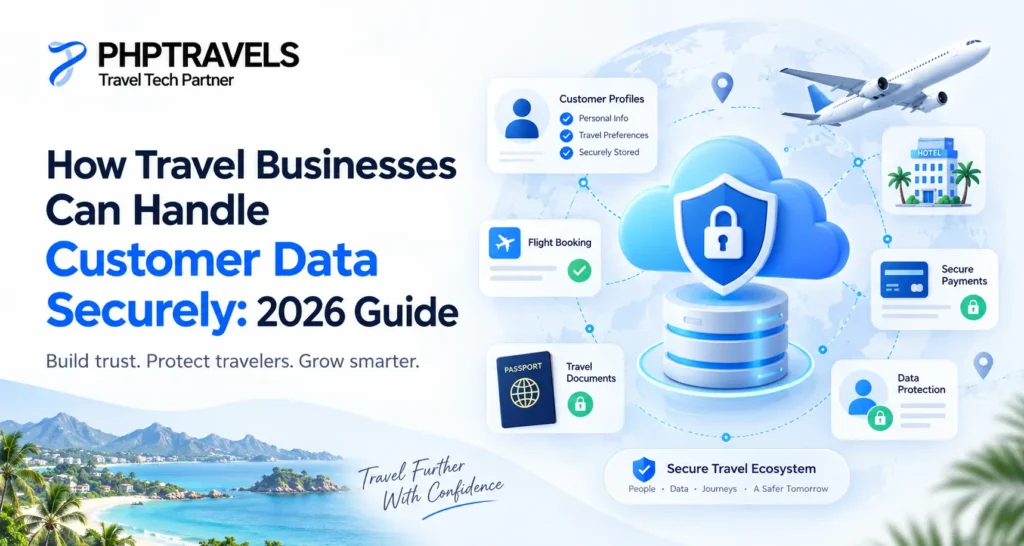
Understanding how travel businesses can secure customer data starts with knowing what they hold. Travel businesses process some of the most valuable personal information customers share online. A booking may include a traveler’s name, contact details, passport information, itinerary, payment-related data, loyalty details and, in some cases, accessibility or special-service requests.
That makes customer data security an operational requirement, not just an IT task. Travel agencies, OTAs, tour operators and corporate travel companies need safeguards that protect information from collection through booking, payment, supplier distribution, customer service and eventual deletion.
The safest approach is layered:
This is how travel businesses can secure customer data in practice: collect less data, control access, encrypt sensitive information, secure payments and APIs, train employees and prepare for incidents.
What Customer Data Do Travel Businesses Need to Protect?
Before looking at how travel businesses can secure customer data, it helps to list what they actually collect. Travel companies commonly handle names, email addresses, phone numbers, billing details, passport or ID information, booking history, transaction references, loyalty details, customer-service conversations and technical data such as IP addresses.
The challenge is that a single traveler record can move through a booking engine, CRM, payment processor, GDS, airline or hotel supplier, API and support workflow. A secure travel booking software setup therefore needs controls around the full data flow, not only the customer-facing website. Put simply, how travel businesses can secure customer data depends on protecting every one of those hand-offs.
Why Travel Data Privacy and Cybersecurity Matter
A security incident can interrupt bookings, expose customers, create chargebacks, trigger contractual problems and damage trust. Travel businesses can also be attractive targets because reservation systems may combine identity, itinerary and payment-related information. Understanding how travel businesses can secure customer data is therefore about protecting revenue as well as privacy.
Security should therefore be part of business continuity, and how travel businesses can secure customer data should be a leadership question, not only an IT one. For a deeper overview, see PHPTRAVELS’ guide to cybersecurity in the tourism industry.
1. Map Your Data and Collect Only What You Need
Start by identifying what information your company collects, where it is stored, who can access it, which suppliers receive it and how long you retain it. This map is the foundation of how travel businesses can secure customer data in practice.
For each data type, document the business purpose. If a field is not required for booking, support, accounting, legal compliance or another legitimate reason, consider removing it.
Data minimization reduces risk because information you never collect cannot be exposed from your systems. It also makes privacy requests, retention rules and breach investigations easier.
Apply the same principle internally. An employee who only needs a booking status should not automatically have access to passport files, payment administration or system settings.
2. Secure Your Website, Servers and Devices
Keep operating systems, booking applications, plugins, libraries and server software patched. Remove unused accounts and applications, change default credentials and maintain tested backups.
Use HTTPS across the complete website, especially login, booking and checkout pages. Protect administrator panels with stronger access controls and avoid exposing management interfaces unnecessarily.
Company devices should use disk encryption, screen locks, endpoint protection and automatic updates. Remote employees should use approved, managed access methods rather than unsecured devices or networks.
Infrastructure also matters. Businesses with higher traffic or integration requirements may need isolated resources and more control over their environment. PHPTRAVELS provides information about dedicated server hosting for companies evaluating that deployment model.
3. Encrypt Sensitive Data in Transit and at Rest
Use modern TLS to protect information moving between customers, your servers, APIs and suppliers. At-rest encryption can protect databases, backups, uploaded documents and storage volumes.
Do not store encryption keys, API secrets or passwords in ordinary source code or share them through chat, spreadsheets or email. Keep secrets in secure storage and rotate them when necessary.
Encryption works best with strong access control. An encrypted database still creates risk if an attacker can log in with a stolen administrator account and read data through the application.
4. Require MFA and Least-Privilege Access
Every employee should have an individual account. Shared administrator logins make it difficult to identify who changed a booking, exported data or modified settings.
Require multi-factor authentication for administrative accounts, email, cloud storage, remote access and other systems containing sensitive information. Use role-based permissions so employees receive only the access required for their work.
Review permissions when roles change and disable accounts promptly when staff leave. A travel agency CRM may centralize valuable customer information, making permission design especially important.
5. Protect Payment Data and Reduce PCI Exposure
Avoid storing raw card data unless there is a genuine business requirement and your environment is designed to protect it. In many cases, using an established payment provider with tokenization and secure authentication reduces direct exposure.
PCI DSS applies to entities that store, process or transmit payment card data, as well as environments that can affect card-data security. In 2026, businesses should assess the PCI DSS v4.x requirements relevant to their payment environment.
A modern travel payment gateway integration can connect payment status to the booking while using provider controls such as tokenization and 3-D Secure where supported.
Also secure payment-related scripts, validate webhooks, monitor unexpected changes and keep credentials out of public repositories. See the guide on choosing a payment gateway for a travel agency.
6. Secure APIs, GDS Connections and Third-Party Integrations
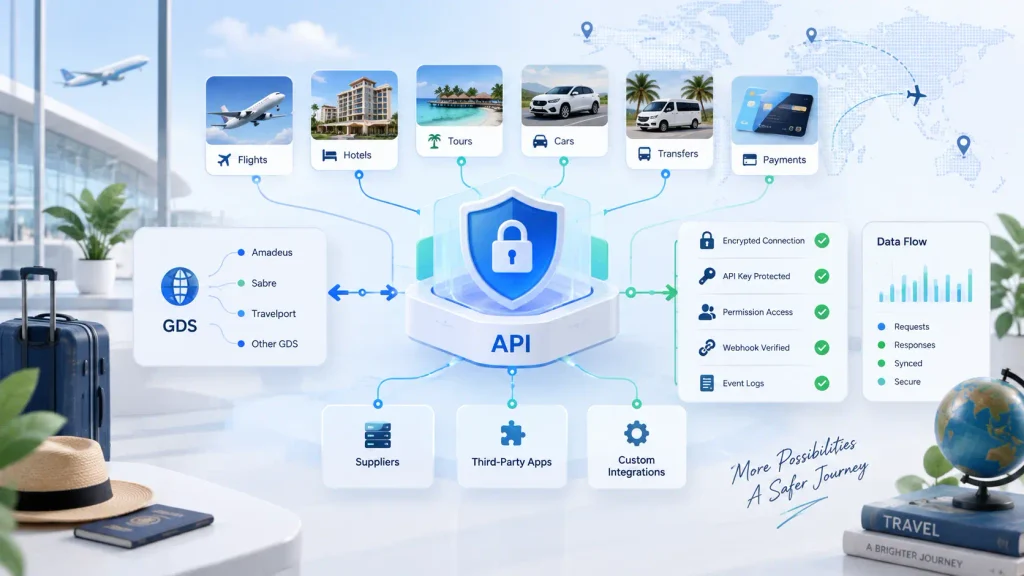
Travel platforms rely on external services for flights, hotels, tours, cars, transfers and payments. Every integration adds credentials, endpoints and data transfers that need protection.
Store API keys securely, use encrypted connections, restrict credentials by environment and permission where possible, and rotate exposed keys quickly. Authenticate webhooks, validate incoming data, log important events and avoid error messages that reveal unnecessary system details.
When planning travel API integration, review what traveler data a supplier receives, where it is processed, who can access it and what happens when the commercial relationship ends. Third-party security is part of your own risk surface.
7. Follow the Privacy Rules That Apply to Your Business
There is no single privacy law for every travel company. Your obligations depend on where you operate, where customers are located, what information you process and how you use it.
For organizations within GDPR scope, core principles include transparency, purpose limitation, data minimization, storage limitation, security and accountability. The GDPR also gives individuals rights over their data. Where its breach-notification rules apply, certain personal-data breaches must be reported to the relevant supervisory authority without undue delay and, where feasible, within 72 hours after the organization becomes aware of them.
US businesses may also need to consider state privacy laws such as California’s CCPA/CPRA when they fall within scope. Other markets have their own requirements. HIPAA is not a general travel-industry rule; it is mainly relevant to specific US healthcare contexts involving protected health information.
Your privacy notice should accurately explain what you collect, why you collect it, how it is shared and how customers can exercise applicable rights. PHPTRAVELS’ privacy statement shows how a dedicated privacy page can communicate data-use practices.
Because privacy obligations vary by jurisdiction and business model, obtain qualified legal advice when determining the requirements that apply to your organization.
8. Train Employees Against Phishing and Social Engineering
Technology cannot protect customer data if an employee is tricked into giving away credentials.
Training should cover phishing emails, fake supplier invoices, password-reset scams, suspicious attachments, impersonation attempts and requests to change payment details. Staff should know exactly how to report a suspicious message or request.
Use password managers, combine them with MFA and repeat training regularly.
9. Monitor Systems and Prepare for Incidents
A security plan should assume that something may eventually go wrong.
Log important administrator activity, authentication events, payment events, API failures and unusual data exports. Create alerts for suspicious behavior such as repeated failed logins, privilege changes or unexpected access patterns.
Maintain an incident-response plan that identifies who makes technical, legal, customer-support and management decisions. Document how to isolate affected systems, preserve evidence, reset credentials, contact vendors and evaluate notification duties.
Test backups regularly. NIST’s Cybersecurity Framework 2.0 organizes risk management around Govern, Identify, Protect, Detect, Respond and Recover a useful model for treating security as an ongoing business process.
10. Set Retention Rules and Delete Data Safely
Keeping customer information forever creates unnecessary risk, and any plan for how travel businesses can secure customer data should end with safe deletion.
Define retention periods for booking records, support tickets, uploaded identity documents, logs and marketing data based on operational, contractual and legal requirements. When information is no longer needed, delete or anonymize it through a controlled process.
Include third-party platforms and backups in retention planning where practical. For corporate travel, access and retention may also need to reflect employer policies. Businesses evaluating those workflows can review corporate travel management software options built around policy and approval processes.
How Travel Businesses Can Secure Customer Data: Quick Checklist
Use this summary of how travel businesses can secure customer data during your next security review:
- Know what customer data you collect and where it is stored.
- Remove unnecessary data collection.
- Patch websites, servers, plugins and dependencies.
- Encrypt sensitive data in transit and at rest where appropriate.
- Require MFA for administrative and sensitive systems.
- Give employees only the access their roles require.
- Minimize payment-card exposure and secure checkout scripts.
- Protect API keys, webhooks and supplier integrations.
- Maintain data-retention and deletion rules.
- Train employees against phishing and impersonation.
- Monitor suspicious logins, changes and exports.
- Test incident response and backup recovery.
- Keep your privacy notice aligned with actual practices.
- Review security whenever you add a new supplier, integration or market.
Final Thoughts: Make Data Protection Part of the Booking Experience
How travel businesses can secure customer data is not a question with a one-time answer. Travel data security is not a feature that can be switched on once. It follows the customer from search and booking through payment, fulfillment, support and data retention.
Start with the highest-impact controls:
know what data you hold, reduce unnecessary collection, enable MFA, keep systems patched, secure payments and APIs, restrict access and prepare for incidents. Then review those controls whenever your business adds a supplier, integration or market.
Customers may never see most of this security work, but they experience its result:
A booking process they can trust. Security should be part of the platform architecture from the beginning, not an afterthought added after growth.