
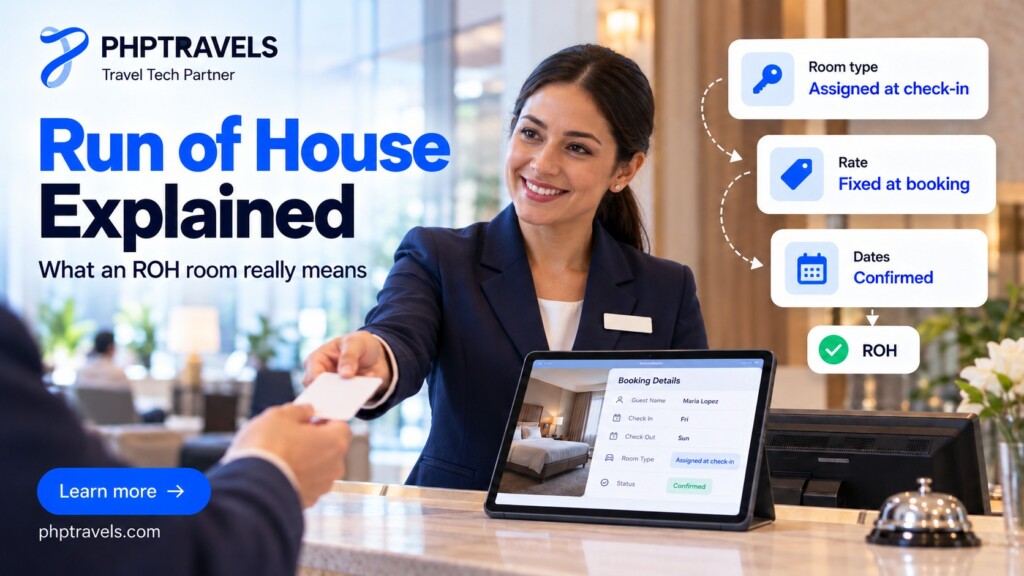
A run of house rate is the hotel equivalent of “any seat on this flight”: you pay for a bed in the building, and the hotel decides which room you get when you arrive. For travellers it is a way to save money if they are flexible. For travel agents, event planners and booking platforms it is a term that causes real problems when nobody explains it before check-in.
This guide explains what run of house (ROH) means, how an ROH booking works from reservation to key handover, how it compares with named room types and rack rates, why hotels sell it, how it shows up in group contracts and hotel APIs, and when you should (and should not) book one.
What Does Run of House Mean?

Run of house (ROH), also written “run of the house”, is a hotel booking where you reserve a room at the property without a guaranteed room type. The hotel assigns the actual room at check-in from whatever is available. The meetings trade press defines ROH simply as “rooms assigned at random according to availability” (Skift Meetings acronym list), and planner glossaries describe it as a basic room type with no guaranteed specific amenities (Social Tables hotel terms dictionary).
The fuller definition, used in event and conference planning, has two parts. IEEE’s conference organiser glossary describes run-of-house as rooms given according to availability, and also as a flat rate at which a hotel agrees to offer any of its available rooms, with the exception of suites, to a group, with final room assignment at the hotel’s discretion.
Hotel software treats ROH the same way. Oracle’s Siebel Hospitality documentation calls a run of house room type a “virtual room type” that can be any associated, available room type at the hotel, and notes that the actual room is determined by the hotel at check-in.
Run of house in one sentence
You are guaranteed a room at that hotel on those dates at that price. You are not guaranteed the room category, bed type, view, floor or size.
Run of house vs run of the house
Both spellings mean the same thing, and both appear in contracts and booking screens. The abbreviation is almost always ROH. On a rate line you may see “Run of House”, “ROH Room”, “Room assigned at check-in” or “Standard room, type assigned on arrival”. If a rate does not name a room type at all, treat it as run of house until the hotel or supplier confirms otherwise.
How a Run of House Booking Works, Step by Step

From the guest’s side an ROH booking looks like any other reservation. The difference is in what the hotel has actually promised.
- Search and booking. The guest or agent selects a rate labelled run of house. Price, dates, occupancy, meal plan and cancellation terms are fixed at this point, exactly as with any other rate.
- Confirmation. The confirmation shows the hotel, dates, number of guests and rate, but the room line reads ROH or a generic description instead of a named category such as “Deluxe King”.
- Inventory held, room not assigned. The hotel counts the booking against its total availability rather than against one room type. Oracle describes this as associating generic room types with ROH room types and taking ROH into account when checking availability.
- Room assignment. On or shortly before the arrival day, the front desk assigns a specific room from what is unsold or unassigned. In most hotels that will be the most plentiful category, which is usually the entry-level room.
- Check-in. The guest learns the room type when they get the key. It might be the standard room, or a higher category if that is what the hotel has spare.
What is and is not guaranteed
| Item | Run of house booking | Named room type booking |
|---|---|---|
| A room at this hotel on these dates | Yes | Yes |
| Price, meal plan and cancellation terms | Yes, as stated on the rate | Yes, as stated on the rate |
| Maximum occupancy | Yes, as booked | Yes, as booked |
| Room category (standard, deluxe, suite) | No, assigned on arrival | Yes |
| Bed type (king, queen, twin) | No, request only | Usually yes, if the rate names it |
| View, floor, connecting rooms | No, request only | Request only, unless sold as a separate category |
| Accessible room features | Do not rely on ROH; book the accessible room type | Yes, when booked as an accessible room |
The occupancy line matters. A run of house rate booked for two adults should still give you a room that sleeps two adults. What it does not promise is two separate beds. If two colleagues need twin beds, an ROH rate with only a bed-type request is a gamble.
Run of House vs Room-Specific Rates and Rack Rate
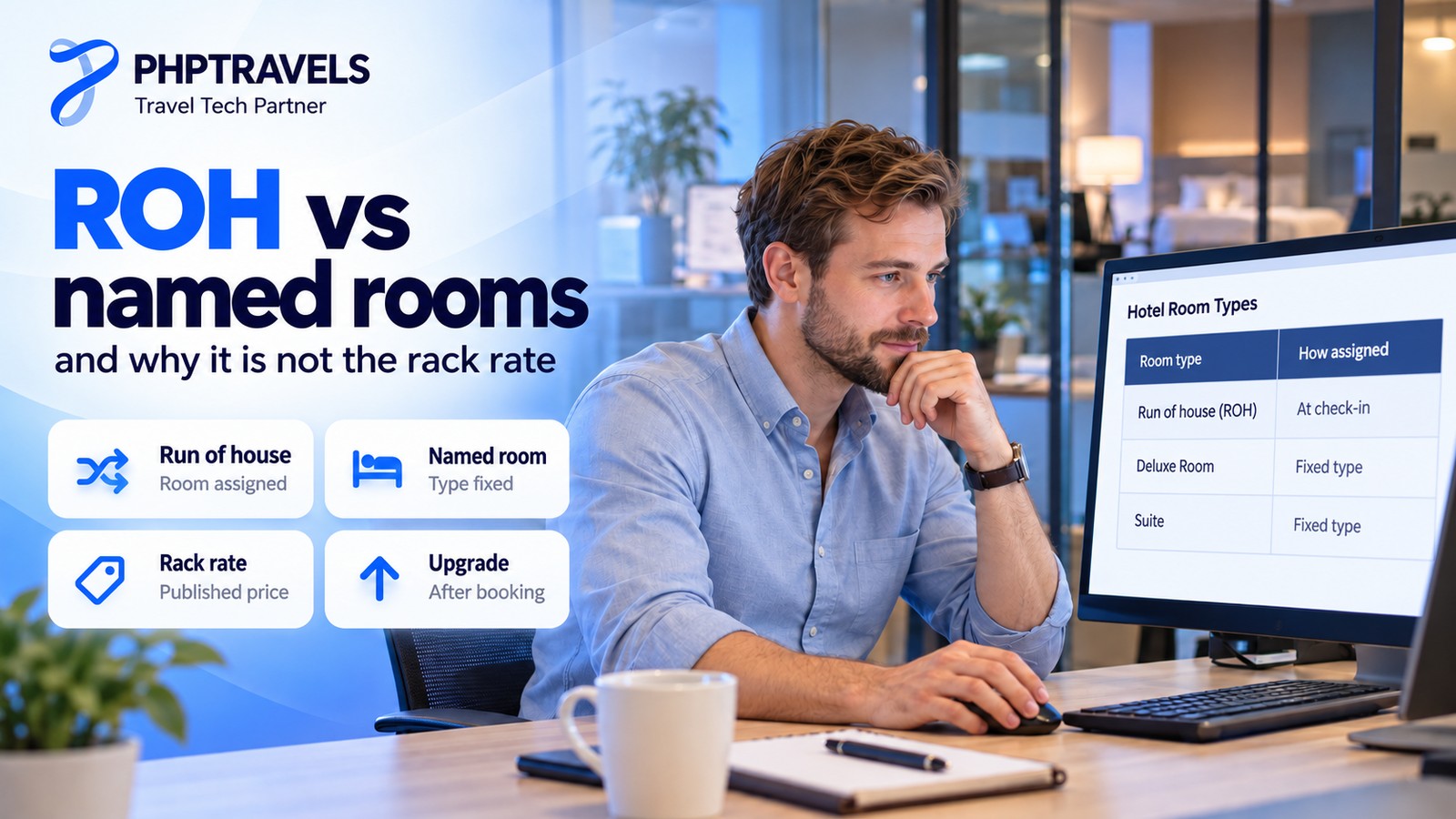
ROH is often confused with other hotel rate terms. The differences are practical, not academic, because they decide what a guest can complain about at the front desk.
| Term | What it means | Room type fixed at booking? |
|---|---|---|
| Run of house (ROH) | Any available room, assigned by the hotel at check-in | No |
| Named room rate | A rate for a specific category, such as “Superior Twin” or “Deluxe King, Sea View” | Yes |
| Rack rate | The hotel’s published, undiscounted price for a room type | Yes, per room type |
| Upgrade | A move to a higher category than the one booked, free or paid | Changes it after booking |
| Group or block rate | A negotiated rate for a set number of rooms, which may be ROH or by room type | Depends on the contract |
Is run of house the same as rack rate?
No, although at least one travel-trade glossary blurs them. The IFTTA glossary describes a run of the house rate as a flat rate that may be upgraded on arrival at no extra charge, and then adds “also called minimum or rack rate”. In day-to-day hotel distribution the two are different things. A rack rate is the published full price attached to a specific room type. A run of house rate is defined by the missing room type, and it is normally priced at or below the cheapest room type it can be assigned from. If a contract or supplier uses the terms interchangeably, ask which one they mean before you quote it to a client.
ROH and meal plans are separate decisions
Run of house describes the room, not the board basis. An ROH rate can be room only, bed and breakfast, half board or all-inclusive. If you sell packages, keep the two fields separate in your quotes and vouchers; our guide to hotel meal plans explains the EP, CP, MAP and AP codes you will see beside the room line.
Why Hotels Sell Run of House Rooms

Hotels do not sell ROH out of generosity. It solves several inventory problems at once.
- Selling every room, not every room type. Oracle’s documentation says ROH lets a property “maximize the potential number of rooms being sold”. If 20 rooms are free but spread across five categories, a hotel can sell all 20 under one ROH product instead of running out of the one category that is in demand.
- Simpler room assignment. The front office can place guests wherever the house plan works best on the day, instead of honouring a long list of specific category bookings and juggling individual requests.
- Price-sensitive demand. Because the guest gives up the choice of room, an ROH rate only sells if it is priced at or below the cheapest named room, which makes it a tool for reaching flexible, price-conscious travellers without discounting the named categories.
- Group business. According to Oracle, ROH bookings “are generally used for groups and not for transients”. A conference or tour group usually cares about the number of rooms and the rate more than which floor each person sleeps on.
What the guest can gain
The flip side of hotel flexibility is a possible free upgrade. Oracle notes that the rooms actually given to an ROH group “can range from all standard rooms to all luxury rooms, depending on availability”. That is a possibility, not a promise. Sell ROH as “standard room or better, chosen by the hotel”, never as “a chance at a suite”.
The hotel can define more than one ROH product
ROH does not always mean “anything in the building”. Oracle’s documentation gives the example of a property with an “ROH Standard” and an “ROH Deluxe” room type, each mapped to a different pool of real rooms. When you see two ROH rates at one hotel, read the description: the deluxe ROH product should only assign from the deluxe pool.
Run of House in Group Blocks and Event Contracts

Most run of house rooms are sold inside room blocks for conferences, incentive trips, weddings, sports teams and tour groups. This is where the term carries the most money and the most risk.
A training handout used in MPI’s hotel contracts boot camp shows how ROH appears in a real-looking contract exercise: a block of 100 run of house rooms per night, an ROH rate quoted for single or double occupancy, staff rooms priced at 50% off the ROH rate, a 10% allowable attrition and a 30-day cut-off date. Planners reading that clause need to know what the hotel can and cannot do with “run of house” before they sign.
Clauses to clarify before you sign an ROH block
- Which rooms are in the pool. Ask whether suites, accessible rooms, connecting rooms and club floors are excluded. Glossary definitions such as IEEE’s exclude suites by default, but your contract wording is what counts.
- Bed mix. Ask for a minimum number of twin or double-double rooms if attendees will share. Without it, the hotel may meet the block with king rooms.
- Occupancy pricing. Confirm the rate for single, double, triple and quad occupancy, and whether extra beds fit in every room the hotel might assign.
- Rate parity with the public site. If the hotel’s own public run of house rate drops below your group rate, attendees will book around your block and you may still owe attrition.
- Rooming list deadline. The hotel assigns rooms from the rooming list. Late lists mean worse assignments.
Rooming lists, deposits and amendments are where most group blocks go wrong operationally; our article on group travel booking software covers those workflows, and the MICE travel operations guide covers the wider event context.
Accessibility is not a “request”
Never place a guest who needs an accessible room on an ROH rate and add “accessible room requested” as a note. In the United States, 28 CFR 36.302(e) requires lodging providers to let guests reserve accessible rooms in the same way as other rooms, to describe accessible features in enough detail, to block a requested accessible room from all reservation systems, and to guarantee that the specific accessible room reserved is held for the guest. That protection works when the booking is for the accessible room type itself. Book it that way, wherever the hotel is.
How Run of House Appears in Hotel APIs and Booking Engines
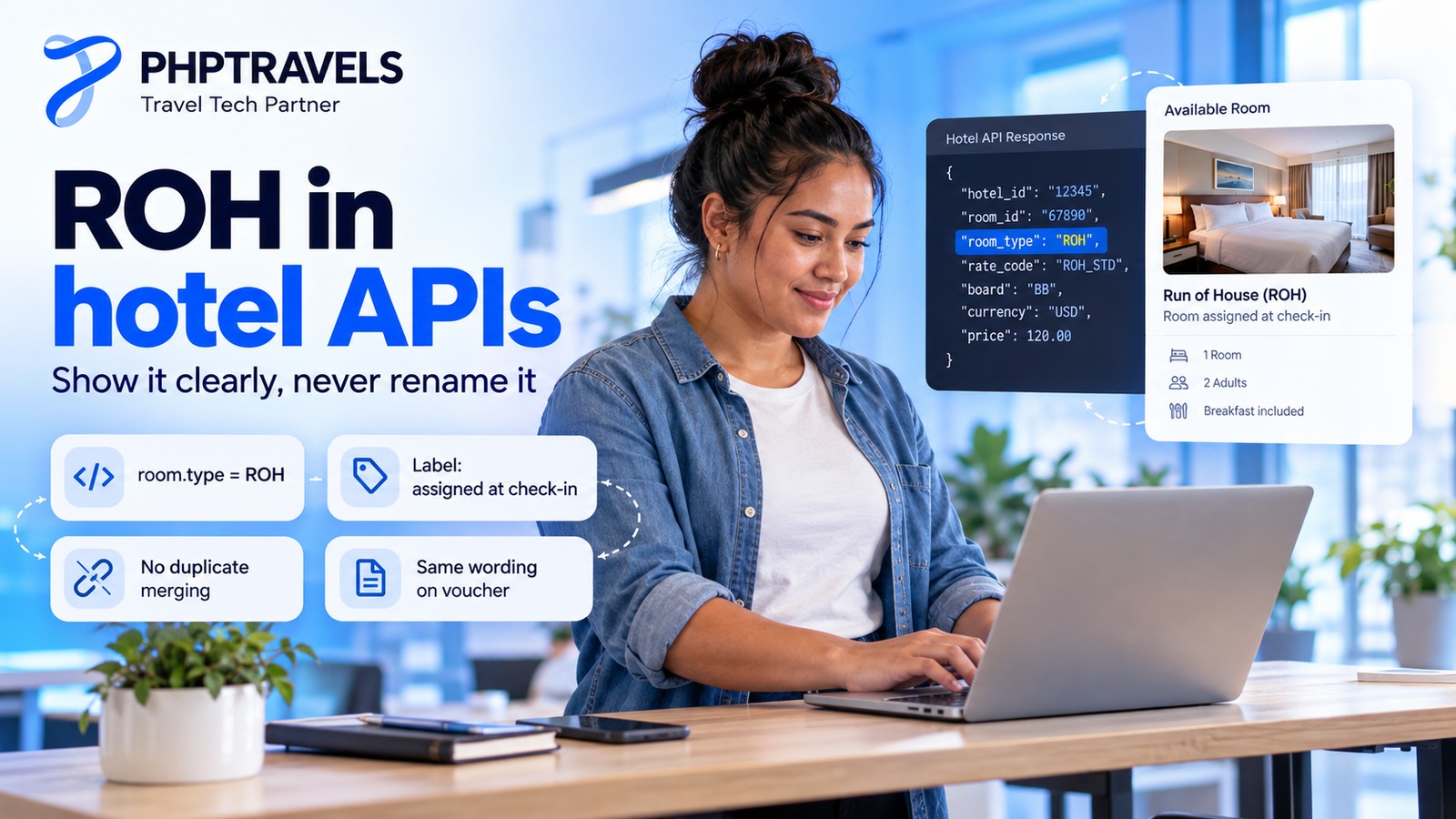
If you sell hotels online, ROH is not just a phrase; it is a code your booking engine has to display correctly.
The ROH room code
Room types in GDS-style hotel content are often short codes. In the Amadeus Self-Service Hotel Search API specification, the room type is a three-character code where the first character is the room category, the second the number of beds and the third the bed type, and the spec states there is “a special case where ROH is returned”, which “stands for Run Of House”. In other words, when that field says ROH, the API is telling you there is no room category to show.
When ROH appears by accident
ROH is not always a deliberate commercial choice. The help pages for Amadeus’s hotel administration portal explain that if a property does not create room type mappings for a channel, the room type code is displayed as ROH (Run of House) regardless of the room type created, although agents still see the room description. So an ROH code can mean “the hotel will choose your room” or simply “nobody mapped this room”. The description text, cancellation policy and price are what tell you which case you are looking at.
Wholesale and bed-bank feeds add another layer, because each supplier sends room names in its own format. Before you go live with a bed bank, it helps to know which calls return room and rate availability and which return static content; TravelsOTA’s Hotelbeds API integration guide walks through the booking API and content API split.
Display rules that prevent complaints
- Never rename ROH. Do not let “ROH” become “Standard Double” or “Deluxe” on your storefront because it looks better. The guest will hold you to the name you showed.
- Explain it in plain words. Show “Room type assigned by the hotel at check-in” beside the price.
- Keep ROH out of duplicate merging. An ROH offer is not the same product as a named room, so it should not be merged with “Deluxe King” from another supplier just because the price is close. Our guide to hotel room mapping explains how to keep room identity clean across suppliers.
- Carry the label to the voucher. The confirmation and hotel voucher should repeat the ROH wording so the front desk and the guest are reading the same thing.
Where PHPTRAVELS fits
PHPTRAVELS is self-hosted travel booking software with a Stays module that can connect hotel supplier APIs such as Hotelbeds, RateHawk, TBO Holidays and Stuba (the live list is on the integrations page; you bring your own supplier contracts and credentials). According to the Stays feature page, rooms are matched on hotel, room type, board and policy so only true duplicates are merged, each room shows its boards side by side with refundable or non-refundable labels and the free-cancellation deadline, and markups can be set per supplier, hotel, city, star rating or channel. Operators who contract hotels directly can load their own stays, rooms and room options, including in bulk from Excel, so a directly contracted ROH allocation can be listed as its own clearly named room. If you want to see how room and rate lines display, try the demo or price your setup.
Should You Book a Run of House Room?

ROH is a good deal for some trips and a bad one for others. A quick way to decide is to ask: “Would I be unhappy with the smallest standard room in this hotel?” If the answer is no, ROH is probably fine.
Good fit
- Solo travellers and couples who are happy in a standard room with any bed size.
- Short stays, late arrivals and transit nights, where you mainly need a bed and a shower.
- Conference and tour groups where the rate and room count matter more than individual room choice.
- Hotels where the room categories differ only slightly, so the downside is small.
Poor fit
- Guests who need an accessible room, specific bed configuration, connecting rooms or a cot.
- Honeymoons, anniversaries and other trips where the view or room category is part of what was sold.
- Families who need a room that genuinely fits three or four people comfortably.
- Resorts with very different room types (garden room vs overwater villa), where “any room” can mean very different stays.
Tips for travellers and agents
- Read the rate line before you pay. Whether you book on a global OTA or a local platform such as Bookin, which lists hotels, apartments and guest houses across Pakistan, check whether the room is named or says “Run of House” or “assigned at check-in”.
- Compare the price gap. If the cheapest named room is only slightly more than ROH, the named room is usually worth it.
- Make requests early and in writing. Bed type, quiet room and high floor requests are easier to honour before rooms are assigned. They remain requests.
- Arrive with a plan B. If the room assigned does not work (for example, one bed for two colleagues), ask at check-in what it would cost to move to a named category.
- Agents: write it on the quote. One line such as “Run of house: the hotel assigns the room type at check-in” prevents most complaints.
Run of house FAQ
What does ROH mean in a hotel booking?
ROH stands for run of house. You book a room at the hotel, and the hotel chooses which room or room type you get at check-in, based on availability.
Is a run of house room bad?
No. It is usually the hotel’s standard room, sometimes better. It is only a problem when the guest needs something specific, such as twin beds, a view or accessible features, that the rate does not guarantee.
Can I get upgraded with a run of house booking?
Sometimes. If the standard rooms are full, the hotel has to place you in a higher category. Treat that as luck, not as part of the deal.
Is run of house cheaper?
Often, because you give up the choice of room. Always compare it with the cheapest named room type on the same dates and terms before booking; the difference is sometimes very small. For trade buyers, our guide to getting better B2B hotel rates explains where net rates come from.
Run of house is a simple idea with a precise meaning: the stay and the price are fixed, the room is not. Hotels use it to sell every available room and to price group blocks. Travellers use it to save money when they are flexible. Agents and booking platforms protect themselves by showing ROH clearly, never renaming it, and keeping it out of duplicate matching. If you are building or upgrading a hotel booking site and want those room and rate lines to stay honest across suppliers, book a PHPTRAVELS demo.