When a pharmaceutical firm flies 400 distributors to Dubai for a three-day conference, or a tech company rewards its top sellers with an incentive trip to the Maldives, none of that happens by accident. Behind every business event of that scale sits a specialist discipline: MICE travel. It is one of the most demanding, highest-value segments in the entire travel trade, and it runs on a very different operating model than leisure or transactional online booking.
This guide explains what MICE travel actually involves at the operational level how a request becomes a confirmed program, the workflows that hold it together, the technology that powers it, and the mistakes that quietly destroy margins. It is written for the people doing the work: agencies, DMCs, tour operators, corporate travel teams, and the MICE companies building this as a core line of business.
Quick Summary
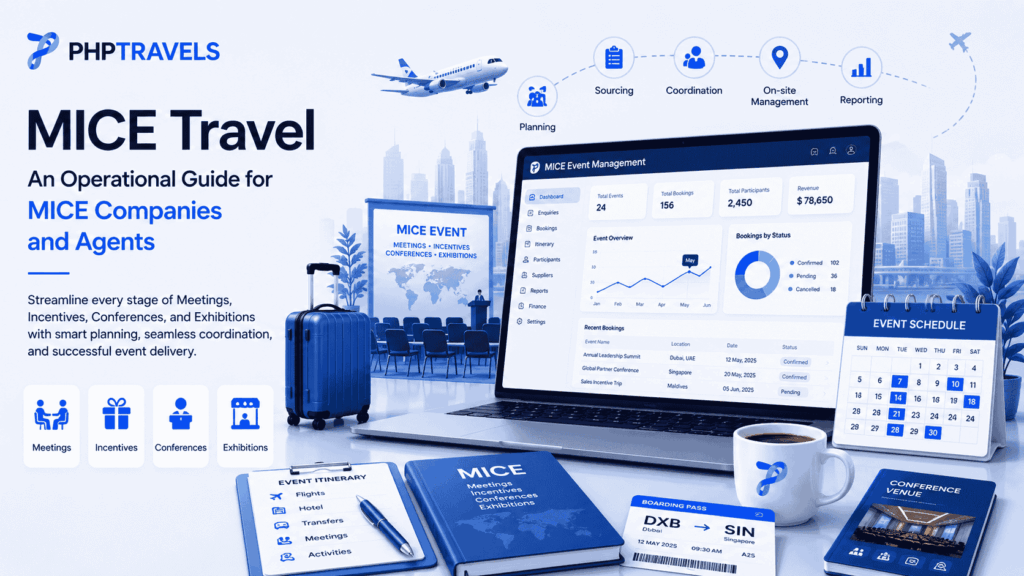
MICE stands for Meetings, Incentives, Conferences, and Exhibitions the business-events segment of travel. A MICE company or MICE agent sources venues, accommodation, transport, and event services for groups, then manages logistics, budgets, and on-site delivery end to end. The work is project-based, group-heavy, and document-intensive, which makes it operationally harder than standard travel sales. Margins live in sourcing, negotiation, and flawless execution, and modern MICE operators increasingly depend on group booking systems, supplier integrations, and centralized reservation tools to manage complexity at scale.
Why This Matters
MICE travel is where the highest-value, lowest-volume business in the industry sits. A single confirmed program can be worth more than hundreds of individual leisure bookings, and it usually comes attached to a long-term corporate relationship. That is the upside.
The downside is operational risk. A leisure booking that goes wrong affects one traveler. A MICE program that goes wrong affects an entire corporate client, their attendees, their event objectives, and your reputation across the sector. The buyers are professional, the budgets are scrutinized, and the tolerance for error is close to zero. This combination of high reward and high exposure is exactly why MICE deserves to be treated as its own discipline rather than a side service bolted onto a leisure agency.
What MICE Travel Actually Is
MICE breaks into four related but distinct categories.
Meetings are smaller, frequent, business-purpose gatherings board meetings, sales kick-offs, training sessions, client workshops. Volume is steady, lead times are often short, and repeat business is common.
Incentives are reward trips that companies give to top performers, distributors, or partners. The experience itself is the product, so the bar for quality, exclusivity, and memorable detail is extremely high.
Conferences are larger structured events built around content keynotes, breakout sessions, networking. They involve significant venue, AV, catering, and accommodation coordination across many attendees.
Exhibitions (and trade shows) bring buyers and sellers together around stands and booths. Here the travel operator often handles attendee and delegation logistics rather than the show floor itself.
A MICE company is an organization that specializes in delivering these programs. A MICE agent is the individual or agency professional who sources, plans, and manages them on behalf of a corporate client. The defining trait across all four categories is that the traveler is moving for business outcomes, not personal leisure, and they are moving as part of a managed group.
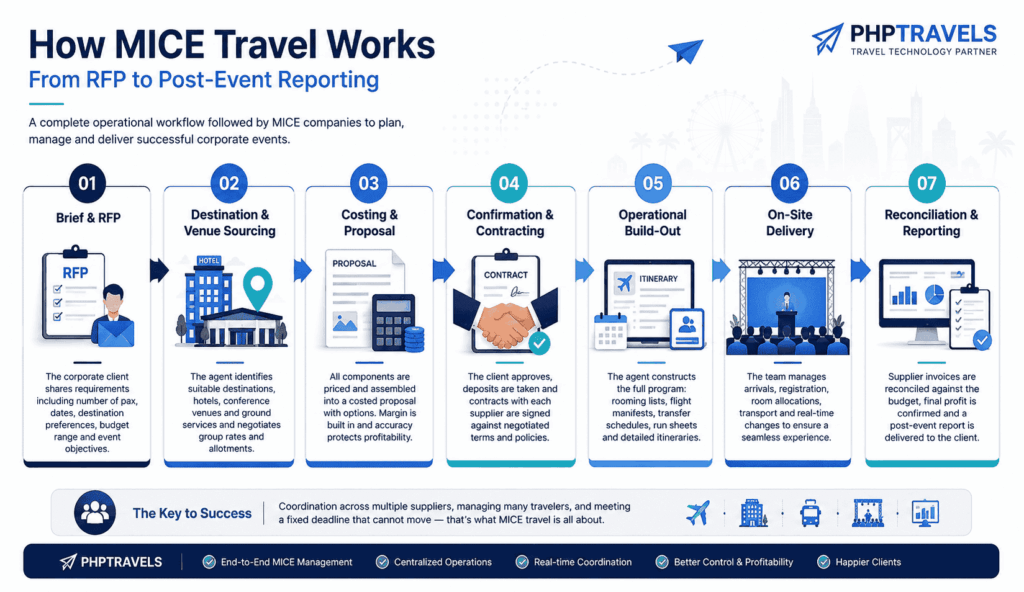
How MICE Travel Works, Step by Step
The operational lifecycle is consistent across program types even when the scale varies.
1. Brief and RFP.
A corporate client issues a request number of pax, dates (often flexible at this stage), destination preferences, budget range, and event objectives. The MICE company responds to this RFP with a proposed program.
2. Destination and venue sourcing.
The agent identifies suitable destinations, hotels, conference venues, and ground services. This is where relationships and inventory access matter most, because the agent is negotiating group rates and holding allotments that don’t exist in standard retail channels.
3. Costing and proposal.
Every component rooms, meeting space, transfers, meals, activities, AV, gala dinners is priced and assembled into a costed proposal, usually with options. Margin is built in at this stage, and accuracy here protects profitability later
4. Confirmation and contracting.
The client approves, deposits are taken, and contracts with each supplier are signed against negotiated terms, cancellation policies, and rooming blocks.
5. Operational build-out.
The agent constructs the full program: rooming lists, flight manifests, transfer schedules, event run sheets, and detailed itineraries for every participant or sub-group.
6. On-site delivery.
During the event, the team manages arrivals, registration, room allocations, transport, and the inevitable real-time changes late flights, dietary requirements, room swaps, last-minute attendee additions.
7. Reconciliation and reporting.
After the event, every supplier invoice is reconciled against the budget, the final profit is confirmed, and a post-event report is delivered to the client.
The thread running through all seven stages is coordination across many suppliers, many travelers, and a fixed deadline that cannot move.
The Technology Components Behind MICE
The complexity above is why MICE operations have steadily moved off spreadsheets and onto proper systems.
A group booking and reservation engine sits at the center. Unlike a transactional booking flow built for one traveler, a group system has to hold blocks of inventory, manage rooming lists, track partial payments, and let an agent adjust passenger counts without rebuilding the whole quote. The way a group reservation system differs from single-booking architecture is worth understanding for anyone building this capability; the mechanics are covered well in this overview of how a Hotel Reservation System Works.
Supplier connectivity feeds inventory and pricing into the platform. MICE programs pull from hotel bedbanks, ground operators, and activity suppliers, and increasingly these come through direct connections rather than email and PDFs. A practical primer on the providers behind this sits in this guide to Travel API Suppliers.
Air content matters because most MICE programs involve flying groups in. Air inventory historically flows through GDS systems, and a clear explanation of that layer is available in this piece on the Global Distribution System (GDS). Newer NDC connections give richer fare and ancillary content, which is increasingly relevant for group air sourcing.
A CRM layer holds the client relationship, the history of past programs, and the pipeline of future RFPs. Because MICE is repeat-relationship business, a Travel CRM is often the difference between winning the next program and losing it to a competitor who remembered last year’s preferences.
Multi-currency and finance handling is essential the moment a program crosses borders, because suppliers invoice in their local currency while the client is billed in theirs.
Finally, reporting and analytics close the loop, turning event data into the profit reconciliation and client report that every program ends with.
Real Business Use Cases
A corporate travel team uses MICE capability to run internal events sales conferences, leadership offsites, training programs with policy compliance and budget control built in.
An incentive house specializes purely in reward travel, where the entire value is the experience. These operators win on creativity, exclusivity, and execution rather than price.
A DMC (destination management company) handles the ground side venues, transport, local activities, on-site staff on behalf of agents and corporates who don’t have local presence.
A full-service travel agency adds MICE as a high-margin line alongside leisure and corporate, often using it to deepen relationships with business clients it already serves. Agencies looking to move in this direction will recognize the relationship dynamics in this guide on how to get corporate clients for a travel agency.
Common Challenges in MICE Operations
Inventory at scale.
Holding 200 rooms across a fixed set of dates is a fundamentally different problem from booking one room. Allotments, release dates, and attrition clauses all carry financial risk.
Constant change.
Attendee counts shift until the last minute. Flights move. Requirements appear late. The operation has to absorb change without losing the budget.
Margin erosion.
Profit assumed at proposal stage leaks away through unbudgeted extras, currency movement, and supplier invoice discrepancies if reconciliation is weak.
Coordination overhead.
A single program can involve a dozen suppliers across multiple time zones, each with its own contract, deadline, and payment schedule.
Documentation volume.
Rooming lists, manifests, run sheets, and itineraries multiply across attendees, and manual handling of these is where errors creep in.
Implementation Considerations
Operators building or upgrading MICE capability should weigh a few things before committing.
Decide whether you need group-specific functionality rather than a transactional booking tool the two are not interchangeable. Assess your supplier connectivity: which bedbanks, ground operators, and air sources you can plug in directly versus manage manually. Plan for multi-currency and finance from the start rather than bolting it on later. Consider whether you operate B2B, B2C, or both, since corporate clients and direct attendees need different access models; the distinction is well framed in this B2B travel portal guide. And build a reconciliation process before your first large program, not after it, because that is where profit is protected or lost.
Mistakes Businesses Make
The most common failure is treating MICE like leisure, applying a single-booking mindset to group programs and getting buried in manual work. Close behind is under-pricing risk accepting attrition and cancellation terms without modeling the downside. Many operators neglect reconciliation, assuming the proposed margin is the realized margin when it rarely is. Some rely entirely on email and spreadsheets, which works until the program scales past what a human can track, at which point errors become expensive. And a surprising number win the program but forget the relationship, failing to capture preferences and history that would secure the repeat business that makes MICE profitable over time.
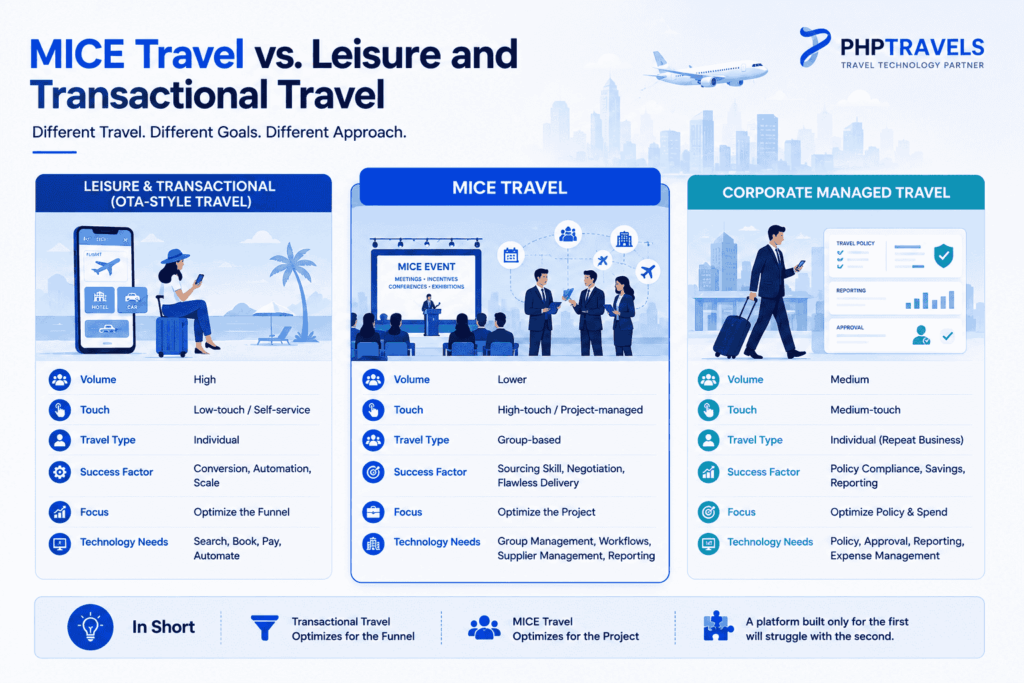
MICE Travel vs. Leisure and Transactional Travel
The contrast clarifies why MICE is its own discipline.
Leisure and transactional OTA-style travel is high-volume, low-touch, individual, and largely self-service. Success comes from conversion, automation, and scale. MICE is the inverse: lower volume, high-touch, group-based, and project-managed, where success comes from sourcing skill, negotiation, and flawless delivery.
Corporate managed travel sits between the two repeat business travel with policy and reporting, but usually individual trips rather than coordinated group programs. MICE shares its client base and CRM discipline but adds the group logistics layer on top.
In short, transactional travel optimizes for the funnel; MICE optimizes for the project. A platform built only for the first will struggle with the second.
Future Trends in MICE Travel
Several shifts are reshaping the segment. Automation is moving repetitive work rooming list updates, payment tracking, document generation off human hands. AI applications are starting to support faster proposal building, smarter destination matching, and on-site assistance for attendees. NDC and richer air content are improving group air sourcing beyond traditional GDS limitations. Integrated finance and reporting are becoming standard rather than optional, as corporate buyers demand transparency. And hybrid and virtual components continue to blend into physical events, adding a digital layer that operators increasingly need to coordinate alongside the travel itself. The broader direction is captured in this overview of the future of travel technology.
How PHPTRAVELS Supports MICE Operations
For operators who want the systems behind all of this in one place, PHPTRAVELS provides the underlying travel technology stack that MICE companies and agents depend on. The platform brings together booking and reservation handling, hotel and flight supplier integrations, multi-currency operations, and a travel CRM within a single environment, so a MICE team can manage sourcing, group logistics, client relationships, and reconciliation without stitching together disconnected tools.
Because MICE work spans both business clients and direct attendees, the platform supports B2B and B2C models, white-label portals, and the supplier connectivity that group programs rely on. Operators building group capability specifically can explore the dedicated group travel management software. The goal is the same in both cases: give MICE operators the operational backbone to handle complexity reliably, protect margin, and deliver programs that win repeat business.
Conclusion
MICE travel rewards operators who treat it as a serious operational discipline rather than an occasional service. The value is real high-margin programs attached to long-term corporate relationships but so is the risk, and the difference between the two usually comes down to sourcing skill, disciplined reconciliation, and systems built for group complexity rather than single bookings. Get those three right, supported by the right technology, and MICE becomes one of the most durable and profitable lines a travel business can build.