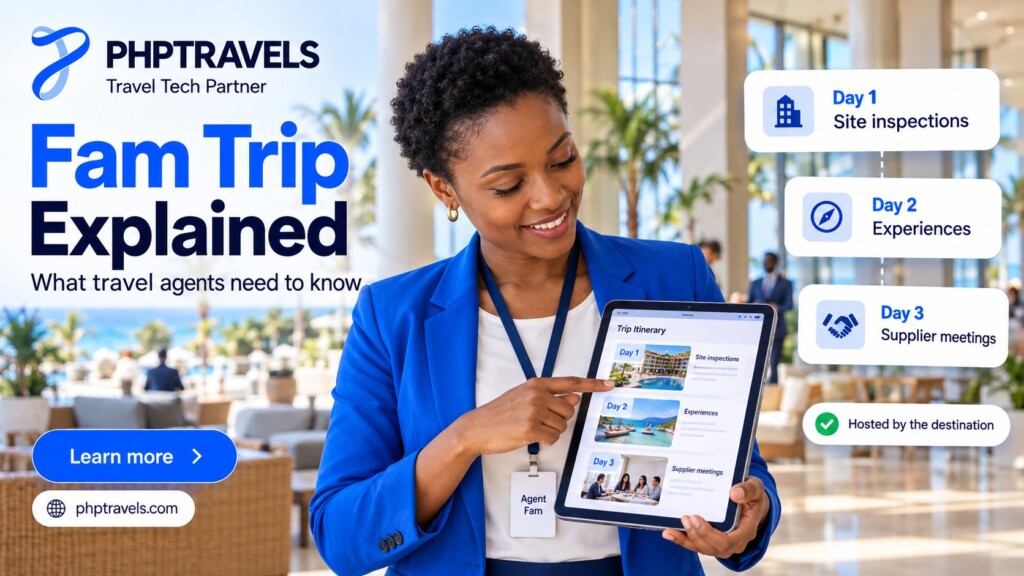
A fam trip is a short, usually free or heavily discounted trip that a destination, hotel, cruise line, tour operator or DMC offers to travel agents so they can see a product before they sell it. The idea is simple: an agent who has slept in the room, walked the transfer route and met the guide will sell that product with more confidence, and to the right clients.
The reality is less simple. Most fam trips are working trips with early starts and back-to-back site visits, the best ones are invite-only, and they only pay off if the agent turns what they saw into bookings. This guide explains what a fam trip is, who hosts them and why, how agents get invited, what they cost, and how both sides (the agent and the host) can measure whether the trip was worth it.
- Fam trip meaning: FAM is short for familiarization (familiarisation in British and Australian English). A fam trip is an educational trip for travel trade professionals.
- Who hosts: tourism boards, hotels and resorts, cruise lines, tour operators, DMCs, airlines, host agencies and consortia.
- Who goes: travel agents and advisors, tour operator product managers and, on media fams, journalists and creators.
- Cost: anything from fully hosted to a participation fee, often with flights or tips excluded.
- How to get one: a sales record in the destination, the host’s specialist training and a relationship with the host.
What is a fam trip?
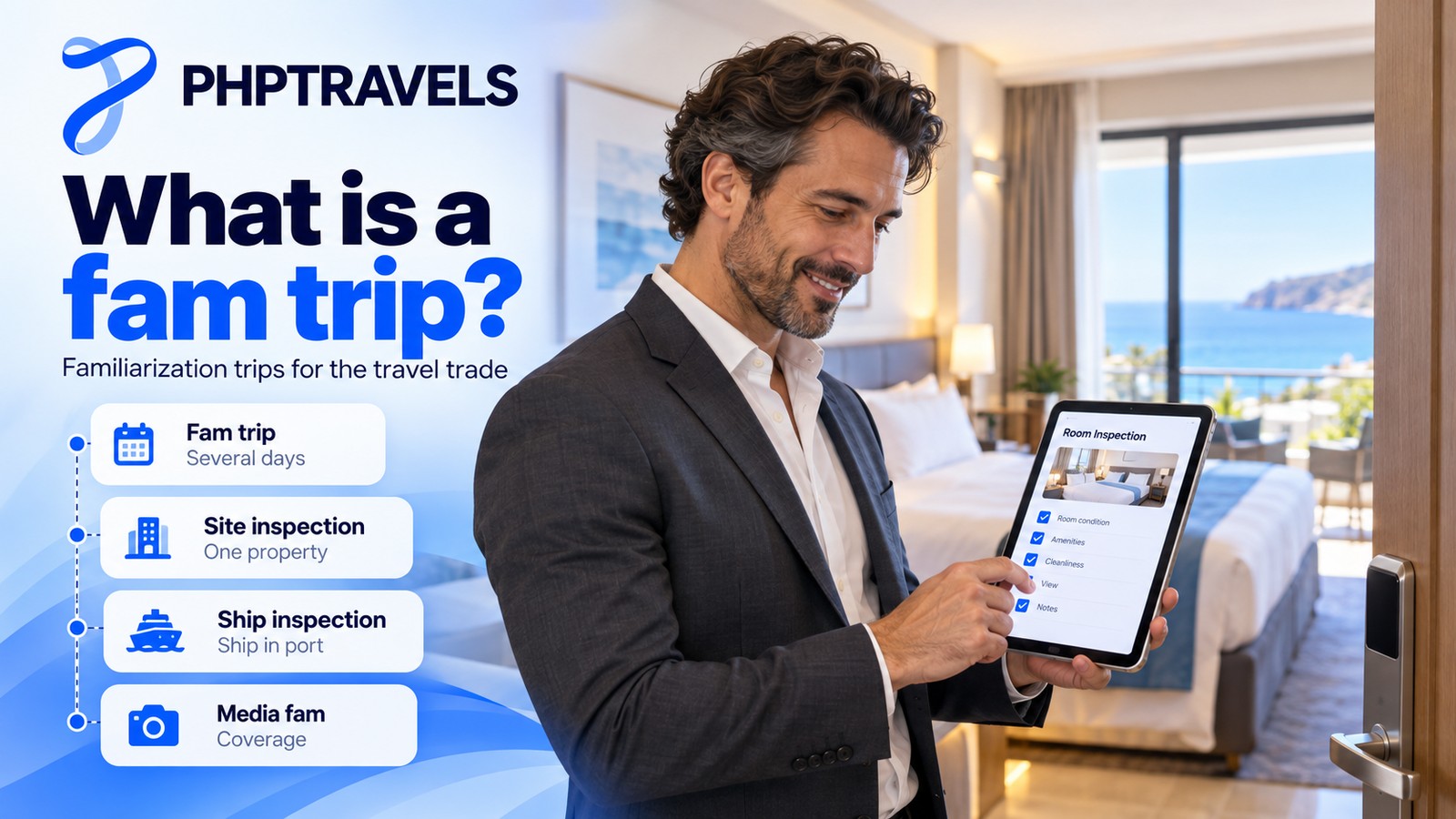
A fam trip (also called a fam tour or familiarization trip) is a trip organised by a travel supplier or destination for travel sellers, with the aim of teaching them about a product so they can sell it. The hotel-industry glossary at Xotels describes FAMs as trips organised by tour operators, airlines, hotel chains, tourism boards or other destination bodies to educate the trade about their products and services, usually free of charge or at a discounted fee. Host Agency Reviews adds industry associations, host agencies and consortia to the list of hosts.
The word is trade jargon, not a consumer term. FAM has nothing to do with family; partners or “plus ones” are allowed on some trips, often at an extra cost, but most fams are for the advisor alone. A fam is also not the same thing as travel agent rates. Agent rates are discounts on personal holidays; a fam is a structured programme with a host, an itinerary and an expectation that you will learn and later sell.
Fam trip vs site inspection, ship inspection, press trip and incentive trip
Several trade trips get lumped together under “fam”. The differences matter because they change who pays, how long the trip is and what the host expects back.
| Trip type | Who goes | What it is | Typical length |
|---|---|---|---|
| Fam trip (fam tour) | Travel agents, tour operator staff | A hosted programme across a destination or product range: hotels, activities, transfers, meals with suppliers | Several days |
| Site inspection | An agent, planner or buyer | A visit to one property or venue to check rooms, public areas and facilities, often part of a fam | An hour to a day |
| Ship inspection | Cruise sellers | A tour of a cruise ship while it is in port | A few hours |
| Seminar at sea | Cruise sellers | Training delivered while sailing on the ship | A short cruise |
| Media or press fam | Journalists, writers, creators | A hosted trip aimed at coverage rather than bookings | Several days |
| Award or incentive fam | Top-producing agents | A reward trip for sales performance that still includes some product visits | Several days |
The cruise terms come from industry usage: Host Agency Reviews notes that cruise fams are often called seminars at sea when you sail, and ship inspections when you tour the ship in port. Meetings and events buyers use the same idea at a larger scale; if you sell conferences and incentives, our guide to MICE travel covers how that side of the trade works.
Who hosts fam trips, and what they want back
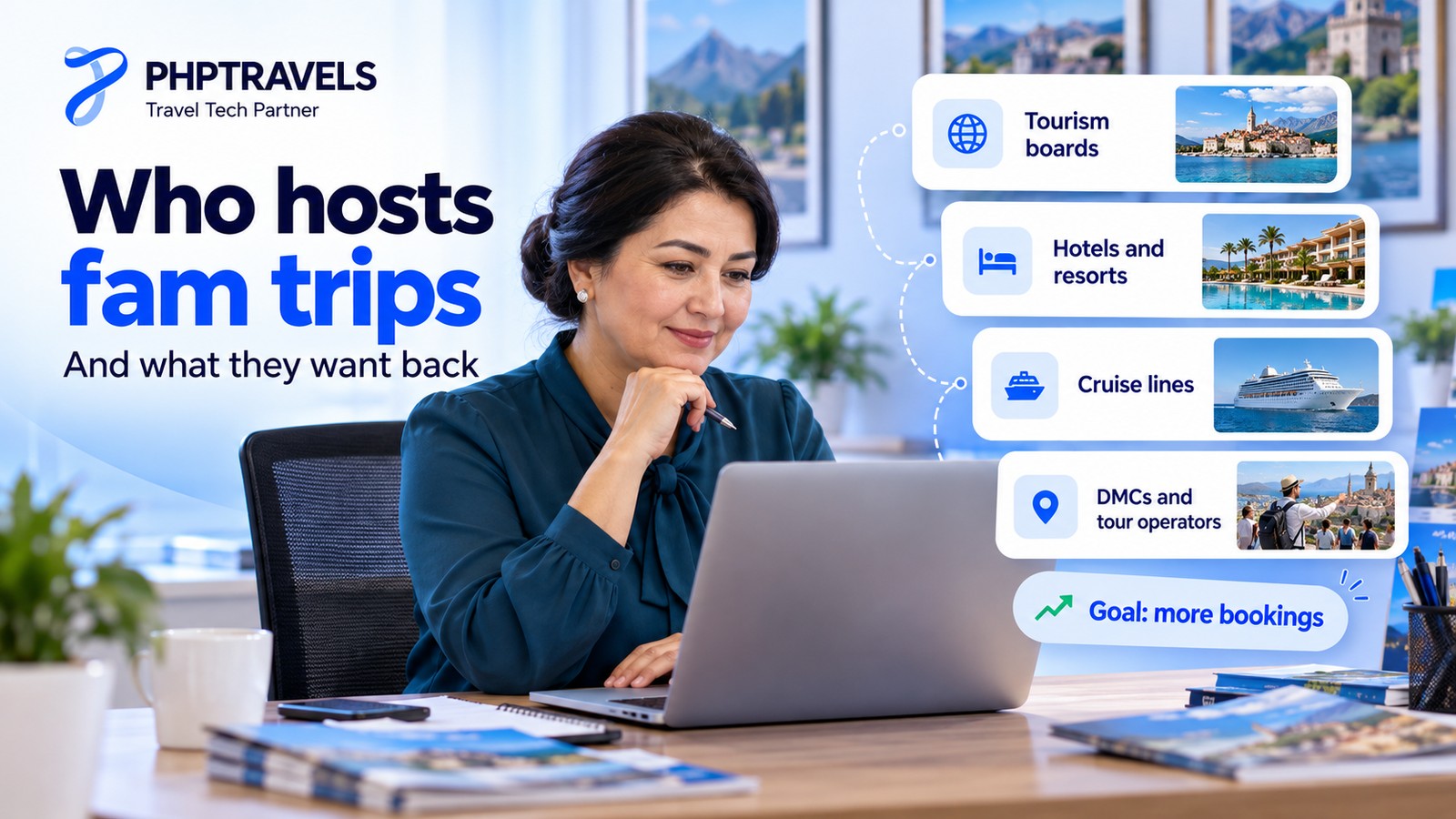
A fam trip is a marketing cost. Every host is paying for hotel nights, guides, transport and staff time because it expects the agents on the bus to send more, or better-matched, clients later. Knowing what each host wants back is the fastest way to get invited, and invited again.
Tourism boards and destination marketing organisations
National and regional tourism boards run some of the largest fam programmes, and they tie them closely to agent training:
- Brand USA runs Destination Immersions, which its own events page says were formerly known as MegaFams and give travel trade professionals first-hand experience of US destinations. For the UK and Ireland in 2026, Travel Weekly reported that 60 agents would travel from 23 April to 1 May, selected by logging bookings on partner airlines between 1 January and 28 February and completing a badge on the USA Discovery Programme.
- Tourism Australia keeps in touch with qualified Aussie Specialists through newsletters, trade events and familiarisation trips, according to its Aussie Specialist Program page. The programme’s terms and conditions state that Australian-based inbound tour operators can join with a restricted list of benefits that does not include familiarisation trips, which shows how clearly fams are aimed at the agents who sell to travellers.
- India’s Ministry of Tourism lists inviting “social media influencers, tour operators and opinion makers to visit the country under the Hospitality Programme of the Ministry” among its promotion activities in a 2024 statement to Parliament.
What they want back: more agents recommending the destination, sold with accurate detail, and itineraries that include places beyond the obvious first stop.
Hotels, resorts, cruise lines, tour operators and DMCs
Suppliers host smaller, product-specific fams. A resort group may fly ten agents in to see three properties; a cruise line may invite local agents to a ship inspection while the ship is in port; a destination management company may show overseas tour operators the hotels, guides and excursions it can package for them. Cruise lines also use training credentials: CLIA’s professional development programme includes ship inspections (when available) at its Live Learning Events, and offers virtual ship inspections to members that count towards CLIA certification.
What they want back: bookings into their product, the right type of client for it, and agents who can describe the difference between room categories without guessing.
Host agencies and consortia
Host agencies and consortia negotiate fams for their member advisors. Host Agency Reviews notes that the most generously subsidised fams are often not advertised at all: they are invite-only or need an application, and network fams may come with sales requirements.
Types of fam trips
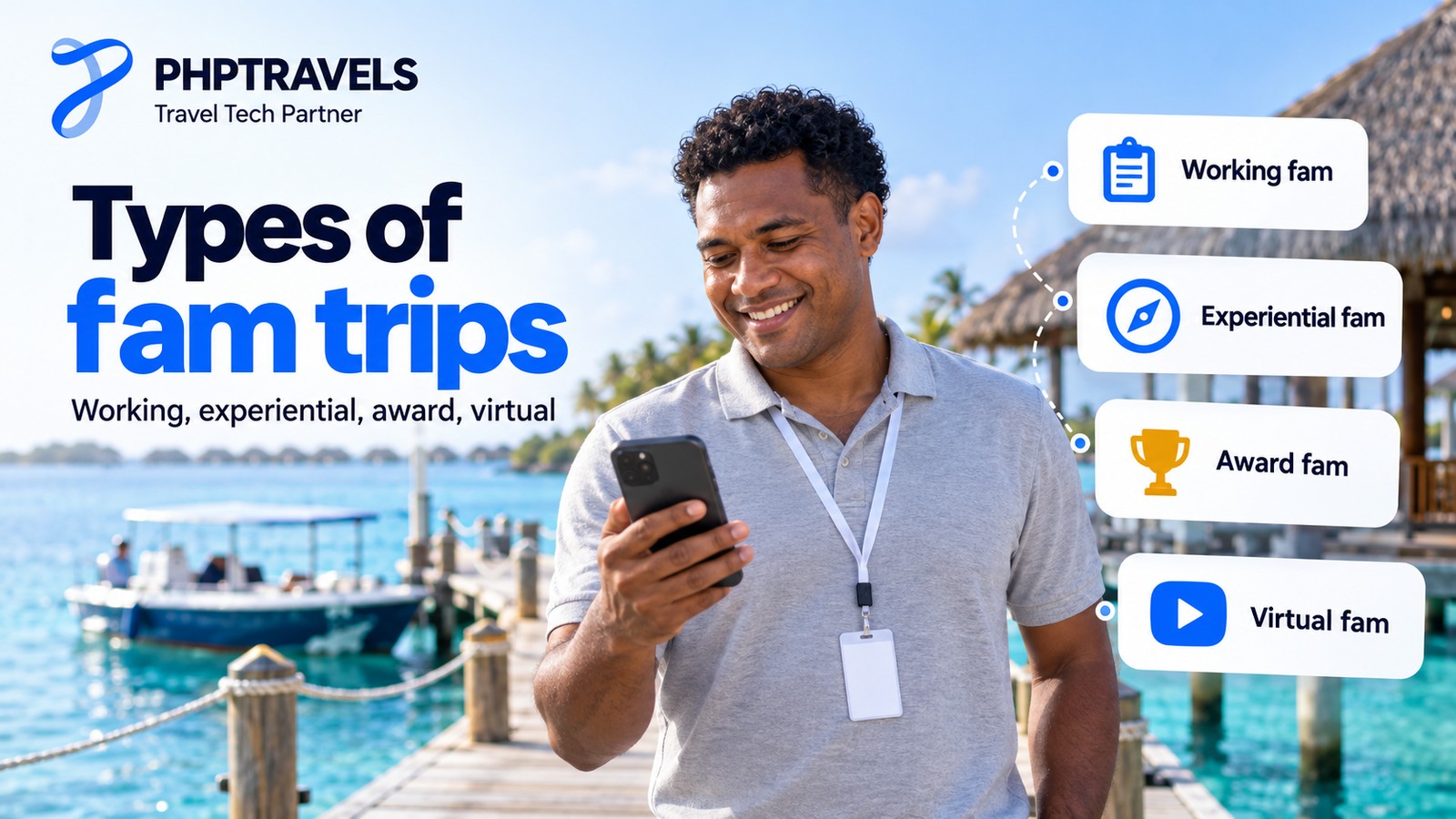
No official classification exists, so the labels below are descriptive. They are still useful, because the type tells you how much free time you will have, what you will pay and what the host will expect afterwards.
Working fams
The most common kind. Days start early and are filled with site inspections, hotel lunches, activity samples and dinners with supplier staff. You might see four or five properties in a day.
Experiential fams
Still educational, but with fewer properties and more time doing what the client would do: a cooking class, a full-day safari, a long trek. They are better for learning how an experience feels: walking distances, heat, waiting times, how early the pickup really is.
Award fams
Reward trips for top-producing agencies. They are usually fully hosted and lighter on inspections, because the host is thanking proven sellers rather than educating new ones.
Paid or subsidised fams
Many fams are not free. The agent pays a participation fee and the host covers the rest. As an example, TravelPress reported that Tourism Australia’s G’day Australia 2024 programme for Canadian Aussie Specialists had a participation fee of C$700 that included accommodation, the workshop, fam activities and international return flights from Vancouver. That is a real cost for an independent advisor, so it deserves the same return-on-investment thinking as any other business expense.
Virtual fams
Webinars, video walk-throughs and virtual ship inspections teach the basics without travel. They are cheap for both sides, but they cannot show you how long the transfer really takes.
Media fams
Press trips for journalists and creators, aimed at coverage rather than bookings. The disclosure rules below apply directly.
How travel agents get invited on fam trips

Hosts have limited seats, so they pick agents they believe will sell. Almost every selection rule comes back to three things: proof of sales, proof of training and a relationship with the host.
Build a sales record the host can see
The clearest signal is bookings. Brand USA’s UK and Ireland programme selected agents partly on the airline bookings they logged during the qualifying window. Its Latin America 2027 programme, run with United Airlines, asks agents in Colombia, Mexico and Brazil to make eligible United bookings with a specific tour code (026MF), register each booking and reach the next level of the USA Discovery Program between 15 August and 30 November 2026. A tour code lets the airline and the tourism board count exactly which agent produced which ticket, which is why it is a selection tool. Host Agency Reviews puts it plainly: the main requirement, after being an agent, is being a producing one; new advisors are invited only rarely, usually when they can show a client network that fits the trip.
Finish the specialist training
Destination and supplier training programmes are often the gate to their fams. Tourism Australia’s G’day Australia 2024 required applicants to complete the Introduction to Australia curriculum and the Western Australia course before applying. Even when training is not mandatory, a completed specialist course tells the host you will not need the basics explained on the bus.
Get into the right databases
Register as an advisor with the suppliers, tourism boards and DMCs you sell; that is usually how fam invitations are sent out. Make sure your credentials are in order before you apply. Our guide to the travel agent ID card explains which industry IDs suppliers recognise and what they do and do not unlock. If you are still setting up, start with how to become a travel agent and whether you need a licence to be a travel agent, because a fam host will ask who you sell for.
Write an application a host can say yes to
When a fam needs an application, keep it short and specific:
- How many trips you sold to that destination or brand in the last 12 months, and their typical value.
- Which client type you would send there (families, honeymooners, small groups, Umrah or faith travellers, adventure travellers).
- Which of the host’s products you already sell and which you want to add.
- What you will produce afterwards: a client email, a presentation to your agency, social posts.
Hosts remember behaviour too: turn up on time, attend every scheduled visit, do not bring an unannounced guest, and send a thank-you with your follow-up plan.
What fam trips cost, and the fine print agents miss
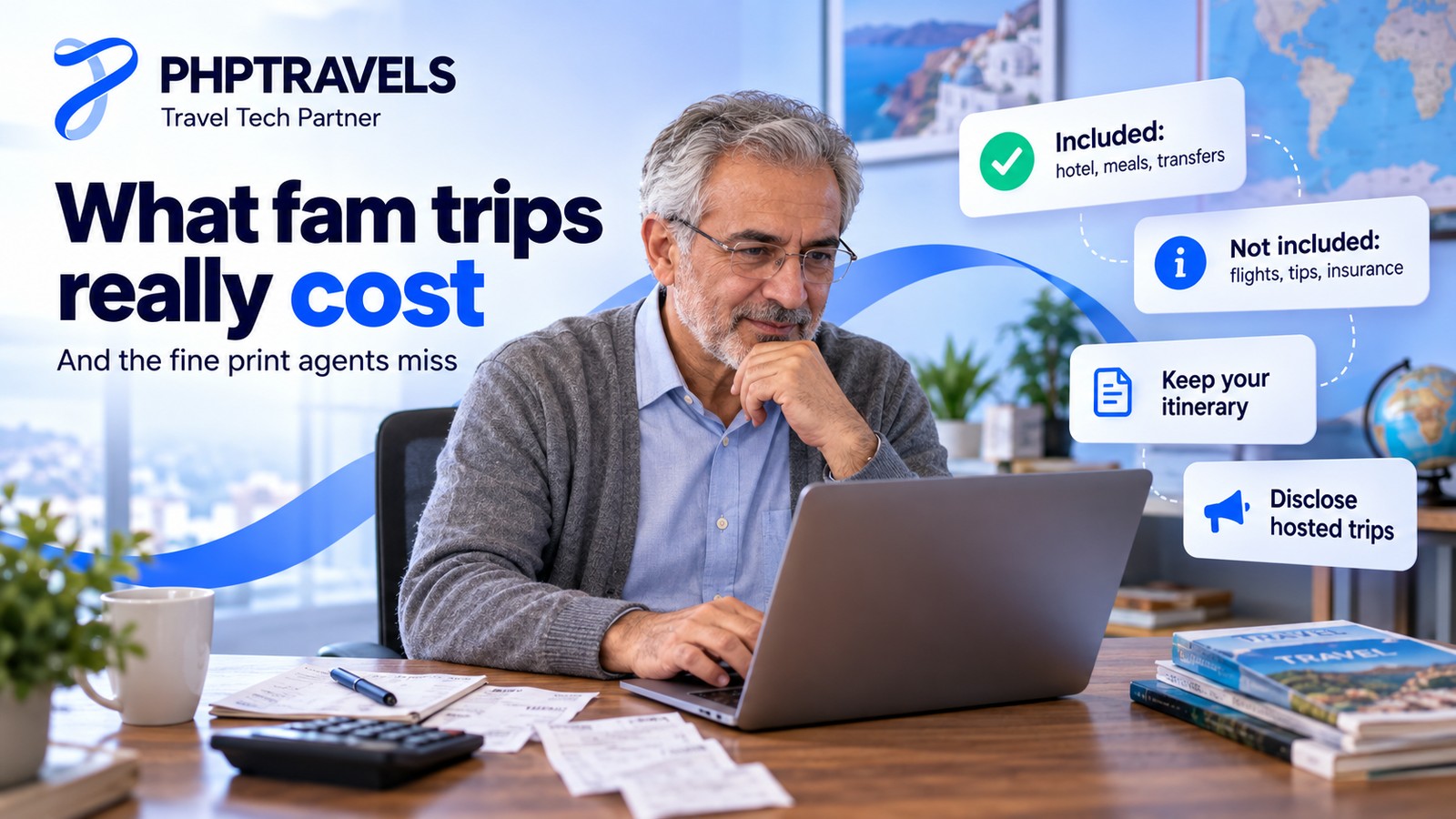
Fam prices range from fully hosted to a modest discount. Host Agency Reviews lists lodging, meals, excursions and transfers as what is generally included, and airfare, tips for drivers, guides and hotel staff, and your own travel insurance as what usually is not. Treat that as a starting point, then read each fam’s own terms for cancellation fees, no-show penalties, single supplements and whether a companion is allowed.
Taxes: business trip or holiday?
Tax rules depend on your country and your business structure, so check with an accountant. For US-based advisors, the IRS explains in Publication 463 that travel expenses can be deducted when a trip is entirely or primarily for business, and only the business part when personal days are added. It also warns that “a trip to a resort or on a cruise ship may be a vacation even if the promoter advertises that it is primarily for business.” Keep the itinerary, the host’s invitation and your notes from each site visit; they are your evidence that the trip was work.
Disclosure when you post about a hosted trip
Agents post a lot from fams, and hosts want them to. In the US, the FTC’s endorsement guides (16 CFR Part 255) say a material connection between an endorser and a seller must be disclosed clearly and conspicuously when the audience would not expect it, and that free or discounted products count as a material connection. A hosted fam is exactly that. A simple line such as “hosted by XYZ Resort on a travel agent fam trip” in the post itself, not only in your profile, keeps you and the host on the right side of the rule. Other countries have their own advertising codes, so follow the local one too.
How to turn a fam trip into bookings

A fam is only a perk if nothing changes afterwards. Advisors who get value from fams treat them like a sales project with a before, a during and an after.
Before: decide who you are going for
Pick two or three real client profiles before you leave: a couple who want a quiet beach, a family with a toddler, a group of six friends. On every visit, ask “would I send them here, and to which room?” That turns a blur of lobbies into decisions.
During: take notes you can sell from
Brochures already tell you the room count. Your notes should capture what only a visit can:
- Room categories you would and would not sell, and why (view, noise, distance from the lift, connecting rooms).
- Real transfer times from the airport and between places.
- Accessibility: steps, ramps, lifts, beach access.
- Which meals and drinks the board basis actually includes; our guide to hotel meal plans explains the codes.
- The name and email of the sales or reservations contact you met.
- Your own photos and short videos, taken with permission, for client emails.
After: follow up within a week
Send past clients who match each profile a personal note within days, while the details are fresh. Present the trip to your agency team so the knowledge spreads beyond one person. Then log each enquiry the fam produces so you can see later whether it paid off. A travel agency CRM makes that easier; Travel CRM System, for example, lists lead capture with follow-up tasks and reminder automation, which is exactly the job after a fam: every interested client gets a reminder instead of being forgotten in the inbox.
A worked example: does the fam pay for itself?
Here is a simple way to check, with illustrative numbers. Suppose an independent advisor pays a C$700 participation fee (the G’day Australia level mentioned above) and spends about C$300 on tips, insurance and incidentals, so the trip costs C$1,000 in cash. The advisor also loses six selling days.
| Item | Illustrative figure |
|---|---|
| Cash cost of the fam | C$1,000 |
| Average package value sold to the destination | C$8,000 |
| Commission rate on that package (varies by supplier and contract) | 10% |
| Commission per booking | C$800 |
| Bookings needed to recover the cash cost | 2 (C$1,600) |
Two bookings in the following year cover the cash cost; anything after that is return on the time invested. If the advisor has no clients for that destination and no plan to find them, the same trip is a holiday, however busy the itinerary. Our article on how travel agencies and travel agents make money explains commissions and markups in more detail.
Running a fam trip as a supplier, DMC or tour operator
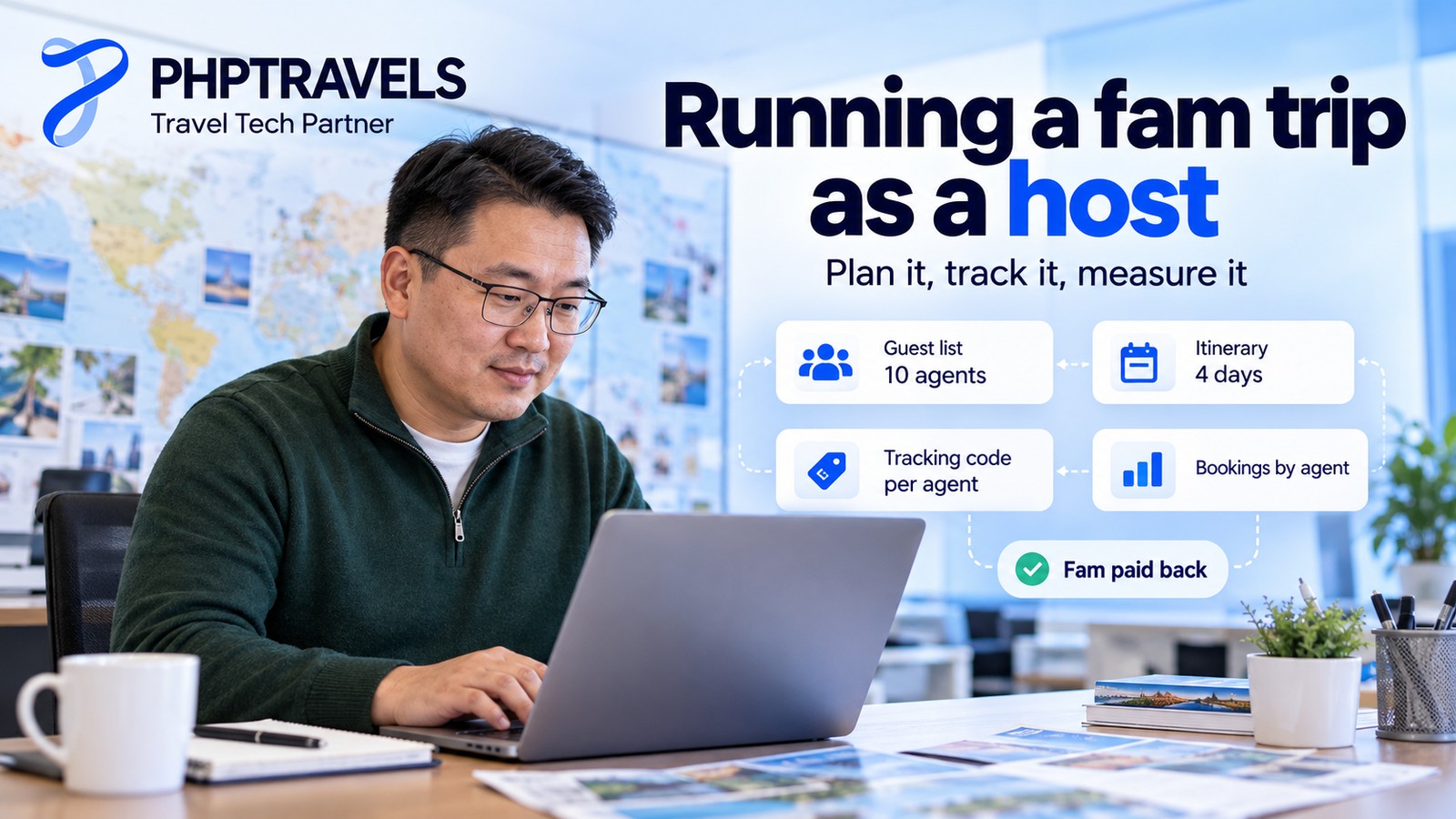
From the host’s side, a fam is a sales campaign with a travel budget, and it should be planned like one.
Planning checklist
- Objective: one sentence, such as “get ten UK agents selling our new three-night desert circuit”.
- Guest list: agents with a sales record in your source market and the right client type, not only the most enthusiastic applicants.
- Group size: small enough to fit one vehicle and one guide per group; large groups see less and ask fewer questions.
- Itinerary balance: enough site inspections to educate, enough real experiences to remember, and some free time so agents do not leave exhausted.
- Partners: hotels, activity providers and transport companies often contribute rooms or services in exchange for the exposure; agree this in writing.
- Tracking: give every attendee a unique code or agent account so you can count the bookings each one makes afterwards, just as the Brand USA and United campaign uses a tour code.
- Follow-up kit: rate sheets or a booking link, photo library, a named contact and a deadline for any fam-only offer.
The follow-up kit is where many fams lose momentum. Agents who come home to a bookable product can sell it the same week; agents who come home to a PDF rate sheet have to email for availability first. Even a basic tours module covers the minimum: TravelBookingPanel’s tour package software page, for example, describes day-by-day itineraries, a seat limit for each departure date and deposits, which is enough for an agent to book the circuit they just travelled for a client.
Measuring the return
Count bookings and margin from attendees over 6 to 12 months and compare them with the full cost, including staff time. With illustrative numbers: if a DMC spends US$15,000 hosting ten agents and those agents book 25 trips in the next year at US$3,000 each, that is US$75,000 in sales; at a 20% margin it returns US$15,000, so the fam has just paid for itself. If you cannot see which agent booked what, you cannot run this calculation, and the next fam budget becomes a guess.
Where PHPTRAVELS fits
The hard part for a tour operator or DMC is not the trip itself. It is giving agents a way to book what they just saw, at their trade price, and seeing afterwards which agent booked what. That is a booking-system problem.
PHPTRAVELS is travel booking software that agencies, tour operators and DMCs install and run as their own (self-hosted, source code included under a commercial licence). Its tour operator software lets you build tours day by day, open departures with live seat counts, and sell them on your website, in your office and through agents. The B2B travel portal gives each agent their own login to search and book at the rates you set, with markup layers and credit limits per agent group, and B2B and B2C bookings land in the same admin and reports. The tours module also lets partner operators use the same tour builder from their own login. In practice, the circuit agents saw on the fam can be a live tour product in the portal they log into the day they get home, and each booking is tied to the agent account that made it. For DMC-specific needs, see the destination management system page.
Other tools can do the job too, and a small operator that only publishes a few packages may need much less. PHPTRAVELS does not supply inventory or agent networks: you bring your own products, supplier contracts and trade partners. If you want to see how agents would book your tours, open the PHPTRAVELS demo (it includes the agent portal), then build a quote for the modules you need on the pricing page.
Fam trip FAQ
What does FAM stand for in travel?
FAM stands for familiarization (familiarisation in British and Australian English). A fam trip is a familiarization trip for travel trade professionals.
Are fam trips free for travel agents?
Some are fully hosted. Many charge a participation fee, and most leave out some costs such as flights, tips and travel insurance. Read each fam’s terms before you accept.
Can a new travel agent go on a fam trip?
Occasionally. Hosts prefer producing agents, so new advisors improve their chances by completing the destination’s specialist training, joining a host agency or consortium, and showing a client base that fits the trip.
What is the difference between a fam trip and a site inspection?
A site inspection is a visit to one hotel or venue to check its rooms and facilities. A fam trip is a multi-day programme that usually includes several site inspections plus activities, transfers and meetings with suppliers.
Key takeaways
A fam trip is a sales investment dressed as travel. Agents get invited by selling the destination, finishing the host’s training and keeping relationships warm; they get value by going with client profiles in mind, taking notes they can sell from and following up within a week. Hosts get value by choosing the right agents, tracking bookings per attendee and making the product easy to book the moment agents get home.