
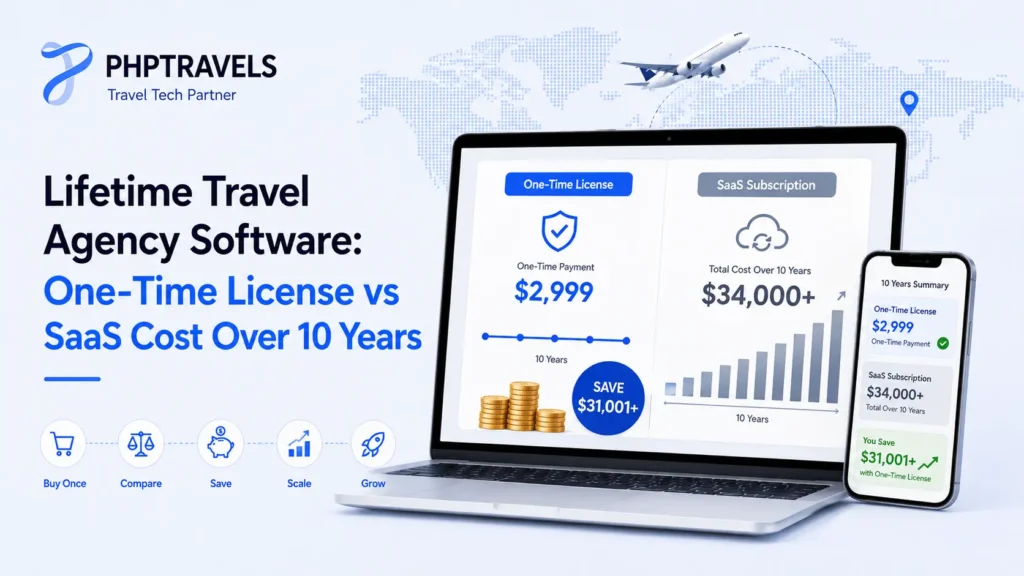
Lifetime travel agency software can reduce recurring license fees, but pay once does not mean every future cost disappears. Hosting, supplier APIs, payment gateways, maintenance, upgrades, custom development, mobile apps and migration can all affect the real total.
The best way to compare a one-time license with SaaS is to calculate the full cost after 1, 3, 5 and 10 years. This guide gives you a transparent method, an example calculator and a practical checklist.
What Is Lifetime Travel Agency Software?
Lifetime travel agency software normally means that you pay once for the right to use a licensed version of the platform for an indefinite period. It is also called a perpetual license.
A SaaS platform works differently. You pay monthly or annually to keep using the system. When the subscription stops, access usually stops too.
A lifetime license applies to the software license, not automatically to connected services. Confirm the included version, source-code rights and support terms. For related modules, see travel agency management software.
Does “Lifetime” Mean the Software Is Free Forever?
No. It may remove the recurring platform license fee, but you may still pay for:
- Web hosting and servers
- Domain and SSL renewals
- Travel supplier or GDS APIs
- Payment processing
- Technical support
- Security maintenance
- Major version upgrades
- Custom features
- Mobile application updates
What Is the Difference Between a One-Time License and SaaS?
With Software as a Service (SaaS), the provider runs the application on cloud infrastructure, while customers typically access it through a browser or software interface.
| One-Time License | SaaS Subscription |
|---|---|
| Higher upfront cost | Lower upfront cost |
| No continuing core license fee in many cases | Monthly or annual payments continue |
| May be self-hosted | Usually hosted by the vendor |
| Greater control may be available | Vendor controls the main platform |
| Maintenance may be separate | Routine updates are often included |
| Easier to budget over a long period | Easier to start with limited capital |
Neither model is automatically better. Startups may value SaaS’s lower entry cost, while growing agencies may prefer more control over data, integrations and customization.
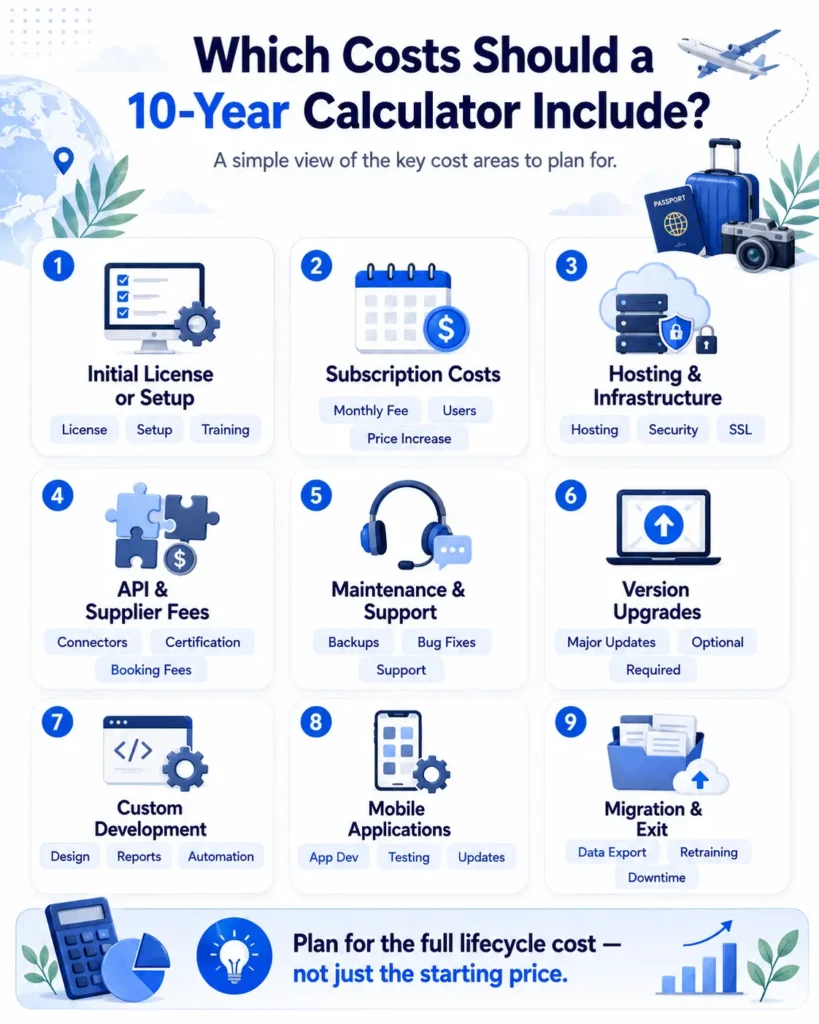
Which Costs Should a 10-Year Calculator Include?
A useful calculator covers the full cost of launching, operating, improving and leaving the system.
1. Initial License or Setup
Enter the license, installation, configuration and training for a one-time product. For SaaS, include onboarding, setup, data import and implementation.
2. Monthly or Annual Subscription
Enter the basic fee, user charges, B2B agent fees, premium modules, booking-volume charges and commissions.
Add an annual price-increase field because today’s subscription may not remain unchanged for ten years.
3. Hosting and Infrastructure
A self-hosted platform needs suitable hosting, backups, monitoring, security, a domain and SSL.
Review the PHPTRAVELS server requirements before choosing shared hosting, a VPS or a dedicated server.
4. API Integration and Supplier Fees
Separate connector costs from the supplier’s continuing charges:
- Initial connector setup
- Supplier account activation
- Certification
- Annual API access
- Per-search or per-booking fees
- Payment gateway integration
- Future API changes
Review available travel API integrations and what API integration means.
5. Maintenance and Support
Include support, backups, security patches, bug fixing and compatibility work. Either model may charge separately for advanced assistance.
6. Version Upgrades
Ask whether major upgrades are included, optional or required. Review the vendor’s change log for its release history.
7. Custom Development
Include design changes, booking flows, reports, accounting connections, supplier integrations and automation.
Request a written scope and review the available travel software customization services.
8. Mobile Applications
Do not assume mobile apps are included. Calculate design, development, APIs, app-store accounts, testing and operating-system updates.
Review the available travel mobile apps and confirm the package terms.
9. Migration and Exit
Include data export, customer and booking migration, API remapping, redirects, retraining, downtime and cancellation.
A cheap platform can become expensive when your business outgrows it.
How Does the Travel Software Cost Calculator Work?
Use the following formulas with real quotations from each vendor.
One-Time Software Total Cost
Initial license + hosting + API costs + maintenance + upgrades + custom development + mobile apps + migration and exit costs
SaaS Software Total Cost
Setup fee + cumulative subscription fees + add-ons + API costs + customization + mobile apps + migration and exit costs
For a subscription that increases every year, calculate each year separately:
Annual subscription cost = previous year’s cost × (1 + annual price increase)
For example, a $3,588 annual subscription with a 5% increase becomes $3,767.40 in year two and $3,955.77 in year three.
What Could Each Model Cost After 1, 3, 5 and 10 Years?
The following example is illustrative. It is not a PHPTRAVELS quotation or a promise of savings. Replace every figure with your own vendor prices.
Example One-Time License Costs
- License: $3,500
- Initial API work: $2,000
- Initial customization: $2,500
- Initial mobile apps: $4,000
- Hosting: $720 per year
- API provider fees: $1,200 per year
- Maintenance: $900 per year
- Continuing custom work: $500 per year
- App maintenance: $600 per year
- Major upgrade: $1,500 in years four and eight
- Exit cost: $3,000 in year ten
Example SaaS Costs
- Setup: $750
- Initial API work: $1,000
- Initial customization: $1,500
- Subscription: $299 per month
- Annual subscription increase: 5%
- API provider fees: $1,200 per year
- Continuing custom work: $800 per year
- Mobile app add-on: $1,788 per year
- Exit cost: $5,000 in year ten
Cumulative Cost Example
| Period | One-Time Model | SaaS Model | Lower Example Total |
|---|---|---|---|
| After 1 year | $15,920 | $10,626 | SaaS |
| After 3 years | $23,760 | $25,925 | One-time |
| After 5 years | $33,100 | $42,016 | One-time |
| After 10 years | $57,200 | $91,259 | One-time |
Here, SaaS begins with a lower cost, while the one-time model becomes lower during year three. Your result will change with your hosting, development and upgrade needs.
A transparent calculator should let users replace every example with their own numbers rather than showing only a fixed comparison.
When Does a One-Time License Break Even?
The break-even point is the moment when cumulative SaaS spending becomes higher than cumulative ownership spending.
A quick estimate is:
Break-even period = additional upfront ownership cost ÷ annual SaaS cost avoided
A complete calculation also includes price increases, hosting, support, upgrades, APIs and custom work.
Per-user, per-agent or per-booking charges can move the break-even point as sales grow.
Is Lifetime Travel Agency Software Always Cheaper?
No. It may be cost-effective for long-term use and customization, but less attractive when the business is still testing its model or expects major changes.
When Can a One-Time License Be a Good Choice?
It may suit an agency that:
- Has a proven business model
- Wants to control hosting and data
- Needs custom workflows
- Expects booking volume to grow
- Wants to avoid per-user or per-booking platform charges
- Can manage maintenance internally or through a developer
When Can SaaS Be the Better Choice?
It may suit a business that:
- Needs to launch quickly
- Has a small initial budget
- Does not have technical resources
- Is testing a new market
- Wants vendor-managed infrastructure
- May change platforms within a short period
How Do Self-Hosting and Source Code Affect Long-Term Cost?
Self-hosting adds infrastructure responsibility but gives you control over providers, server capacity, backups and migration timing.
Source-code access supports customization and reduces dependence on a closed system, although skilled development, testing and maintenance are still required.
PHPTRAVELS currently describes its platform as open-source and self-hosted. Its pricing information also shows that package benefits differ, including lifetime updates and customization permissions. Buyers should compare the latest package details rather than assume every benefit is included in every plan.
Read more about open-source travel management software and the platform’s technology.
How Should Travel API Costs Be Calculated?
Treat the software connector and the supplier contract as separate cost centres.
A ready-made connector may still require supplier credentials, approval and a separate commercial agreement. Suppliers may charge setup, annual, usage or commission fees.
Before calculating API costs, ask:
- Is the connector already available?
- Is activation included in the package?
- Does the supplier charge separately?
- Is certification required?
- Who maintains the connector after an API change?
- What happens if the agency changes suppliers?
PHPTRAVELS states that it provides pre-built XML and JSON connections for listed travel suppliers and payment gateways. Integrations that are not already listed can be scoped separately.
What Hidden Costs Can Change the Final Comparison?
Hidden costs are often missed because buyers focus only on the license or subscription.
Staff Training and Downtime
Include administrator training, agent onboarding, testing and temporary productivity loss.
Custom Feature Maintenance
Ask who will test and maintain custom features after software releases or API changes.
Data Export and Vendor Lock-In
Confirm that customers, agents, bookings, invoices and website content can be exported in usable formats.
Being able to view data is not the same as having a complete export that another platform can use.
SEO Migration
Plan URLs, metadata, redirects, analytics and content migration to reduce broken pages and tracking gaps.
Security and Compliance
Include backups, access control, server updates, payment security and any compliance required in the markets where the agency operates.
Which Pricing Model Is Better for Different Travel Businesses?
| Business Type | Model to Consider | Main Reason |
|---|---|---|
| New travel startup | SaaS or entry-level license | Lower initial commitment |
| Growing travel agency | One-time or self-hosted | More long-term control |
| Tour operator | Customizable licensed platform | Flexible workflows |
| B2B travel company | Source-code platform | Agent and pricing customization |
| Large OTA | Enterprise or custom platform | Infrastructure control |
| Temporary project | SaaS | Short period of use |
How Does PHPTRAVELS Fit an Ownership-Based Strategy?
PHPTRAVELS is positioned for travel businesses that want a self-hosted, open-source booking platform with travel modules, integrations and customization options.
The current pricing page lists Startup, Agency and Enterprise packages, but their inclusions vary. Buyers should confirm support, updates, B2B functions, customization permission, APIs, mobile apps and other services in writing before purchasing.
A sensible buying process is to:
- Review the platform features.
- Compare the latest PHPTRAVELS pricing and package terms.
- Test the travel booking software demo.
- Review relevant case studies.
- Request a written quote covering integrations, customization, hosting, apps, upgrades and support.