Across B2B travel platform projects, we have found that the difficult part is rarely giving agents a login. The operational challenge is keeping supplier pricing, agent markups, wallet or credit usage, booking permissions and post-booking records consistent as the reseller network grows.
This is especially important for agencies operating across Arabic and English workflows, where pricing rules, booking documents and agent permissions need to remain consistent regardless of the language used by the sales team.
What is an Arabic B2B travel portal?
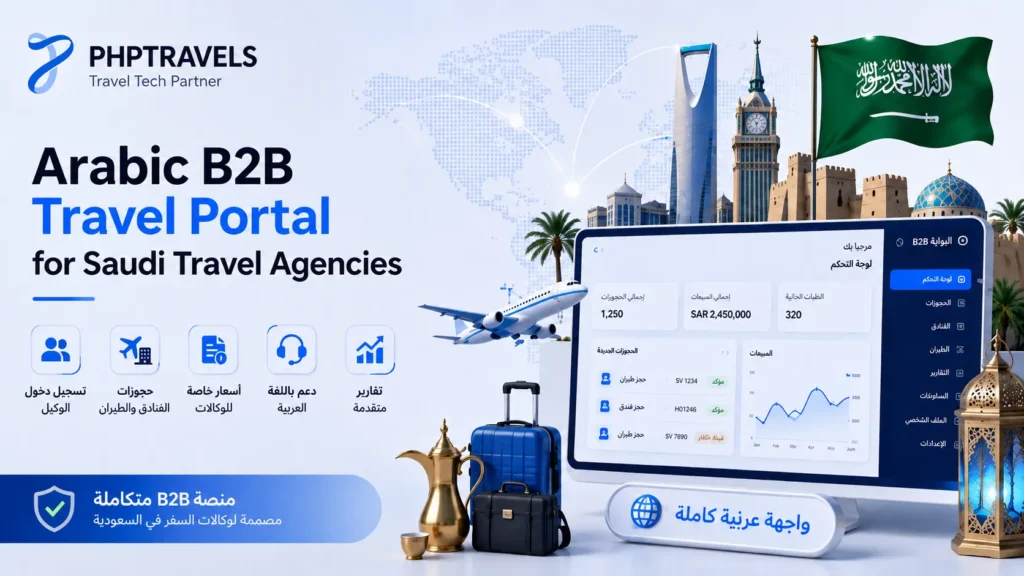
An Arabic B2B travel portal is an agent-facing booking platform designed for business-to-business travel sales.
Travel agencies, wholesalers and destination management companies can give approved partners their own accounts. These partners can search flights, hotels, tours, transfers or other connected products and make bookings under rules set by the main agency.
The interface can support Arabic right-to-left pages while also providing English for international employees, suppliers and partners.
Why do Saudi Travel Agencies Need an Arabic B2B portal?
Saudi travel agencies often work with different types of customers and distribution partners. One agency may serve retail travellers, corporate clients, sub-agents and Umrah customers through separate sales channels.
Managing these channels manually can create several problems:
- Agents receive inconsistent prices.
- Markups are approved through messages.
- Credit limits are checked manually.
- Booking details are stored in different files.
- Vouchers and invoices may not match the booking.
- Management cannot easily see agent performance or profit.
These are not only theoretical workflow problems. In a PHPTRAVELS B2B flight project for Tazkira in the Middle East, the operational challenges included approval-heavy booking steps, wallet and credit handling, and clearer control over fare and markup rules. The project focused on simplifying agency execution while giving the business better visibility over these controls.
This type of experience is useful when evaluating a Saudi B2B portal because the same controls become increasingly important as the number of agents, bookings and pricing rules grows.
What makes a B2B portal suitable for the Saudi market?
A Saudi-ready Arabic B2B travel portal should match the way the agency’s team, sub-agents and business partners actually work. Adding Arabic text to an English template is not enough.
Saudi agencies should evaluate the complete booking and back-office experience.
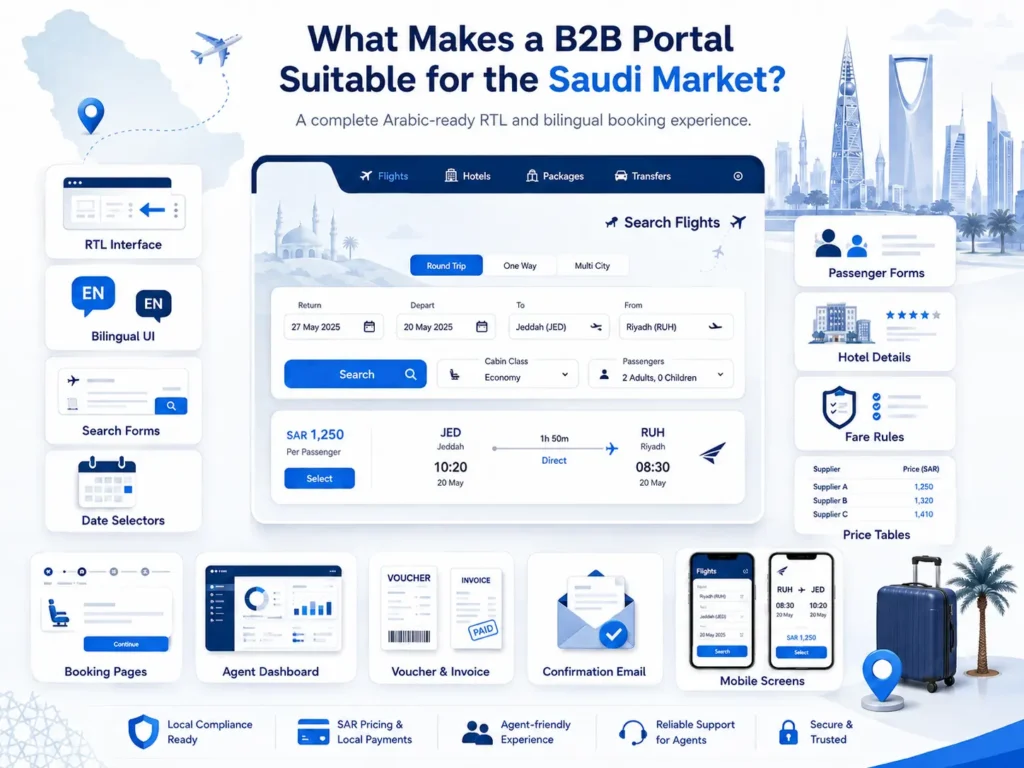
Does the portal support a complete Arabic RTL interface?
Arabic pages should display correctly from right to left. This includes more than menus and headings.
The agency should test:
- Search forms
- Date selectors
- Passenger forms
- Hotel details
- Fare rules
- Price tables
- Booking pages
- Agent dashboards
- Vouchers and invoices
- Confirmation emails
- Mobile screens
Arabic and English may appear together in airline names, airport codes, hotel names and supplier policies. The layout should remain clear when both languages are displayed on the same page.
Agencies that need an Arabic-ready booking experience can review the PHPTRAVELS Arabic travel system.
Can agents view prices in Saudi Riyal?
Saudi agents should be able to quote and review prices in Saudi Riyal where required.
The platform may also need to handle supplier costs in other currencies. A complete pricing workflow should separate:
- Supplier cost
- Currency conversion
- Agency markup
- Agent commission
- Service fee
- Tax
- Customer selling price
Can the agency control markups for each agent?
Not every partner should receive the same price.
A B2B portal should allow the main agency to create different pricing rules based on factors such as:
- Agent level
- Product type
- Supplier
- Destination
- Route
- Booking value
- Branch
- Market
- Sales volume
Can the portal manage commissions?
The system should show how commission is calculated and when it becomes payable.
Commission records should remain connected to the original booking, including any cancellation, amendment or refund.
This prevents disagreements caused by calculating commissions manually at the end of the month.
Does it support wallets and credit limits?
Many B2B travel agencies allow approved agents to book using a prepaid balance or an assigned credit limit.
The portal should show:
- Available balance
- Used credit
- Remaining credit
- Pending payments
- Booking deductions
- Refund credits
- Payment history
- Credit expiry or settlement dates
In real B2B operations, wallet management and pricing control are closely connected. For include, PHPTRAVELS’ work with Tazkira focused on clearer wallet operations together with stronger fare and pricing-rule visibility, showing why these functions should be tested as part of one complete agent workflow rather than as isolated features.
How Does an Arabic B2B Travel Portal Work?
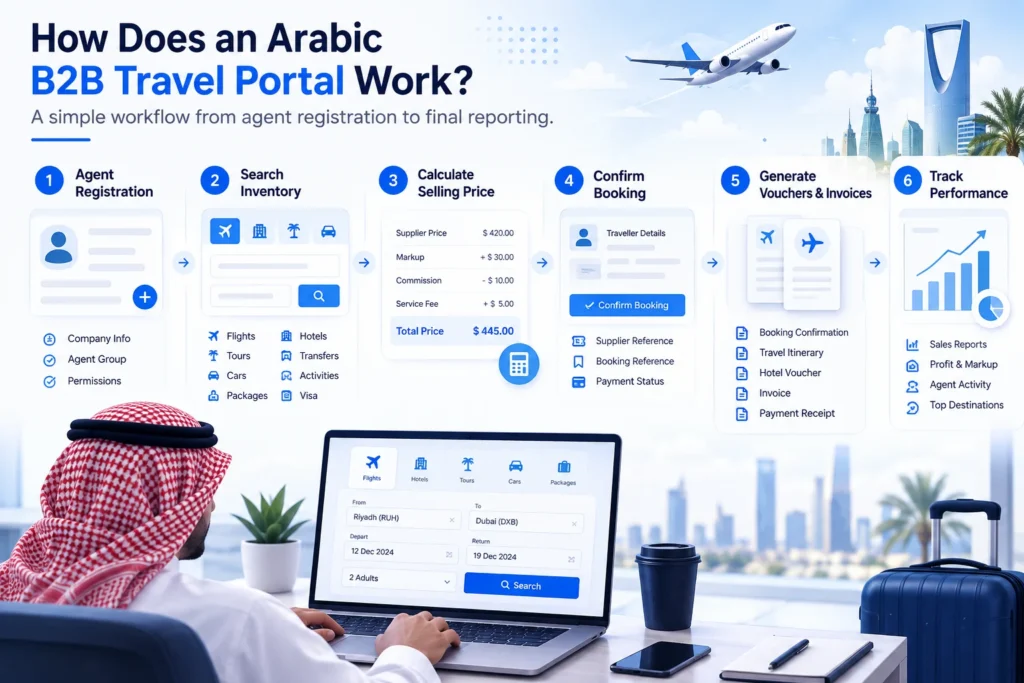
A well-organised portal follows a controlled workflow from agent registration to final reporting.
Step 1: How is an agent registered?
The agency creates or approves an agent account.
The account may include:
- Company information
- Contact details
- Branch
- Preferred language
- Currency
- Agent group
- Credit limit
- Pricing level
- Product access
- Staff permissions
Not every employee needs access to finance reports or account settings. Role-based permissions help protect sensitive information.
Step 2: How does the agent search travel inventory?
The agent signs in and searches available products.
Depending on the connected modules and supplier agreements, the portal may display:
- Flights
- Hotels
- Tours
- Transfers
- Cars
- Activities
- Packages
- Visa-related services
Inventory may come from GDS connections, supplier APIs, hotel bedbanks, XML feeds or the agency’s direct contracts.
Software access does not automatically provide permission to sell every supplier’s inventory. The agency normally needs a commercial agreement and valid supplier credentials.
Step 3: How is the selling price calculated?
The platform receives the supplier price and applies the agency’s commercial rules.
These may include:
- Supplier-specific markup
- Agent-level markup
- Commission
- Service fee
- Currency conversion
- Tax treatment
- Promotional discount
One implementation detail that agencies sometimes underestimate is the order in which pricing rules are applied. Supplier cost, currency conversion, agency markup, agent-level pricing and service fees should be tested together using actual booking scenarios. A configuration that looks correct in the admin panel can still produce unexpected selling prices if overlapping rules have not been tested end to end.
Step 4: How is a booking confirmed?
The agent enters the traveller’s information and submits the booking.
The platform should keep the supplier reference, internal booking reference, customer details, price and payment status connected to the same record.
For flights, the workflow may also involve ticketing and post-booking support. For hotels, it may include confirmation deadlines, cancellation policies and supplier vouchers.
Step 5: How are vouchers and invoices created?
Once the booking is confirmed, the portal can generate the required documents using saved booking data.
Documents may include:
- Booking confirmation
- Travel itinerary
- Hotel voucher
- Invoice
- Payment receipt
- Cancellation document
- Credit note
For Saudi businesses, invoice generation should also be reviewed against applicable ZATCA E-Invoicing (Fatoorah) requirements. The travel booking platform and the agency’s accounting or e-invoicing setup may have different responsibilities, so agencies should confirm exactly where compliant tax invoices are generated, stored and, where applicable, integrated with ZATCA.
Step 6: How does the agency track performance?
The admin dashboard should provide reports for:
- Sales by agent
- Sales by branch
- Bookings by product
- Supplier cost
- Markup
- Commission
- Profit
- Credit exposure
- Pending payments
- Refunds
- Cancellations
- Top destinations
- Agent activity
These reports help the agency identify profitable partners and control financial risk.
Which features should a Saudi B2B travel portal include?
The right Arabic B2B travel portal should support the agency’s pricing, inventory, credit and reporting workflows. Exact requirements depend on the agency’s business model and reseller network.
| Feature | Why It Matters |
|---|---|
| Arabic and English Interface | Supports local teams and international partners. |
| Correct RTL Display | Keeps Arabic search, booking and document pages clear and readable. |
| Agent Registration | Creates controlled access for approved travel partners. |
| Agent Groups | Allows different rules for different reseller levels. |
| Markup Management | Protects profit margins and prevents inconsistent pricing. |
| Commission Tracking | Records agent earnings against each confirmed booking. |
| Wallets and Credit Limits | Controls prepaid balances and credit-based travel sales. |
| SAR and Multi-Currency | Supports local selling in Saudi Riyal and international supplier costs. |
| Supplier Integrations | Provides access to live or contracted travel inventory. |
| Booking Management | Keeps booking records, references and statuses in one place. |
| Vouchers and Invoices | Creates booking documents using the same saved information. |
| Branch Permissions | Controls access for different offices, branches and employees. |
| Reports | Shows sales, margins, balances and agent performance. |
| Mobile-Responsive Design | Allows agents to work from smartphones and tablets. |
| Audit History | Records important changes to pricing, credit limits and bookings. |
Agencies should test each feature with real booking, cancellation, payment and reporting scenarios before launching the portal.
A long feature list is not enough. Agencies should test each important feature using a real booking scenario.
What travel products can agents sell through the portal?
The available products depend on the connected modules, supplier contracts and licences held by the business.
Can agents book flights?
Yes, when the portal is connected to an approved flight supplier, aggregator, airline API or GDS.
Agents may be able to search routes, compare fare options, create bookings and manage ticketing workflows.
Flight operations should also be tested for:
- Baggage information
- Fare rules
- Children and infants
- Schedule changes
- Cancellations
- Refunds
- Ticketing deadlines
- Failed payments
For detailed supplier selection guidance, read How to Choose Flight and Hotel APIs for Saudi Travel Agencies.
Can agents book hotels?
Yes. Hotels may be supplied through bedbanks, hotel APIs, GDS inventory or direct contracts.
A B2B hotel workflow should clearly show:
- Room type
- Meal plan
- Cancellation policy
- Check-in requirements
- Taxes or fees
- Supplier confirmation
- Booking deadline
- Voucher information
Saudi agencies serving religious travel should carefully test hotel availability, policies and support for Makkah and Madinah bookings.
Can agents sell tours and transfers?
A portal can also distribute tours, activities, airport transfers and local transport.
These products are useful for DMCs and agencies creating complete packages instead of selling only flights or hotel rooms.
Can an agency sell Umrah services?
A properly configured system can support approved agencies and operators managing Umrah-related products and packages.
The exact products, booking process, supplier permissions and legal requirements should be confirmed before accepting bookings.
Agencies needing specialised functionality can review Umrah booking software.
What is the difference between a B2B and B2C travel portal?
A B2C portal sells directly to travellers. A B2B portal gives controlled access to agents and business partners.
| Area | B2B Portal | B2C Portal |
|---|---|---|
| Main User | Travel agent, reseller or approved business partner. | Individual traveller or retail customer. |
| Pricing | Agent-specific rates, markups, commissions and service fees. | Public selling prices displayed directly to customers. |
| Payment | Wallet, credit limit, deposit, bank transfer or direct payment. | Customer checkout using the available payment methods. |
| Access | An approved and secure agent account is required. | Usually open to the public without prior approval. |
| Documents | Agent vouchers, account statements, invoices and booking records. | Customer booking confirmations, receipts and travel documents. |
| Reporting | Agent, branch, credit, commission, markup and sales reports. | Customer sales, conversion and booking performance reports. |
| Relationship | Ongoing business relationship with registered travel partners. | Usually based on an individual customer transaction. |
A travel agency can operate both models together by providing a public B2C website for travellers and a secure B2B portal for approved agents.
PHPTRAVELS has also implemented combined B2B and B2C operating models. In the UmraPro project, flights, hotels and tours that had previously been managed through separate routines were brought into one multi-product booking environment serving both retail and agency users.
For a Saudi agency considering both channels, the important question is therefore not simply whether the software has two front ends, but whether both channels share controlled inventory, booking records and operational processes behind them.
Should an agency choose a white-label or custom B2B portal?
The right option depends on budget, workflow and technical requirements.
When is a white-label portal suitable?
A white-label portal is suitable when the agency wants to launch under its own name without developing every component from the beginning.
The agency can normally configure:
- Domain or subdomain
- Logo
- Brand colours
- Contact details
- Email templates
- Vouchers
- Invoices
- Agent accounts
- Commercial rules
This approach is often suitable for agencies with a standard reseller booking model.
When is customisation needed?
Customisation may be needed when the agency has special operational requirements, such as:
- Complex agent hierarchies
- Custom approval workflows
- Special corporate accounts
- Unique package rules
- Multiple accounting connections
- Special supplier contracts
- Branch-specific settlement
- Custom Arabic documents
- Existing CRM or ERP systems
For include, in PHPTRAVELS’ Middle East B2B work with Insperia, the requirement was not simply to add more booking features. The project focused on creating more consistent corporate account handling and clearer approval paths. This is why agencies with corporate or multi-level approval workflows should document the operational sequence before deciding how much customization they need.
When is a fully custom platform suitable?
A fully custom build may be considered when the business model cannot be supported through configuration or normal customisation.
However, a custom build requires a larger technical scope. The agency must plan for development, testing, security, hosting, maintenance and future supplier changes.
How should a Saudi agency choose supplier integrations?
Start with the products customers and agents actually request.
Do not connect a large number of APIs simply to create a longer supplier list. Each integration adds commercial, technical and operational work.
Compare suppliers using:
- Relevant flight routes
- Hotel coverage
- Net rates
- Cancellation terms
- Booking reliability
- Post-booking support
- Refund handling
- Currency requirements
- Deposit requirements
- API documentation
- Testing environment
- Support response
- Contract conditions
The best supplier mix is the one that matches the agency’s customers, destinations and support capability.
PHPTRAVELS provides a directory of available travel integrations and a broader travel XML API suppliers list.
Which local operational details should be tested?
A Saudi-focused portal should be tested as a complete business system, not only as a search page.
Is the Arabic mobile experience clear?
Agents may access the portal from a phone while speaking with a customer. Search, passenger entry, payment status and vouchers should remain usable on smaller screens.
Test both Arabic and English versions on common mobile devices.
Are Saudi Riyal amounts consistent?
Check how SAR is displayed in:
- Search results
- Booking pages
- Agent wallets
- Invoices
- Vouchers
- Refunds
- Reports
Currency rounding should not create differences between the amount shown to the agent and the amount stored in the booking.
Are payment records connected to bookings?
A payment should not be recorded in a separate spreadsheet with no clear booking reference.
Deposits, wallet deductions, bank transfers, card payments and refunds should be linked to the related booking wherever possible.
Are customer and traveller records protected?
Travel bookings may contain names, contact information, identity details, passport information and payment-related records.
The agency should limit access to employees who need the information. It should also define how data is stored, shared, backed up and removed.
From a system-design perspective, agencies should decide which roles genuinely need access to traveller identity details, booking records and financial information instead of giving every back-office user the same level of access.
How does a B2B portal help a multi-branch agency?
A multi-branch agency needs visibility without giving every employee full administrative access.
The system can assign users to specific branches and control which actions they can perform.
For example:
- A booking employee can create and manage reservations.
- A finance employee can review balances and settlements.
- A branch manager can view the branch’s sales.
- The main office can review consolidated performance.
- An administrator can manage pricing and supplier settings.
Branch-level controls reduce the risk of unauthorised pricing changes or access to sensitive financial information.
How can an agency launch an Arabic B2B portal?
A structured rollout reduces errors and makes agent onboarding easier.
Step 1: Define the business model
Decide whether the agency will act as a wholesaler, consolidator, DMC, corporate travel provider or hybrid travel business.
Step 2: List the required products
Choose the products agents need first. Avoid launching unnecessary modules before the main workflow is stable.
Step 3: Define agent levels
Create clear reseller groups, pricing rules, commissions, credit limits and permissions.
Step 4: Select suppliers
Confirm commercial agreements, credentials, deposits, currencies and support responsibilities.
Step 5: Configure Arabic and English content
Review menus, labels, policies, emails, vouchers and invoices in both languages.
Step 6: Connect payments and finance workflows
Define how wallets, credit, deposits, invoices, receipts and refunds will be handled.
Step 7: Test real booking situations
Test successful bookings as well as:
- No availability
- Supplier errors
- Price changes
- Failed payments
- Credit-limit errors
- Cancellations
- Refunds
- Arabic documents
- Mobile booking
- Agent permission restrictions
Step 8: Start with a small agent group
Onboard a limited number of trusted agents first. Use their feedback to improve instructions, pricing and support before opening the portal to a larger network.
What mistakes should Saudi agencies avoid?
Adding Arabic only to the homepage
Arabic should work across the actual booking process, dashboard and documents.
Giving every agent the same price
Agent groups and pricing rules should reflect sales volume, risk and commercial agreements.
Offering unlimited credit without controls
Credit should be assigned, monitored and reviewed using a clear policy.
Connecting suppliers without testing support
Search and booking are only part of the process. Cancellations, changes and refunds must also be tested.
Managing invoices outside the booking system
Documents created manually can contain different prices, traveller details or booking references.
Launching too many products at once
Start with the products the agency can support properly. Additional modules can be added after the main workflow is stable.
Ignoring agent training
Even a well-designed portal can fail if agents do not understand pricing, payment, cancellation and support procedures.
Review the B2B travel portal, B2B booking engine and Saudi Arabia travel agency software pages to compare the available workflows.
Agencies should confirm their exact Arabic, supplier, payment, accounting and customisation requirements before selecting a configuration.
How can PHPTRAVELS support an Arabic B2B portal?
PHPTRAVELS works with travel businesses operating different distribution models, including B2B flight agencies, corporate travel operations and combined B2B+B2C platforms.
For example, its Tazkira project in the Middle East focused on agency flight workflows, wallet operations and fare-control visibility, while the Insperia project addressed structured corporate account and approval workflows. Other projects such as UmraPro demonstrate how retail and agency booking channels can operate through a more unified multi-product environment.
For a Saudi implementation, these capabilities can be combined with Arabic and English interfaces, RTL booking pages, agent accounts, markup and commission rules, credit management, supplier connectivity, booking documents and reporting. The final configuration should be based on the agency’s actual supplier agreements, reseller structure, finance process and Arabic workflow rather than a standard feature checklist.
Agencies evaluating PHPTRAVELS should test their own booking scenarios during the demo: one Arabic agent booking, one SAR pricing rule, one wallet or credit transaction, one cancellation or refund, and one invoice or voucher workflow. This gives a more useful evaluation than reviewing features individually.
Final Thoughts
An Arabic B2B travel portal should make it easier for Saudi travel agencies to grow their reseller network without losing control of pricing, credit or booking records.
The most important requirements are not only attractive design or a long supplier list. The portal should provide a complete Arabic and English workflow, clear SAR pricing, controlled agent accounts, automated commercial rules and reliable reporting.
Before choosing a system, create a list of real booking situations and test each one. A portal that works for searches but fails during cancellations, refunds or agent settlement will create more work instead of reducing it.
PHPTRAVELS offers Arabic-ready travel technology, B2B booking tools and supplier integration options for agencies that want to bring agent distribution and booking operations into one connected platform.
View the live demo or contact PHPTRAVELS to discuss your Arabic B2B portal requirements.