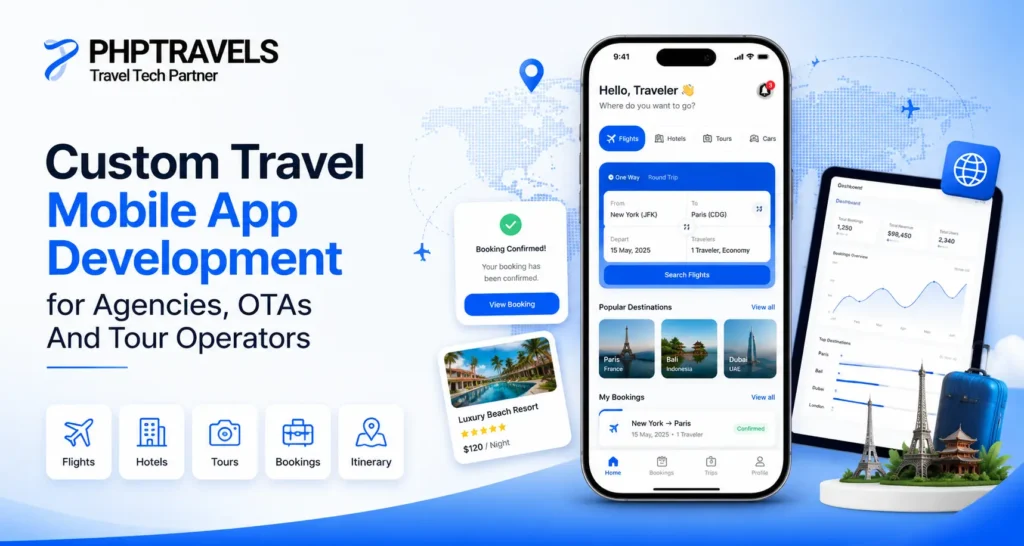
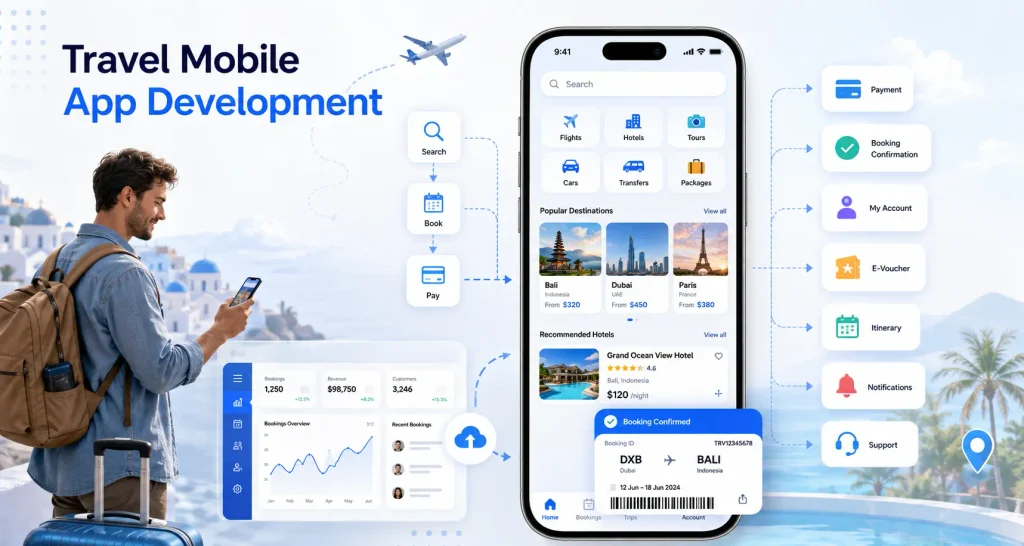
Travel mobile app development helps travel agencies, OTAs, tour operators, hotels, and DMCs give customers a faster way to search, book, pay, receive confirmations, and manage trips from a phone.
A useful travel app is more than a branded interface. It needs to connect with live inventory, supplier APIs, payment gateways, booking rules, customer accounts, vouchers, notifications, and the same back-office workflows your team already uses.
For travel businesses that want a branded booking experience on iOS and Android, PHPTRAVELS offers mobile apps for travel businesses that connect mobile booking with day-to-day travel operations.
This guide covers the features, integrations, costs, launch decisions, and operational checks that matter when building a travel agency app.
What Is Travel Mobile App Development?
Agencies planning an iOS release should also review Apple’s App Store Review Guidelines before submission to understand requirements around safety, performance, design, business practices, and user privacy.
For a travel agency, the app should connect customer-facing actions with operational systems behind the scenes. A traveler might search for a flight, compare hotel rates, pay through a local gateway, receive a voucher, and later open the booking from the same account. Your staff should see that activity in the booking platform without manually re-entering the reservation.
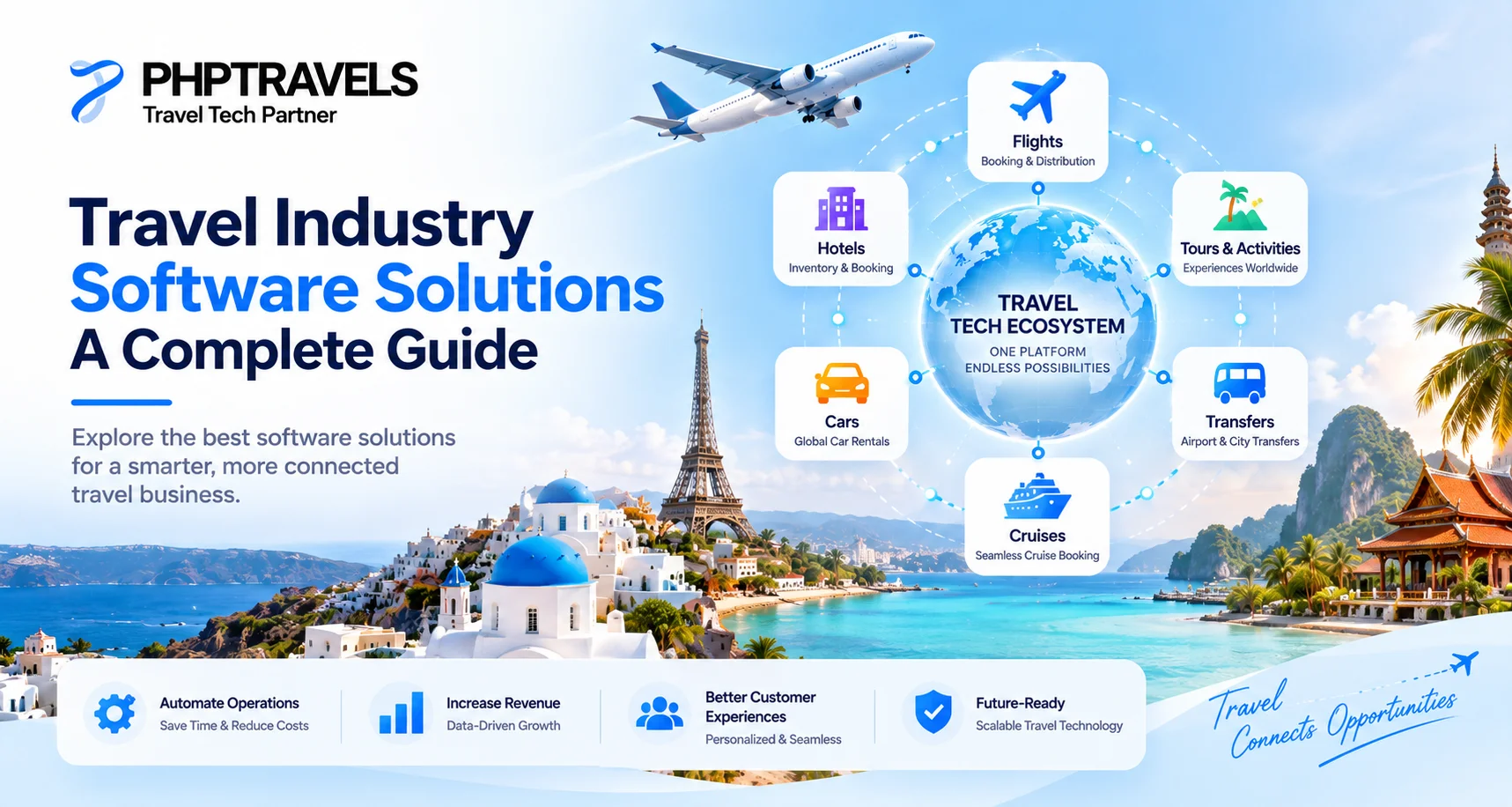
A connected travel app can support flights, hotels, tours, cars, transfers, packages, visas, and other travel products.
Businesses planning a more customized build can explore PHPTRAVELS’ travel mobile app development services, while agencies that want a ready-to-brand product can review the white-label mobile travel app.
Why Travel Agencies Invest in Mobile Apps
A mobile app gives an agency a direct digital channel alongside its website and agent desk. Customers can move from search to booking and post-booking service without jumping between disconnected tools.
A More Direct Booking Journey
A branded app gives returning customers a familiar place to search and manage trips. Saved traveler profiles, booking history, preferences, and notifications can reduce repeated steps.
Instead of beginning every booking from zero, returning travelers can use an environment already connected with their account and previous reservations.
Better Post-Booking Service
Travel does not end at checkout. Customers may need vouchers, itinerary details, booking status, support, cancellation information, or reminders.
A mobile application can keep these functions accessible from one place while giving the agency another channel for communicating important booking information.
Connected Operations
The commercial value increases when the app is integrated with your travel booking software.
Mobile bookings can then follow the same supplier, pricing, payment, invoicing, and reporting workflows as bookings generated through your website.
Essential Features of a Travel Agency Mobile App
Most production-ready travel apps need the following capabilities.
| Feature | Why It Matters |
|---|---|
| Real-Time Search | Shows current inventory, availability, and pricing |
| Booking Engine | Lets customers complete reservations inside the app |
| Secure Payments | Supports cards, wallets, bank methods, or local gateways |
| Customer Accounts | Stores traveler profiles, history, and preferences |
| Booking Management | Gives users access to confirmations and trip status |
| Vouchers and Invoices | Makes travel documents available after booking |
| Push Notifications | Sends booking alerts, reminders, and service messages |
| Multi-Language and Currency | Supports international customers |
| Supplier API Integration | Connects with live third-party travel inventory |
| Back-Office Sync | Keeps staff, finance, support, and customer data aligned |
How Supplier APIs Work Inside a Travel Mobile App
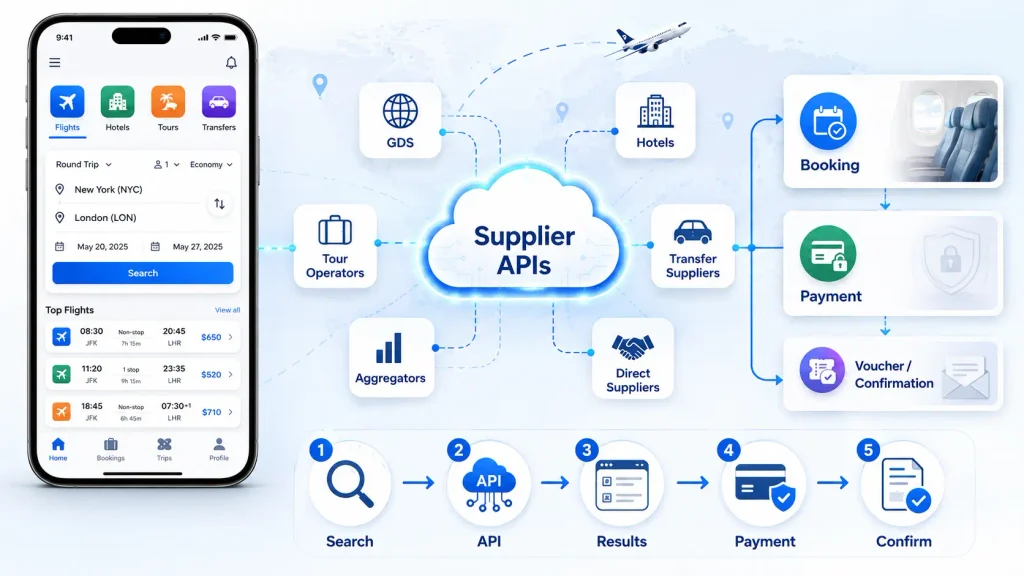
Most agencies do not own all the inventory they sell. Flights, hotels, tours, and transfers may come from GDSs, wholesalers, aggregators, or direct suppliers.
That is why travel API integrations are a core part of mobile app development.
A typical booking flow works like this:
- A customer searches for a travel product in the app.
- The booking platform requests data from a supplier API or internal inventory.
- Available options and prices are returned to the app.
- The customer selects an option and enters traveler details.
- Payment is processed and the booking request is confirmed.
- The customer receives a voucher, confirmation, or itinerary.
- The transaction is recorded in the back office for support and reporting.
The app should act as another sales and service channel connected to the same booking logic.
Agencies with complex supplier requirements can also review PHPTRAVELS’ API integration services.
Payments, Security, and Booking Reliability
Travel apps handle customer identities, booking details, and payment-related data, so security needs to be planned from the beginning.
A mobile booking flow should use encrypted connections, secure authentication, controlled permissions, validated API requests, and payment providers appropriate for the markets where the business operates.
The payment stage also needs clear failure handling.
For example, the booking architecture should define what happens if payment succeeds but the supplier cannot confirm the reservation, or if supplier confirmation arrives while payment status is still pending.
Without those workflows, staff can end up reconciling bookings manually and customers may receive confusing information.
PHPTRAVELS supports businesses that need travel payment gateway integration as part of a connected booking stack.
White-Label App vs Custom Travel App Development
One of the biggest decisions is whether to start with a white-label application or build a custom app.
| White-Label Travel App | Custom Travel App |
|---|---|
| Faster starting point | Built around unique requirements |
| Existing booking structure | Greater workflow control |
| Custom branding | Deep UI and architecture customization |
| Lower initial development effort | More design and engineering work |
| Fits common agency models | Fits unusual or complex business logic |
Why Connected Booking Operations Matter
A successful travel mobile app depends on more than an attractive interface. The real value comes from how well the app connects with supplier inventory, booking rules, payments, traveler accounts, vouchers, notifications, and back-office operations.
This becomes especially important for agencies managing both B2C and B2B workflows. If mobile bookings are disconnected from supplier processes or staff systems, teams may still need to handle quotations, confirmations, and customer updates manually.
PHPTRAVELS has worked with travel businesses facing these types of operational challenges. For example, Skyvela, a luxury travel marketplace using B2B and B2C workflows, needed to improve processes affected by manual quotation loops, fragmented supplier workflows, and an inconsistent customer journey. The platform work focused on creating a more connected booking experience and giving the business stronger operational control.
This is why a travel mobile app should be treated as part of the wider booking ecosystem rather than as a standalone product. When the mobile interface, supplier APIs, payments, and back office work together, agencies can create a more consistent experience for both travelers and internal teams.
Businesses evaluating similar implementations can explore PHPTRAVELS client success stories to see how different travel companies use connected booking technology.
Choosing the Right Travel Mobile App Development Partner
Travel technology has requirements that are very different from a standard ecommerce or service application. Developers need to understand live availability, booking states, markups, cancellations, supplier responses, vouchers, payment reconciliation, traveler data, and post-booking support.
Working with a team that already understands these workflows can reduce unnecessary complexity during development and integration.
PHPTRAVELS specializes in travel technology and provides booking software, supplier integrations, payment integrations, mobile solutions, and custom development for travel businesses. Agencies can also review the PHPTRAVELS team, explore published client success stories, and test the booking experience through the live demo before deciding how they want to build their mobile channel.
Final Takeaway
Travel mobile app development should be treated as a connected travel-commerce project, not simply a mobile design project.
The most useful application lets customers search, book, pay, receive documents, and manage trips while keeping suppliers, pricing rules, customer records, finance workflows, and back-office systems synchronized.
If your agency is ready to add a branded mobile booking channel, explore PHPTRAVELS’ mobile apps for travel businesses or request a live demo to see how the mobile booking workflow can fit your operation.