

Travel is emotional. A delayed flight can disrupt a family holiday, a hotel problem can affect a business trip, and a refund delay can leave a traveler worried about a large payment. Even a normally calm customer may become frustrated when a booking does not go as expected.
So, how do you deal with difficult customers in a travel agency? Stay calm, listen without interrupting, confirm the facts, acknowledge the concern, explain what you can do, offer realistic options, agree on a clear next step, document the case, and follow up when promised. The goal is not to win an argument. It is to reduce uncertainty and move the customer toward a fair resolution.
For travel agencies, OTAs, tour operators, and DMCs, complaint handling is also an operational discipline. Service becomes easier when agents can see the full history of quotes, bookings, payments, supplier messages, and previous follow-ups.
Why Travel Customers Become Difficult
A difficult interaction usually starts with a difficult situation. Common triggers include flight cancellations, schedule changes, hotel overbooking, missing transfers, incorrect passenger details, payment confusion, refund delays, documentation misunderstandings, and differences between what a traveler expected and what was included.
The issue may involve an airline, hotel, tour supplier, payment gateway, GDS, or another third party. Even when the agency did not cause it, the customer often expects the agency to coordinate the solution.
This is why clear processes and reliable travel agency management software matter. Agents need accurate booking information before they promise a refund, rebooking, upgrade, or other remedy.
The best mindset is simple: do not label the person as the problem. Identify the problem, understand its impact, and manage the conversation professionally.
1. Stay Calm Before You Try to Solve the Problem
When a customer is angry, keep the conversation from becoming more emotional. Speak steadily, use neutral language, and avoid matching the customer’s tone.
Do not rush to defend the agency. Statements such as “That is not our fault” or “You should have read the policy” can make the customer feel dismissed. Start by understanding what happened.
A useful opening is:
“I understand this has disrupted your plans. Let me review the booking details so I can see what options are available.”
This acknowledges the impact without promising an outcome before the facts are checked.
If the customer becomes abusive or threatening, follow the company’s escalation policy. Professional service does not require staff to accept abuse.
2. Listen Without Interrupting
Active listening is one of the best ways to de-escalate an unhappy customer. Let the person explain the issue before offering solutions.
Identify four things:
- What happened?
- What did the customer expect?
- What outcome do they want now?
- Is there an urgent deadline such as a flight departure or hotel check-in?
Then summarize the issue in your own words:
“To make sure I have this right, your hotel booking is confirmed, but the property says the room type is unavailable, and you need an alternative before check-in this evening.”
3. Show Empathy Without Making False Promises
Empathy means recognizing the customer’s experience. It does not mean admitting responsibility before you understand the case.
Useful phrases include “I can see why that would be frustrating,” “I understand why you need a clear answer before departure,” and “I’m sorry this situation has affected your trip.”
Avoid promises such as “I guarantee this will be fixed today” unless you control the outcome. Travel agents often depend on supplier policies and response times. A more trustworthy approach is to explain what you can control, what requires third-party confirmation, and when the customer will receive the next update.
4. Verify the Booking Facts Before Offering a Solution
Before discussing compensation, cancellation, rebooking, or refunds, check the actual record.
Review the booking reference, passenger names, travel dates, fare or room rules, payment status, supplier confirmation, previous messages, and any action already taken by another agent.
This prevents a common service failure: giving a quick answer and changing it later.
If several team members handle the same traveler, a travel agency CRM can keep customer profiles, quotes, bookings, follow-ups, and communication history together.
Protect sensitive information while handling complaints. Passport details, payment information, itineraries, and customer records should only be accessed or shared when necessary. See how travel businesses can handle customer data securely.
5. Separate the Customer’s Request From the Available Options
An upset customer may ask for a full refund, free upgrade, same-day payment, different flight, or special exception. Understand the request, then compare it with what is actually possible.
Use three points:
Requested outcome: What the customer wants.
Available options: What the agency or supplier can realistically provide.
Limitations: Fare rules, supplier policies, availability, deadlines, or costs.
Instead of saying only “No, we cannot do that,” explain the alternatives.
For example:
“A full refund is not available under this fare rule, but I can check a date change and travel credit. I’ll compare both options and show you the cost before you decide.”
That gives the customer some control without creating an unauthorized promise.
6. Offer Two or Three Clear Solutions
When possible, give the customer a small number of realistic choices. Too many options can create more confusion.
For a flight disruption, the choices might be a later flight, a different date, or a refund request if the fare and airline policy allow it. For a hotel issue, the choices could be another room category, another property, or cancellation under the booking terms.
Explain each option in plain language, including any additional cost, refund amount, supplier approval, or time limit.
Good service quality is not about saying yes to every demand. It is about accurate information, fair options, and dependable follow-through.
7. Give a Specific Next Step and Follow-Up Time
Never end a difficult conversation with “We’ll get back to you soon.”
Tell the customer what will happen next and when to expect an update.
For example:
“I’m contacting the hotel now and will update you by 4:00 PM, even if I am still waiting for their final confirmation.”
A precise follow-up time reduces uncertainty. If the supplier has not replied by then, contact the customer anyway. A short status update is better than silence.
This is especially important for time-sensitive travel problems. If you say you will call, call. If you promise an email summary, send it. Reliable follow-up rebuilds trust.
8. Document Every Important Interaction
After the conversation, record the facts while they are fresh.
Include the customer’s main concern, booking reference, what was verified, options offered, what the customer selected, supplier contacts, promised follow-up time, and final resolution.
Documentation protects both the customer and the agency. It also prevents the next agent from asking the traveler to explain everything again.
The role of CRM in travel and tourism goes beyond sales; it can support ownership, follow-ups, customer history, and consistent communication.
Keep notes factual. Do not write emotional or insulting descriptions of customers.
9. Know When to Escalate
Not every issue should be handled by the first agent who receives it.
Escalate when the case involves significant financial impact, legal or regulatory concerns, chargebacks, threats, suspected fraud, data-security issues, repeated service failures, VIP or group bookings, or a decision outside the agent’s authority.
Explain why another person is taking over and transfer the full context:
“This refund needs manager approval because of the amount involved. I have documented the case and I’m escalating it now, so you will not need to repeat the full story.”
Teams should define escalation rules before a crisis happens. This becomes increasingly important as a travel agency grows and more people share sales, booking, finance, and support responsibilities.
10. Follow Up After the Problem Is Resolved
For significant complaints, send a short follow-up after the refund is processed, a replacement hotel is confirmed, or the new itinerary is issued. Confirm that the customer received the resolution and does not need anything else.
Then review what the complaint revealed. Was the original information unclear? Did an agent miss a follow-up? Was a supplier unreliable? Did the booking system show outdated information? Could an alert or clearer policy have prevented the issue?
This turns complaints into useful operational feedback.
Common Travel Complaint Scenarios and the Best First Response
| Situation | Best First Response |
|---|---|
| Flight cancellation or schedule change | Confirm the airline update, fare rules, and available alternatives before promising a rebooking or refund. |
| Hotel says the booking is missing | Verify the supplier confirmation and contact the property or supplier with the booking reference. |
| Refund is taking too long | Identify whether the agency, payment provider, airline, or supplier currently holds the refund and give a realistic status update. |
| Customer says the price changed | Explain whether the amount was a live fare, quote, or confirmed booking, then verify current availability. |
| Traveler received incorrect details | Compare the customer’s submitted information with the booking record and explain correction options and costs. |
| Customer expected something not included | Review the quote, inclusions, voucher, and messages, explain the difference, and offer a reasonable option where possible. |
What Not to Do With an Angry Customer
Avoid these mistakes:
- Do not interrupt just to prove a point.
- Do not blame the customer, supplier, or another employee during the first conversation.
- Do not promise refunds, upgrades, or compensation without authority.
- Do not use vague timelines.
- Do not leave important agreements only in a phone call; document them.
- Do not expose private traveler or payment information.
- Do not continue an abusive interaction when company policy requires escalation.
How Travel Agencies Can Prevent Difficult Customer Situations
The best complaint is the one that never becomes a crisis.
Set accurate expectations before payment. Make cancellation terms, inclusions, exclusions, baggage rules, refund conditions, hotel policies, and supplier limitations easy to understand.
Keep booking and customer information in one operational system instead of spreading it across personal chats, spreadsheets, and disconnected inboxes. Use reminders for pending quotes, payment deadlines, supplier confirmations, and promised callbacks.
Train agents to write clear notes and use consistent escalation rules. Review repeat complaints. If the same supplier or internal process causes repeated issues, treat it as a business problem rather than an isolated support case.
Agencies improving their operation can also use this online travel agency guide to connect customer service with booking, payment, supplier, and back-office workflows.
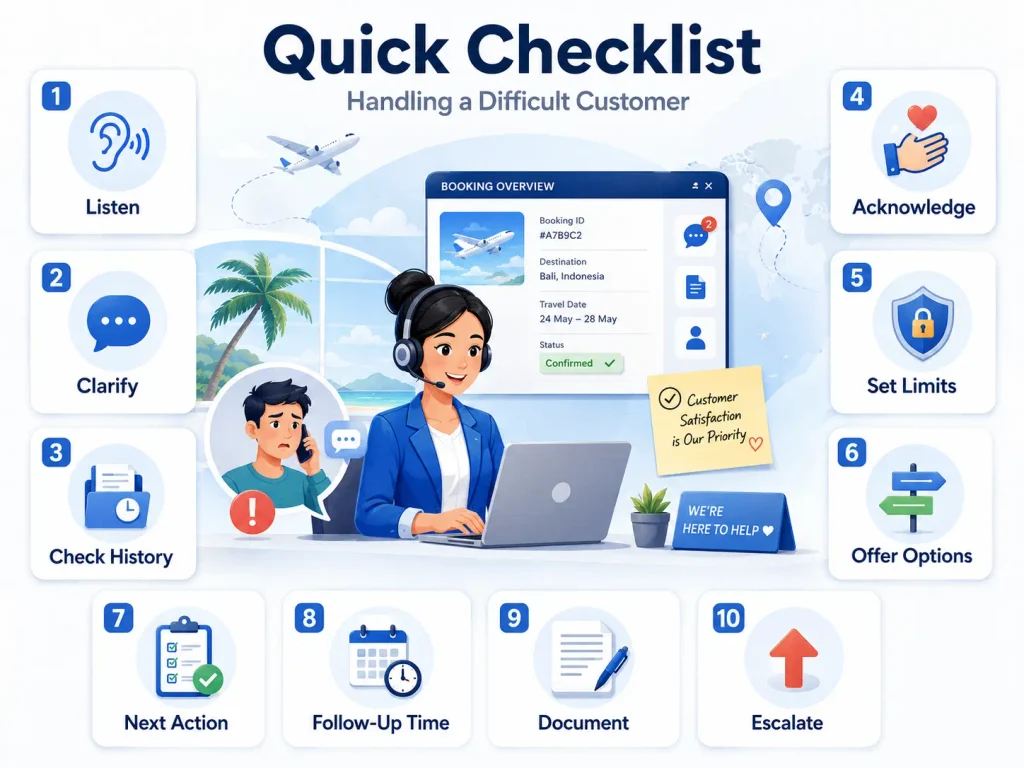
Quick Checklist for Handling a Difficult Customer
Before ending the interaction, confirm that you have:
- Let the customer explain the issue.
- Restated the problem clearly.
- Checked the booking and communication history.
- Acknowledged the impact.
- Explained what you can and cannot do.
- Offered realistic options.
- Agreed on the next action.
- Set a specific follow-up time.
- Documented the case.
- Escalated when necessary.
Final Thoughts
Learning how to deal with difficult customers is not about memorizing a perfect script. It is about combining calm communication with accurate travel operations.
Listen first, verify the facts, show empathy, offer realistic choices, give a clear timeline, document the conversation, and follow up when promised. When these habits become part of the normal workflow, difficult situations become easier to manage even when the journey does not go according to plan.