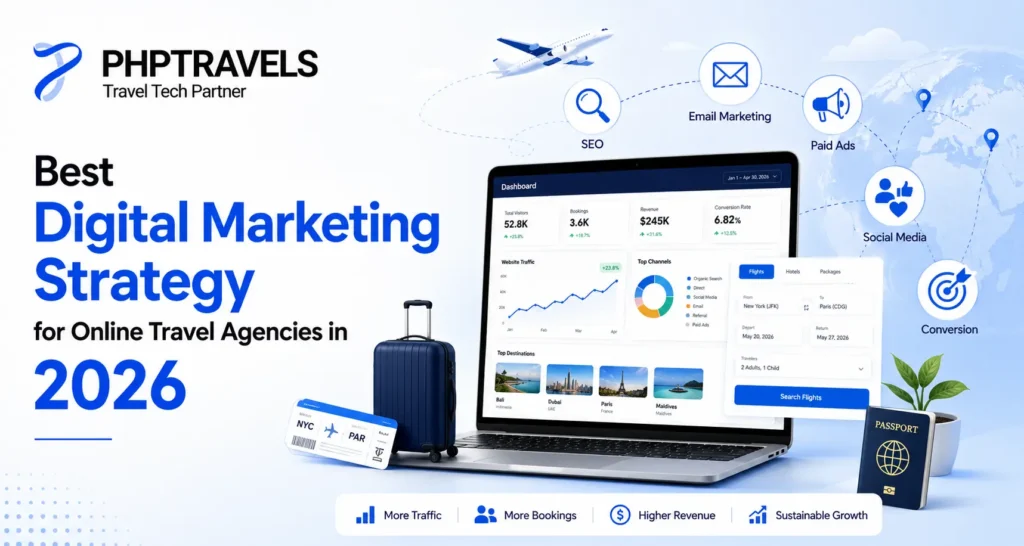
The best digital marketing strategy for an online travel agency (OTA) in 2026 is a connected growth system combining high-intent SEO, AI-search visibility, paid demand capture, conversion rate optimization, CRM automation, first-party data, and retention marketing.
The goal is not simply “more traffic.” It is to acquire qualified travelers at a sustainable customer acquisition cost (CAC), convert more searches into bookings, and increase repeat revenue from customers you have already paid to acquire.
Travel marketing is especially competitive because flights, hotels, tours, transfers, car rentals, and packages often have thin margins, changing prices, long research journeys, and strong marketplace competition. Marketing, booking technology, and customer data therefore need to work as one system.
If you are still building your business model, start with this guide on how to start an online travel agency. If your OTA is already live, use the framework below to improve acquisition and revenue.
What Is the Best Digital Marketing Strategy for an Online Travel Agency?
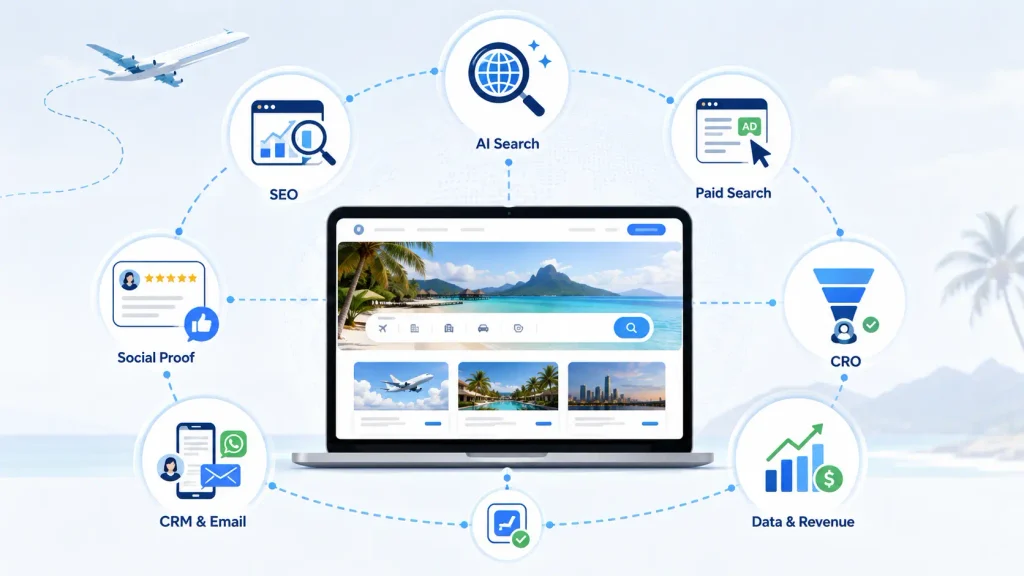
A strong OTA strategy has seven connected parts: SEO and topic authority; AI Overviews, answer-engine and generative-search visibility; high-intent paid search; booking-funnel CRO; email, CRM and WhatsApp automation; social proof and brand demand; and first-party data with revenue-based measurement.
The order matters. Paying for more clicks before fixing a weak booking funnel usually increases waste. Publishing hundreds of generic articles creates volume, not necessarily authority. Collecting leads without useful follow-up also leaves revenue on the table.
1. Build SEO Around Travel Intent, Not Just Keywords
SEO remains one of the strongest long-term acquisition channels for OTAs because it can capture demand at different stages of the travel journey without paying for every click.
Organize travel SEO by intent. Informational searches answer planning questions. Commercial searches compare destinations, services, suppliers, or software. Transactional searches move closer to the booking action through routes, dates, inventory, or product-specific queries.
Build topic clusters around what your OTA actually sells. A tours business can cover destination guides, itinerary ideas, activity comparisons, attraction pages, and booking questions. A flight-focused OTA can develop route, airport, baggage, fare, and booking-help content. A B2B travel company may need deeper content around APIs, GDS, NDC, commissions, and agent workflows.
For editorial planning, PHPTRAVELS already has a resource on travel agency blog ideas. The important step is to connect useful articles to relevant commercial pages instead of treating the blog as a separate traffic project.
Use descriptive internal anchors, avoid thin or overlapping pages, and refresh older posts when intent has changed. One strong page that fully satisfies an intent is usually better than several near-duplicates competing with one another.
2. Optimize for AI Overviews, AEO and GEO Without Forgetting SEO
AI Overviews, AI assistants, and generative search have changed how users discover travel information, but they have not removed the need for crawlability, indexation, technical SEO, or useful content.
For an OTA, GEO should mean making information easy for search and AI systems to retrieve, understand, verify, and cite. It should not mean stuffing pages with artificial Q&A blocks or producing hundreds of generic AI-written pages.
Use answer-first writing: give a direct answer near the start of an important section, then support it with details, examples, trade-offs, and next steps. Use descriptive headings that reflect real traveler or operator questions. Keep facts, policies, and product claims accurate. Add original experience where possible through screenshots, implementation notes, supplier comparisons, booking-flow examples, case studies, or proprietary data.
Entity clarity matters too. Make it obvious who PHPTRAVELS is, what it provides, which travel products it supports, and how related topics connect. Strong author pages, company information, product documentation, and well-linked topic clusters help both users and machines understand the site.
Structured data can support machine understanding when it accurately describes visible page content, but it is not a shortcut to AI citations.
For broader adoption, see how to implement AI in a travel agency.
3. Use Paid Search as a Demand Accelerator
Paid search can reach users close to a booking decision, but travel campaigns can become expensive quickly.
Build campaigns around economics rather than traffic volume. Separate flights, hotels, tours, cars, transfers, and other categories so margin and conversion can be measured by product. Keep high-intent route, destination, brand, and service queries separate from broad research terms. Use negative keywords, location controls, audience signals, and landing pages that match the ad promise.
Tightly controlled exact or phrase targeting can help when data is limited. Broader targeting can be tested later when reliable conversion signals exist.
Connect ad spend to confirmed booking value. Measure cost per booking, gross profit after acquisition cost, cancellation-adjusted revenue, and repeat value. Scale paid media only when the funnel and follow-up process can turn extra demand into profitable revenue.
4. Improve the Booking Funnel Before Buying More Traffic
An OTA can rank well and run good ads while still losing customers because of booking friction. The booking engine is part of marketing.
Travelers need fast search results, clear filters, transparent pricing, mobile usability, recognizable payment options, simple forms, trust signals, and a smooth path to confirmation. When supplier prices change, revalidation should be handled clearly rather than appearing as an unexplained error.
The PHPTRAVELS guide to travel booking engines for agencies and OTAs explains the booking layer in more detail.
Track drop-off through search results, product details, traveler information, payment, and confirmation. Then test the biggest friction points first. Useful tests can include clearer cancellation terms, stronger review visibility, better mobile forms, fewer unnecessary fields, improved price messaging, faster pages, alternative payment methods, and relevant cross-sells.
CRO should be based on observed behavior and revenue impact, not cosmetic changes.
5. Turn CRM, Email and WhatsApp Into a Lifecycle Revenue Engine
Travel has natural follow-up moments, which makes automation valuable when it is contextual rather than spammy.
Connect the booking engine with a travel agency CRM so lead, customer, booking, and communication data are not trapped in separate systems. Segment users by behavior and booking status.
A traveler who searched for Dubai hotels but did not book should not receive the same message as a customer with a confirmed flight next week. Useful lifecycle campaigns include abandoned-search reminders, quote follow-ups, payment reminders, pre-trip information, itinerary messages, post-trip review requests, loyalty offers, and relevant repeat-trip suggestions.
WhatsApp can be useful for service-led travel businesses because customers often want quick answers around booking. See the guide to WhatsApp marketing for travel businesses.
The objective is not more messages. It is better-timed messages based on real customer context.
6. Build Brand Demand With Social Content, Reviews and Trust
Generic social posting is rarely enough. Travel content works better when it helps users imagine, compare, validate, or plan a trip.
Create content from real customer questions, destination trends, booking mistakes, itinerary ideas, supplier updates, short demos, behind-the-scenes operations, and user-generated content. Reuse strong topics across video, social, email, and on-site articles instead of creating disconnected content for every channel.
Reviews deserve their own workflow because they influence trust and conversion. Ask for feedback after a completed trip or successful service interaction, make reviews visible near high-friction decisions, and respond professionally when customers report problems.
For a deeper conversion approach, see how travel product reviews can increase online booking sales.
Social should also create branded demand: direct visits, branded searches, subscribers, repeat users, and referrals often matter more than engagement counts alone.
7. Measure First-Party Data, Revenue and AI Visibility Together
The modern OTA dashboard should combine classic search performance with commercial and AI-discovery signals.
| Area | What to Measure | Why It Matters |
|---|---|---|
| Organic Search | Qualified clicks, conversions, non-brand visibility | Shows whether SEO attracts useful demand |
| AI Search | AI impressions/citations where available, cited pages, referral sessions | Shows generative visibility |
| Paid Media | CAC, booking value, profit after ad cost, cancellations | Prevents unprofitable scaling |
| CRO | Search-to-detail, checkout, payment completion | Finds booking friction |
| CRM | Lead-to-booking, repeat bookings, lifecycle revenue | Measures retention |
| Content | Assisted conversions, internal-link journeys, returning users | Connects content to revenue |
| Customer Value | Margin, repeat revenue, lifetime value | Improves acquisition decisions |
Use travel analytics to connect marketing activity with booking behavior instead of evaluating channels in isolation.
For AI performance, review any visibility or citation reporting available in your search platforms, identify which pages are being cited, and monitor referrals from AI assistants in analytics. Then connect those visits to meaningful actions such as searches, product-page engagement, leads, demos, and bookings.
AI visibility is useful, but the commercial question remains: does it attract the right audience and move them toward a valuable action?
Old OTA Marketing vs the 2026 Growth Model
| Older Approach | Better 2026 Approach |
|---|---|
| Publish for keyword volume | Build intent-based topic clusters |
| Chase backlinks in bulk | Earn relevant mentions through useful assets |
| Measure rankings only | Measure traffic, citations, conversions and revenue |
| Run broad ads immediately | Validate unit economics before scaling |
| Send one newsletter to everyone | Automate lifecycle messages by behavior |
| Treat the booking engine as IT | Treat UX and checkout as marketing |
| Depend on platform audiences | Build first-party customer data |
| Create generic AI content at scale | Add original expertise and evidence |
A Practical 90-Day OTA Marketing Plan
During the first 30 days, fix the foundation: audit indexation, duplicate content, internal links, page speed, mobile usability, conversion tracking, booking-funnel errors, and CRM capture. Identify the product categories and landing pages already generating the most value.
During days 31–60, build demand assets. Refresh weak commercial pages, consolidate topic clusters, improve answer-first sections, add first-hand expertise, strengthen internal linking, and launch lifecycle automations for the highest-value customer moments.
During days 61–90, scale what has evidence. Expand winning organic topics, test high-intent paid campaigns, improve retargeting, collect more reviews, and build reporting that combines CAC, conversion rate, margin, repeat revenue, and AI visibility.
A smaller OTA can compete by being more focused: one region, one traveler type, one product category, or one underserved use case can be enough to build an efficient acquisition loop.
How Much Should an OTA Spend on Digital Marketing?
There is no universal percentage that works for every travel company. Budget should depend on margin, average booking value, cancellation behavior, repeat rate, destination competition, supplier economics, and website maturity.
Separate foundation costs from scalable media. SEO, content, analytics, CRM, booking technology, and CRO build the operating system. Paid ads then add demand to a system that can already convert and retain customers.
Before increasing spend, know your maximum acceptable CAC by product. Flights, hotels, tours, and B2B accounts can have very different economics.
Final Takeaway
The best digital marketing strategy for an online travel agency in 2026 is a connected revenue system, not a collection of tactics.
Start with searchable, expert content. Make it easy for both people and AI-powered search experiences to understand. Send paid traffic only to pages that can convert. Use a reliable booking engine and travel APIs to support the inventory you market. Capture first-party data in your CRM, automate useful lifecycle communication, and measure success by profitable bookings and repeat value.
PHPTRAVELS combines travel booking software, CRM capabilities, supplier integrations, and configurable modules for online travel agencies, tour operators, and travel businesses.
Explore the PHPTRAVELS live demo or review the travel software features to see how the platform can support acquisition, booking, and retention.