
Starting an Online Travel Agency sounds simple on the surface, but most founders underestimate what actually breaks these businesses. Licensing confusion. Supplier restrictions. Payment risks. Refund chaos. Weak systems that collapse under volume.
This guide is written for people who want to build a real OTA business, not a side project. It explains the full journey from business model to operations with practical decisions you will face along the way.
- An online travel agency is a systems driven business, not just a website
- Choosing the wrong suppliers causes failed bookings and refunds
- Payments and cash flow are bigger risks than traffic
- Automation decides whether you scale or burn support hours
- The right platform reduces operational cost and supplier friction
Step 1: Understand the Online Travel Agency Business Model
An online travel agency sells travel services without owning inventory. You connect travelers with airlines hotels and service providers using a digital travel agency platform.
Revenue comes from markup and margins or commissions depending on supplier agreements.
B2C Online Travel Agency
You sell directly to customers through a travel booking website. This model depends heavily on user experience booking conversion rate and customer support efficiency.
B2B Travel Agency
You provide inventory to sub agents using a B2B and B2C travel agency structure. This requires strong commission management and pricing control.
Hybrid OTA Model
Most serious OTAs operate a hybrid OTA business model using one centralized OTA booking system to manage both retail and agent sales.
Step 2: Licensing and Legal Setup
Before you sell a single booking, licensing must be handled.
Common requirements include:
- Travel agency license or registration
- Business and tax registration
- Bank accounts for multi currency payments
- Supplier contracts and distribution agreements
- Public policies for cancellation and refunds
Skipping licensing blocks supplier integration and payment gateway approvals later. Fix this early.
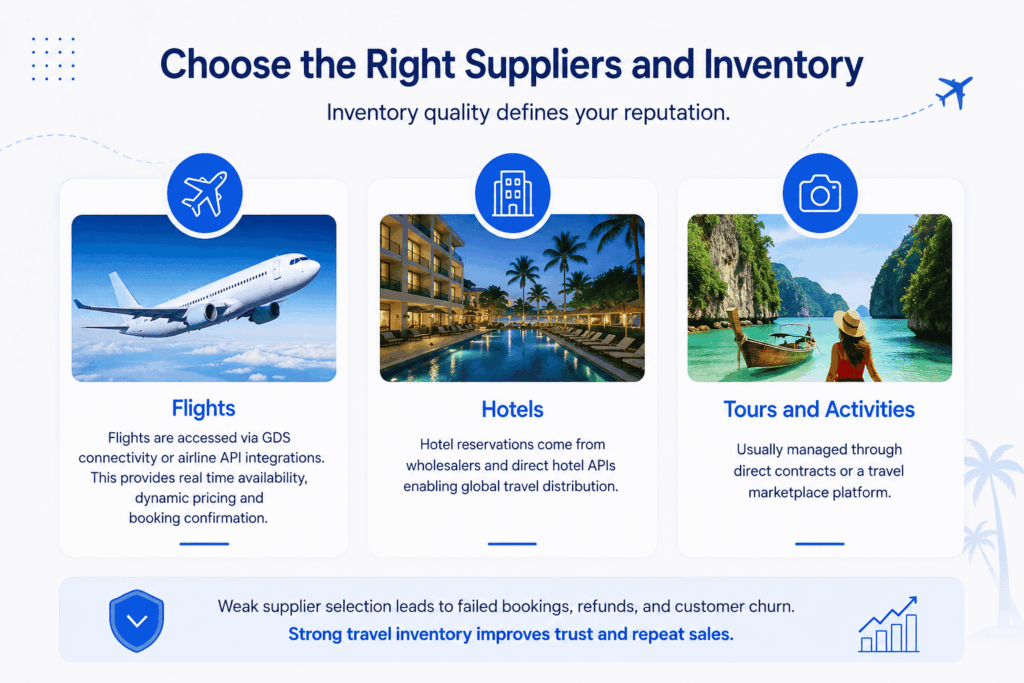
Step 3: Choose the Right Suppliers and Inventory
Inventory quality defines your reputation.
Flights
Flights are accessed via GDS connectivity or airline API integrations. This provides real time availability dynamic pricing and booking confirmation.
Hotels
Hotel reservations come from wholesalers and direct hotel APIs enabling global travel distribution.
Tours and Activities
Usually managed through direct contracts or a travel marketplace platform.
Weak supplier selection leads to failed bookings refunds and customer churn. Strong travel inventory improves trust and repeat sales.
Step 4: How Booking Flow Actually Works
This is where many founders fail.
A real OTA booking flow includes:
- Search using live travel inventory
- Pricing with markup and margins
- Availability recheck before payment
- Secure checkout and fraud prevention
- Supplier confirmation via API integrations
- Voucher issuance and customer notifications
Any weak step increases cancellations chargebacks and support tickets.
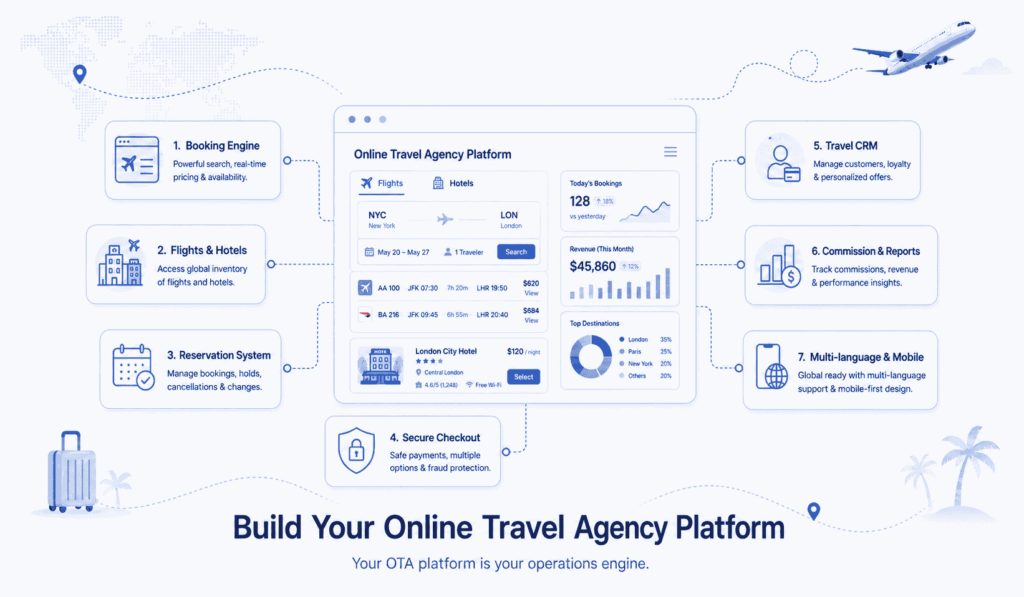
Step 5: Build Your Online Travel Agency Platform
Your OTA platform is your operations engine.
Core components include:
- Travel agency booking engine
- Flight and hotel booking platform
- Travel reservation system
- Secure checkout and fraud prevention
- Travel CRM for customer support
- Commission management and reporting
- Multi language platform and mobile bookings
Most agencies use online travel agency software solutions instead of building from scratch to reduce risk and launch faster.
Step 6: Payments and Financial Flow
Payments are where OTAs lose money.
You must manage:
- Payment gateway integrations
- Multi currency payments
- Supplier settlement timelines
- Customer refunds handling
- Chargebacks and fraud prevention
Suppliers charge instantly. Customers cancel later. Poor cash flow planning kills profitability even with high sales.
Step 7: Day to Day Operations
An OTA is an operations business that depends on a centralized system for travel agencies to manage bookings, suppliers, payments, and customer support without manual work.
Key operational areas include:
- Customer support for changes and cancellations
- Travel automation for confirmations and vouchers
- Supplier issue resolution
- Monitoring booking conversion rate
- Reporting and reconciliation
How Businesses Usually Try to Solve This
Most new OTAs take shortcuts.
Common approaches include:
- Using a basic travel booking website without back office control
- Relying on one supplier for all inventory
- Handling confirmations manually
- Ignoring refund workflows until problems start
Common Mistakes That Break OTAs
- Choosing suppliers without testing booking success rate
- Ignoring cancellation and refund logic
- Weak fraud prevention
- Poor customer support processes
- Treating technology as secondary
What Actually Works
Successful OTAs focus on:
- Multiple suppliers with fallback logic
- Strong travel automation
- Clear financial controls
- A scalable online booking business platform
- Operational visibility from day one
Where PHPTRAVELS Fits
Once you understand the operational complexity, platform choice becomes a business decision.
PHPTRAVELS is used by agencies that need:
- A full OTA booking system
- B2B and B2C sales in one platform
- Supplier integration flexibility
- Built in travel CRM and automation
- Control over markup and margins