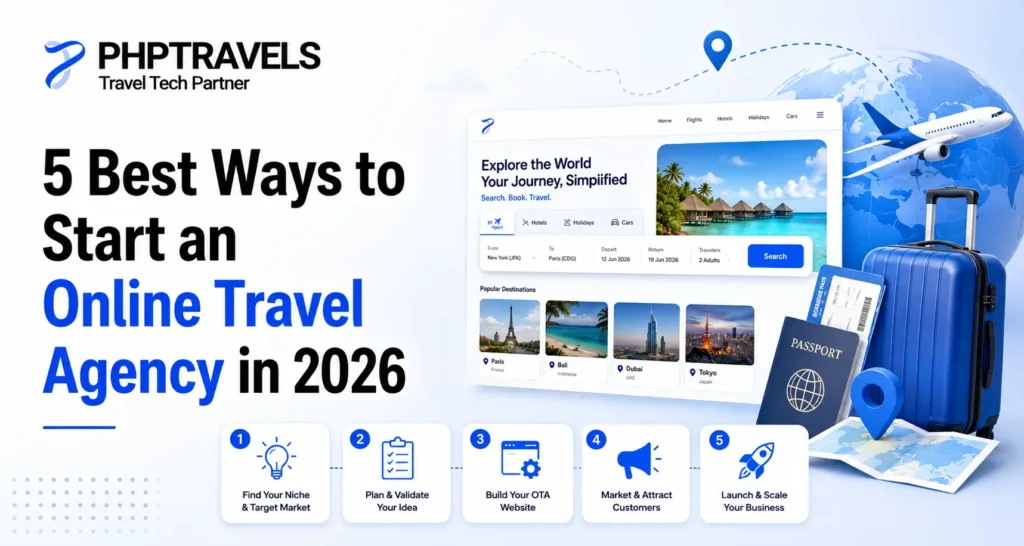
Starting an online travel agency (OTA) takes more than putting a travel website online and waiting for bookings. A successful OTA combines a clear business model, legal compliance, reliable inventory, booking technology, secure payments, customer service, and repeatable marketing.
The short answer is: choose a focused travel niche, register the business correctly, connect reliable suppliers, launch a platform that can manage real bookings, and build demand through SEO, partnerships, and customer trust.
What Is an Online Travel Agency?
An online travel agency is a digital travel business that lets customers or travel agents search, compare, and book travel services through a website or portal. An OTA may sell flights, hotels, tours, transfers, car rentals, travel packages, or a combination of services.
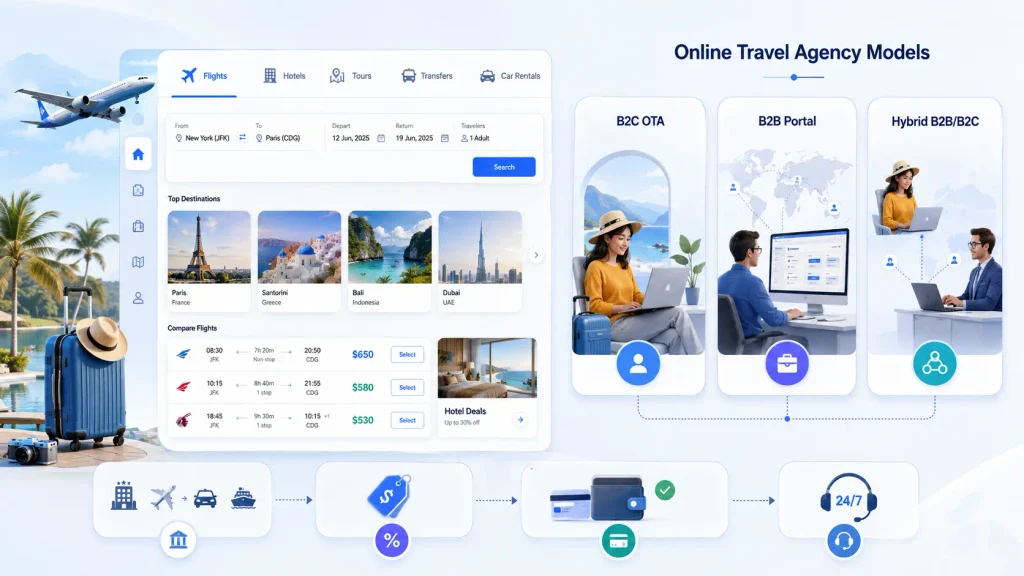
Most new travel businesses use one of three models:
- B2C OTA: sells directly to travelers.
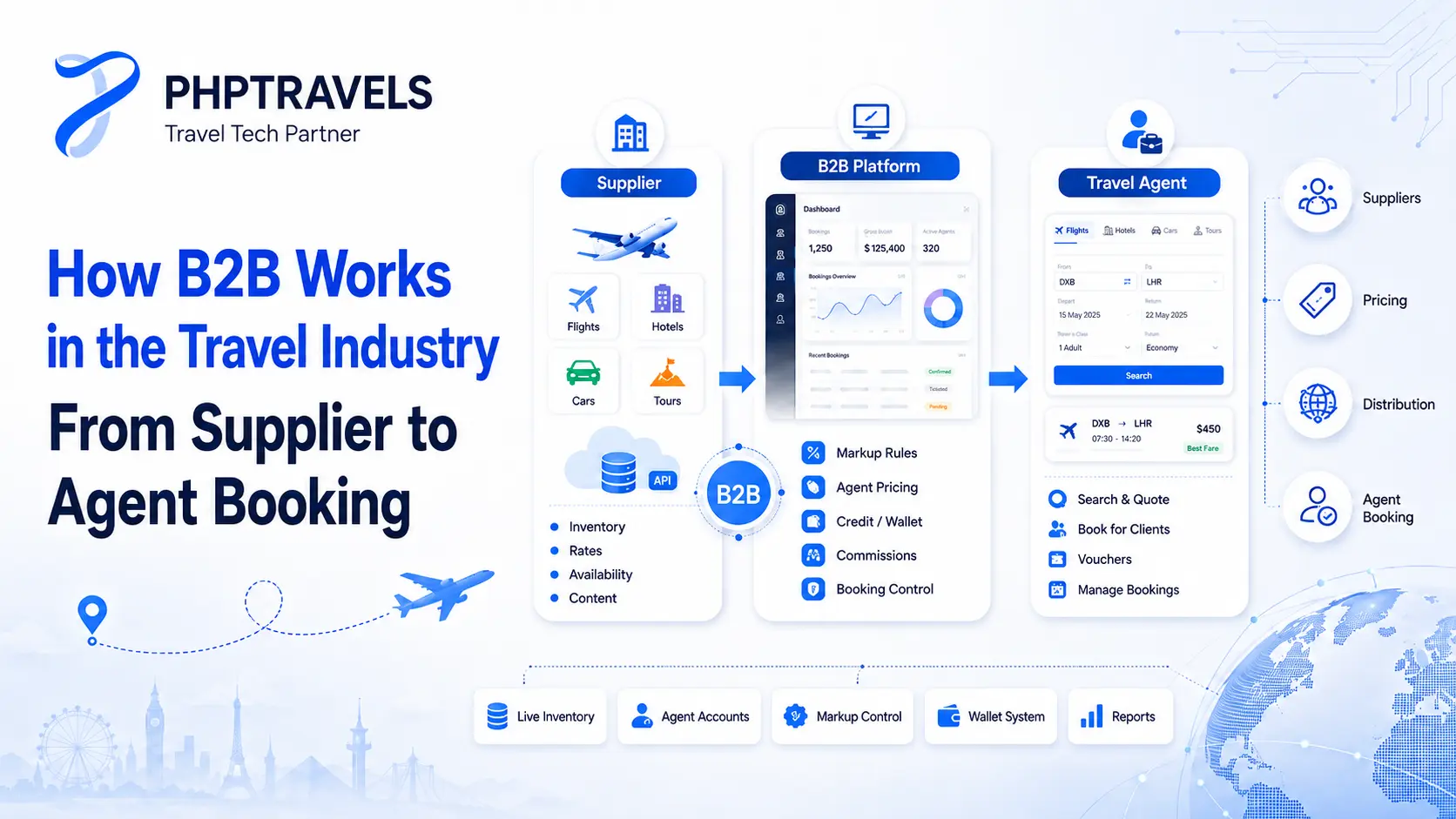
- B2B travel portal: provides inventory and pricing to sub-agents or corporate buyers.
- Hybrid B2B/B2C OTA: serves both end customers and travel agents from one back office.
Your model affects supplier contracts, markups, payments, technology, support, and marketing.
1. Research the Market and Choose a Focused OTA Business Model
The first step is deciding exactly who you want to serve and what problem your online travel agency will solve.
Large OTAs compete heavily for broad searches such as cheap flights and hotels. A new agency usually has a better chance of gaining traction by starting with a specific market, destination, traveler type, or service.
You could focus on corporate travel, Umrah travel, luxury holidays, adventure tours, destination packages, group travel, regional flights, hotel-only bookings, or B2B distribution for smaller agents.
Start by answering four questions:
- Who is the ideal customer?
- What travel products will you sell?
- Which countries or destinations will you serve?
- How will the business make money?
Common revenue models include supplier commissions, booking fees, service fees, markups on net rates, package margins, and B2B agent commissions.
Your goal is a simple value proposition. Instead of “We sell travel online,” use positioning such as “We help small businesses manage regional corporate travel” or “We provide curated Umrah packages with online booking and support.”
Before investing heavily, validate demand. Review competing agencies, search results, pricing models, reviews, and common traveler questions. Speak with potential customers and identify friction in their current booking process.
For a deeper operational view, guide to starting an online travel agency.
2. Register the Business and Understand Travel Licensing
Your OTA needs a legal foundation before it processes real bookings.
Requirements differ by country and sometimes by state or region, so there is no single worldwide license every online travel agency must obtain. Depending on your location and model, you may need company registration, a travel agency or seller-of-travel license, tax registration, a business bank account, insurance, payment-provider approval, and supplier agreements.
Publish clear policies covering cancellations, refunds, privacy, payment terms, booking changes, and customer support.
Do You Need IATA Accreditation?
Not every online travel agency needs IATA accreditation on day one.
IATA accreditation can matter for agencies that want specific airline distribution and settlement capabilities, but the right path depends on your market, airline relationships, consolidators, GDS access, and local regulations.
Some startups begin with accredited partners, consolidators, airline APIs, wholesalers, or other suppliers instead of becoming directly accredited immediately. As the agency grows, direct accreditation may become more relevant.
Check the rules where the business is registered and confirm the requirements of the suppliers and payment providers you plan to use.
Trust also starts here. Display registered business details, real contact information, support channels, policies, and relevant certifications clearly.
3. Choose Reliable Travel Suppliers and Inventory Sources
An OTA cannot sell useful travel products without inventory.
For flights, agencies may connect to a Global Distribution System (GDS), NDC provider, airline API, aggregator, or consolidator. Hotel inventory can come from wholesalers, bedbanks, direct contracts, channel partners, or hotel APIs. Tours and activities may come from local destination management companies, direct operators, or global marketplaces.
The website is the storefront. Supplier access is what makes the products bookable.
When comparing suppliers, evaluate:
- coverage in your target market;
- commercial terms and markup potential;
- cancellation and refund rules;
- booking confirmation reliability;
- support quality;
- API stability;
- payment and settlement requirements;
- test or sandbox access.
If you use several suppliers, your booking system should help manage pricing rules, markups, currencies, booking records, and supplier responses in one place.
PHPTRAVELS, for include, provides travel API integrations across multiple travel categories and payment gateways. A technical connector can simplify integration, but commercial agreements and API credentials still normally come from each supplier.
Do not go live after testing only search results. Test the full journey: search, price recheck, traveler details, payment, supplier confirmation, voucher or ticket generation, cancellation, refund handling, and notifications.
A reliable OTA is built around what happens when a booking changes, not only when everything works perfectly.
4. Build a Fast, Trustworthy Online Travel Agency Website
Once your business and suppliers are ready, you need technology that connects customers to inventory.
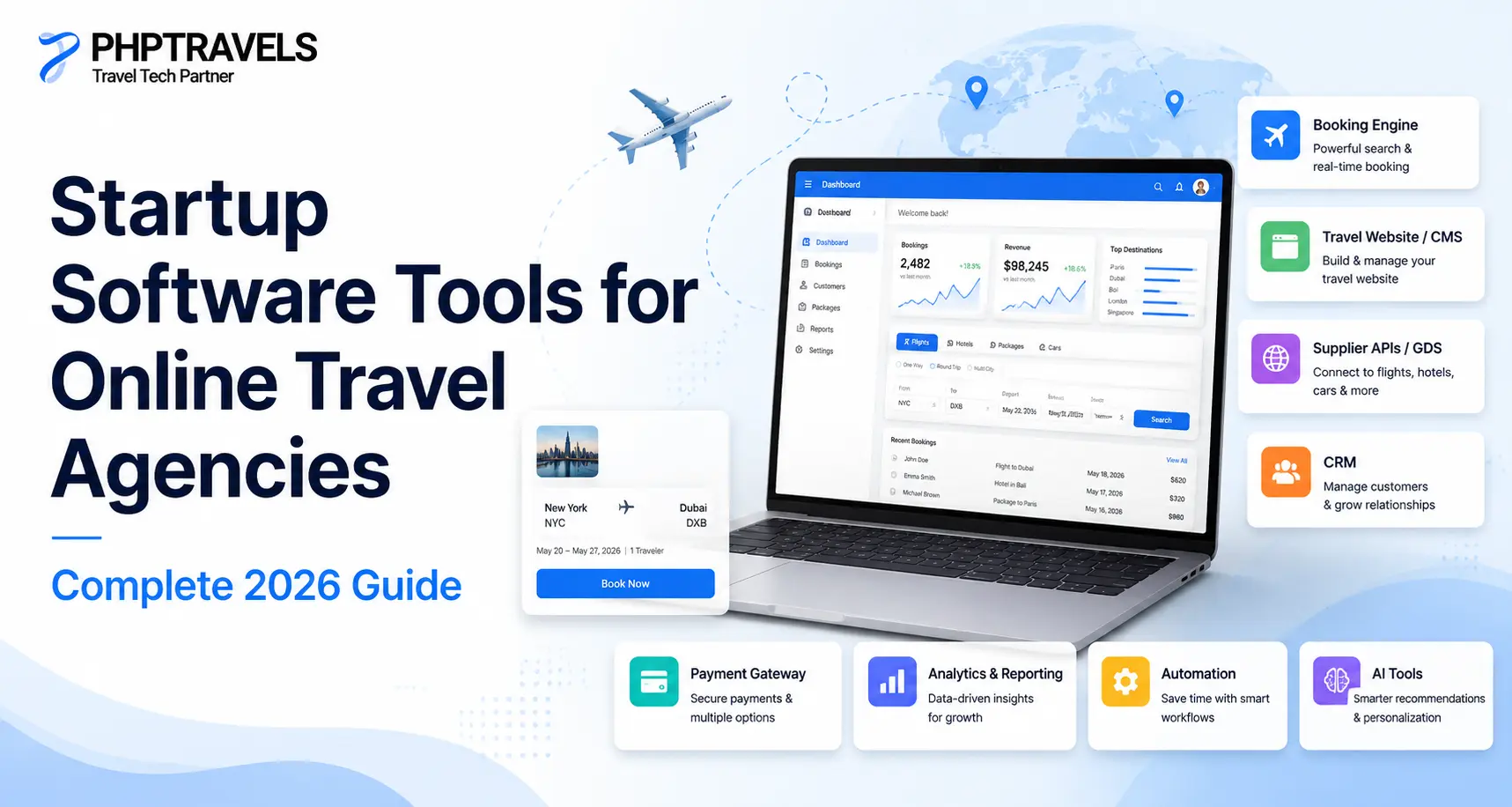
A modern OTA website should help users search live inventory, compare options, book, pay securely, receive confirmation, and contact support.
Important capabilities may include:
- mobile-friendly search and checkout;
- booking modules for the products you sell;
- supplier API or GDS connectivity;
- secure payment gateway integration;
- markups and commission rules;
- multi-currency and, when relevant, multi-language support;
- vouchers, invoices, and notifications;
- customer and agent accounts;
- booking management and reporting;
- CRM or support workflows;
- clear cancellation and refund information.
You generally have three routes: build from scratch, use a hosted or white-label system, or use self-hosted/open-source travel booking software.
A custom build offers flexibility but requires more development, testing, security work, integrations, and maintenance. A white label booking system can shorten launch time by providing an existing booking structure under your brand. Self-hosted software can offer more control over code, hosting, integrations, and customization.
Choose based on operational needs rather than design alone.
If you plan to sell to sub-agents, make sure the system supports B2B pricing, agent logins, commissions, invoices, and booking records. For a hybrid model, a B2B travel portal connected to the same back office can reduce duplicated work.
Make the Website Search-Friendly From Day One
SEO should be part of the site structure, not an add-on after launch.
Create useful landing pages for destinations, services, and products you genuinely offer. Add clear titles, headings, internal links, descriptive image alt text, clean URLs, author information, and current company details.
Your blog should answer real customer questions. Instead of publishing many short generic posts, create fewer pages that demonstrate practical experience and cover a topic completely.
Useful topics include destination booking guides, travel-technology explainers, supplier and GDS education, refund and cancellation guidance, B2B travel resources, and comparisons of booking models.
5. Launch, Market, and Grow the Agency
After launch, the main challenge becomes customer acquisition.
Do not depend on one traffic source. Build a mix of organic search, direct outreach, partnerships, social media, email, referrals, and carefully measured paid campaigns.
Build Organic Search Visibility
SEO can become a long-term acquisition channel when content matches real search intent.
Create pages around services you actually provide and topic clusters around your expertise. If you serve a specific region or niche, publish content that demonstrates real knowledge rather than repeating information already available everywhere.
Keep important content updated as travel technology, supplier options, regulations, and customer expectations change.
Use Partnerships and Referrals
Depending on your niche, partners can include hotels, tour operators, destination management companies, corporate clients, local businesses, travel agents, event organizers, universities, or community organizations.
Referral business is valuable because travel is trust-sensitive. Make it easy for satisfied customers and B2B partners to recommend you.
Track the Numbers That Matter
Traffic matters, but bookings and margin determine whether the business works.
Track search-to-booking conversion, abandoned checkouts, average booking value, gross margin, cancellations, refunds, support tickets, repeat customers, supplier performance, and acquisition cost.
As volume increases, automate repetitive work such as confirmations, vouchers, invoices, markup rules, agent reporting, CRM workflows, and booking status updates.
How Much Does It Cost to Start an Online Travel Agency?
There is no universal startup cost. An OTA can range from a small niche agency using a limited supplier setup to a multi-market platform with custom development and several integrations.
Your budget may include business registration and licenses, insurance, booking software, hosting, supplier deposits or guarantees, payment processing, API or GDS setup, branding, content, marketing, customer support, and working capital for refunds or settlement timing.
Instead of asking only, “What is the cheapest way to launch?”, calculate what is required to process a real booking reliably from beginning to end.
Common Mistakes New Online Travel Agencies Should Avoid
Avoid trying to sell every travel product to every customer. Avoid choosing suppliers only because they advertise large inventory. Do not assume IATA requirements are identical in every market. Do not launch without testing cancellations and refunds, and do not depend on manual processes that will fail as volume grows.
Also avoid generic SEO content published only to target keywords. Search engines and AI-powered search experiences increasingly favor useful, original, well-structured information with clear evidence of who created it.
The strongest long-term strategy is to build a real travel business and make the website accurately reflect that expertise.
Quick Checklist: Starting an OTA
Before launch, confirm that you have:
- A defined niche, customer, and revenue model;
- Required business registration and local permissions;
- Supplier agreements and working inventory;
- A tested booking and payment flow;
- Clear cancellation, refund, privacy, and support policies;
- A mobile-friendly booking website;
- Analytics and conversion tracking;Aa customer acquisition plan;
- A process for changes, support, and refunds;
- Enough working capital for operating delays and booking issues.
Final Thoughts
Starting an online travel agency does not require building the next global marketplace on day one. The strongest path is to begin with a clear niche, reliable suppliers, compliant operations, dependable booking technology, and a marketing plan based on real customer needs.