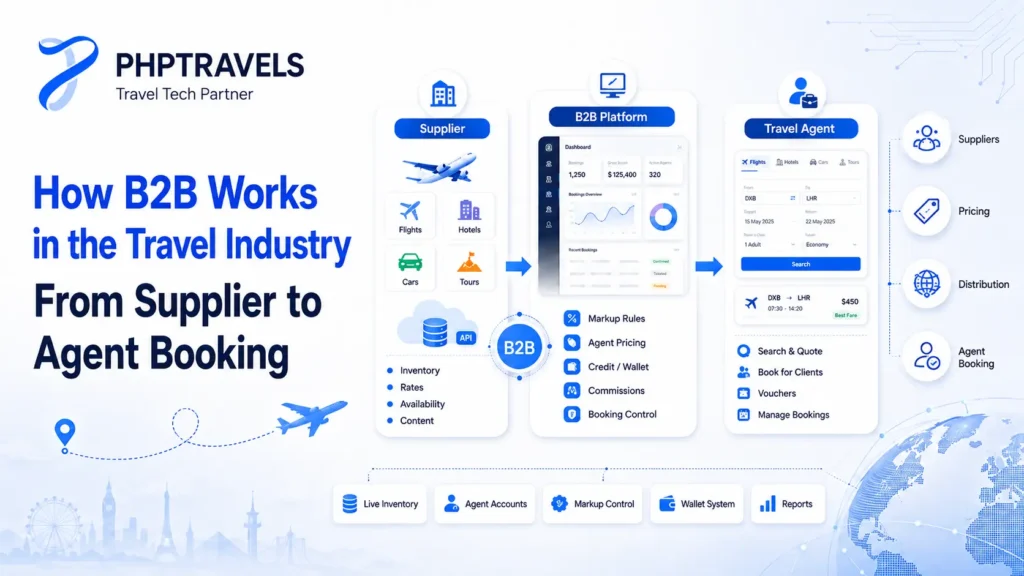
B2B travel works by connecting travel suppliers and inventory distributors with agencies, OTAs, tour operators, DMCs, corporate travel companies, and sub-agents that resell travel services.
A hotel, airline, wholesaler, bedbank, consolidator, or other supplier makes inventory available. A travel business accesses that inventory through a GDS, supplier platform, API, XML feed, direct contract, or another distribution connection. The agency then applies its commercial rules, sells the service, manages the booking, collects payment, and eventually reconciles the transaction with the supplier.
That is the B2B travel model in simple terms.
The difficult part is everything happening between those steps: real-time availability, supplier mapping, pricing rules, commissions, agent credit, booking confirmations, cancellations, refunds, vouchers, invoices, and financial settlement.
Quick Answer
B2B travel is a distribution model in which one travel business supplies inventory or booking access to another business. Travel agencies and OTAs obtain flights, hotels, tours, transfers, and other services from suppliers or intermediaries, add pricing rules or service fees, sell them through agents or business channels, and manage booking and settlement through connected travel systems.
A typical flow looks like this:
Supplier inventory → distribution connection → travel platform → pricing rules → agent search → booking → payment or credit → confirmation → servicing → settlement and reconciliation.
If you first need the basic terminology, read this explanation of what B2B means in the travel industry.
Who Participates in the B2B Travel Ecosystem?
Several different businesses can participate in one B2B travel transaction.
| Participant | Main Role |
|---|---|
| Airlines and Hotels | Create or control primary travel inventory |
| Tour and Activity Suppliers | Supply tours, attractions, packages, or experiences |
| Wholesalers and Bedbanks | Contract and distribute inventory to travel businesses |
| Air Consolidators | Provide agencies with access to airline fares and ticketing arrangements |
| GDS Platforms | Distribute travel content and booking capabilities across connected sellers |
| Aggregators | Combine content from multiple supplier sources |
| Travel Agencies | Buy or access inventory and resell it to travelers or other agents |
| OTAs | Distribute inventory digitally through online booking channels |
| DMCs | Package and distribute destination-based services |
| Tour Operators | Combine services into tours or packages and distribute them |
| Sub-Agents | Sell inventory provided by a master agency or distributor |
| Corporate Travel Companies | Manage business-travel bookings, policies, approvals, and reporting |
How B2B Travel Works Step by Step
1. Travel Inventory Starts With a Supplier
Every booking begins with inventory.
For flights, the inventory ultimately comes from airlines. Hotel inventory can originate with individual hotels, hotel groups, wholesalers, bedbanks, or contracted suppliers. Tours, transfers, rental cars, ferries, and other services have their own supplier networks.
The supplier controls important commercial information such as availability, rates, booking conditions, cancellation rules, and restrictions.
A travel agency does not necessarily need a separate direct contract with every airline or hotel it sells. It can gain access through wholesalers, consolidators, GDS connections, aggregators, or other approved suppliers.
For hotel distribution specifically, agencies evaluating wholesale inventory can also review the guide to B2B hotel suppliers.
2. Inventory Reaches the Agency Through Distribution Connections
This is where B2B travel technology begins to matter.
Inventory can reach a travel company through several distribution relationships.
GDS
A Global Distribution System provides access to travel content and booking capabilities from participating suppliers. GDS connectivity has traditionally been especially important for airline distribution, although GDS platforms can also distribute hotels, cars, and other products.
Agencies deciding whether this distribution model fits their business can read the guide on choosing a GDS for a travel business.
Direct Supplier Connection
An agency may have a commercial relationship directly with an airline, hotel provider, tour company, or other supplier.
The supplier may provide inventory through its own booking interface or a technical integration.
Wholesaler or Bedbank
A wholesaler contracts inventory and redistributes it to agencies and other travel sellers.
This is especially common in hotel distribution because it allows agencies to access large inventories without negotiating separately with every hotel.
Aggregator
An aggregator connects multiple content sources so the travel business can search a broader inventory set through a unified integration or platform.
APIs and XML Feeds
An important distinction is that an API is not necessarily the supplier itself.
APIs, REST interfaces, JSON services, and XML feeds are methods systems use to exchange data.
For example, a hotel wholesaler can expose its inventory through an API. An airline may provide an API. An aggregator may also provide one API that represents several upstream suppliers.
Agencies evaluating connectivity can explore available travel API suppliers and integration options.
3. The Platform Aggregates and Normalizes Inventory
Connecting several suppliers creates another problem: their data rarely arrives in exactly the same structure.
One supplier may use different hotel identifiers, room names, currencies, cancellation formats, fare codes, meal-plan descriptions, or destination mappings than another.
A travel platform therefore has to convert supplier responses into a usable format.
Depending on the product, this can include:
| Processing Task | Why It Matters |
|---|---|
| Content Mapping | Prevents duplicate or inconsistent listings |
| Currency Normalization | Makes rates comparable |
| Availability Checking | Reduces failed bookings |
| Rate-Rule Processing | Keeps cancellation and booking conditions clear |
| Supplier Identification | Preserves the source of each offer |
| Search Filtering | Helps agents find appropriate inventory |
| Deduplication | Avoids showing the same product several times |
This aggregation layer becomes especially important when an agency connects multiple suppliers.
For a more technical explanation, see how B2B travel portal architecture handles supplier aggregation and booking workflows.
4. Pricing and Markup Rules Are Applied
Supplier cost is not always the final selling price.
A B2B travel business can apply commercial rules based on factors such as supplier, product, destination, agent tier, branch, market, customer agreement, or sales channel.
Pricing may involve net rates, markups, commissions, service fees, negotiated rates, or combinations of these models.
Consider a simplified hotel example.
A supplier provides an agency a room at a net cost of $200.
The master agency applies a $15 margin before distributing the rate to one of its agents. The agent may then add a $20 service margin before presenting the booking to its customer.
The commercial chain would therefore be:
Supplier cost: $200 → agency rate: $215 → customer selling price: $235
Real bookings may also involve taxes, currency conversion, commissions, discounts, payment costs, or contractual restrictions, so the actual calculation can be more complex.
This is why centralized markup control is important in a B2B operation. It prevents individual agents from relying on disconnected spreadsheets or manual calculations.
5. Agents Receive Controlled Access
A mature B2B system does not give every reseller identical permissions.
An agency may operate a hierarchy containing:
Master agency → branch → agent → sub-agent
Each account can have its own commercial settings.
Examples include separate markups, credit limits, currencies, booking permissions, branch restrictions, payment terms, and reporting access.
Instead of sending booking requests through email or messaging applications, approved agents can log in and search the inventory that has been made available to them.
A B2B booking engine for travel agencies and wholesalers is designed to centralize this process.
6. The Agent Searches and Creates a Booking
Once logged in, the agent enters the travel requirements.
For a hotel search this could include destination, dates, rooms, and guests. For a flight booking it may include origin, destination, travel dates, passenger details, and cabin requirements.
The system requests matching inventory from the relevant suppliers.
Before confirmation, good B2B workflows recheck important information such as:
current availability → current rate → booking conditions → cancellation rules → payment or credit eligibility
This matters because travel inventory can change between the original search and final booking request.
After successful confirmation, the booking system records the supplier reference and internal booking reference. Depending on the product, it may also record airline PNRs, ticket numbers, hotel confirmation numbers, or other service-specific references.
7. The System Handles Payment, Wallet, or Credit
B2B payments often work differently from a standard consumer checkout.
Some agents pay immediately. Others maintain prepaid wallet balances. Approved agents may receive credit limits that allow bookings up to an agreed exposure amount.
Common models include:
| Payment Model | How It Works |
|---|---|
| Prepaid Wallet | Agent deposits money before booking |
| Credit Limit | Agent books within an approved credit amount |
| Payment Gateway | Booking is paid electronically |
| Bank Transfer | Payment is reconciled after transfer |
| Invoice Terms | Approved business clients settle according to agreed terms |
Credit control is particularly important because the company distributing the inventory may still owe the supplier even when an agent has not yet paid its balance.
For this reason, B2B finance systems should connect booking records, wallet movements, outstanding balances, invoices, refunds, and supplier costs rather than managing them separately.
8. Confirmation Documents Are Generated
A confirmed booking creates operational documents.
Depending on the service and business model, these may include booking confirmations, vouchers, itineraries, invoices, receipts, and tickets.
Ideally, these documents use the same central booking information.
That creates one traceable record connecting:
customer → agent → booking → supplier → payment → invoice → voucher → amendment or refund
This becomes increasingly important as booking volume grows.
9. Post-Booking Servicing Begins
The booking confirmation is not the end of the B2B workflow.
Travel businesses must also manage changes, cancellations, refunds, supplier responses, schedule changes, customer support, and other servicing requirements.
A flight schedule can change. A hotel reservation may be cancelled. A traveler may modify dates. A supplier may issue a partial refund.
These activities need to remain connected to the original booking.
Otherwise operations teams can end up with one status in the booking platform, another in accounting, and another at the supplier.
10. Settlement and Reconciliation Close the Transaction
The final stage is financial reconciliation.
The business compares what was booked, what the supplier charged, what the agent paid, what was refunded, and what margin or commission the transaction generated.
A reconciliation process can check:
supplier cost + selling price + payment received + commission + refund + outstanding amount
Any mismatch requires investigation.
At scale, accounting and booking systems therefore need to work together. Agencies building this layer can review how travel accounting system integration connects financial workflows with travel operations.
B2B Travel Supply: GDS, Wholesaler, Direct Supplier or API?
These terms are frequently confused.
| Term | What It Actually Describes |
|---|---|
| GDS | A travel distribution and reservation network |
| Wholesaler / Bedbank | A business that contracts and redistributes inventory |
| Consolidator | An intermediary, commonly associated with air distribution |
| Direct Supplier | The company providing the underlying travel product |
| Aggregator | A platform combining multiple inventory sources |
| API | A technical method systems use to exchange data |
| XML Feed | A data-exchange format or method used by some integrations |
B2B vs B2C Travel
B2B and B2C travel can sell the same flight or hotel, but the commercial workflow is different.
| Area | B2B Travel | B2C Travel |
|---|---|---|
| Buyer | Agency, reseller, company, partner | Individual traveler |
| Pricing | Net rates, markups, commissions, contract rules | Retail selling price |
| Accounts | Agents, branches, corporate accounts | Customer accounts |
| Payments | Wallets, credit, invoicing, gateway payments | Mainly direct payment |
| Distribution | Multi-level reseller networks possible | Direct to consumer |
| Documents | Agent/customer vouchers and invoices | Consumer booking documents |
| Reporting | Agent margin, credit, supplier and settlement reporting | Customer sales and conversion reporting |
| Access | Permission and agent-level controls | Public retail access |
How Travel Agencies Make Money From B2B Bookings
A travel agency can generate revenue through several commercial arrangements.
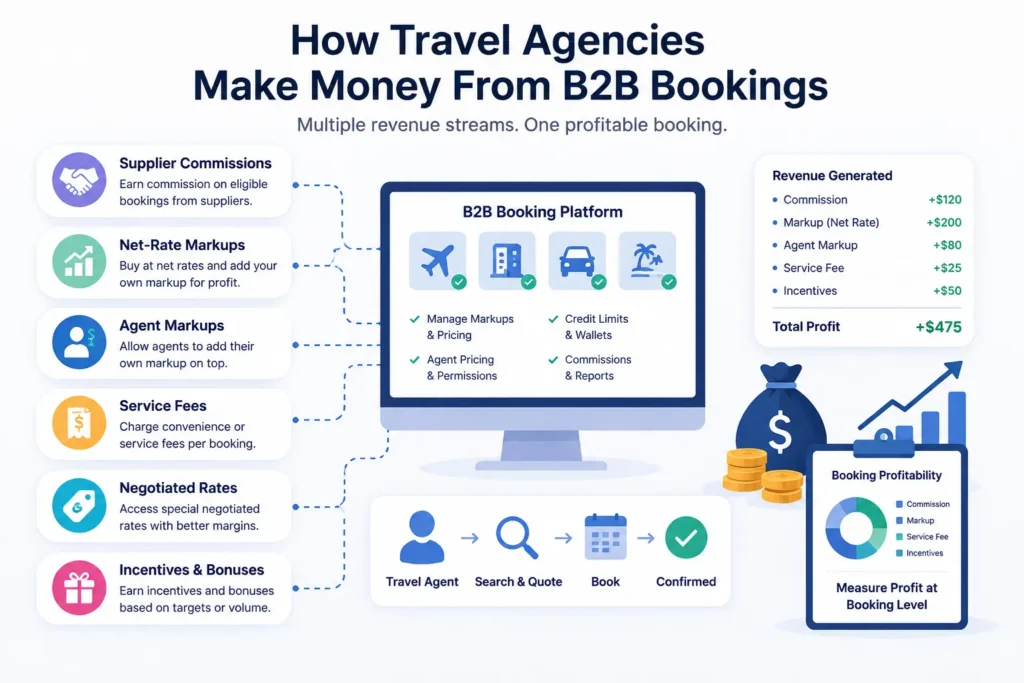
The most common are supplier commissions, net-rate markups, agent markups, service fees, negotiated rates, and incentives based on contractual agreements or sales performance.
The exact model varies by supplier and product.
For example, an agency might receive a hotel net rate and add a markup. A different hotel contract may pay commission instead. An air booking may involve a negotiated fare plus a service charge.
For this reason, profitability should be measured at booking level rather than only by gross sales.
What Technology Does a B2B Travel Business Need?
As a B2B operation grows, the technology usually extends beyond a basic booking website.
A complete operating stack can include a supplier integration layer, search and booking engine, agent portal, pricing engine, wallet and credit ledger, back-office system, CRM, accounting integration, document generation, reporting, and support tools.
The important principle is not simply having more software.
It is keeping the systems connected.
A booking should not have one price in the sales system, another amount in accounting, and a third supplier status stored in an employee’s email.
For businesses evaluating an operational platform, the B2B travel portal guide explains how agent-facing systems fit into this workflow.
Common B2B Travel Problems
Stale Prices and Availability
Travel rates change quickly. Systems should revalidate pricing and availability before final confirmation whenever the supplier workflow requires it.
Duplicate Supplier Content
Connecting multiple hotel suppliers can create duplicate hotels and inconsistent room information. Mapping and normalization are therefore important aggregation functions.
Incorrect Markup Rules
A poorly configured pricing rule can either make an offer uncompetitive or reduce the agency’s intended margin.
Uncontrolled Agent Credit
Allowing agents to exceed approved credit exposes the distributing agency to financial risk.
Failed Bookings
A successful search response does not guarantee that the supplier will successfully confirm the booking. Systems need clear failure handling and transaction status.
Cancellation and Refund Mismatches
Supplier penalties, customer refunds, agent balances, and accounting records must remain synchronized.
Manual Reconciliation
High booking volumes make spreadsheet-based supplier reconciliation increasingly difficult and error-prone.
How B2B Travel Scales From One Agency to a Distribution Network
A small agency may start with a few supplier accounts and manually service its clients.
As volume grows, the business can introduce structured supplier integrations, agent accounts, automatic markup rules, wallet or credit controls, booking automation, and reporting.
It can then onboard branches and sub-agents while keeping centralized control over inventory and commercial rules.
Some companies eventually operate B2B2B or B2B2C structures in which inventory passes through more than one distribution layer before reaching the traveler.
Technology makes this possible, but the business rules must be defined first.
An agency planning this expansion should determine:
who can sell → what they can sell → which supplier serves the request → what pricing applies → how payment works → who owns servicing → how settlement is reconciled
Companies considering their own reseller network can also follow this guide on how to start a B2B travel business online.
Where PHPTRAVELS Fits Into a B2B Workflow
PHPTRAVELS provides travel businesses with technology for connecting supplier inventory, managing agent access, applying markups and commissions, processing bookings, generating documents, and managing operational reporting.
Instead of treating supplier integrations, agent pricing, bookings, and finance as unrelated processes, a B2B platform brings them into a connected workflow.
Agencies that specifically need agent and reseller distribution can explore the PHPTRAVELS B2B travel portal.
Conclusion
Understanding how B2B works in the travel industry requires looking beyond the moment an agent clicks Book.
A complete B2B transaction connects suppliers, distribution channels, inventory integrations, pricing rules, agents, booking systems, payments, servicing, accounting, and settlement.
The basic operational flow is:
Supplier → distribution connection → travel platform → pricing → agent → booking → payment → confirmation → servicing → reconciliation.
Travel agencies and OTAs that structure these stages correctly can add suppliers and agents without creating the same amount of additional manual work.
The goal of B2B travel technology is therefore not simply to put inventory online. It is to give a travel business controlled distribution: the right inventory, shown to the right agent, at the right price, under the right payment rules, with every booking traceable from supplier cost to final settlement.