Choosing the right software tools for online travel agencies is the first real decision a new OTA makes. Launching an online travel agency (OTA) today requires more than a website and a booking form. A modern OTA needs connected software for inventory, reservations, customer data, payments, supplier integrations, finance, marketing, analytics, and post-booking service.
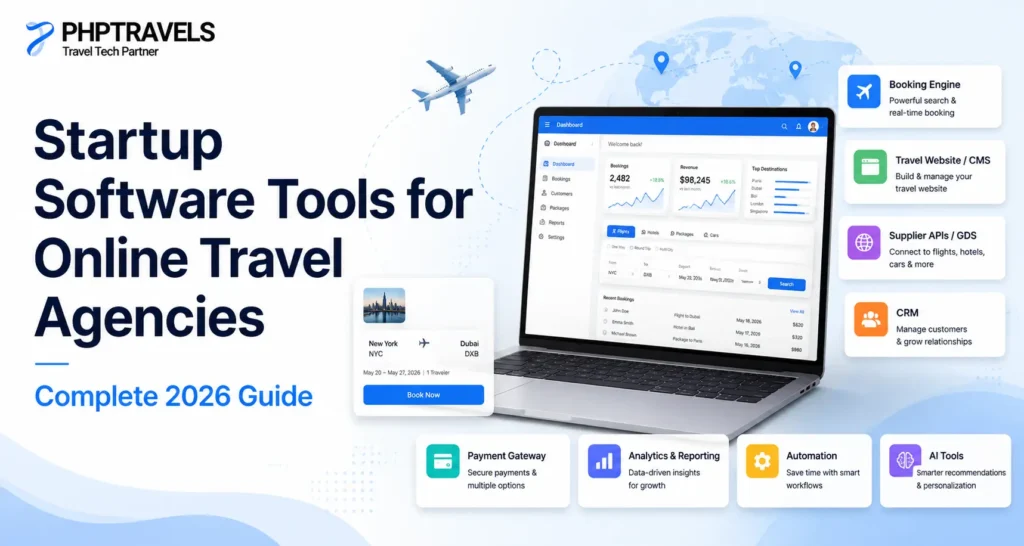
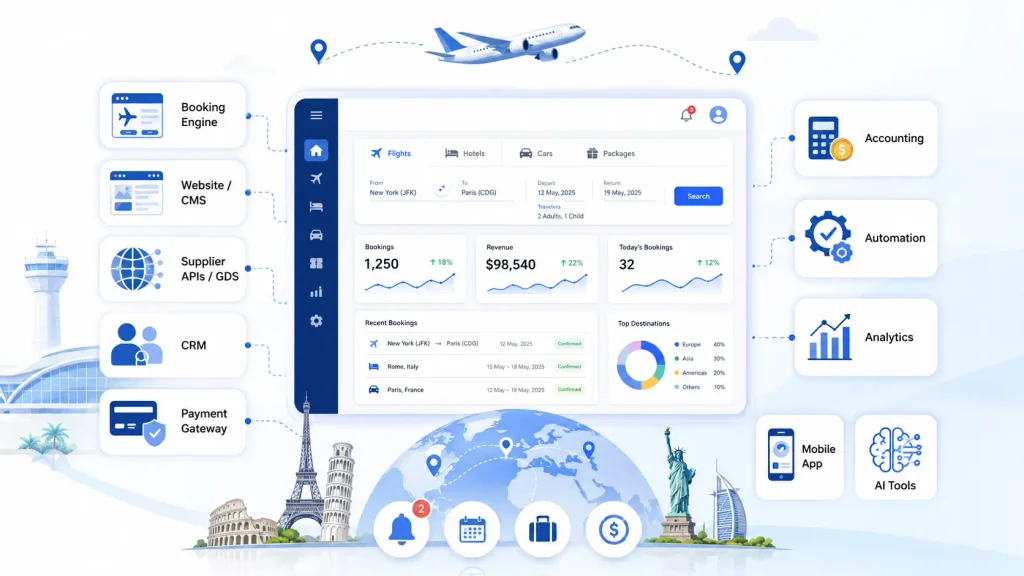
For most startups, the essential software tools for online travel agencies are a booking engine, travel website or CMS, supplier API or GDS connections, CRM, payment gateway, accounting tools, communication automation, and analytics. Mobile apps, B2B portals, and AI tools become valuable when they support a proven booking workflow.
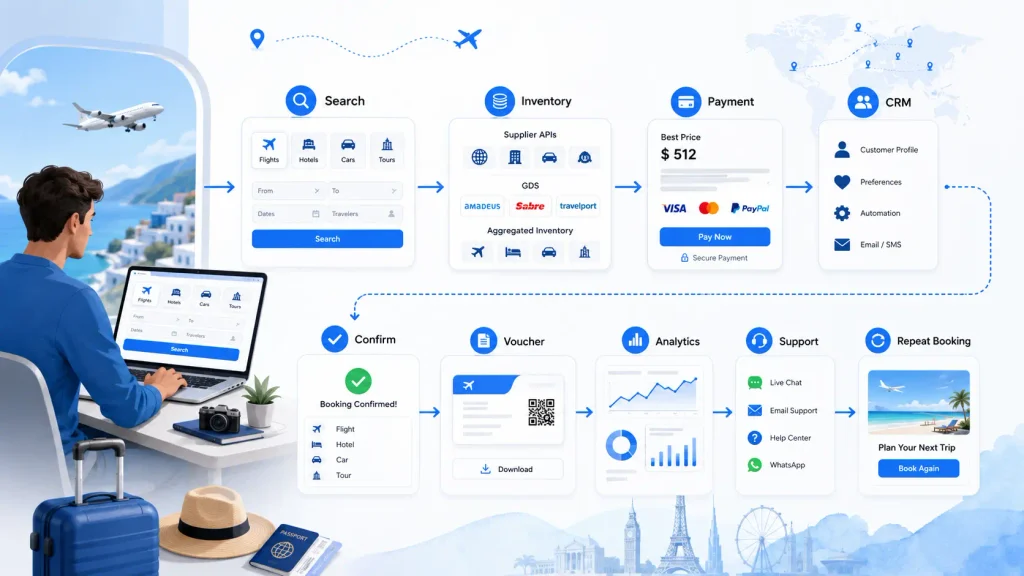
The goal is to build a connected system that moves a traveler from search to payment, confirmation, support, and repeat booking with minimal manual work. The software tools for online travel agencies below are ordered by how early a startup usually needs them.
Quick Answer: Essential Software Tools for Online Travel Agencies
| Tool | What It Does | Startup Priority |
|---|---|---|
| Booking Engine | Search, pricing, reservations, vouchers | Essential |
| Travel Website / CMS | Content, landing pages, booking entry point | Essential |
| Supplier APIs / GDS | Live travel inventory and rates | Essential for live inventory |
| Travel CRM | Leads, quotes, follow-ups, customer history | Essential |
| Payment Gateway | Online checkout, refunds, multi-currency payments | Essential |
| Accounting Tools | Invoices, commissions, reconciliation | High |
| Automation | Email, alerts, reminders, workflows | High |
| Analytics | Conversion, revenue, supplier and campaign reporting | Essential |
| Mobile App | Repeat engagement and post-booking service | Growth stage |
| AI Tools | Assistance, personalization, workflow support | Optional but useful |
1. Travel Booking Engine: The Core of an OTA
Of all the software tools for online travel agencies, the booking engine matters most. The booking engine is the commercial heart of an online travel agency. It connects customer search with inventory, pricing, markups, payment status, confirmations, vouchers, cancellations, and back-office records.
Choose a system around your business model, not just its front end. You may need contracted inventory, API inventory, B2C/B2B markups, commissions, or additional products later.
A scalable travel booking software platform should help manage those workflows without forcing staff to copy booking data between separate tools.
Look for B2C and B2B support, real-time pricing, markup controls, amendments, cancellations, vouchers, notifications, multiple currencies, supplier connections, payment integrations, and reporting.
2. Travel Website and CMS
Your website is where organic search traffic, campaigns, direct visitors, and returning customers enter the booking journey. A generic website can publish pages, but an OTA usually needs deeper connections between content, search, bookings, payments, and customer data. Among software tools for online travel agencies, the website is the one customers actually see.
A purpose-built travel website builder can connect destination content, offers, lead capture, search, checkout, and operations.
For SEO and conversion, use fast mobile pages, clear navigation, indexable destination/service content, strong internal links, and a consistent booking experience. Informational content should naturally support commercial pages.
3. Supplier APIs and GDS Connections
An OTA needs inventory. It may come from direct hotel contracts, wholesalers, airline or hotel APIs, aggregators, GDS platforms, tour suppliers, car rental providers, ferry systems, or a mix of sources. Supplier connections are the software tools for online travel agencies that decide what you can sell.
This is where travel API integrations become important. APIs let your platform request live availability, rates, rules, and booking data from suppliers and return confirmations to the traveler.
Before choosing a supplier, review market coverage, commercial terms, support, cancellation processes, currencies, documentation, and booking reliability.
If you are new to distribution technology, this guide to how travel API integration works explains the basics.
The supplier with the largest inventory is not automatically the best supplier. The better choice is the one that matches your customers, margins, service model, and markets.
4. Travel CRM for Leads, Quotes and Repeat Customers
A CRM is one of the most underrated software tools for online travel agencies. A CRM should do more than store contact details. Travel sales can involve inquiries, multiple quotes, itinerary changes, passenger information, partial payments, follow-ups, and repeat bookings.
A dedicated travel agency CRM helps connect leads and customer history with actual booking operations.
It should show which leads need follow-up, which quotes are expiring, who owns each account, and which inquiries convert.
When CRM data is connected to bookings instead of living in a spreadsheet, agents can personalize service without losing operational context.
5. Payment Gateway and Checkout Technology
Travel purchases can involve high transaction values, multiple currencies, cancellations, partial refunds, and different payment preferences by country. Your payment system therefore needs to be secure, reliable, and connected to booking status.
A proper travel payment gateway integration should give customers a clear checkout while helping the agency track successful payments, failed transactions, refunds, disputes, and settlements.
Evaluate countries, currencies, payment methods, 3D Secure, fraud controls, refunds, status updates, settlement timing, fees, and platform compatibility. Local payment behavior can directly affect conversion.
6. Accounting, Billing and Reconciliation
Spreadsheets may work for the first few bookings, but they become risky as transaction volume increases. Travel businesses have to track supplier costs, invoices, commissions, customer payments, refunds, credit, taxes, and profitability.
A travel-focused accounting and reconciliation system can connect financial records with booking IDs and reduce duplicate data entry.
At minimum, your finance workflow should connect each reservation with the customer invoice, supplier cost, payment, refund status, commission, and margin. Operations and finance should be looking at the same transaction.
7. B2B Agent Tools
If you plan to distribute inventory to other travel agents, you may need separate agent logins, credit limits, commissions, markup rules, statements, and booking visibility.
A B2B booking engine can help an OTA manage sub-agent sales without handling each request manually.
Even if B2B is a future channel, it is smart to choose core software that can add agent distribution later without requiring a complete platform rebuild.
8. Marketing Automation and Customer Communication
Useful automations include quote follow-ups, payment reminders, confirmations, pre-departure information, service updates, review requests, and post-trip campaigns.
Automation works best when it is triggered by real CRM and booking data. A customer who already paid should not receive an unpaid reminder, and a canceled reservation should not continue through the normal pre-departure sequence.
Email, SMS, WhatsApp, and push notifications can all be useful. The right channel depends on the market and message type.
9. Analytics and Reporting
An OTA should know where profit comes from, not only where website traffic comes from.
Track metrics such as search-to-booking conversion, booking value, gross margin, supplier performance, cancellation rate, payment failures, quote-to-booking conversion, repeat booking rate, customer acquisition cost, and revenue by product or destination.
A structured travel analytics framework helps separate marketing problems from pricing, supplier, checkout, and service problems.
Traffic without bookings is not growth. Bookings without margin are not healthy growth either.
10. Mobile Apps and AI Tools
A mobile app can improve repeat engagement, itinerary access, notifications, customer accounts, and post-booking service. But a startup should first make sure its website, booking engine, checkout, and support workflows work properly.
Once those foundations are stable, branded travel mobile apps can extend the same customer and booking experience to iOS and Android.
AI can also help with trip discovery, customer support, lead qualification, itinerary suggestions, personalization, and content workflows. The key is to use AI on top of reliable travel data.
AI can explain options or narrow down destinations, but live prices, availability, cancellation rules, and confirmations should come from connected supplier and reservation systems. Start with one measurable AI use case.
11. Security and Access Control
Travel agencies handle customer identities, contact details, financial records, and booking information. Security belongs in the core software plan.
Use strong authentication, role-based access, encrypted connections, regular backups, software updates, activity logs, and clear permissions for agents and administrators. Let compliant payment providers handle sensitive card data rather than storing it unnecessarily.
As the business grows, review broader cybersecurity practices for travel companies.
White Label vs API-Based OTA Software
A white-label solution can be useful when you want to launch quickly with limited development and test market demand. The trade-off is usually less control over the booking journey, supplier mix, pricing, or customer data. White-label products bundle many software tools for online travel agencies into one subscription.
An API-based or fully managed travel platform gives more flexibility for supplier choice, margins, customer experience, and operations, but it requires more setup.
Neither option is automatically better. Your decision should depend on budget, target market, inventory strategy, technical resources, and growth plans. This comparison of API and white-label travel portals covers the main trade-offs.
Recommended OTA Software Stack by Growth Stage
Stage 1: Launch
Start with a fast website, booking engine, relevant inventory source, payment gateway, CRM, basic finance workflow, and analytics.
Stage 2: Growth
Add more suppliers, automated communication, stronger reporting, B2B distribution, extra payment options, and better reconciliation.
Stage 3: Scale
Add mobile apps, advanced CRM segmentation, deeper automation, custom integrations, stronger security, AI-assisted service, and multi-market operations.
This staged approach prevents paying for complexity before booking volume justifies it.
Final Takeaway
The best software tools for online travel agencies form a stack that grows with the business, and the best startup stack for an online travel agency is not the one with the most tools. It is the one that creates the cleanest flow between customer demand, live inventory, bookings, payments, service, and finance.
Start with the systems that directly affect sales and fulfillment: website, booking engine, supplier connections, CRM, payment gateway, accounting, and analytics. Add B2B tools, mobile apps, automation, and AI as your booking volume and customer needs become clearer.
Shared customer and booking data reduces manual work and gives teams more time to improve conversion, service, and profitability.