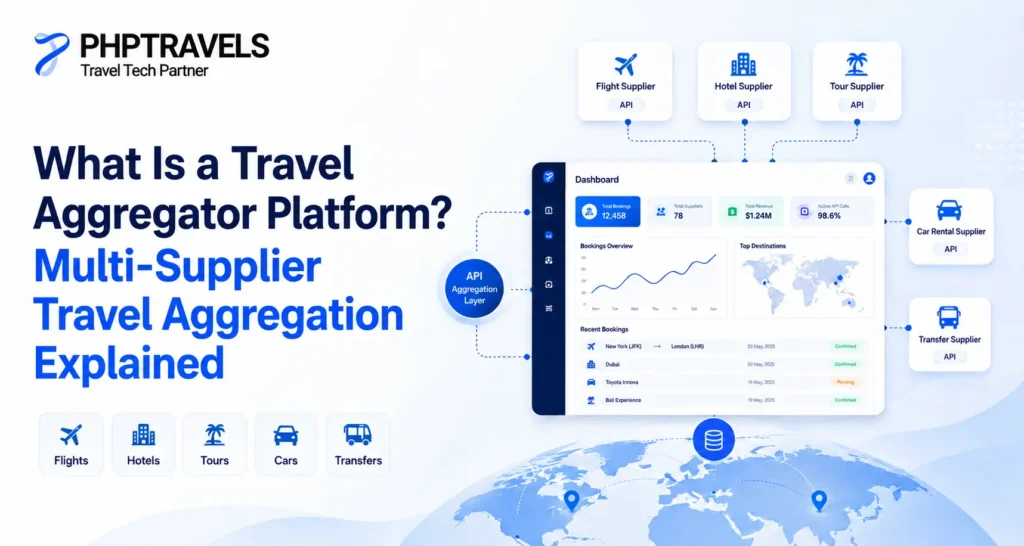
Connect multiple travel content sources through one platform instead of managing disconnected supplier workflows.
PHPTRAVELS provides a travel aggregator platform for travel agencies, OTAs, DMCs, tour operators and travel businesses that need to bring inventory from multiple suppliers into one booking environment.
Connect GDS sources, NDC connections, bedbanks, wholesalers, direct inventory and supplier APIs, then manage search results, pricing rules, availability and bookings through a unified workflow.
Connect suppliers. Normalize inventory. Apply your business rules. Sell through one platform.
Book a Live Demo, View Pricing
What Is a Travel Aggregator Platform?
A travel aggregator platform connects inventory from different travel suppliers and makes that content available through a consistent booking and distribution workflow.
Instead of operating each supplier connection as a separate system, a travel aggregation platform can receive supplier data, standardize relevant fields, apply pricing and business rules, compare available options and route a booking to the selected source.
For a travel business, the goal is not simply to connect more APIs. The goal is to make multiple sources of inventory usable from one operational layer while keeping supplier-specific requirements under control.
PHPTRAVELS supports this model across travel products while allowing businesses to choose suppliers according to their markets, commercial agreements and distribution strategy.
Aggregate Multiple Travel Suppliers in One Platform
Different suppliers provide inventory in different formats, commercial models and technical workflows.
A multi-supplier travel platform gives your business a central layer where those sources can work together without forcing customers or agents to move between disconnected supplier systems.
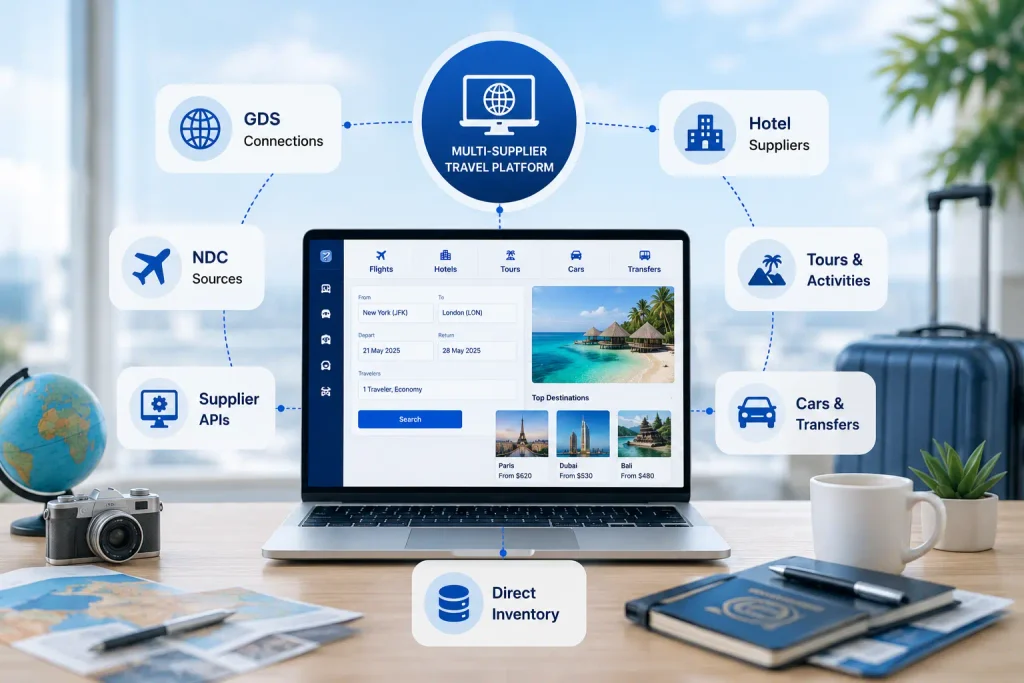
Depending on your business model and available supplier access, your setup can include:
GDS Connections
Connect global distribution sources where they fit your inventory and servicing requirements.
NDC Sources
Connect modern airline distribution sources based on the New Distribution Capability (NDC) standard alongside other available flight supply. IATA defines NDC as an industry-supported data exchange standard designed to improve communication and offer distribution between airlines and travel sellers.
Airline and Travel Supplier APIs
Connect supplier APIs based on the routes, markets, products and booking functionality your business needs.
For detailed API connectivity information, explore our travel API integrations.
Hotel Bedbanks and Wholesalers
Bring hotel rates and availability from multiple accommodation suppliers into the same booking environment.
For hotel-specific inventory mapping and supplier workflows, see our multi-supplier hotel booking system.
Tours and Activities
Connect tour and activity inventory alongside your other travel products.
Cars and Transfers
Add car rental and transfer suppliers without creating a completely separate customer journey.
Direct Inventory
Where supported by your operating model, direct contracts and manually managed inventory can work alongside connected supplier sources.
View our supported travel supplier integrations to explore available connections.
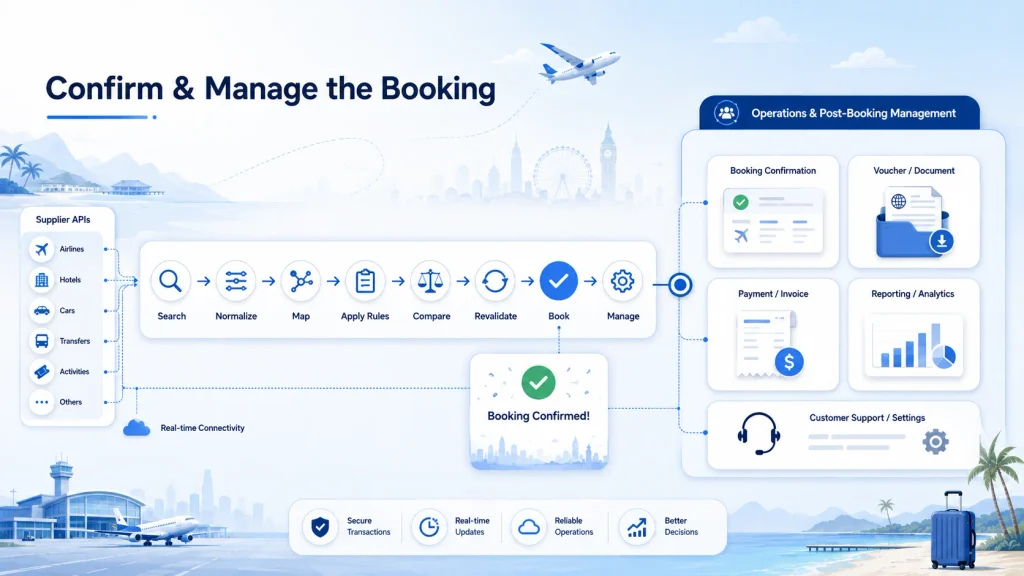
How the Travel Aggregation Layer Works
A successful travel supplier aggregation workflow does more than send a search request to several APIs.
The aggregation layer must coordinate what happens between the supplier and the final booking experience.
1. Connect Supplier Sources
Your business first connects the suppliers relevant to its products and target markets.
These may include GDS connections, NDC sources, bedbanks, wholesalers, XML or REST APIs and direct inventory.
Supplier contracts, credentials and API permissions remain dependent on the individual provider and your commercial agreement with them.
2. Search Available Inventory
When a customer or agent makes a search, the platform requests relevant availability from enabled sources.
The objective is to create one usable results flow rather than requiring the user to search every supplier separately.
3. Normalize Supplier Responses
Different suppliers may describe similar products using different data structures.
The aggregation layer converts the information required by the booking workflow into a more consistent format so search results, pricing and booking logic can be managed predictably.
4. Map and Control Duplicate Content
When the same underlying inventory exists through more than one source, mapping can help prevent unnecessary duplicate presentation.
This is particularly important for accommodation inventory, where the same property may be supplied by multiple bedbanks or distribution partners.
5. Apply Pricing and Business Rules
Supplier rates can pass through your configured commercial rules before being displayed.
Depending on your setup, these rules can include:
- markups
- commissions
- service fees
- taxes
- currency rules
- supplier preferences
- agency-level pricing
6. Compare and Route the Offer
The platform can present available offers according to the filters and business rules configured for your operation.
The selected booking is then routed through the appropriate supplier workflow.
7. Revalidate Before Booking
Travel inventory changes quickly.
Where the supplier workflow supports it, availability and pricing should be checked again before confirmation so the booking is not completed against an outdated offer.
8. Confirm and Manage the Booking
After confirmation, booking information can continue into the appropriate operational workflow for documents, payments, reporting and servicing.
Multi-Supplier Travel Inventory Without Disconnected Workflows
Adding more suppliers can increase inventory coverage, but it can also create operational complexity.
Every new source may introduce different response structures, rate rules, cancellation policies, currencies, booking references and servicing requirements.
A travel inventory aggregation platform helps place an orchestration layer between those supplier systems and the booking experience.
Inventory Normalization
Standardize the data required by your booking workflow rather than designing a separate customer interface around every supplier.
Supplier Comparison
Display relevant inventory from enabled sources within one results workflow.
Content Mapping
Map equivalent content where necessary so customers are not forced to interpret supplier-specific inventory structures.
Duplicate Inventory Control
Reduce unnecessary duplicate results when identical or equivalent inventory is supplied through more than one source.
Rate and Availability Handling
Keep live commercial information connected to the supplier that owns the selected offer.
Preferred Supplier Logic
Use your operating strategy to determine which suppliers should be enabled or prioritized for particular products and markets.
Booking Revalidation
Confirm supplier-side availability and current pricing at the appropriate stage of the booking flow.
This is the difference between simply collecting supplier connections and building multi-source travel inventory that can operate as one commercial booking environment.
Travel Products You Can Aggregate
PHPTRAVELS can support a cross-vertical travel business where different product types operate through the same wider platform.
Flights
Connect relevant airline distribution sources and manage flight search, pricing and booking within the flight workflow.
For flight-specific functionality, visit our flight booking software.
Hotels
Combine hotel supply from supported bedbanks, wholesalers, GDS sources and other accommodation connections.
Hotel-specific property mapping and room inventory require additional considerations that are covered in our hotel booking system API.
Cars
Add supported car rental inventory to the same wider travel platform.
Tours and Activities
Offer tours, attractions and activities alongside transport and accommodation products.
Transfers
Connect ground transportation where supported by your chosen supplier setup.
Ferries and Other Travel Products
Expand your product mix with additional modules and supplier connections according to your business requirements.
Travel Aggregator Platform Features
A useful travel content aggregator should help your team control both the technical supplier layer and the commercial booking workflow.
Multi-Supplier Search
Search enabled supplier sources without requiring a separate storefront for every connection.
Supplier Normalization
Convert the data needed by your application into a more consistent internal booking structure.
Inventory Mapping
Align equivalent content where multiple suppliers represent the same travel product differently.
Duplicate Management
Reduce duplicate inventory where mapping information allows equivalent results to be identified.
Supplier Routing
Route the selected offer through the supplier responsible for the availability and booking.
Markups and Commercial Rules
Apply pricing rules according to the requirements of your B2C or B2B sales model.
Multi-Currency Operations
Support international selling while maintaining the appropriate pricing and settlement logic for your configuration.
Search and Booking Revalidation
Recheck time-sensitive inventory before confirmation where the connected supplier provides the required functionality.
B2C and B2B Distribution
Use aggregated inventory across customer-facing and agent-facing business models without turning supplier connectivity into a separate system for every sales channel.
Reporting and Booking Management
Keep booking information connected to the wider operational workflow after confirmation.
Travel Aggregator vs GDS vs Booking Engine vs Meta Search
These technologies can work together, but they do not perform the same job.
| Technology | Primary Role |
|---|---|
| Travel Aggregator Platform | Brings multiple supplier/content sources into one controlled inventory and booking layer |
| GDS | Provides access to travel inventory and distribution services |
| Booking Engine | Manages the customer or agent journey from search through checkout and booking |
| Meta Search | Compares offers from multiple sources, commonly as a discovery/comparison layer |
| B2B Portal | Gives agents or resellers controlled access to inventory, pricing and booking tools |
The important distinction is that an aggregator focuses on bringing multiple sources together, while a booking engine focuses on completing the selling workflow.
Businesses researching comparison-only technology can read our travel meta search engine guide.
Who Needs a Travel Aggregator Platform?
A travel API aggregation platform can be useful when a travel business has outgrown a single-source inventory model.
Online Travel Agencies
Combine different sources of travel inventory while maintaining one branded customer experience.
Travel Agencies
Give staff access to a broader supplier mix without requiring a completely separate operational workflow for every provider.
DMCs
Combine external supplier content with products relevant to local destination operations.
Tour Operators
Bring bookable supplier inventory together with the products and packages managed by the business.
Travel Wholesalers
Organize multi-source supply before distributing inventory through the required sales channels.
Travel Startups
Build around a supplier-independent architecture that can support additional connections as the business model develops.
B2B Travel Sellers
Aggregated inventory can also be distributed to agent networks.
For agent accounts, credit limits, commissions, reseller controls and white-label distribution, use our dedicated B2B travel portal.
Supplier Integrations Built Around Your Business Model
There is no universal supplier combination that is right for every travel company.
Your ideal setup depends on factors such as:
- countries and markets you sell in
- destinations customers search
- product types you offer
- supplier commercial agreements
- available API credentials
- booking and servicing requirements
- B2B or B2C distribution
- payment model
- expected booking volume
PHPTRAVELS provides integrations across multiple travel categories, but access to a supplier’s inventory ultimately depends on the credentials, permissions and commercial relationship available to your business.
That distinction matters.
A strong travel aggregation software setup should be designed around inventory you can actually sell and service—not simply around the largest possible supplier list.
Explore PHPTRAVELS Integrations
One Aggregation Layer for B2C and B2B Distribution
Your supplier layer and your sales channel solve different problems.
The aggregation layer brings relevant inventory sources together.
Your B2C booking experience determines how travelers search and purchase that inventory.
Your B2B environment determines how agents access inventory, receive pricing, use credit, earn commissions and manage bookings.
Keeping these roles clear allows a travel aggregation platform to support different distribution channels without replacing the specialized controls required by each channel.
Learn more about B2B travel portal software.
Why Build Supplier Aggregation Around an Operational Booking Workflow?
Connecting an API is only the beginning of a live travel operation.
Real bookings also involve questions such as:
What happens when a price changes before checkout?
The selected offer may need supplier-side revalidation before the booking is confirmed.
What happens when two suppliers return the same hotel?
A content mapping strategy can help identify equivalent properties and reduce duplicate presentation.
What happens when suppliers use different cancellation rules?
The booking experience needs to preserve the supplier conditions that apply to the selected offer.
What happens when one supplier performs better in one market than another?
Your supplier mix and commercial rules should reflect the markets and products your business actually sells.
What happens after a booking is confirmed?
Confirmation data needs to remain usable for payments, documents, customer support, amendments, cancellations and reporting according to the capabilities of the connected supplier.
These operational details are why effective aggregation requires more than placing several API responses on the same search page.
Plan Your Multi-Supplier Travel Platform with PHPTRAVELS
If your travel business needs to connect multiple sources of flights, hotels, cars, tours, transfers or other inventory, PHPTRAVELS can help you organize those connections around one booking and distribution environment.
Start by identifying:
- the products you want to sell;
- the countries and customer segments you serve;
- the suppliers for which you have or can obtain commercial access;
- the sales channels you need;
- the pricing and markup rules you want to control;
- the booking and servicing workflows your team must support.
Connect Your Travel Inventory Through One Platform
Bring multiple supplier sources into a structured booking workflow without building a separate travel system around every provider.
Connect. Normalize. Control. Distribute.
See how PHPTRAVELS can support your multi-supplier travel business.