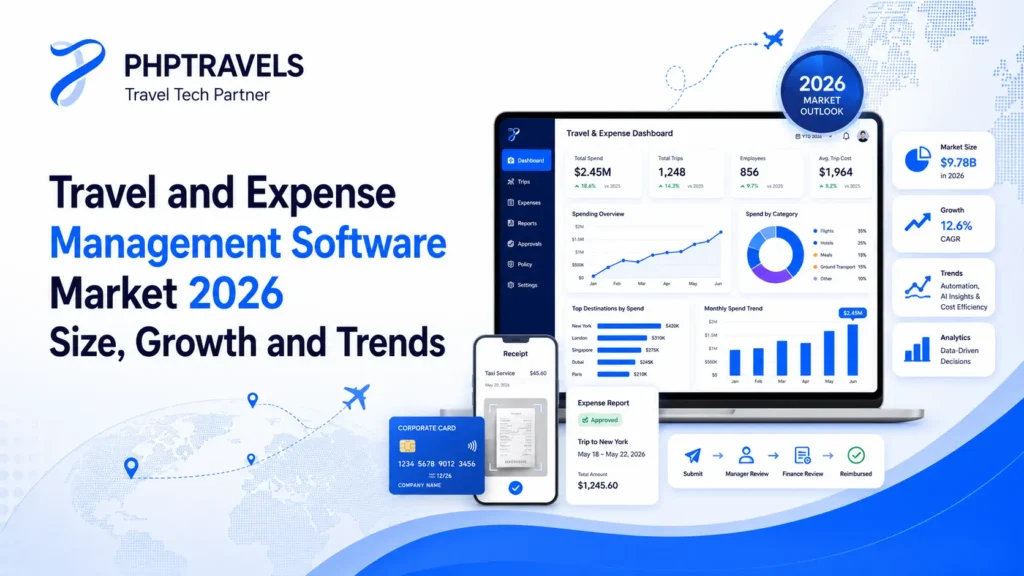
The travel and expense management software market is expanding as companies move corporate travel, expense reporting, approvals, reimbursements, policy enforcement, and spend analytics into connected digital platforms. In 2026, the category is no longer limited to digitizing receipts after a trip. Buyers increasingly expect software to influence spending before, during, and after travel through policy controls, real-time data, automation, and AI-assisted decision support.
Market estimates vary because research firms define the category differently. Grand View Research estimates the market at about $5.4 billion in 2026 and projects approximately $10.7 billion by 2030. Fortune Business Insights estimates $4.63 billion in 2026 and projects $12.98 billion by 2034. A 2026 360iResearch estimate places the market at approximately $4.05 billion. The exact totals differ, but the direction is consistent: travel and expense management is a growing software category supported by higher business travel spend, cloud adoption, finance automation, and tighter cost control.
Travel and Expense Management Software Market Snapshot
A useful way to understand this market is to separate corporate travel spending from the software used to manage it.
According to the Global Business Travel Association, global business travel spending is forecast to reach $1.71 trillion in 2026, while worldwide business travel volume is expected to exceed 1.84 billion trips. GBTA also reported that business travel spending reached approximately $1.59 trillion in 2025.
That does not mean T&E software is a trillion-dollar software market. It means the pool of spending companies need to approve, book, monitor, reconcile, and analyze is enormous.
| Research Source | 2025 Estimate | 2026 Estimate | Longer-Term Forecast |
|---|---|---|---|
| Grand View Research | — | $5.4B | $10.7B by 2030 |
| Fortune Business Insights | $4.08B | $4.63B | $12.98B by 2034 |
| 360iResearch | $3.63B | $4.05B | $8.12B by 2032 |
What Is Travel and Expense Management Software?
Travel and expense management software, often shortened to T&E software, helps organizations control employee travel and business spending from the initial trip request through reimbursement and financial reporting.
A modern platform can connect travel approvals, booking rules, corporate cards, receipts, expense claims, invoices, accounting exports, and spend analytics.
The category overlaps with corporate travel management, spend management, accounts payable automation, and business travel systems. The key difference is that T&E software specifically connects travel activity with financial governance.
For a detailed explanation of the technology and its core capabilities, see our guide to travel expense management software.
Why the T&E Software Market Is Growing
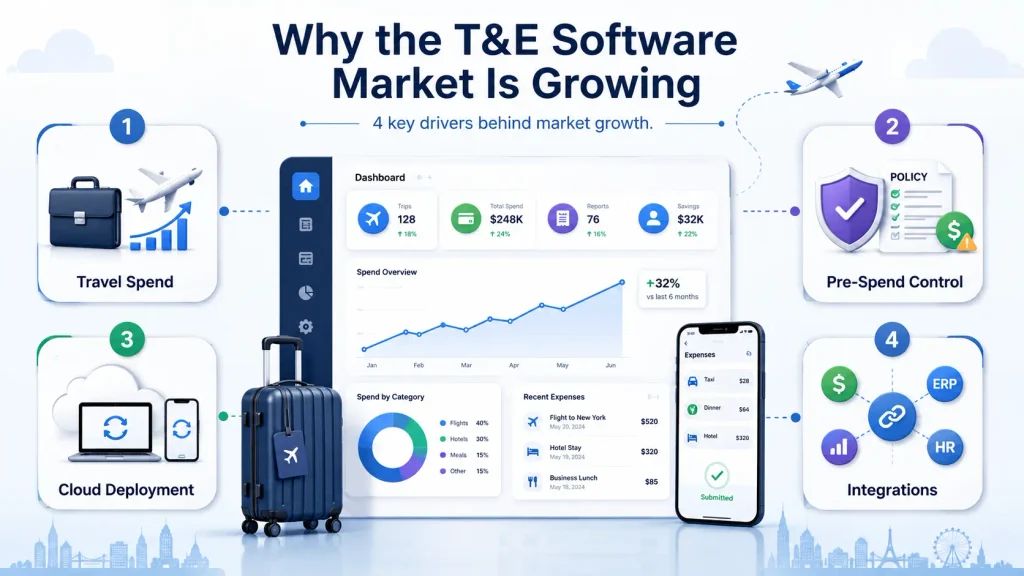
1. Business Travel Spending Is Rising
More business travel creates more transactions, policy decisions, supplier relationships, and reconciliation work.
GBTA’s 2026 outlook points to record global business travel spending, with higher transportation and travel costs contributing to the increase. Companies therefore have a stronger reason to monitor what employees book, which suppliers they use, and whether each expense stays within corporate policy.
2. Finance Teams Want Control Before Money Is Spent
Traditional expense systems focused primarily on what happened after a trip.
An employee traveled, submitted an expense report, a manager approved it, and finance processed reimbursement.
The market is moving toward pre-spend control.
That includes trip approvals, booking limits, preferred suppliers, budget rules, cost-center checks, travel policies, and alerts before a purchase is completed.
This shift is closely connected with corporate travel management software, where booking, policy, traveler information, approvals, and reporting operate as one connected process.
3. Cloud Deployment Reduces Operational Friction
Cloud-based T&E platforms are easier to deploy across offices, countries, and remote teams than traditional on-premise systems.
They can support mobile receipt capture, centralized policy updates, integrations, real-time reporting, and access for employees who are already traveling.
Grand View Research reported that hosted deployment represented the largest market share in its base-year data, while current Fortune Business Insights research also identifies cloud deployment as a leading part of the market.
4. Integration Is Becoming a Buying Requirement
Travel and expense software becomes considerably more valuable when it does not operate as an isolated expense application.
Enterprises increasingly expect connections with ERP platforms, accounting systems, HR software, corporate cards, travel inventory, approval workflows, and reporting tools.
For travel companies and corporate programs, travel accounting systems integration is particularly important because clean data movement reduces duplicate work and accelerates reconciliation.
Key Travel and Expense Management Software Market Trends
AI Is Moving From Receipt Scanning to Decision Support
Artificial intelligence has already been used to extract receipt data, categorize transactions, detect duplicates, and automate repetitive expense-processing tasks.
The next phase is broader.
AI can help organizations identify unusual spending patterns, summarize policy exceptions, recommend compliant options, forecast budgets, assist employees, and explain why a transaction may require additional review.
The important shift is not “AI replacing finance.”
It is AI reducing repetitive administrative review so finance and travel teams can concentrate on exceptions, compliance issues, complex transactions, and higher-risk spending.
For a wider travel-industry perspective, see how to implement AI in a travel agency.
Pre-Trip Approval and Policy Automation Are Becoming Standard
Companies increasingly want travel policies to work inside the booking process rather than remain in a document employees may never read.
Modern systems can evaluate trip purpose, budget, route, cabin class, hotel rate, advance-booking window, traveler role, department, and approval level before a reservation is completed.
That makes travel approval software closely connected with the wider travel and expense management market.
Mobile Workflows Remain Important
Travel takes place away from the office, so expense management must work wherever employees are.
Mobile receipt uploads, card notifications, approval alerts, itinerary access, and on-the-go expense submission reduce the delay between a transaction taking place and appearing inside the company’s financial workflow.
Real-Time Spend Visibility Is Replacing Month-End Surprises
Finance leaders increasingly want visibility into committed and actual travel spending before the accounting period closes.
Real-time dashboards can organize costs by department, legal entity, project, destination, traveler, supplier, or cost center.
That turns T&E information into useful data for forecasting, procurement, policy decisions, and budget control rather than simply creating an archive of historical expense reports.
Unified Travel and Expense Platforms Are Gaining Attention
The separation between booking software and expense software is becoming less rigid.
Buyers increasingly prefer connected workflows in which an approved trip leads to a compliant booking, transactions can be associated with that trip, expenses can be reconciled, and financial data can move into accounting systems without repeated manual entry.
A business travel management system can support this wider workflow by connecting requests, approvals, bookings, expenses, and reporting.
How the Travel and Expense Management Market Is Segmented
The T&E software market is commonly analyzed by deployment model, organization size, industry, and region.
By deployment, the market is broadly divided between cloud or hosted platforms and on-premise software. Cloud products continue attracting demand because of scalability, mobile access, easier software updates, and integration capabilities.
By organization size, large enterprises usually require complex policy configuration, multi-entity operations, audit controls, and extensive integrations.
Small and midsize businesses often adopt T&E software for a different reason: replacing spreadsheets, email approvals, manual expense reports, and disconnected accounting processes.
By region, North America remains the largest market in several major industry studies. Grand View Research reported a 37% North American share in its 2023 base year, while Fortune Business Insights estimated a 38.9% share in 2025. Asia Pacific is also important as corporate travel activity, digital payments, and cloud technology adoption expand.
What Enterprise Buyers Now Expect
Growth in the travel and expense management software market is also being shaped by more demanding buyers.
Enterprises are evaluating how effectively a platform controls spending and connects financial data rather than simply comparing dashboards.
Important capabilities include configurable travel policies, multi-level approvals, receipt and invoice capture, corporate-card reconciliation, multi-currency support, tax handling, ERP and accounting integrations, role-based access, audit logs, analytics, mobile access, and data security.
Companies actively evaluating individual vendors can use our best travel expense management software guide for the product-selection side of the topic.
This market guide has a different purpose: understanding market size, growth drivers, trends, segmentation, and future direction.
Challenges That Could Slow Adoption
Strong growth does not mean every T&E implementation will succeed.
Integration complexity can delay deployments when HR, ERP, card, supplier, and travel systems store information differently.
Global organizations also have to account for different currencies, tax requirements, privacy regulations, reimbursement policies, and local business-travel rules.
Employee adoption matters as well. A technically advanced platform can still underperform if booking or expense submission creates unnecessary friction.
Security is another major consideration because travel and expense platforms may process employee information, financial data, receipts, travel patterns, invoices, and payment-related information.
As a result, buyers increasingly evaluate governance, access controls, auditability, integrations, and security alongside automation.
Travel and Expense Management Market Outlook Through 2030 and Beyond
The long-term market outlook remains positive, although growth will vary among vendors, customer segments, and regions.
Demand is likely to favor platforms combining cloud delivery, integrations, mobile workflows, automation, analytics, and proactive spend control.
AI will continue to receive significant attention, but the most valuable applications are likely to remain practical: anomaly detection, reducing manual data entry, explaining policy exceptions, forecasting spending, assisting employees, and helping finance teams prioritize higher-risk transactions.
The wider corporate-travel environment also supports continued demand. GBTA’s 2026 forecast shows record business travel spending even as organizations face elevated travel costs and continuing economic uncertainty.
More spending combined with greater pressure to control that spending creates a favorable environment for travel and expense management technology.
For a wider industry perspective, read our analysis of business travel trends for 2026.
What This Market Means for Travel Agencies, TMCs and Travel Technology Companies
Travel agencies, travel management companies, and travel technology providers do not need to become accounting-software companies to benefit from this market.
They do, however, need to recognize that corporate buyers increasingly expect travel booking to connect with approvals, policy, reporting, and finance.
A travel platform serving corporate accounts should be capable of passing clean traveler and booking information into expense and accounting workflows.
It should also support policy-aware booking, cost centers, approval chains, reporting, and integrations that reduce manual handoffs between travel operations and finance.
The opportunity is therefore not simply to produce another expense dashboard.
It is to create connected workflows that allow organizations to control travel spending while making travel administration easier for employees, managers, travel teams, and finance departments.