Searching for travel normally starts with forms.
A traveler selects a destination, chooses dates, enters passengers, selects a cabin or room type, adjusts filters and then repeats much of the same process when moving from flights to hotels, tours or other travel products.
An AI trip planner for travel agencies introduces another way to begin that journey.
Instead of navigating every search field manually, the traveler can describe what they need in normal language.
For example:
“Find me a flight from Lahore to Dubai next Friday for two adults.”
Or:
“Show me hotels in Istanbul for three nights for two people.”
Or:
“Find tours available in Dubai this weekend.”
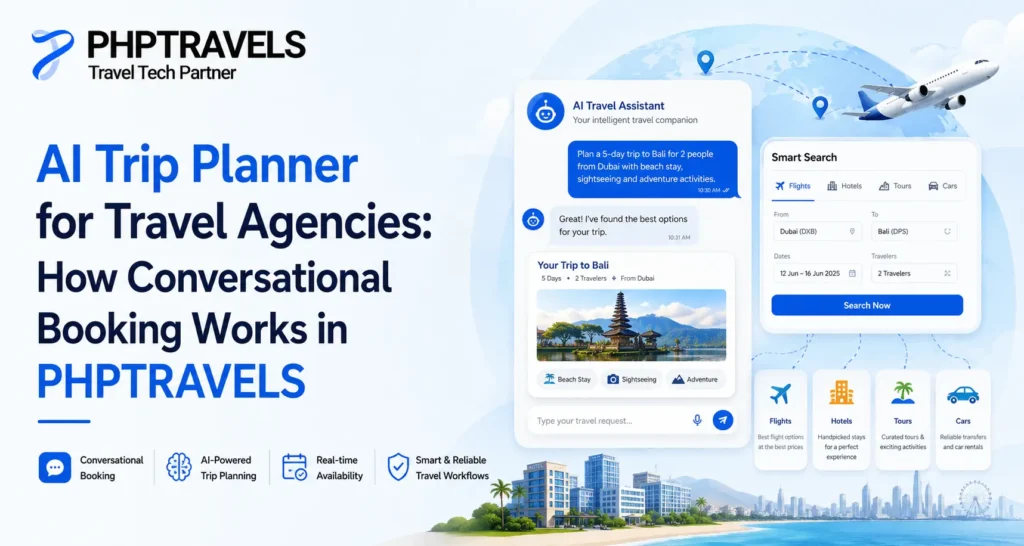
The PHPTRAVELS AI Trip Planner is designed to interpret requests like these and connect them with the appropriate booking module.
The important difference is that AI is not replacing the travel booking system. It is making the booking system easier to use.
What Is an AI Trip Planner for Travel Agencies?
An AI trip planner for travel agencies is a conversational interface that helps users search and navigate travel inventory using natural-language requests.
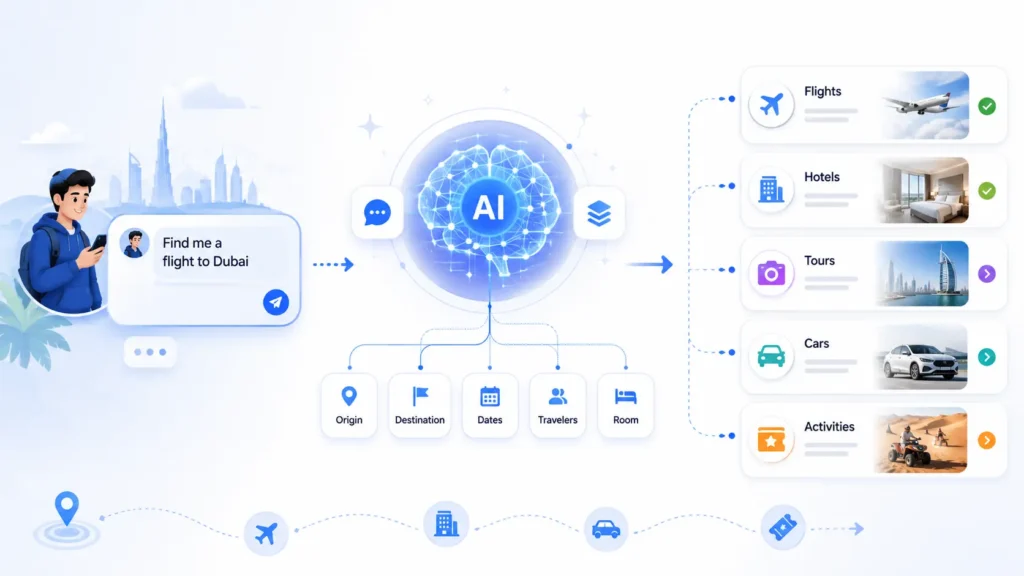
Instead of forcing the traveler to understand the structure of every booking form, the system interprets the request and identifies important information such as:
- Travel product
- Origin
- Destination
- Travel dates
- Number of travelers
- Room requirements
- Trip type
- Other relevant search preferences
The request can then be passed to the appropriate booking workflow.
In PHPTRAVELS, this approach fits naturally alongside the existing multi-product booking platform, which supports travel products such as flights, hotels, tours, cars and other reservation modules.
The AI layer therefore works as an easier entry point into the booking experience rather than as a separate travel website.
How Does the PHPTRAVELS AI Trip Planner Work?
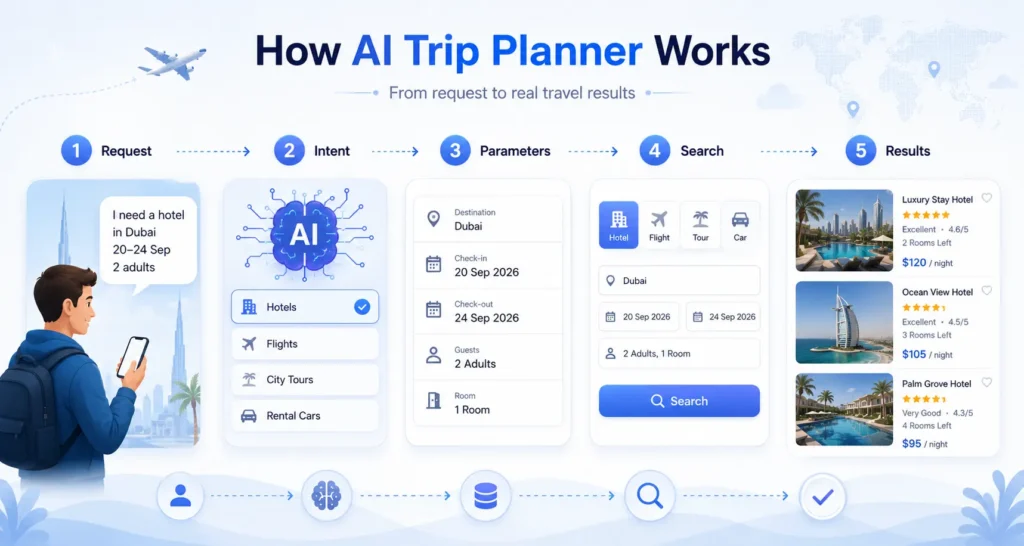
The basic process can be understood in seven steps.
1. The traveler writes a normal request
The user begins by describing what they want.
They do not necessarily need to know which module, filter or search page should be opened first.
A request might be:
“I need a hotel in Dubai from 20 to 24 September for two adults.”
The system receives the sentence as travel intent rather than as a collection of manually completed form fields.
2. AI identifies the travel intent
The AI Trip Planner determines what type of travel service the user is requesting.
For example:
“Find a flight” → flight search
“Show hotels” → hotel search
“Find a city tour” → tour search
“Show rental cars” → car search
This routing step is important because a travel booking platform may contain several independent modules.
The traveler should not need to understand the technical structure behind them.
3. The request is converted into booking parameters
Natural language must eventually become structured booking data.
For a flight request, that may include:
Origin → Lahore
Destination → Dubai
Departure date → requested date
Passengers → two adults
Trip type → one way or return
For a hotel request, the required structure may instead include destination, check-in date, check-out date, rooms and guests.
The AI interface simplifies the input experience, while the underlying booking engine still receives structured information.
4. The correct booking module handles the search
Once the request has been understood, the relevant PHPTRAVELS booking module can continue the normal search process.
This distinction matters.
AI interprets the request. The booking engine performs the travel workflow.
That keeps conversational interaction separate from supplier inventory, pricing, reservation rules and payment logic.
Travel businesses can review the broader PHPTRAVELS travel booking software workflow to understand how these modules operate together.
5. Connected inventory provides the available results
Travel availability should come from the inventory sources connected to the booking platform.
For flights, this could involve configured airline, GDS or flight API sources.
Hotels may use configured hotel suppliers or local inventory.
Tours, cars and other products follow their respective inventory workflows.
PHPTRAVELS already supports supplier and API connectivity as part of its travel technology architecture.
The AI assistant therefore should not invent a flight price, hotel rate or available seat.
It helps create the search request, while the connected booking infrastructure remains responsible for commercial travel data.
Which Booking Modules Can an AI Trip Planner Work With?
The usefulness of an AI travel assistant increases when it is connected with more than one product.
PHPTRAVELS already operates as a multi-module booking platform covering flights, hotels, tours, cars and additional travel products.
Depending on which modules an agency has enabled and configured, an AI-driven interface can help users begin searches across areas such as:
Flights
A traveler could request:
“Show me return flights from London to Dubai next month for one adult.”
The flight booking workflow can then handle routes, dates, passengers and available airfare.
Hotels
A traveler might ask:
“Find a four-night hotel stay in Kuala Lumpur for two adults.”
The hotel engine can continue with availability, room options, rates and booking conditions.
Tours and activities
A request such as:
“Find sightseeing tours in Istanbul this weekend.”
can be directed toward the tour or activity inventory.
Cars and transfers
Travelers may also use natural requests to begin searches for rental cars or transportation where the relevant module and inventory are available.
Other enabled travel products
The same architecture can potentially work across additional structured booking modules because the AI layer first determines user intent and then sends the request to the relevant workflow.
That makes the model more scalable than building a separate chatbot for every travel product.
Is an AI Trip Planner Different From an AI Itinerary Generator?
Yes.
This distinction is important for both users and search engines.
Many AI trip planners primarily generate destination ideas or day-by-day itineraries.
A booking-connected AI Trip Planner has a different purpose.
It connects conversation with actual travel search workflows.
| AI Itinerary Generator | Booking-Connected AI Trip Planner |
|---|---|
| Suggests places to visit | Understands booking requests |
| Creates day-by-day ideas | Routes requests to booking modules |
| May use general travel knowledge | Uses structured search parameters |
| Often stops at recommendations | Can continue into booking results |
| Mainly planning-focused | Planning and booking workflow focused |
PHPTRAVELS should therefore position this feature around conversational travel booking, not only itinerary generation.
That differentiation also helps avoid competing only with consumer AI itinerary tools.
How Is AI Search Different From a Traditional Booking Form?
Traditional forms remain useful.
They are structured, predictable and familiar to experienced travelers.
AI simply provides another way to start.
A traveler who already knows exactly what they need may prefer the standard flight or hotel form.
Another traveler may prefer typing:
“I want to travel from Manchester to Bangkok for one week in October.”
The AI Trip Planner can reduce the amount of navigation required before reaching relevant results.
The two interfaces do not need to compete.
A strong travel platform can offer both:
Traditional search for precise manual control + AI search for conversational convenience.
What Happens If the Traveler’s Request Is Incomplete?
Travel requests are often incomplete.
Someone may type:
“Find me a hotel in Paris.”
But a hotel search normally also needs dates and occupancy.
A useful AI travel booking assistant should recognize missing information instead of making important booking assumptions.
It can ask for what is still required:
“What dates would you like to stay?”
Then:
“How many guests will be traveling?”
Once the required information is available, the booking request can continue.
This conversational collection of missing information is one of the most practical advantages of an AI interface.
Does AI Control Travel Prices?
No.
An AI assistant should not independently create commercial prices.
Travel prices and availability should continue to come from the booking platform, connected suppliers, configured inventory and agency pricing rules.
PHPTRAVELS booking workflows already separate product availability, supplier connectivity, pricing, payments, confirmations and administration.
The AI layer should help the traveler communicate with that infrastructure.
This makes the architecture easier to understand:
Traveler request → AI interpretation → booking module → supplier/inventory search → results → normal booking workflow
That separation is especially important in travel because fares, room rates and availability can change.
Why Can Conversational Booking Help Travel Agencies?
The main advantage is not simply that “the website has AI.”
The real value comes from reducing friction between customer intent and the correct booking workflow.
Faster product discovery
Users can explain what they want without navigating several pages first.
Easier multi-product navigation
A single conversational entry point can understand whether the traveler needs a flight, hotel, tour or another supported service.
Simpler experience for new users
Not every traveler understands fare terminology, occupancy fields or booking-engine structures.
Natural-language interaction can make the first step easier.
Better use of an agency’s existing technology
The agency does not need AI to replace its booking engines.
Instead, AI becomes an intelligent interface connected to the technology already responsible for inventory and bookings.
More room for future automation
Once intent detection is connected with booking modules, agencies can gradually add more intelligent workflows around recommendations, customer assistance and trip planning.
Can AI Replace Travel Agents?
Not necessarily.
For agencies, AI is more useful when it removes repetitive navigation and search work while keeping humans available for decisions that need judgment.
Complex trips may still involve:
- Special passenger requirements
- Group bookings
- Visa questions
- Multi-city itineraries
- Supplier exceptions
- Refunds
- Changes
- Negotiated rates
- Complex tour arrangements
AI can make searching faster, but professional agents still add value where experience, supplier knowledge and customer communication matter.
The aim should be AI-assisted travel selling, not removing every human interaction.
What Should Travel Agencies Test Before Using an AI Trip Planner?
Agencies should test the actual booking journey rather than judging the feature only from the chat interface.
Start with realistic requests.
For example:
“Find a flight from Karachi to Jeddah next Monday.”
Then check whether the system correctly understands:
- Departure city
- Destination
- Date
- Passenger requirements
- Relevant booking module
Test incomplete requests as well.
Try:
“Find me a hotel in Dubai.”
The assistant should identify that important search information is missing.
Also test unusual wording, spelling variations and different product requests.
Most importantly, verify what happens after the AI interaction.
The complete process should remain clear:
Prompt → intent → search → results → selection → booking → payment → confirmation
A conversational interface is useful only when it connects cleanly with the operational booking workflow behind it.
Why Is This More Than Just a Travel Chatbot?
A basic chatbot usually answers questions.
A booking-connected AI assistant can do something more useful: turn a travel request into an action inside the booking platform.
That is a major difference.
A chatbot might answer:
“Dubai is a popular destination in December.”
A booking-connected assistant can understand:
“Show me flights to Dubai in December.”
and route that request toward the flight search workflow.
The value therefore comes from the connection between language understanding and booking infrastructure.
Where Does PHPTRAVELS Fit?
PHPTRAVELS already brings multiple travel booking modules, supplier integrations, payments and administrative workflows into one platform.
The AI Trip Planner adds a more conversational way for users to interact with those capabilities.
Instead of creating a separate AI tool that sits outside the booking system, the stronger model is:
AI interface + existing booking modules + connected travel inventory + normal reservation workflow
For agencies, OTAs and travel businesses, this means AI can become part of the booking experience rather than another disconnected tool.
Travel businesses can test the current PHPTRAVELS application and see how the AI Trip Planner works alongside the available booking modules.
Final Thoughts
AI in travel becomes useful when it solves a real customer problem.
For booking websites, one of those problems is simple: travelers know what they want, but booking systems often require them to translate that request into multiple forms, filters and navigation steps.
An AI trip planner for travel agencies can reduce that friction.
The traveler communicates naturally.
AI interprets the request.
The appropriate booking module handles the search.
Connected inventory provides the results.
The normal booking workflow remains responsible for pricing, reservation and confirmation.
That is a much more practical use of AI than adding a chatbot simply because AI is popular.
For PHPTRAVELS, the AI Trip Planner creates a natural bridge between conversational technology and the existing travel booking engine.