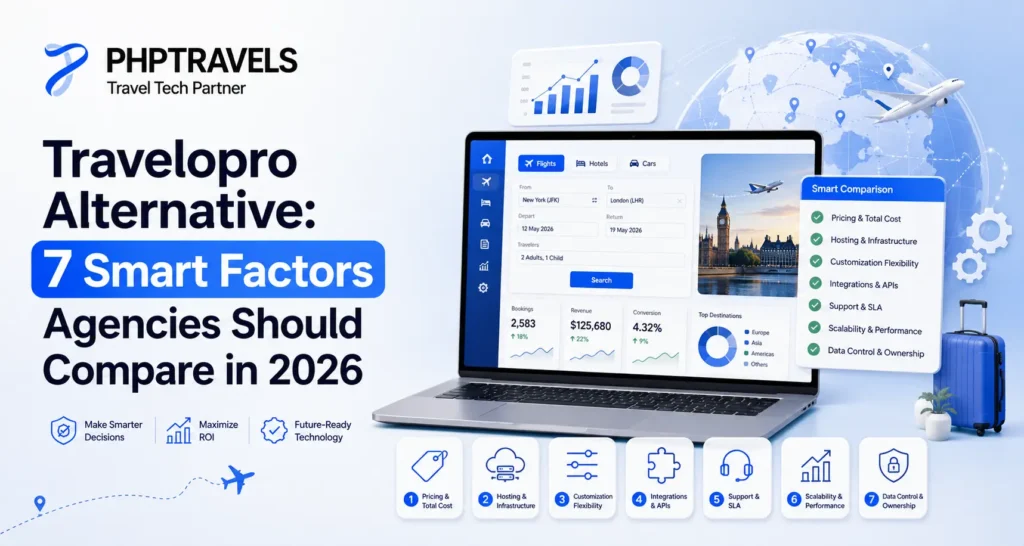
If you are searching for a Travelopro alternative, you probably already understand what travel portal software does. The harder question is whether a different technology and ownership model would better fit your agency.
Travelopro and PHPTRAVELS both provide technology for travel agencies, tour operators and online travel businesses. Both cover booking portals, B2B and B2C workflows, travel products and external supplier connectivity. However, their delivery models differ in important areas such as source-code access, hosting, pricing structure and platform control.
This guide does not try to declare one vendor universally better. Instead, it explains the practical questions an agency should answer before choosing or replacing a travel platform.
What is the short answer for agencies looking for a Travelopro alternative?
PHPTRAVELS is worth evaluating as a Travelopro alternative when self-hosting, source-code access, one-time software pricing and greater deployment control are important to your business.
Travelopro may remain suitable when you prefer a SaaS-style, vendor-managed environment and want the technology provider to handle more of the portal development, hosting and infrastructure. Travelopro’s current pricing information describes its solutions as SaaS-based and tailored to individual business requirements.
The right decision therefore depends less on a marketing feature count and more on how you want to operate your technology.
Travelopro alternative comparison at a glance
| Buyer Criterion | PHPTRAVELS | Travelopro | What Should You Verify? |
|---|---|---|---|
| Source Code | Source code included; modification permissions should be checked by plan | Travelopro currently describes its travel tools as closed-source | License, modification and IP rights |
| Pricing Model | One-time pricing with custom quotes | Tiered packages with pricing based on business requirements | Three-year total cost |
| Hosting | Self-hosted | SaaS/vendor-managed approach | Server and infrastructure responsibility |
| B2C | Supported | Supported | Customer booking and payment workflow |
| B2B | Supported on relevant plans | Supported | Agents, credit, commissions and markups |
| B2B2C | Can be configured for multi-channel travel operations | Publicly offered | Reseller and customer controls |
| Supplier Connectivity | GDS, XML/API suppliers and custom integrations | GDS, XML/API and supplier integrations | Your exact supplier and API version |
| Customization | Code-level customization depends on package rights | Bespoke features and portal customization offered | Scope, ownership and future maintenance |
| Demo | Frontend and admin workflows available | Live demo available by request | Test your real workflows |
| Best Fit | Agencies wanting greater technical control | Companies preferring vendor-managed delivery | Match the model to your internal resources |
1. How important is source-code and platform ownership?
For some agencies, source code is simply a technical detail. For others, it determines whether they can continue developing the platform independently.
PHPTRAVELS currently describes itself as an open-source, self-hosted travel booking platform. Its pricing page states that source code is included, although its plan comparison separately shows code-modification permission as dependent on the selected package. That distinction is important: source-code access and contractual customization rights should be verified separately.
Travelopro’s current official response to a source-code inquiry states that it does not offer the source code for its travel tools and describes its solutions as closed-source.
2. How do the pricing models differ?
PHPTRAVELS currently promotes one-time pricing with no software subscriptions. It offers Startup, Agency and Enterprise packages, with final quotes depending on business size, modules, API integrations and customization requirements.
Travelopro publicly lists Basic, Advanced, Premium, Platinum and Enterprise tiers. Its official pricing page says that final price depends on business goals, company size and the technical features required. The same page describes its solutions as SaaS-based.
You can review Travelopro’s official pricing information when comparing commercial models.
Do not decide based only on the first quote. Calculate the cost of:
- platform licensing;
- hosting;
- supplier integrations;
- GDS certification;
- custom development;
- support;
- updates;
- payment gateway work;
- future supplier additions;
- migration and exit work.
For PHPTRAVELS, the current pricing plans provide a useful starting point for building that comparison.
3. Which booking modules does your business actually need?
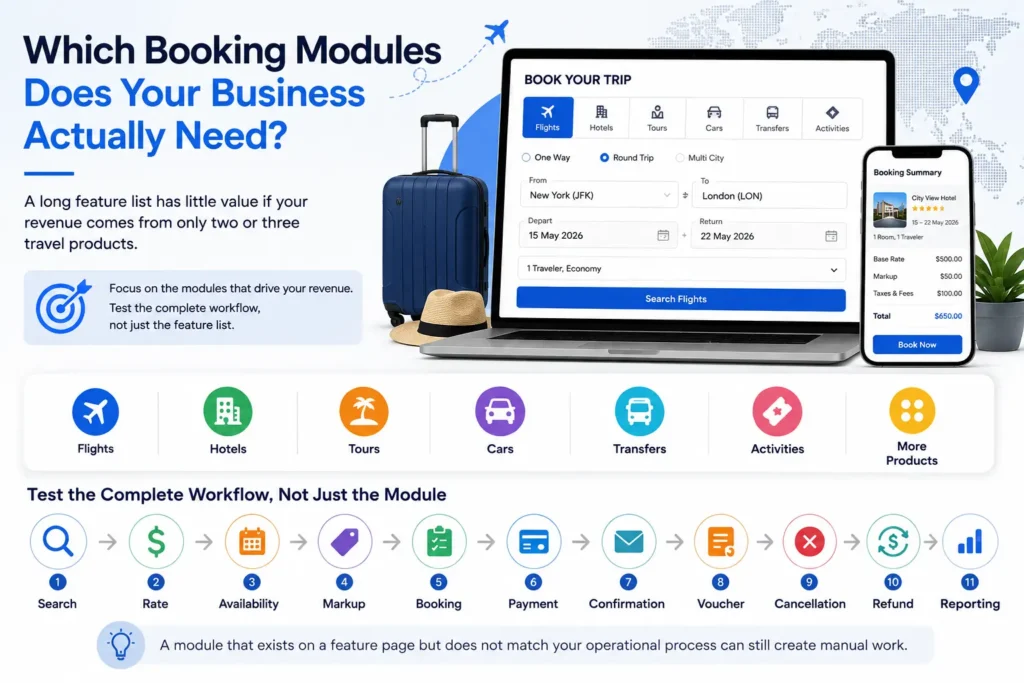
A long feature list has little value if your revenue comes from only two or three travel products.
PHPTRAVELS currently presents modules across flights, hotels, tours, cars and additional travel products, with B2B/B2C booking, payment and administration functions around them. Its broader travel booking software pages can help agencies map modules to their own business requirements.
Travelopro’s current public offering includes flight, hotel, holiday and car booking products across its package levels, with other portal functions and supplier integrations available according to project scope.
Instead of asking, “Does the platform have a hotel module?” test the complete workflow:
Search → rate → availability → markup → booking → payment → confirmation → voucher → cancellation → refund → reporting.
A module that exists on a feature page but does not match your operational process can still create manual work.
4. Do you need B2B, B2C or B2B2C capabilities?
Both platforms support travel businesses selling through more than one channel.
PHPTRAVELS provides B2C functionality and includes B2B functionality on relevant packages. Agencies building agent distribution can review its B2B travel portal when checking agent-facing requirements.
Travelopro’s official B2B portal documentation describes B2B and B2C portals as well as B2B2C and other sales-channel models. It also describes agent and sub-agent operations, markup functionality and connections to GDS and third-party suppliers.
For a serious B2B operation, test more than agent login.
Check:
- master agents and sub-agents;
- agent-specific markups;
- commissions;
- credit limits;
- wallet or deposit workflows;
- branches;
- permissions;
- booking servicing;
- vouchers and invoices;
- agent-level reports.
For B2B2C, also confirm who controls branding, customer relationships, pricing and support.
5. How should you compare supplier and GDS integrations?
Supplier connectivity is often where a travel platform succeeds or fails.
PHPTRAVELS publishes GDS and supplier connectivity across flights, hotels and other travel products. Its travel API integrations directory is the better place to verify a specific provider before purchasing. PHPTRAVELS also supports custom integration work for suppliers outside ready-made connections.
Travelopro likewise promotes integration with multiple GDSs, consolidators and third-party supplier APIs. Its current API information specifically describes connections to multiple GDS and consolidator sources for flights, hotels, rental cars and packages.
Do not compare vendors by counting supplier logos.
For every supplier important to your business, ask:
- Is the connection already production-ready?
- Which API version is supported?
- Does the supplier require certification?
- Who completes certification?
- Are revalidation and price changes handled?
- How do cancellations and refunds work?
- What happens when the supplier times out?
- Who maintains the integration after an API change?
Your five most important suppliers matter more than fifty integrations you may never use.
6. How much customization and hosting control do you need?
There are two types of customization.
Configuration includes changing branding, currencies, languages, payment settings, markups and business rules.
Engineering customization involves changing booking logic, source code, databases, supplier connectors or proprietary workflows.
PHPTRAVELS is self-hosted and its Enterprise plan currently includes full code-modification rights. Businesses requiring deeper changes can also review the customization options.
Travelopro emphasizes customized portal development but uses a different ownership model. Its pricing page describes bespoke features and SaaS-based solutions, while its B2B documentation states that server, bandwidth, performance and IT infrastructure can be handled by Travelopro.
That creates a practical choice:
More platform control usually means more technical responsibility. Vendor-managed infrastructure can reduce internal workload but may provide less infrastructure independence.
Neither approach is automatically better.
7. What should you compare for support, updates and exit options?
Travel software is not finished when it launches.
Supplier APIs change. Payment gateways update requirements. GDS connections may need certification work. Security updates and infrastructure maintenance continue.
Before purchasing, ask both vendors to define:
- support channels;
- support hours;
- response targets;
- update policy;
- security patches;
- supplier API maintenance;
- customization charges;
- hosting responsibility;
- backup responsibility;
- documentation handover;
- data export;
- termination process.
PHPTRAVELS’ current pricing shows different update and customization entitlements by package, so your selected plan matters.
Travelopro promotes after-sales service and training as part of its offering, but the exact support scope should still be documented in the commercial agreement.
Exit terms deserve special attention. A travel platform may eventually hold years of customer records, agent accounts, bookings, supplier mappings and financial data.
Can you demo both platforms before deciding?
Yes, and you should.
PHPTRAVELS provides a live software demo that allows buyers to evaluate B2B/B2C portals, flights, hotels, tours, cars, markups, suppliers, booking administration and reporting workflows.
Travelopro also offers live demonstrations through its demo-request process.
Use the same test script for both platforms.
For example:
- Log in as an administrator.
- Create or test an agent.
- Apply a markup.
- Search your priority supplier.
- Complete a test booking.
- Inspect the voucher or invoice.
- Test cancellation handling.
- Review reporting.
A structured demo produces better information than watching a vendor’s standard presentation.
Which type of company may prefer PHPTRAVELS?
PHPTRAVELS may be worth shortlisting when your business:
- wants a self-hosted booking environment;
- values source-code access;
- prefers one-time software pricing;
- needs B2B and B2C workflows;
- wants greater infrastructure control;
- expects future engineering customization;
- needs several travel booking modules;
- has or plans to build technical resources.
Its current product positioning is specifically built around agencies and OTAs operating their own booking environment.
When might Travelopro still be the better fit?
Travelopro may suit a company that wants a technology partner to take greater responsibility for development and infrastructure.
Its public offering covers B2B, B2C and B2B2C travel portals, multiple booking modules, supplier integrations, custom development and SaaS delivery.
That model can make sense for an agency that does not want its internal team managing source code or hosting infrastructure.
The goal of evaluating a Travelopro alternative should therefore not be to switch vendors simply because another platform exists. It should be to identify which operating model creates fewer restrictions for your specific business.
What should you do before migrating from Travelopro?
If you already operate on Travelopro or another booking system, build a migration inventory before committing to a replacement.
Document:
- active bookings;
- customer accounts;
- B2B agents;
- supplier credentials;
- API contracts;
- markups and commissions;
- credit balances;
- payment gateways;
- currencies;
- reports;
- custom workflows;
- historical data.
Then determine what can be exported, what must be recreated and which supplier certifications may need to be completed again.
If you are still building a broader vendor shortlist rather than replacing Travelopro specifically, our travel software alternatives guide compares different operating models without making Travelopro the primary search intent.
Final decision: should you consider PHPTRAVELS as your Travelopro alternative?
Yes—if the reasons you are evaluating alternatives are ownership, self-hosting, source-code access, one-time pricing or greater control over future development.
Travelopro remains a valid model for businesses that prefer SaaS delivery, vendor-managed infrastructure and customized portal development. PHPTRAVELS takes a more ownership-oriented approach built around a self-hosted travel booking platform.
Do not choose between them based on claims such as “best” or “cheapest.”
Create one requirements sheet covering source code, pricing, modules, B2B/B2C, suppliers, customization, hosting, support, updates, demos and exit options. Give both vendors the same requirements and compare the written answers.
If the PHPTRAVELS operating model matches your business, review the platform features, verify your required supplier integrations, compare the pricing plans and test the live demo before making a final decision.