If you are researching Hotel Engine alternatives, start by deciding what you actually need to replace.
Some companies simply need employees to book hotels, flights, and rental cars while following company travel policies. Others are travel agencies, TMCs, OTAs, or technology businesses that want to operate their own booking platform, connect suppliers, control branding, and serve customers or agents.
Those are different requirements.
Hotel Engine also changed its name to Engine in 2024 as it expanded beyond hotels into flights and rental cars. The old Hotel Engine name still matters because many buyers continue to search for it when comparing business travel platforms. Engine’s official rebrand announcement explains that transition.
This guide compares five alternatives based on the operating model behind each platform rather than declaring one vendor universally “best.”
What are the best Hotel Engine alternatives to compare?
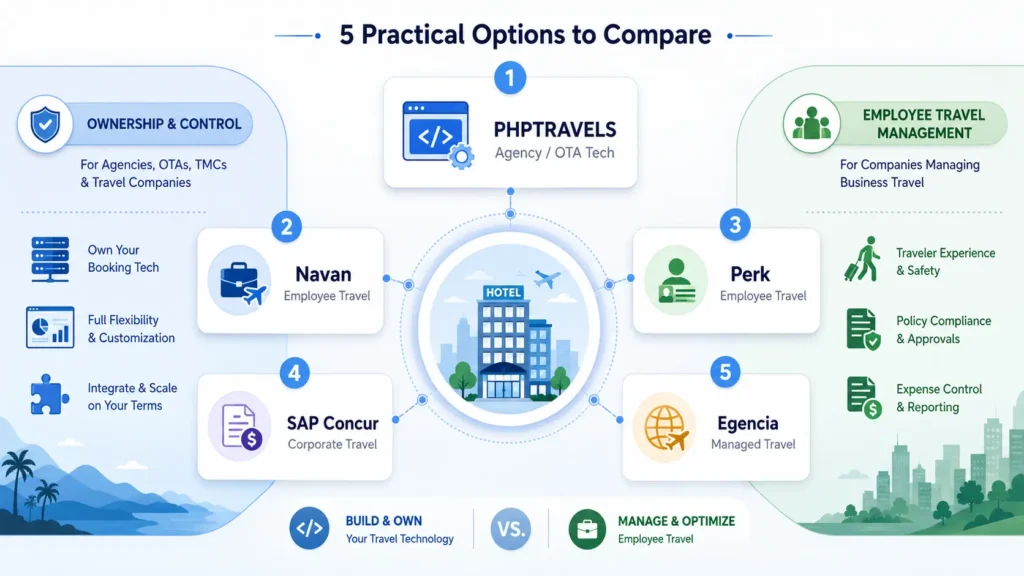
A practical shortlist includes PHPTRAVELS, Navan, Perk, SAP Concur, and Egencia by Amex GBT.
The right choice depends on your use case.
PHPTRAVELS is most relevant when a travel agency, OTA, TMC, or travel company wants greater ownership of its own booking technology.
Navan, Perk, SAP Concur, and Egencia are closer comparisons when your main goal is managing travel for your company’s employees.
That distinction should come before features or pricing.
Hotel Engine alternatives at a glance
| Platform | Primary Model | Main Strength | Best Suited To |
|---|---|---|---|
| Engine | Managed business travel platform | Employee travel booking and policy control | Businesses managing their own travelers |
| PHPTRAVELS | Self-hosted travel booking platform | Code, deployment and supplier control | Agencies, OTAs, TMCs and travel businesses |
| Navan | Travel and expense platform | Corporate booking plus spend controls | Growing and enterprise travel programs |
| Perk | Travel and spend platform | Travel, policy and expense workflows | SMBs and larger distributed teams |
| SAP Concur | Travel and expense ecosystem | Policy, expense and enterprise integrations | Complex or enterprise organizations |
| Egencia | Managed corporate travel platform | Booking, servicing and global travel support | Companies wanting TMC-style managed travel |
What exactly does Hotel Engine, now Engine, do?
Engine is designed primarily for companies managing business travel for their own workforce.
Its current platform brings hotels, flights, and rental cars into one business travel environment. Engine also promotes company travel policies, centralized trip management, spend visibility, and corporate travel support.
Engine’s pricing page currently says companies can join without membership fees, contracts, or minimum spend.
That can make Engine attractive when a construction company, staffing business, project-based organization, or other employer wants employees or travel arrangers to book corporate trips without building a travel technology stack.
The comparison changes, however, when the business wants to sell travel to customers, agents, resellers, or corporate clients through its own platform.
1. When is PHPTRAVELS a Hotel Engine alternative?
PHPTRAVELS is not a direct replacement for every Engine customer.
It belongs on the shortlist when the requirement changes from “help our employees book travel” to “give us our own travel booking platform.”
PHPTRAVELS is positioned for agencies and OTAs that want B2B and B2C booking capabilities across products such as flights, hotels, tours, transfers, and other travel services. It also supports supplier connectivity and a self-hosted deployment model.
This makes the ownership model different.
A company building a travel operation may want to control its domain, branding, database environment, suppliers, markups, booking workflows, agents, and future customization instead of using a centralized employee-booking service.
Businesses evaluating this model can review the broader travel booking software architecture before deciding whether a platform approach is necessary.
Consider PHPTRAVELS when: you are an agency, OTA, TMC, DMC, tour operator, or travel startup that wants to operate and customize its own booking system.
2. When is Navan a stronger Engine alternative?
Navan is one of the closer alternatives when the buyer wants corporate travel management rather than a platform to resell travel.
Navan’s business travel product provides flights, hotels, trains, rental cars, and ground transportation inventory while supporting company travel policies and spend controls.
Its positioning combines travel management with payments and expense-related workflows, making it particularly relevant when finance teams want travel and spending processes connected.
Navan is therefore more comparable to Engine for companies asking:
“How can our employees book business travel while finance maintains visibility and control?”
It is less relevant if your question is:
“How can we launch our own branded OTA or B2B travel portal?”
Consider Navan when: corporate travel and expense automation are more important than owning the underlying booking platform.
3. When should you consider Perk instead of Engine?
Perk, formerly known as TravelPerk, is another close corporate-travel alternative.
TravelPerk officially rebranded to Perk in November 2025 as its product scope expanded across travel and spend management.
Perk currently supports booking and managing flights, hotels, trains, and cars while combining travel policies, spend controls, integrations, and expense-related workflows.
Unlike Engine’s current no-membership-fee positioning, Perk publicly offers paid plans using per-user pricing, with travel booking fees applying under its published plan structure.
That difference makes total cost of ownership important.
Do not compare only whether one platform has a monthly fee. Compare the travel volume, booking fees, policy controls, expense functionality, implementation requirements, support, and finance-team workload.
Consider Perk when: you want a modern travel-and-spend platform with structured policy and expense workflows.
4. When is SAP Concur a better fit?
SAP Concur is worth evaluating when travel management is closely tied to expense management, compliance, finance systems, and enterprise processes.
Concur Travel allows employees to search and manage flights, hotels, rental cars, and rail while helping companies apply travel policies and monitor spending. SAP also positions Concur Travel as part of a broader expense and invoice ecosystem.
That can make Concur attractive to organizations with more complex approval rules, ERP connections, finance controls, or existing SAP-related infrastructure.
The tradeoff is that buyers may be evaluating a broader spend-management ecosystem rather than only a simple travel-booking tool.
Consider SAP Concur when: policy compliance, expense processing, reporting, finance integration, and enterprise workflow depth are major buying criteria.
5. When does Egencia by Amex GBT make sense?
Egencia by American Express Global Business Travel is another managed business-travel option.
Its current platform combines booking, policy guidance, traveler support, analytics, travel marketplace content, and integrations. Egencia also provides API developer tools and connects travel data with expense systems.
Egencia states that it serves companies ranging from startups and mid-market businesses to multinational organizations, with global 24/7 traveler support available through multiple channels.
This makes it relevant when the buyer values a travel-management-company relationship and servicing capability alongside software.
Consider Egencia when: you want a managed corporate travel program backed by global TMC infrastructure and traveler support.
Is PHPTRAVELS really a direct competitor to Hotel Engine?
Not always—and that distinction matters.
Engine primarily helps organizations consume business travel for their own employees.
PHPTRAVELS primarily helps travel businesses operate and sell travel through their own booking technology.
There can be overlap for TMCs and organizations building customized corporate booking environments, but their standard buying models are different.
If you only want employees to book company trips, platforms such as Engine, Navan, Perk, Concur, or Egencia are more direct comparisons.
If you want to become the travel provider, operate a B2B/B2C portal, control supplier connections, or build a branded booking product, PHPTRAVELS becomes more relevant.
PHPTRAVELS also has a dedicated corporate travel management software solution for teams evaluating corporate workflows within a customizable travel technology environment.
How should you compare Hotel Engine alternatives?
Use the same requirements sheet for every vendor.
1. Who owns and controls the technology?
Ask whether you are purchasing access to a managed cloud service or licensing software that your company can deploy and customize.
Managed SaaS platforms reduce infrastructure responsibility.
A self-hosted platform can provide more control over hosting, development, data environment, and long-term customization.
PHPTRAVELS explicitly markets self-hosted and open-source deployment, while Engine and the other corporate platforms are primarily presented as managed services.
2. What will the platform cost as you grow?
Do not compare only the first-year price.
Include membership or subscription fees, per-user costs, booking charges, implementation, integrations, support, hosting, customization, and future development.
PHPTRAVELS currently uses a one-time software pricing model across its plans, while some corporate platforms use subscription, booking-fee, or quote-based commercial models. Review the latest PHPTRAVELS pricing alongside current vendor proposals before deciding.
3. Who will use the platform?
This may be the most important question.
If users are your employees, prioritize policy controls, approvals, traveler profiles, expense integration, centralized billing, duty of care, and support.
If users are your customers or travel agents, prioritize B2B/B2C architecture, markups, commissions, agent hierarchy, supplier inventory, payment gateways, vouchers, bookings, and reseller controls.
The two workflows should not be treated as interchangeable.
4. Which booking products and supplier connections do you need?
List your actual inventory requirements.
Do you need only hotels?
Hotels plus flights and cars?
Or do you also need tours, transfers, activities, ferries, rail, or other travel products?
Travel businesses requiring their own supplier stack should also verify GDS, NDC, bedbank, aggregator, payment, and custom API connectivity. PHPTRAVELS maintains a current list of travel API integrations that buyers can check against their supplier requirements.
Never choose software simply because it displays a large number of supplier logos. Verify your exact supplier, API version, certification process, booking flow, cancellations, refunds, and post-booking servicing.
5. How much customization do you require?
Configuration and customization are not the same.
Changing a company policy, approval threshold, logo, or cost center is configuration.
Changing booking logic, integrating a new supplier, creating a proprietary reseller workflow, or modifying the database may require development access.
Businesses with unusual requirements should define those changes before asking vendors for quotes. PHPTRAVELS also provides customization options for projects that need deeper platform changes.
6. What happens if you leave the platform?
Exit planning is often ignored during procurement.
Ask how you export traveler, booking, supplier, customer, financial, and reporting data.
Also clarify what happens to integrations, custom development, documentation, hosting, and support when the commercial relationship ends.
The easiest time to negotiate an exit process is before implementation.
Which Hotel Engine alternative fits your situation?
If you are a company simply managing travel for employees, start by comparing Engine, Navan, Perk, SAP Concur, and Egencia.
If expense automation is central, Navan, Perk, and SAP Concur deserve closer evaluation.
If global managed travel and traveler servicing matter, Egencia is particularly relevant.
If you are a travel agency, TMC, OTA, or technology company that wants to control the booking platform itself, compare PHPTRAVELS against other agency-oriented technology vendors rather than evaluating it only against employee travel tools.
For an even broader shortlist, see our travel software alternatives comparison.
Final verdict: which Hotel Engine alternative should you choose?
There is no universal winner because the alternatives solve different versions of the travel-management problem.
Choose Engine, Navan, Perk, SAP Concur, or Egencia when your main objective is helping employees book and manage company travel within a controlled corporate program.
Consider PHPTRAVELS when your requirement is fundamentally different: you want to operate the travel platform, connect your own suppliers, serve B2B or B2C users, control deployment, and customize the booking environment.
Before making a decision, compare the same ten items across every proposal: ownership, pricing, booking modules, user model, supplier connectivity, customization, hosting, support, updates, and exit options.
If the ownership-oriented model matches your business, review PHPTRAVELS pricing, verify the required supplier integrations, and test the live demo before requesting a final implementation quote.