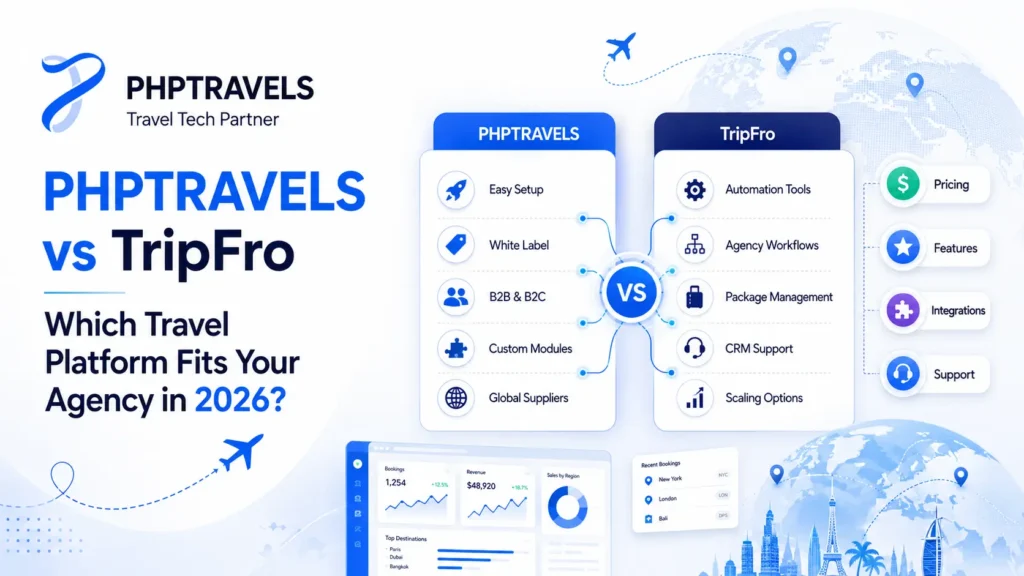
Choosing between PHPTRAVELS and TripFro is not just a feature comparison. Both serve travel agencies, OTAs, tour operators and other travel businesses, and both support online booking, B2B distribution and supplier connectivity. The bigger question is how each solution is delivered, controlled and adapted to your business.
PHPTRAVELS is positioned as a self-hosted, open-source travel booking platform with one-time pricing and plans for startups, agencies and enterprise users. TripFro presents itself as a managed B2B travel network and travel technology provider, while also offering cloud-based portals, white-label solutions, custom development and API/GDS integration.
If you are comparing PHPTRAVELS vs TripFro, focus on ownership, deployment, pricing, booking modules, B2B controls, integrations, customization and post-launch responsibilities.
What is the quick answer: PHPTRAVELS or TripFro?
PHPTRAVELS may suit a travel business that wants a self-hosted platform, source-code access, deployment control and a one-time software pricing model. TripFro may suit a company that prefers a managed or cloud-based approach, a B2B travel network, white-label deployment or vendor-led portal development.
Neither is automatically better for every agency. Give both vendors the same requirements sheet and compare their written proposals against the same criteria.
PHPTRAVELS vs TripFro: quick comparison
| Buyer criterion | PHPTRAVELS | TripFro | What you should verify |
|---|---|---|---|
| Delivery model | Self-hosted booking platform | Managed B2B network, cloud/white-label and custom portals | Who operates production |
| Pricing | One-time pricing; quote depends on plan and scope | Cost varies by modules, functionality and integrations | Three-year total cost |
| Source code | Open-source access; modification rights vary by plan | White-label model does not require source-code access; custom terms should be confirmed | License, IP and modification rights |
| B2C | Supported | Supported | Checkout and payment workflow |
| B2B | Supported on relevant plans | Core part of TripFro’s offering | Agents, credit, markups, commissions and reports |
| B2B2C | Supported in relevant workflows | Supported on portal solutions | Branding and reseller controls |
| Supplier connectivity | GDS, XML/JSON suppliers and custom integrations | GDS, XML/JSON suppliers and TripFro API connectivity | Exact suppliers and API versions |
| Booking products | Flights, hotels, tours, cars and more | Flights, hotels, cars, transfers, packages and more | Modules included in your quote |
| Customization | Code-level customization on eligible plan | Custom development and white-label options | Scope, ownership and maintenance |
| Demo | Public frontend/admin demo | Demo can be requested | Test your real workflow |
What is the biggest difference between PHPTRAVELS and TripFro?
The clearest difference is the operating model.
PHPTRAVELS is built around software installed in a self-hosted environment. Its current PHPTRAVELS pricing page describes the platform as open source and self-hosted, while plan-level permissions determine how much code modification is allowed.
TripFro has a broader service-led model. Its online travel portal development offering describes a cloud-based booking system alongside white-label, B2B, B2C, B2B2C, API and GDS capabilities. TripFro also positions its main platform as a managed B2B travel network.
A company with an internal technical team may value platform control. A company without developers may prefer a provider to manage more of the implementation.

How does PHPTRAVELS vs TripFro pricing compare?
PHPTRAVELS currently promotes one-time pricing with no software subscription. Its Startup, Agency and Enterprise plans are quote-based, and features such as B2B access, updates and customization permissions vary by plan.
TripFro does not publish one universal price for every portal. Its white-label travel portal cost guidance says development cost depends on portal type, functionality, modules, API/GDS integrations and design requirements, and it invites buyers to request a quote for custom projects.
Do not ask only, “Which is cheaper?” Compare the initial platform cost, integrations, hosting, customization, support, supplier certification, updates, migration and future development.
For PHPTRAVELS, review the current pricing and plan permissions. For TripFro, request an itemized proposal separating platform, development, integration and recurring operating costs.
Which platform gives you more source-code and deployment control?
PHPTRAVELS explicitly publishes open-source code access and self-hosting. Its pricing table also shows that permission to modify code is plan-dependent, with full customization listed at the Enterprise level. Buyers should therefore separate source-code access from contractual modification rights.
TripFro’s public white-label documentation says a ready-made white-label website does not require source-code access or major structural changes. Because TripFro also sells customized portal development, source-code and intellectual-property terms for a custom project should be confirmed separately.
If ownership matters, ask both vendors:
- Can our developers modify the platform?
- Who owns custom code developed for us?
- Can we move the application to another server?
- Can we export customer and booking data?
- What remains usable if support ends?
These questions give a clearer answer than simply asking whether the platform is “customizable.”
Do both platforms support B2B, B2C and B2B2C travel sales?
Yes. Both vendors publish support for multiple travel sales models.
PHPTRAVELS supports B2C workflows and includes B2B functionality on relevant plans. If agent distribution is important, evaluate its B2B travel portal for agent access, pricing rules, markups, commissions, credit limits, documents and booking management.
TripFro places strong emphasis on B2B travel. Its B2B travel portal development documentation describes agent registration, markup management, commissions, permissions, multiple branches, reporting and redistribution APIs. TripFro also publishes B2C and B2B2C portal capabilities.
During demos, create the same sample roles such as administrator, master agent, sub-agent and retail customer and test the same booking and payment scenarios.
Which booking modules are available?
PHPTRAVELS covers flights, hotels, tours, cars and additional travel modules, with administration, pricing, reports, CMS functionality and supplier integrations around the booking flow. Buyers can review the wider travel booking software offering before deciding which modules are required.
TripFro’s public portal pages cover flights, hotels, cars, transfers, sightseeing, packages and other travel products. Its B2B network also emphasizes selling multiple products through a single platform.
Do not choose a vendor simply because it has the longest module list. Test the products that generate your revenue, including search, pricing, booking, confirmation, cancellation and post-booking management.
How do supplier APIs and GDS integrations compare?
Both platforms are designed to work with external travel inventory.
PHPTRAVELS has a dedicated travel API integrations directory covering flight, hotel, tour, car and payment categories, plus custom integration for suppliers outside its ready integration list. Its current directory lists connections including Amadeus, Travelport, Duffel, Kiwi, TBO, PKfare, Hotelbeds, Stuba, Agoda, Viator and others.
TripFro publishes travel API integration for flights, hotels, cars, transfers, activities and other products. Its B2B pages reference GDS connectivity including Amadeus, Sabre and Travelport, while its API documentation describes XML/JSON and third-party supplier connections.
Instead of counting supplier logos, ask:
- Is our exact supplier production-ready?
- Which API version is supported?
- Is supplier certification required?
- Who handles certification costs?
- Are cancellation and refund workflows supported?
- How are API failures or timeouts managed?
- Can another supplier be added later?
A live test with your priority supplier is more useful than a generic “API supported” claim.
What about white-label branding and customization?
TripFro actively promotes white-label portals for agencies that want to launch under their own brand without developing everything from scratch. It also offers customized travel portal development.
PHPTRAVELS provides a software base that can be branded and configured, while deeper code-level customization depends on plan permissions. Businesses requiring bespoke workflows can also review PHPTRAVELS customization services.
If you only need branding and standard booking pages, white-label deployment may be enough. If you need proprietary workflows or custom supplier logic, compare code-level customization, ownership and long-term maintenance.
Which hosting model is better for your travel business?
PHPTRAVELS explicitly supports self-hosting, giving technical teams more control over hosting, deployment and the data environment. That also means the business needs clear responsibility for infrastructure, backups, security and maintenance. Buyers can review the published server requirements before deployment.
TripFro describes its online travel portal as a cloud-based booking system and offers managed solutions. This may appeal to businesses that prefer the technology provider to handle more of the platform environment.
Before choosing, define who is responsible for uptime, backups, SSL, monitoring, security patches, scaling and disaster recovery.
Can you test PHPTRAVELS and TripFro before buying?
Yes, and you should.
PHPTRAVELS provides a public travel booking software demo covering frontend and admin workflows for flights, hotels, tours and cars. The demo also includes booking management, markups, commissions, multi-supplier routing and reporting functions.
TripFro’s portal pages invite prospective customers to schedule or take a demo for relevant B2B and travel portal solutions.
Use the same test script for both: search your main product, apply a markup, create a test booking, check confirmation output, review reporting, test a cancellation and inspect the admin workflow.
What should you compare for support, updates and exit options?
Travel platforms depend on changing supplier APIs, payment gateways and external services, so support should cover more than basic bug fixing.
Ask about support channels, response targets, update policy, security fixes, supplier API changes, custom-development charges and escalation. Also confirm data export, code/documentation handover and what happens if you stop purchasing support or managed services.
PHPTRAVELS publishes different update and customization entitlements by plan. TripFro emphasizes after-sales and technical support, but exact responsibilities should be written into the proposal and contract.
Who should consider PHPTRAVELS?
PHPTRAVELS may be worth shortlisting if you:
- want a self-hosted travel booking platform;
- value open-source access and deployment control;
- prefer one-time software pricing;
- need B2C and B2B functionality;
- want multiple supplier integrations;
- expect future code customization;
- want to test frontend and administration before purchase.
Those preferences align with PHPTRAVELS’ current published deployment, pricing, integration and demo options.
Before requesting a quote, review the PHPTRAVELS pricing, integrations and technical requirements so your team knows which modules and deployment model it needs.
Who should consider TripFro?
TripFro may be worth shortlisting if you:
- want a B2B-focused travel platform or network;
- prefer a cloud or managed implementation;
- want a white-label portal;
- need vendor-led custom development;
- require B2B agent and markup controls;
- need GDS/API integration as part of a broader project.
These fit TripFro’s current positioning around its B2B network, portal development and API services.
Its model can be especially relevant when the travel company wants the technology provider to take a larger implementation role.
What should you do before making the final decision?
Create one requirements document and send the same version to both vendors.
Include your business model, countries, booking products, expected volume, B2B hierarchy, currencies, languages, supplier list, GDS contracts, payment gateways, hosting preference, reporting requirements, customization needs and target launch date.
Then compare the responses line by line. For every critical feature, ask whether it is available now, requires configuration, needs custom development or depends on a third party.
If you are evaluating several vendors, keep the same scoring criteria for all of them. You can also review our existing Travelopro alternative comparison rather than changing your buying criteria for every vendor.
Final verdict: PHPTRAVELS vs TripFro
PHPTRAVELS and TripFro solve many of the same travel-commerce problems, but their delivery models differ.
PHPTRAVELS is a strong option to evaluate when you want self-hosting, open-source access, one-time pricing, multiple booking modules and greater deployment control. TripFro is a credible option when you want a B2B-oriented travel network, cloud or white-label delivery, custom portal development and a more vendor-led implementation model.
The decision should come from a side-by-side requirements test, not marketing labels such as “best.”
If platform control and extensibility matter, review PHPTRAVELS pricing, test the live demo and verify your required supplier integrations. If managed delivery matters more, ask TripFro for a detailed proposal covering hosting, modules, APIs, customization, support and ownership.