Choosing travel software is rarely about finding one platform that is “best” for every business. A startup OTA, a B2B wholesaler, a tour operator and a DMC can need very different combinations of supplier connectivity, booking modules, source-code control, hosting, pricing and support.
If you are researching travel software alternatives, the useful question is not “Which company has the longest feature list?” It is “Which operating model fits the way my business sells travel and plans to grow?”
This guide compares seven travel technology options using practical buyer criteria. It is for agencies replacing an existing platform, comparing vendor proposals or building a shortlist for a new travel business.
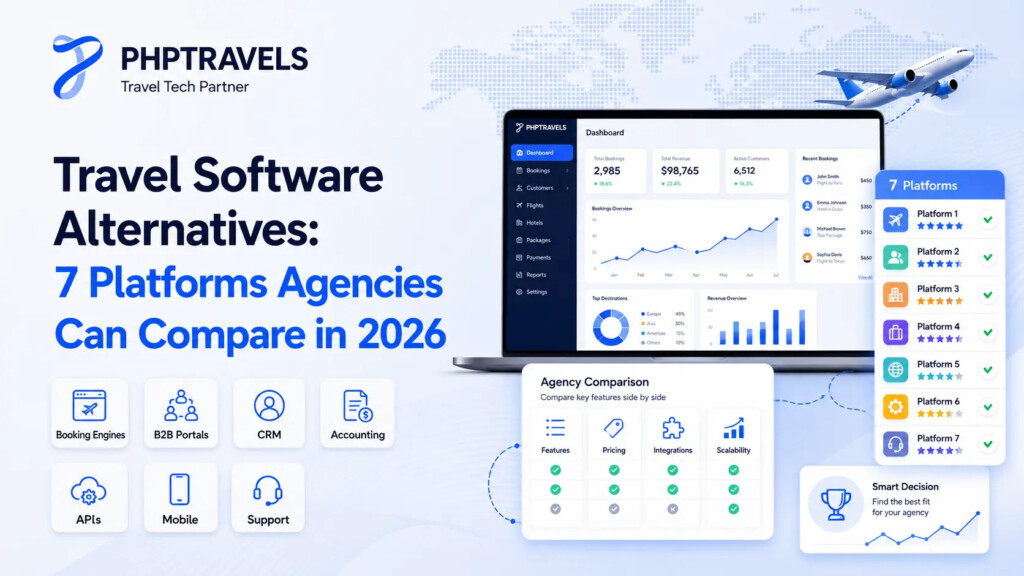
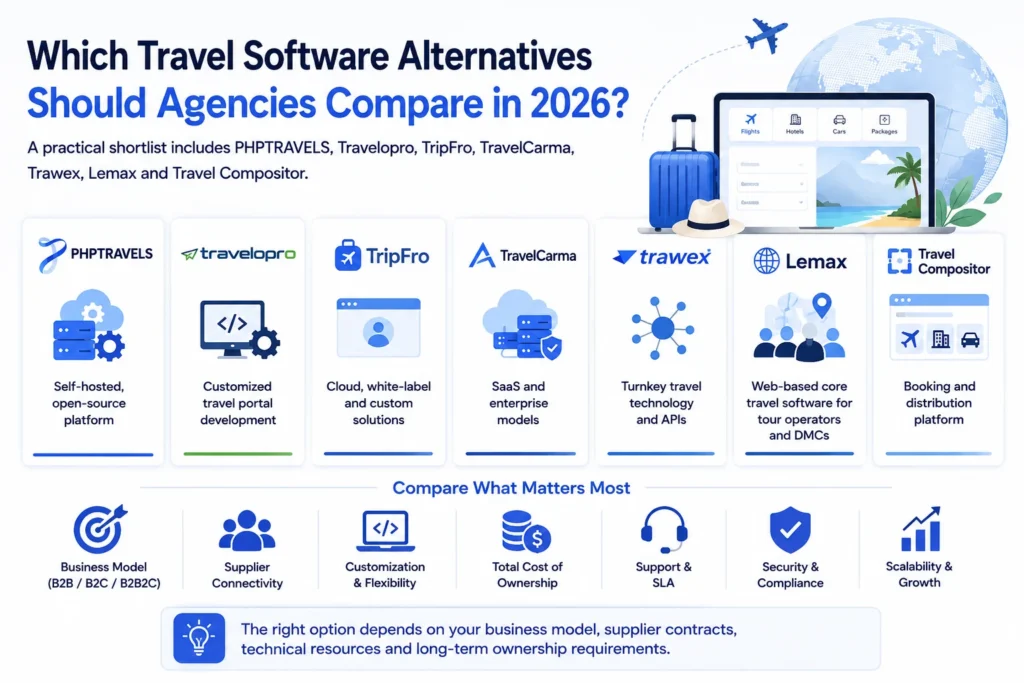
Which travel software alternatives should agencies compare in 2026?
A practical shortlist includes PHPTRAVELS, Travelopro, TripFro, TravelCarma, Trawex, Lemax and Travel Compositor.
PHPTRAVELS is relevant when self-hosting, source-code access and deployment control matter. Travelopro is oriented toward customized travel portal projects. TripFro emphasizes B2B and white-label travel portals. TravelCarma offers SaaS and enterprise models. Trawex focuses on turnkey booking technology and supplier/API connectivity. Lemax is positioned around tour operators and DMCs. Travel Compositor focuses strongly on multi-product and dynamic travel packaging.
The right option depends on your business model, supplier contracts, technical resources and long-term ownership requirements.
Travel software alternatives at a glance
| Platform | Delivery Model | Main Focus | Supplier Connectivity | Best-Fit Use Case |
|---|---|---|---|---|
| PHPTRAVELS | Self-hosted, open-source platform | B2B and B2C | Pre-built and custom integrations | Agencies wanting code and deployment control |
| Travelopro | Customized travel portal development | B2B, B2C and B2B2C | GDS, XML/API and supplier integrations | Vendor-led custom portal projects |
| TripFro | Cloud, white-label and custom solutions | Strong B2B plus B2C | GDS, LCC and third-party APIs | B2B distribution or white label |
| TravelCarma | SaaS and enterprise models | B2B and B2C | Existing and custom integrations | Managed SaaS or enterprise modernization |
| Trawex | Turnkey travel technology and APIs | Multi-channel selling | GDS, LCC and third-party APIs | API-heavy booking ecosystems |
| Lemax | Web-based core travel software | Tour operators and DMCs | Third-party integrations | Complex multi-day tour operations |
| Travel Compositor | Booking and distribution platform | OTAs, DMCs, operators | Multi-product provider ecosystem | Dynamic packaging and multi-destination selling |
1. When is PHPTRAVELS a suitable alternative?
PHPTRAVELS is worth considering when a business wants greater control over the travel platform itself. Its current positioning centers on a self-hosted, open-source booking system, while pricing is provided according to plan and project scope.
It supports multi-product travel selling and publishes integrations across flight, hotel, tour, car and payment categories. If supplier connectivity is important, review the current travel API integrations rather than assuming an integration exists because a supplier is popular.
Best fit: agencies, OTAs and travel businesses that value source-code access, self-hosting, customization and deployment control.
2. When does Travelopro make sense?
Travelopro is better understood as a travel technology and portal-development provider than as a simple off-the-shelf subscription. Its public pages describe B2B, B2C and B2B2C portal development, booking engines, supplier integrations and customized project work.
Its pricing information says cost depends on business goals, company size and technical requirements. That makes scope definition important: modules, integrations and custom development can change the final project.
If Travelopro is already on your shortlist, our Travelopro alternative comparison goes deeper into ownership, pricing, modules, APIs and deployment questions.
Best fit: businesses that prefer a vendor-led custom travel portal project.
3. When is TripFro a practical option?
TripFro places B2B distribution and white-label travel technology at the center of much of its public offering. Its pages describe B2B agent tools, white-label portals, multiple sales channels, GDS connectivity, third-party APIs and markup controls.
The main due-diligence point is to distinguish a white-label deployment from a fully custom project. Branding control, source-code rights, hosting responsibilities and future customization can differ between these models.
For a direct buyer-intent comparison, see PHPTRAVELS vs TripFro.
Best fit: B2B-focused agencies and companies looking for white-label or vendor-managed delivery.
4. Who should consider TravelCarma?
TravelCarma currently presents both SaaS and enterprise approaches. Its agency software pages describe B2C/B2B booking workflows, CRM, back-office functions, supplier/API integration, direct inventory and agent management.
Its published commercial model separates a hosted SaaS approach from an enterprise approach. The SaaS model uses a setup fee plus monthly subscription for hosting, maintenance, upgrades and basic support, while its enterprise model uses a license fee plus annual maintenance.
Best fit: agencies that want a hosted SaaS foundation or an enterprise modernization path.
5. What type of buyer should evaluate Trawex?
Trawex positions itself around end-to-end travel technology, including booking engines, B2B/B2C sales channels, GDS connectivity, LCC content, supplier APIs, white-label solutions, reservation management and back-office functions.
Broad capability should not replace technical verification. Ask which integrations are production-ready for your market, which modules are standard, what requires custom work and how post-booking servicing is handled.
Best fit: travel businesses that need broad API connectivity and a vendor-led turnkey booking ecosystem.
6. When is Lemax a stronger fit?
Lemax is more specialized than many general OTA platforms. Its current positioning focuses on mid-to-large tour operators and DMCs, with software for creating, selling and operating multi-day tours.
Its broader product information covers travel products, reservations and operational workflows, making it particularly relevant when a business builds complex packages or coordinates multi-day operations rather than mainly selling commodity flights and hotels.
Best fit: established tour operators and DMCs managing complex packages and operational workflows.
7. When should Travel Compositor be shortlisted?
Travel Compositor focuses on booking and distribution across multiple products and business models. Its current platform covers tour operators, OTAs, DMCs and agency networks, with strong emphasis on multiple booking engines and tailor-made trip creation.
If your operation mainly needs a straightforward flight-and-hotel portal, some of that depth may be unnecessary. If you build complex multi-stop products, it can become much more relevant.
Best fit: businesses where dynamic packaging, multi-service trips or multi-destination booking are central requirements.
What should you compare before replacing travel software?
The vendor shortlist is only the beginning. Use the same evaluation sheet for every provider so marketing language does not change your criteria from one demo to the next.
Who owns the source code and business data?
Ask who controls the production code, database, customer records and custom developments.
Source-code access does not always mean unrestricted modification rights, and “customizable” does not always mean you can move the system to another hosting provider.
If ownership matters, request the license, data-export process and exit terms before signing.
Is pricing one-time, subscription-based or project-based?
Compare total cost of ownership, not only the headline fee.
Include:
- initial implementation;
- supplier connections;
- hosting;
- upgrades;
- technical support;
- custom development;
- payment integrations;
- mobile applications if required;
- future supplier additions;
- migration and exit costs.
For PHPTRAVELS, you can review the current pricing options when building your cost comparison. Its current pricing page explains that quotes vary according to plan, business size, required modules, integrations and customization.
Which booking modules are actually required?
List the products your business sells today and expects to sell over the next two to three years: flights, hotels, tours, activities, cars, transfers, trains, ferries or packages.
Then check whether each module supports the complete booking lifecycle:
search → pricing → booking → confirmation → payment → change → cancellation → refund → reporting.
PHPTRAVELS publishes its current platform features by module if you need a practical reference while building your requirements sheet.
A platform with ten modules is not automatically more useful than one with four modules that match your real business.
Do you need B2B, B2C or B2B2C?
B2C is not the same operational problem as B2B distribution.
A serious B2B system may need:
- master agents and sub-agents;
- credit limits;
- wallets or deposits;
- agent-specific markups;
- commissions;
- branch controls;
- permissions;
- vouchers;
- reseller reporting.
If agent distribution matters, evaluate the actual workflow rather than accepting a “B2B supported” label.
A B2B travel portal should be tested using real agent scenarios from your business.
Which supplier, GDS and NDC connections matter?
The useful question is not “How many supplier logos does this software show?”
It is:
“Does it support the suppliers and booking workflows our business actually needs?”
For air distribution, modern connectivity may involve GDSs, aggregators and IATA’s NDC standard. IATA describes NDC as a standard intended to enhance communication between airlines and travel sellers and technology intermediaries.
How much customization do you really need?
Separate configuration from engineering.
Changing a logo, language, markup or payment option may be configuration. Changing checkout logic, building a proprietary booking workflow or adding a new supplier connector usually requires engineering.
If your requirements are unique, compare what is included in standard setup with the cost and ownership of custom work.
PHPTRAVELS also documents its customization services for businesses that need deeper changes.
Who controls hosting, updates and the exit process?
A managed cloud platform can reduce infrastructure work. A self-hosted system can provide more deployment control.
Neither model is automatically better.
Before signing, define responsibility for:
- backups;
- server monitoring;
- uptime;
- security patches;
- version updates;
- supplier API changes;
- disaster recovery;
- database exports;
- code handover;
- termination and migration.
Exit conditions matter because changing travel software after thousands of bookings, customer records and agent accounts exist is much harder than changing it during procurement.
Which travel software alternative fits your company size?
For a startup, simplicity and launch cost often matter more than a large enterprise feature set. A white-label or structured platform can reduce initial implementation work.
For a growing agency, supplier flexibility, B2B controls, reporting and customization usually become more important.
For a large OTA, wholesaler or DMC, evaluate scalability, internal development requirements, multiple branches, supplier normalization, data ownership and support escalation.
Company size alone is not enough.
A small agency with unusual supplier contracts can have more technical complexity than a larger business selling standardized products.
How should you run a fair travel software demo?
Give every vendor the same tasks.
Ask them to:
- Search your primary travel product.
- Apply the markup rules your business uses.
- Create a B2B or B2C booking.
- Show a cancellation or booking change.
- Produce a report your operations team actually needs.
PHPTRAVELS offers a live demo for reviewing customer and administration workflows.
For other vendors, request a demonstration based on your actual business model and supplier requirements rather than relying only on a generic sales walkthrough.
After every demo, score the platform on ownership, workflow fit, supplier connectivity, cost, customization, support and exit flexibility.
Final decision: choose the operating model before the brand
The strongest travel software shortlist is not the one with the most famous vendor names.
It is the one that matches how your company buys inventory, distributes rates, sells travel, services bookings and controls technology.
PHPTRAVELS is worth evaluating when self-hosting, open-source access and customization matter. Travelopro and Trawex fit more vendor-led development models. TripFro is relevant for B2B and white-label distribution. TravelCarma gives buyers SaaS and enterprise paths. Lemax is more specialized for tour operators and DMCs, while Travel Compositor is notable for complex packaging and multi-destination selling.
Before choosing, document your non-negotiable requirements, request comparable commercial proposals, verify supplier integrations and test the same workflows in every demo.
If PHPTRAVELS matches your operating model, the next step is to review the live demo, pricing, supplier integrations and technical requirements before requesting a project quote.