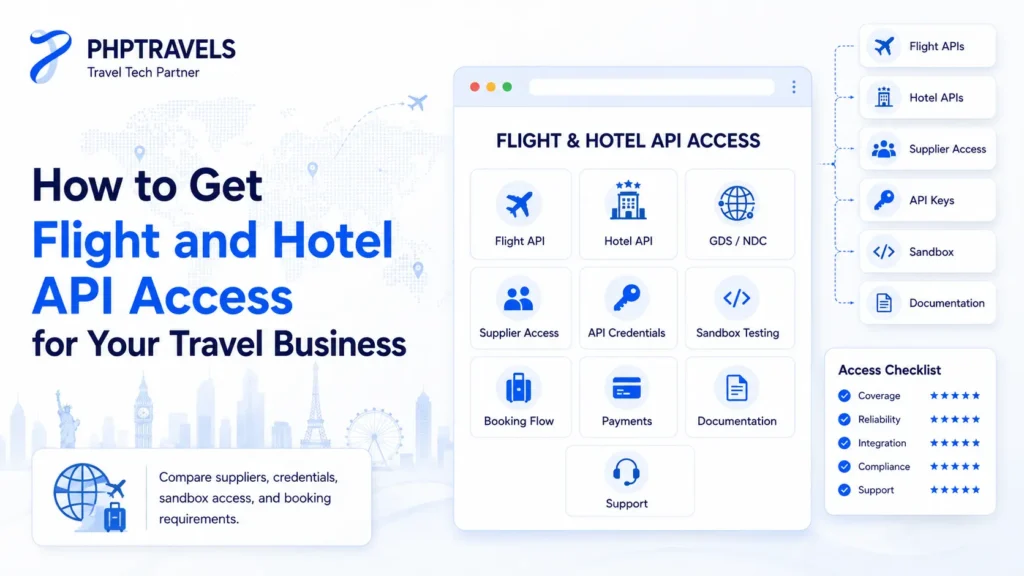
Getting flights and hotels API access is one of the first challenges when launching an online travel agency, travel booking website, or B2B portal. You need reliable inventory from airlines, GDSs, NDC providers, hotel bedbanks, wholesalers, or travel API aggregators before customers can search and book on your platform.
The process is not only about receiving API credentials. A production-ready travel business also needs live pricing, availability checks, booking confirmation, ticketing or vouchers, cancellations, refunds, payments, markups, and post-booking support.
What Are Flight and Hotel APIs?
Flight and hotel APIs allow your travel website or application to exchange data with airlines, GDSs, NDC providers, bedbanks, wholesalers, hotel distributors, and other travel suppliers.
A flight API can return routes, schedules, fares, baggage rules, availability, and booking information. Depending on the provider, it may also support repricing, reservations, ticketing, cancellations, and servicing.
A hotel API normally provides property content, room availability, rates, taxes, cancellation rules, and booking functions. Some suppliers also provide images, facilities, room descriptions, and geographic data.
If you are comparing supplier types, the PHPTRAVELS travel API solutions page gives a broader view of how travel APIs fit into a booking platform.
How Do You Get Flights and Hotels API Access?
In most cases, the process looks like this:
- Define what you want to sell. Decide your markets, routes, hotel destinations, currencies, customer type, and booking model.
- Choose a supplier or aggregator. Compare airlines, GDSs, NDC providers, flight aggregators, hotel bedbanks, and multi-supplier platforms.
- Apply for a commercial account. Providers may request business details, projected sales, target markets, and technical information.
- Get test credentials. Developers normally begin in a sandbox or test environment.
- Integrate the full booking flow. Build search, price confirmation, booking, payment, confirmation, cancellation, and support processes.
- Complete production checks. Some providers require a review or certification before live credentials are enabled.
Before contacting individual suppliers, review a broader travel XML API suppliers list to understand the types of flight and hotel inventory available.
Which Is Better: Direct Suppliers, GDS/NDC, Bedbanks, or Aggregators?
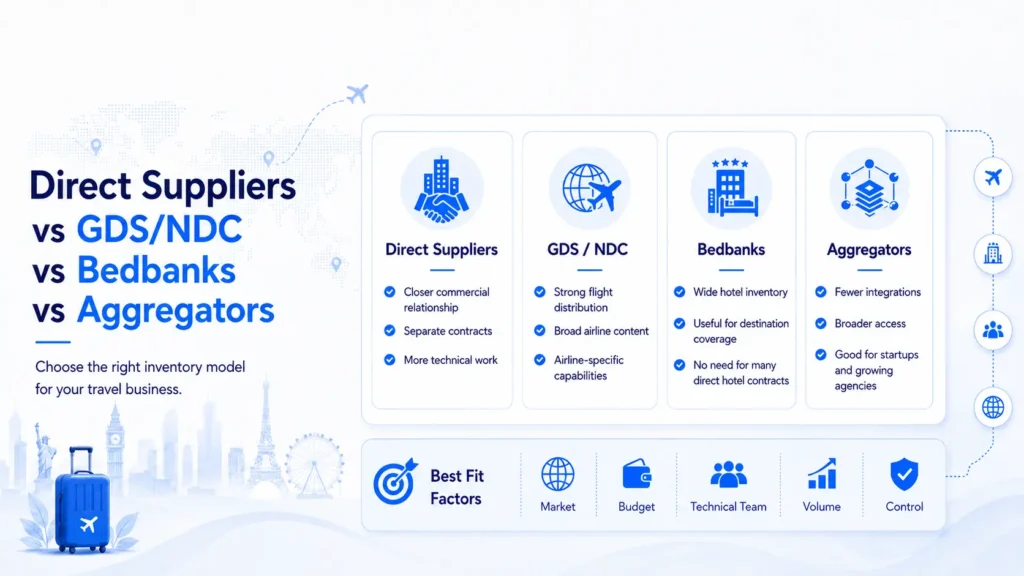
There is no single best model. The right option depends on your market, budget, technical team, expected volume, and the control you need.
Direct supplier connections can give you a closer commercial relationship, but each integration may have its own contract, technical specification, approval process, and support requirements.
GDS and NDC connections are common for flight distribution. GDSs can provide broad airline content, while NDC connections can provide airline-specific content and servicing capabilities. If airline distribution is central to your business, see how an NDC flight booking system fits into the workflow.
Hotel bedbanks and wholesalers aggregate accommodation inventory across many properties and destinations. This makes them useful when you want hotel coverage without building separate commercial relationships with every property.
Aggregators can reduce integration complexity by giving your system access to multiple inventory sources through fewer connections. This can suit startups and growing agencies that want broader coverage without maintaining many separate integrations from day one.
How Does a Flight API Work From Search to Ticketing?
A real flight booking flow is more than sending a search request.
The customer enters the route, travel dates, passenger details, and cabin preference. Your system sends the request to one or more flight suppliers, which may return itineraries, fare families, baggage information, rules, and prices.
When the traveler chooses an option, the system should confirm that the fare is still available and that the price has not changed.
Passenger details are then collected, payment is processed according to your business model, and the booking is created. Where supported, the final steps include ticket issuance, PNR or booking-reference storage, and customer confirmation.
After the sale, your platform may also need to manage cancellations, schedule changes, refunds, voids, or other servicing requests.
This is why an API should be evaluated together with the platform around it. A complete flight booking software setup can connect inventory with the user interface, business rules, markups, payments, and back-office operations.
How Does a Hotel API Work in a Real Booking Flow?
A hotel booking usually begins when a customer searches by destination, check-in and check-out dates, number of rooms, and guest occupancy.
The hotel supplier returns matching properties and room offers. Your website can then display rates, room types, meal plans, taxes, cancellation conditions, and other relevant details.
Before confirmation, the selected offer should be checked again when the supplier supports or requires price verification. Hotel prices and room availability can change between the original search and checkout.
Once the reservation is created, the system stores the supplier booking reference and sends a confirmation to the customer. It also needs a clear process for modifications, cancellations, refunds, and supplier communication.
A dedicated hotel API booking system can help connect hotel inventory with booking and management tools instead of treating the supplier API as a complete booking platform on its own.
What Should You Check Before Choosing a Travel API Supplier?
Do not choose a provider only because the documentation looks simple or the headline price looks low.
Start with inventory coverage. Check which airlines, hotel markets, destinations, rate types, and content sources are included. A provider that performs well in one region may not be the strongest choice for another market.
Then check the booking lifecycle. Can you only search, or can you also reprice, book, cancel, retrieve, and service reservations?
For flights, confirm how ticketing and post-booking requests are handled. For hotels, check cancellation policies, booking retrieval, room and rate mapping, and price verification.
You should also review commercial terms, including setup costs, deposits or credit arrangements, transaction charges, markups, payment responsibility, minimum targets, and settlement terms.
Finally, review the technical side. Documentation, error handling, logs, webhooks or status updates, sandbox quality, technical support, and the production process can matter as much as inventory.
You can compare platform-supported options in the PHPTRAVELS integrations directory instead of adding unrelated suppliers without a clear business reason.
Can You Get Flight and Hotel APIs Instantly?
Sometimes you can get test access quickly, but production access is not always instant.
The timeline depends on the supplier, your business status, contracts, development work, testing, and any certification or launch review required before going live.
Getting sandbox credentials immediately does not necessarily mean that you can start accepting real customer bookings immediately.
For that reason, “fast API access” should mean reducing unnecessary technical work rather than skipping commercial or production requirements.
A practical way to move faster is to choose suppliers that match your target market and use a booking platform that already supports the main search-to-book workflow.
Your team can then focus on supplier credentials, configuration, payment setup, testing, branding, and launch rather than rebuilding every travel workflow from zero.
How Much Do Flight and Hotel APIs Cost?
There is no universal price for a flight or hotel API.
Your total cost may include supplier onboarding, deposits or credit arrangements, transaction fees, development, hosting, payment processing, support, and the software used to manage bookings.
Some suppliers operate through commissions or markups, while others use commercial agreements based on transactions, markets, services, or booking volume.
The cheapest API is not always the lowest-cost option.
A connection that creates weak inventory, frequent booking failures, difficult refunds, or large amounts of manual work may cost more operationally than a stronger supplier with better support.
Before signing a supplier agreement, calculate the full cost of a booking from search through payment, confirmation, customer support, cancellation, and reconciliation.
Are Free Flight or Hotel APIs Enough for a Commercial OTA?
Free or low-cost developer access can be useful for learning, prototyping, and testing a travel product.
It should not automatically be treated as production-ready inventory.
Before building a commercial business around a free API, check whether live bookings are allowed, what inventory is included, whether there are request limits, how cancellations work, what support is available, and what is required to move into production.
A test API can prove that your website interface and technical connection work. It does not by itself prove that you have a reliable supplier relationship or a scalable booking operation.
Can You Use Amadeus, Expedia, or Google for Hotel API Access?
Yes, but they serve different purposes.
Amadeus offers hotel APIs for searching properties, checking offers, and making hotel bookings through its developer platform. The exact production and commercial setup depends on the API and use case, so new businesses should review the current requirements rather than assuming Amadeus hotel APIs are available only to large enterprises.
If Amadeus matches your planned inventory strategy, PHPTRAVELS also provides an Amadeus API integration option for connecting it with a wider travel booking platform.
Expedia Group provides Rapid APIs for travel partners. Businesses need to go through partner onboarding, receive credentials, build and test the integration, and meet the relevant launch requirements before production use.
If Expedia inventory fits your business model, see the PHPTRAVELS Expedia API integration page for the platform-side integration option.
Google Hotel Center and the Travel Partner API are different from a general hotel inventory supplier.
They are designed primarily around managing hotel data and participation across Google travel surfaces. If your goal is to obtain hotel rooms that you can resell through your own OTA, a bedbank, wholesaler, or hotel distribution provider is normally the more relevant type of supplier.
What Mistakes Should You Avoid When Integrating Travel APIs?
One common mistake is building only the search page.
Search results may look impressive, but the actual business depends on reliably completing and managing bookings.
Another mistake is failing to recheck prices and availability before confirmation. Travel inventory changes, so your workflow needs to handle changed or unavailable offers clearly without creating a poor customer experience.
Post-booking operations are also easy to underestimate. Cancellations, refunds, airline schedule changes, supplier failures, payment issues, and customer support requests are part of running a travel booking business.
It is also possible to integrate too many suppliers too early.
More connections can increase inventory coverage, but they also increase data mapping, testing, duplicate results, error handling, maintenance, and reconciliation work.
Finally, avoid selecting suppliers before defining your target market. Your ideal flight or hotel API depends on where you sell, what products you sell, and whether your customers are consumers, travel agents, corporate clients, or another segment.
How Can PHPTRAVELS Help With Flight and Hotel API Integration?
PHPTRAVELS is designed to connect travel inventory with a ready booking environment, so businesses do not have to build every front-end and back-office workflow from scratch.
For flights, the platform can combine supplier integrations with search, pricing, booking, and management workflows.
Businesses considering specific flight providers can also review options such as TBO flights API integration.
For hotels, PHPTRAVELS supports hotel booking workflows and accommodation supplier integrations.
For example, businesses working with Hotelbeds can explore Hotelbeds API XML integration.
The main value is not simply “having an API.”
It is having the booking system around that API the search interface, pricing logic, booking workflow, payments, confirmations, administration, and supplier management needed to turn inventory into a usable travel product.
If you are deciding whether the platform fits your business model, you can review the PHPTRAVELS demo before selecting suppliers and beginning integration work.
What Is the Best Way to Start?
Start by defining the countries, customers, and travel products you want to serve. Decide whether flights, hotels, or both are necessary for your first launch, and then shortlist suppliers based on actual inventory coverage rather than brand recognition alone.
Request commercial terms and production requirements before committing to major development. Test the API, map the complete search-to-book workflow, and begin with the smallest number of suppliers needed to serve your core market.
Once real bookings show where your inventory gaps are, you can add more suppliers for better coverage, pricing, or regional reach.
The best travel API strategy is not about connecting the highest number of suppliers. It is about building a booking flow that is reliable, supportable, and commercially workable.