
Managing hotel inventory across several booking channels becomes difficult very quickly.
A room may be available on your website, Booking.com, another OTA, and a B2B partner at the same time. If one booking is not reflected across the other channels quickly enough, the hotel can face overbookings, inconsistent rates, and extra manual work.
A hotel channel manager solves this problem by giving the hotel one place to control rates, room availability, and distribution rules across connected sales channels.
But which hotel channel manager is best?
There is no single answer for every hotel. The right software depends on your property size, sales channels, PMS or booking system, integration requirements, and future distribution plans.
This guide explains how hotel channel managers work, what features actually matter, and how to compare different solutions without getting distracted by long feature lists.
What is a hotel channel manager?
A hotel channel manager is software that helps hotels manage room availability, rates, and booking restrictions across multiple online sales channels from one central system.
Instead of updating every OTA or sales partner separately, hotel staff can make an update once and distribute it to connected channels.
A channel manager can connect a hotel with channels such as:
- Online travel agencies
- The hotel’s direct booking website
- B2B travel partners
- Wholesalers
- Reservation platforms
- Other hotel distribution systems
Its main purpose is to keep inventory synchronized and reduce manual distribution work.
For hotels building a connected distribution setup, dedicated channel manager integrations can connect the hotel platform with external sales channels and technology partners.
How does a hotel channel manager work?
A hotel channel manager acts as a connection between hotel inventory and the channels selling that inventory.
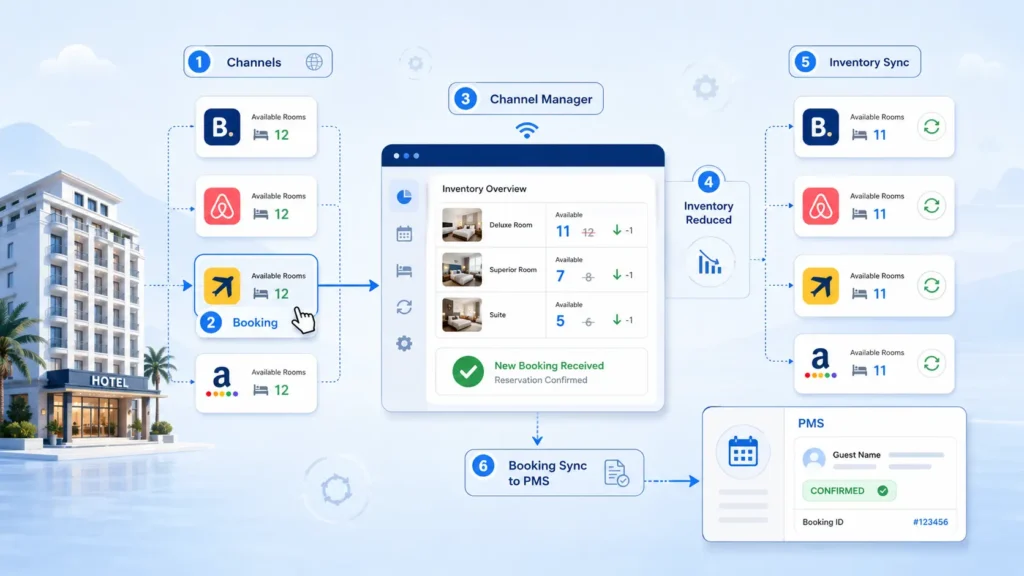
A simple booking workflow looks like this:
- The hotel makes rooms available across several connected channels.
- A guest books a room through one of those channels.
- The reservation is sent to the channel management system.
- The available inventory is reduced.
- Updated availability is sent to the other connected channels.
- The reservation can also be transferred to the hotel’s PMS or reservation system when an integration is available.
This reduces the need for hotel staff to log in to several extranets and update inventory manually.
Synchronization speed depends on the technology and connection used by each platform. API-based connections generally allow systems to exchange information automatically without repeated manual uploads.
You can also see how the wider booking process works in this guide to hotel reservation systems.
Why do hotels need a channel manager?
Hotels normally need a channel manager when managing rates and availability manually starts taking too much time or creates operational risk.
Without centralized distribution, a hotel may experience:
Overbookings
A room sold through one channel may still appear available on another channel until somebody updates it manually.
Rate inconsistencies
Different prices may appear across channels because one platform was updated while another was missed.
Too much administrative work
Staff may have to manage several accounts, calendars, rates, restrictions, and reservation notifications.
Slow inventory updates
Manual changes can become difficult during busy periods when bookings arrive frequently.
Limited distribution visibility
It becomes harder to understand where reservations are coming from when information is spread across different systems.
A channel manager does not automatically solve every hotel distribution problem, but it gives the hotel a central point from which those channels can be managed more efficiently.
What is the difference between a channel manager, PMS, CRS, and booking engine?
These systems perform different jobs, although modern hotel technology often connects them.
| System | Main Purpose | Typical Responsibility |
|---|---|---|
| Channel Manager | Distribution | Sends rates and availability to connected sales channels |
| PMS | Property Operations | Manages reservations, guests, rooms, check-in, and daily hotel operations |
| Booking Engine | Direct Sales | Allows guests to book rooms through the hotel’s own website |
| CRS | Central Reservations | Centralizes reservation and inventory management across one or more properties |
A channel manager manages external distribution.
A PMS manages hotel operations.
A booking engine helps generate direct reservations.
A CRS provides centralized reservation management and may support larger or multi-property operations.
Many hotels get better results when these systems exchange information instead of operating separately.
For example, a hotel booking engine can handle direct website reservations while a hotel management system manages operational workflows behind the scenes.
What features should a good hotel channel manager have?
The best hotel channel manager is not necessarily the one with the longest feature list. It is the one that reliably supports the hotel’s actual distribution workflow.
Does it synchronize inventory automatically?
Inventory synchronization is one of the most important functions.
When a reservation is made, the system should update the remaining availability across relevant connected channels without requiring staff to repeat the same work manually.
Ask providers how frequently updates occur and how synchronization failures are handled.
Can it manage rates and restrictions?
Hotels often need more control than simply changing room prices.
Useful controls may include:
- Room rates
- Rate plans
- Minimum stay requirements
- Maximum stay rules
- Closed-to-arrival restrictions
- Closed-to-departure restrictions
- Stop-sell controls
- Room availability
The exact controls available depend on the channel and integration.
Does it integrate with your PMS?
A channel manager becomes more useful when reservations can move between the distribution system and the hotel’s operational software.
Check whether your current PMS is supported before choosing a provider.
Hotels should also confirm whether the connection is one-way or two-way and what information can actually be synchronized.
Does it support your important channels?
A large number of advertised integrations does not automatically make one channel manager better than another.
A hotel selling mainly through five important channels may benefit more from reliable connections to those five platforms than hundreds of integrations it will never use.
Evaluate channel quality before channel quantity.
Does it provide an API?
An API becomes important when a hotel group, OTA, travel company, or technology provider needs custom integrations.
An application programming interface allows different software platforms to exchange information according to defined rules.
API access can be useful for:
- Custom booking workflows
- External supplier connections
- B2B distribution
- Multi-property systems
- Custom reporting
- Mobile applications
- Centralized inventory systems
Businesses requiring more complex hotel distribution can also use a hotel API booking system as part of the wider technology architecture.
Does it provide useful reporting?
A good channel manager should help operators understand their distribution rather than simply move inventory between systems.
Useful reports may show:
- Reservations by channel
- Revenue by source
- Booking trends
- Cancellation activity
- Room performance
- Rate performance
Reporting requirements will vary depending on the hotel’s size and operating model.
How should you compare hotel channel manager software?
Compare channel managers using real operational requirements rather than marketing claims.
| Evaluation Area | What to Check | Why It Matters |
|---|---|---|
| Inventory Synchronization | How quickly availability changes are distributed | Helps reduce conflicting availability |
| OTA Connectivity | Whether your important sales channels are supported | Relevant integrations matter more than total numbers |
| PMS Integration | Compatibility with your existing hotel systems | Reduces repeated data entry |
| Rate Management | Rate plans and restriction controls | Gives revenue teams better distribution control |
| API Availability | Documentation and integration options | Important for custom or scalable systems |
| Multi-Property Support | Central and property-level controls | Useful for hotel groups |
| B2B Distribution | Agent, supplier, and wholesale workflows | Important for businesses selling beyond consumer OTAs |
| Reporting | Channel and reservation performance data | Helps evaluate distribution results |
| Support | Technical assistance and issue handling | Integration problems can directly affect bookings |
| Scalability | Ability to support additional properties or channels | Reduces the need to replace systems as the business grows |
Which channel manager is best for a small hotel?
For a small hotel, the best channel manager is usually one that is simple to operate, supports the property’s main OTAs, and integrates with its existing booking or property management system.
Small hotels should prioritize:
- Easy inventory management
- Reliable OTA connections
- Simple rate controls
- PMS compatibility
- Direct booking integration
- Clear pricing
- Accessible support
Paying for complex enterprise functionality may not make sense if the hotel only operates one property and a small number of channels.
Which channel manager is best for a hotel group?
Hotel groups need more centralized control than most independent properties.
Important capabilities may include:
- Multi-property management
- Central inventory visibility
- Property-specific permissions
- Centralized rate strategies
- PMS integrations
- API access
- Reporting across properties
- User roles and access controls
The software should allow central teams to manage distribution while still giving individual properties enough flexibility to respond to local demand.
What should OTAs and B2B hotel businesses look for?
OTAs and B2B travel companies usually need a broader distribution architecture than an individual hotel.
Their requirements can include:
- Multiple hotel suppliers
- Direct hotel contracts
- Wholesale rates
- Agent markups
- Supplier APIs
- B2B pricing
- XML or API connectivity
- Multiple currencies
- Distribution to sub-agents
In this model, the channel manager is only one part of the technology stack.
A B2B booking engine can provide agent-facing booking workflows while APIs connect hotel inventory with external suppliers and distribution partners.
How important are APIs in hotel channel management?
APIs are increasingly important when hotel distribution involves multiple systems.
A basic hotel may only need standard integrations provided by its software company.
A hotel group, OTA, DMC, or B2B travel business may require more control.
API connectivity can make it possible to connect:
- Hotel inventory
- Booking engines
- PMS platforms
- External hotel suppliers
- Mobile apps
- B2B portals
- Reporting tools
- Custom applications
However, simply offering an API is not enough.
Businesses should evaluate documentation, supported functions, authentication, error handling, synchronization logic, and technical support before selecting an integration.
How does PHPTRAVELS fit into hotel distribution?
PHPTRAVELS approaches hotel distribution as part of a wider travel booking technology environment.
Instead of viewing the channel manager as an isolated application, hotels and travel businesses can connect distribution with booking, hotel inventory, APIs, and other operational components.
For businesses that require hotel sales functionality, the PHPTRAVELS hotel module provides hotel-related booking and management capabilities within the wider platform.
Different businesses can use this type of architecture in different ways.
An independent hotel may need direct reservations and external distribution.
A hotel group may require centralized management across several properties.
An OTA may need hotel inventory from multiple suppliers.
A B2B travel company may need to distribute hotel rates to agents.
The right configuration therefore depends on the business model rather than a single predefined setup.
What is the best hotel channel manager?
The best hotel channel manager is the one that fits your existing technology, important sales channels, property size, operational workflow, and growth plans.
For a small independent hotel, simplicity and reliable OTA synchronization may matter most.
For a hotel group, centralized inventory and multi-property controls may be more important.
For an OTA or B2B travel company, API connectivity, supplier integrations, and flexible distribution workflows can become the deciding factors.
The most useful comparison is therefore not “Which channel manager has the most features?”
It is:
“Which channel manager can reliably support the way our business actually sells hotel inventory?”