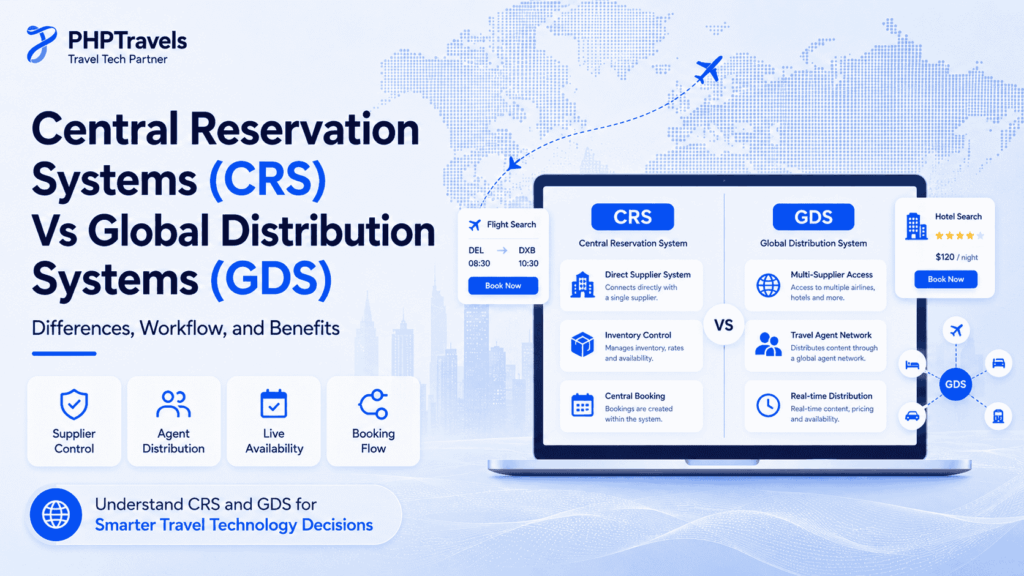
The difference between CRS vs GDS is simple:
CRS manages your own bookings internally, while GDS distributes your inventory to travel agents globally.
A Central Reservation System (CRS) is used by hotels and travel providers to control inventory, pricing, and direct bookings.
A Global Distribution System (GDS) connects that inventory to external travel agencies, OTAs, and global markets.
If a customer books directly on your website, the CRS handles it.
If a booking comes through a travel agent or third party platform, the GDS is involved.
Both systems work together, but they serve completely different roles in travel distribution.
GDS Full Form and Meaning
GDS stands for Global Distribution System. It is a network that connects travel providers like airlines and hotels with travel agents and booking platforms worldwide, allowing real time search and booking.
CRS Full Form in Travel
CRS stands for Central Reservation System. It is a system used by hotels and travel companies to manage their own inventory, pricing, and direct bookings in one place.
What Is a Computer Reservation System?
A computer reservation system, also commonly called a computerized reservation system, is software used by travel businesses to store, manage, and process reservation information electronically. Instead of handling availability, rates, passenger or guest details, and bookings manually, the system keeps reservation data organized in one central platform.
Modern computer reservation systems are used across different areas of the travel industry, including hotels, airlines, car rentals, and other reservation-based services. Depending on the business, a computerized reservation system can help manage inventory, check availability in real time, update prices, create or modify reservations, and keep booking information synchronized.
The term is closely related to CRS, although its meaning can depend on the travel segment. In hotels, CRS usually refers to a Central Reservation System that manages room inventory, rates, and reservations. In aviation, computerized reservation technology has traditionally been used to manage flight schedules, seat availability, passenger bookings, and related reservation records.
A computerized reservation system mainly focuses on managing reservation data, while a GDS focuses on distributing travel inventory to a wider network of travel agencies and booking partners. This distinction is one of the main reasons CRS and GDS are often connected but should not be treated as the same system.
CRS vs GDS Comparison
| Feature | CRS | GDS |
|---|---|---|
| Purpose | Internal booking management | Global distribution |
| Users | Hotels, airlines | Travel agents |
| Booking Type | Direct bookings | Third party bookings |
| Control | Full control | Shared distribution |
| Example | Hotel website booking | Expedia, travel agency booking |
Central Reservation Systems (CRS)
A Central Reservation System (CRS) is a powerful back-end tool that allows hotels and travel providers to manage direct bookings, inventory, and pricing from one place, making operations faster and more reliable, similar to how a central reservations control platform functions in modern travel operations.
Key Features of Central Reservation Systems:
Some key features of Central Reservation Systems are as follows.
- Inventory Management: CRS enables meticulous control over inventory, allowing travel agencies to efficiently manage and allocate resources such as flights, hotels, tours, and cars.
- Real-Time Updates: With real-time updates, CRS ensures that travel agents and operators have the latest information on availability, pricing, and services, enhancing accuracy in bookings.
- Rate Management: CRS empowers businesses to manage rates effectively, optimizing pricing strategies to attract customers and maximize revenue.
- Channel Management: CRS facilitates channel management, ensuring seamless communication across various platforms for a cohesive and synchronized booking experience.
Advantages of CRS
- Full control over pricing and inventory
- Direct bookings without third party commissions
- Real time updates to avoid overbooking
- Better customer data and relationship management
- Centralized system for managing all reservations
Known Central Reservation Systems:
- Hewlett Packard’s EDS
- SabreSonic or Altéa (Sabre)
- Navitaire (owned by Amadeus)
Global Distribution Systems (GDS)
A Global Distribution System (GDS) acts like a digital bridge, linking travel agencies to thousands of flights, hotels, and car rental options around the world in real-time.
Key Features of Global Distribution Systems:
Some key features of Global Distribution Systems are as follows.
- Wide Market Reach: GDS offers a global network, connecting travel agencies and service providers worldwide, expanding the reach of flights, hotels, tours, and car rentals.
- Content Distribution: GDS excels in content distribution, ensuring that a diverse range of travel services is available to travel agents, making it a comprehensive solution.
- Rate Parity: GDS maintains rate parity, providing consistent pricing information across various platforms, avoiding discrepancies and ensuring fairness.
- Streamlined Booking Process: GDS simplifies the booking process, allowing travel agents to access real-time information and make reservations seamlessly for their clients.
Advantages of GDS
- Access to global travel inventory in one place
- Helps travel agents compare prices and options quickly
- Expands reach to international markets
- Real time booking and availability
- Increases sales through third party channels
Known Global Distribution Systems:
- Amadeus
- Galileo
- Sabre
- Worldspan
- Apollo
Learn more about Amadeus GDS and its global impact on travel distribution.
Difference Between CRS vs GDS in the Travel Industry
In the travel industry, Central Reservation Systems (CRS) and Global Distribution Systems (GDS) serve distinct yet complementary roles. While both contribute to efficient travel reservations, their focus and functionalities differ.
CRS in the Travel Industry:
CRS primarily operates as an internal tool, allowing hotels and other service providers to manage their inventory and streamline the booking process. It offers features such as precise inventory management, real-time updates, rate management, and channel management, ensuring effective control over internal booking operations. CRS is tailored for individual businesses, optimizing their direct booking processes.
GDS in the Travel Industry:
In contrast, GDS acts as a vast network that connects various service providers globally with travel agencies. It emphasizes external connectivity, providing a platform for travel agents to access a wide range of services, including flights, hotels, tours, and car rentals. Key features of GDS include wide market reach, content distribution, rate parity, and a streamlined booking process. GDS facilitates a comprehensive and synchronized approach to travel reservations on a global scale, unlike flight metasearch platforms vs booking systems that focus only on price discovery rather than ticketing and post booking workflows.
While CRS is more internally focused, GDS extends its reach externally, connecting businesses with a broader network of travel agencies. Together, they play a crucial role in optimizing the travel reservation process, offering a tailored approach for individual service providers and a comprehensive global solution for travel agencies.
Difference Between GDS and CRS With Examples
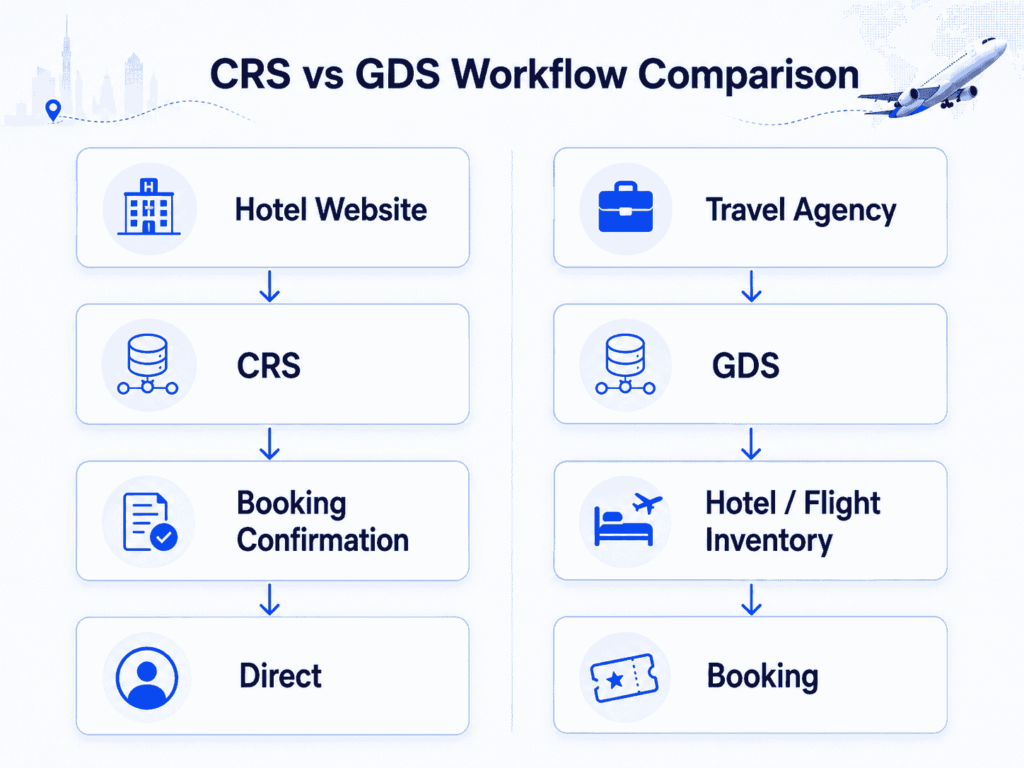
Let’s say a traveler books a hotel room. If they visit the hotel’s own website, the CRS processes that booking. But if they book through an online travel agency like Expedia, the GDS is the system making that connection. CRS is great for managing direct bookings, while GDS is essential for reaching a broader audience and increasing global exposure.
Difference Between CRS and GDS in the Hotel Industry
In the hotel industry, Central Reservation Systems (CRS) and Global Distribution Systems (GDS) serve distinct functions, contributing to the efficiency and global reach of hotels’ booking operations.
CRS in the Hotel Industry:
In hotels, a CRS works behind the scenes, managing rooms, prices, and bookings directly through the hotel’s own website or call center. It focuses on optimizing a hotel’s direct booking process, offering features such as real-time updates, rate management, and channel management. CRS is tailored to the specific needs of individual hotels, ensuring effective control over internal booking operations and direct customer interactions.
GDS in the Hotel Industry:
GDS, on the other hand, acts as a broader external network connecting hotels with travel agencies globally. It facilitates the distribution of a hotel’s inventory, rates, and services to a wide market, extending its reach beyond direct bookings.
Key features of GDS include wide market reach, content distribution, rate parity, and a streamlined booking process for travel agents. GDS is designed to enhance a hotel’s visibility and attract a global audience through the extensive network of travel agencies.
While CRS focuses on internal control and direct bookings for individual hotels, GDS broadens the scope by connecting hotels to a global network of travel agencies, expanding market reach and increasing visibility on a larger scale in the competitive hotel industry.
CRS and GDS for Hotels: Which One Do You Need?
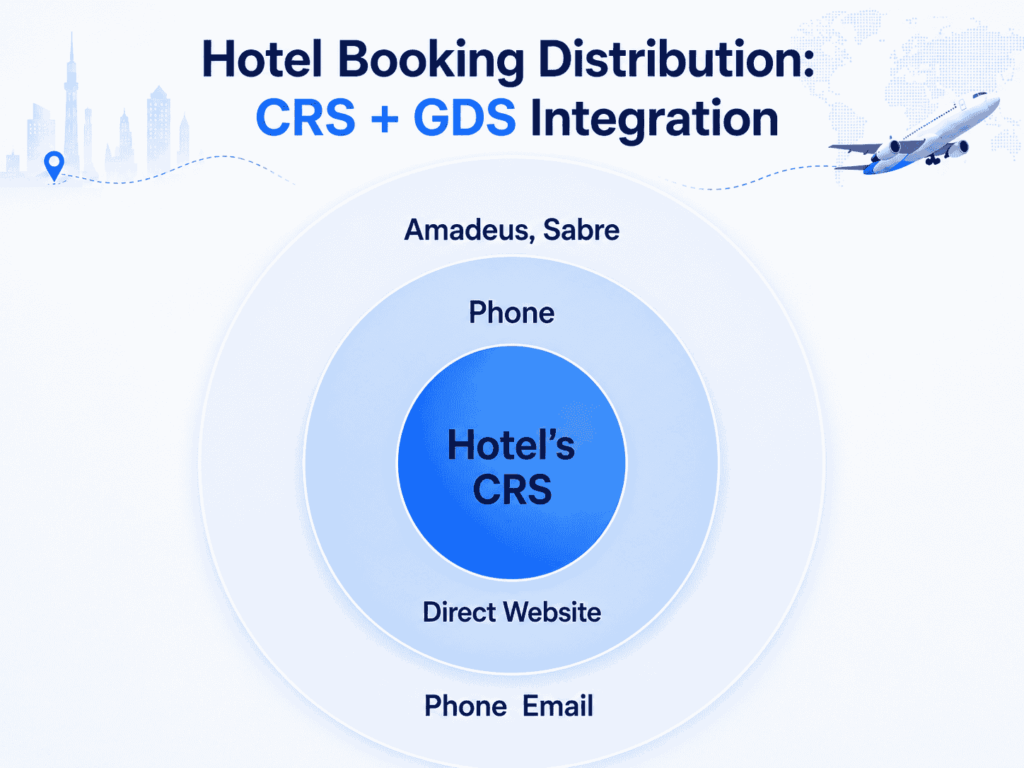
Hotels often use both CRS and GDS together. A CRS helps manage room availability and prices directly through the hotel’s own systems. GDS, on the other hand, broadcasts that availability to global agencies. If you want to boost direct bookings and also get listed on platforms like Booking.com, you need both systems. CRS keeps your house in order. GDS gets you guests from around the world.
For example, Booking.com’s Partner Hub explains how hotels can connect through GDS and channel managers.
Benefits of GDS and CRS
Using both a CRS and a GDS gives hotels and travel providers the best of both worlds. A CRS gives them control over pricing, promotions, and bookings directly on their own channels. GDS expands their market reach, ensuring visibility across thousands of travel agents and OTAs (online travel agencies), and a practical way to enable that reach is using PHPTRAVELS Travelport connectivity for agencies to distribute inventory and confirm bookings in one flow. This combination improves booking efficiency, reduces overbooking risk, and maximizes revenue by attracting both local and international customers.
Benefits of GDS:
- Expanded market reach for travel services
- Efficient content distribution
- Consistent rate parity
- Streamlined and accessible booking process
OTAs and travel agents rely on systems like Sabre GDS to access real-time global inventory across thousands of providers.
Benefits of CRS:
- Effective inventory and rate management
- Real-time updates for accurate bookings
- Channel management for synchronized communication
- Internal control over the booking process
How Do GDS and CRS Work in the Hotel Industry
In the hotel industry, both Global Distribution Systems (GDS) and Central Reservation Systems (CRS) play crucial roles in shaping the booking landscape, albeit with different focuses and functionalities.
Global Distribution Systems (GDS):
GDS serves as a global network that connects hotels with travel agencies worldwide. Hotels integrate their inventory, rates, and services into the GDS, making them accessible to a vast network of travel agents. Travel agents use GDS to check real-time availability, compare rates, and make reservations on behalf of their clients. This external connectivity broadens the hotel’s market reach, increasing visibility and attracting bookings from a global audience.
Central Reservation Systems (CRS):
On the other hand, CRS operates internally within hotels, providing a centralized platform for managing inventory and reservations such as the Amadeus CRS platform. It allows hotels to control and optimize their direct booking process. CRS offers features like real-time updates, rate management, and channel management to ensure efficient internal operations. This internal focus caters specifically to the hotel’s direct booking needs, enhancing control over inventory and pricing.
In essence, GDS and CRS complement each other in the hotel industry. GDS facilitates external connectivity and global exposure, while CRS streamlines internal operations and maximizes direct bookings. Together, they create a comprehensive approach that enhances a hotel’s visibility, increases bookings, and ensures efficient management of both direct and third-party reservations.
How Do GDS and CRS Work in the Travel Industry
In the travel industry, both Global Distribution Systems (GDS) and Central Reservation Systems (CRS) are instrumental in simplifying and optimizing the reservation process for various service providers.
Function of GDS in the Travel Industry:
GDS acts as a comprehensive network connecting airlines, hotels, car rentals, and other travel services with travel agencies globally, while some agencies also rely on negotiated flight sourcing for more specialized fare access. Service providers integrate their offerings into the GDS, allowing travel agents to access real-time information, compare options, and make bookings seamlessly. GDS facilitates a streamlined and accessible booking process, offering a wide market reach and ensuring consistent content distribution and rate parity.
Function of CRS in the Travel Industry:
CRS, on the other hand, operates internally within service providers such as hotels. It provides a centralized platform for managing inventory, rates, and reservations. With features like real-time updates, rate management, and channel management, CRS ensures effective control over internal booking operations. CRS is tailored to the specific needs of individual businesses, optimizing their direct booking processes.
In practical terms, a CRS functions as a computerized reservation system that replaces fragmented or manual booking processes with a centralized digital workflow. Travel providers can use it to maintain accurate availability, manage reservation records, update rates, and process booking changes from one system. This is why computer reservation systems remain an important part of modern travel operations even when businesses also use external distribution channels such as a GDS.
CRS and GDS are Key to Increasing Profitability Through Direct Bookings
CRS and GDS serve as indispensable tools in the travel industry, jointly contributing to the increased profitability of businesses through direct bookings. Central Reservation Systems (CRS) empower hotels and service providers with internal control, optimizing inventory, and managing rates for efficient direct booking processes.
On the other hand, Global Distribution Systems (GDS) extend the reach externally, connecting service providers to a global network of travel agencies, and broadening market visibility. Together, they create a powerful synergy, enhancing connectivity, increasing market exposure, and driving direct bookings. This collaborative approach not only maximizes revenue but also positions businesses competitively in the dynamic landscape of the travel industry.
Conclusion
In conclusion, the dynamic landscape of the travel industry relies heavily on sophisticated tools like Global Distribution Systems (GDS) and Central Reservation Systems (CRS). While GDS acts as a global connector, expanding market reach and facilitating external connectivity with travel agencies, CRS focuses on internal control, optimizing direct booking processes for individual service providers.
Together, they form a comprehensive solution that enhances efficiency and profitability. The collaboration between GDS and CRS proves to be key in navigating the complexities of the travel business, offering a synchronized approach that benefits both service providers and travel agencies.
As technology continues to evolve, the strategic integration of GDS and CRS remains fundamental for businesses aiming to thrive and secure a prominent position in the competitive and ever-changing travel landscape.
FAQs
1. What is the difference between a CRS and a GDS?
The main difference between a Central Reservation System (CRS) and a Global Distribution System (GDS) is how and where they operate. CRS is a hotel or airline’s internal system, handling direct reservations through its own website or staff. It lets the business control inventory and rates without involving third parties. GDS, however, connects that hotel or airline to external platforms like online travel agencies or brick-and-mortar agents so travelers can book through multiple channels. Think of CRS as your private office and GDS as a global marketplace.
2. What are CRS and GDS in aviation?
In aviation, CRS and GDS play essential roles. Central Reservation Systems (CRS) assist airlines in managing internal reservations and inventory, ensuring efficient direct bookings. Global Distribution Systems (GDS) connect airlines to a vast network of travel agencies, optimizing distribution, and increasing the airline’s visibility in the global market.
3. What is CRS in the travel industry?
In the travel industry, CRS stands for Central Reservation System. It is a computerized platform that enables businesses, especially hotels, to manage and optimize their internal inventory, rates, and reservation processes. CRS ensures efficient control over a company’s direct booking operations.
4. What is GDS in travel?
GDS stands for Global Distribution System. It is a sophisticated network that connects various travel service providers, including airlines, hotels, and car rentals, with travel agencies and online booking platforms. GDS facilitates the seamless distribution of travel-related services, streamlining the booking process for both businesses and travelers.
5. What does the GDS stand for?
GDS stands for Global Distribution System.
6. Why should Travel agents/travel operators and travel management companies use GDS?
Travel agents, operators, and management companies should use GDS for several reasons. GDS provides access to a wide range of travel services, enabling agents to offer diverse options to clients. It streamlines the booking process, allowing efficient comparison of options and real-time reservations. GDS enhances global connectivity, providing a vast network of service providers and expanding the reach of travel agencies. Overall, GDS is a key tool for improving operational efficiency, increasing service offerings, and staying competitive in the travel industry.