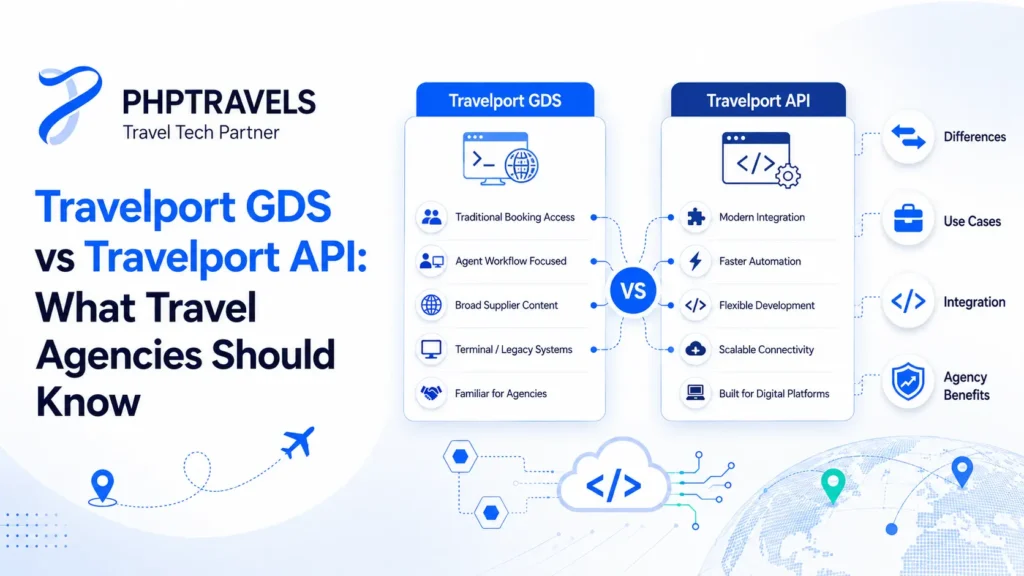
Travel agencies often hear “Travelport GDS” and “Travelport API” used in the same conversation. That can make them sound like two competing products, but they are not the same type of technology.
In simple terms, a Travelport GDS is part of the distribution infrastructure that aggregates and distributes travel content, while a Travelport API gives software a structured way to connect with Travelport content and booking functions.
For an agency, the real question is usually not “GDS or API?” but “How should our business access Travelport content and manage bookings?”
This difference matters when you are building an OTA, B2B portal or customer-facing booking website because it affects search, booking, PNR management and automation.
What is Travelport GDS?
Travelport GDS is global distribution infrastructure used to distribute travel inventory and booking information to travel sellers.
A Global Distribution System connects travel sellers with inventory such as airline schedules, fares and availability. Depending on the system and access agreement, GDS technology can also support hotel and car content.
Travelport’s GDS family includes Galileo, Worldspan and Apollo. Travelport identifies these systems with the industry codes 1G, 1P and 1V. In newer Travelport support material, you may also see Galileo associated with Travelport+ terminology.
For a travel agency, GDS access is closely associated with agent workflows such as searching availability, pricing itineraries, creating booking records and supporting ticketing or servicing.
Travelport’s current Flights APIs support both GDS and NDC content. For technical details about how these content types work, agencies can review the Travelport Flights API documentation.
For a broader explanation, see the PHPTRAVELS guide to the GDS system for travel agents.
What is the Travelport API?
The Travelport API is a software interface that lets a booking platform communicate with Travelport services programmatically.
Instead of requiring a customer or agent to work directly inside a GDS-style interface, an API allows your website, mobile app, B2B portal or back-office system to send requests and receive structured responses.
A flight booking application can use Travelport APIs for search, pricing, reservations, booking retrieval, ticketing and supported servicing workflows. Travelport’s current TripServices Flights APIs use REST and JSON.
For agencies building their own booking experience, the Travelport API integration page explains how this type of connectivity can be mapped into a travel platform.
Is Travelport GDS the same as Travelport API?
No. A GDS is the distribution system and content environment; an API is a method software can use to access services and workflows.
This is the most important point in the comparison.
Using the Travelport API does not automatically mean that you are avoiding GDS content. Travelport’s Flights APIs can support GDS content, and they can also support NDC content for eligible and provisioned users.
So the relationship can look like this:
Travel supplier content → Travelport distribution/content layer → Travelport API → your booking engine → agent or traveler
The API is therefore often an access and automation layer, not a replacement for the entire distribution system behind it.
What is the main difference between Travelport GDS and Travelport API?
| Area | Travelport GDS | Travelport API |
|---|---|---|
| Main role | Distribution and booking infrastructure | Programmatic connectivity |
| Typical user | Travel agent or travel operation | Website, app, OTA, B2B portal or software |
| Interaction | Agent/GDS workflows and tools | API requests and application logic |
| Automation | Can involve agent-driven processes | Designed for software-driven workflows |
| User experience | Usually follows agency/GDS tools | Can be customized in your own UI |
| Booking records | Supports reservation and PNR workflows | Can create, retrieve and service reservations through supported APIs |
| Best fit | Agent-led operations | Digital booking platforms and automated operations |
How does a Travelport booking workflow work with a GDS?
A GDS-centered workflow is usually built around the travel agent or agency operation.
An agent searches travel content, checks availability and fares, selects an itinerary and creates the booking record. Depending on the agency setup, the workflow may continue into ticketing, queues, changes and other servicing tasks.
This can work well for experienced consultants who handle complex itineraries and need direct reservation control.
The tradeoff is that an agent-focused workflow does not by itself create the customer-facing experience expected from a modern OTA.
How does a Travelport API booking workflow work?
An API workflow moves more of the booking process into your own software.
A customer or sub-agent searches from your website or portal. Your application sends a request to Travelport, receives available offers, maps the response into your interface and lets the user continue through pricing and booking.
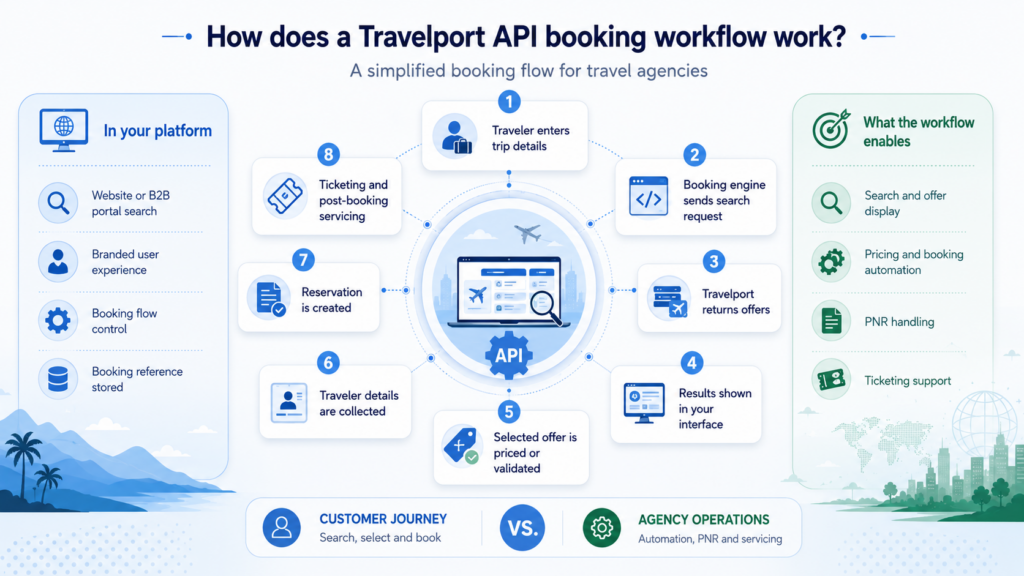
A simplified flow may look like this:
- The traveler enters origin, destination, dates and passenger details.
- Your booking engine sends a flight search request.
- Results are returned and displayed in your own design.
- The selected offer is priced or validated.
- Traveler and booking information is collected.
- A reservation is created.
- The booking reference is stored in your platform.
- Ticketing or later servicing follows the supported workflow and your agency process.
Travelport’s current Flights documentation includes booking, ticketing, retrieval and modification operations, which is why an API-based application can automate much more than the initial search.
For agencies building a complete customer journey rather than only supplier connectivity, flight booking software becomes the application layer that turns API responses into a usable booking experience.
How are PNR and ticketing handled?
Both GDS-based operations and API-based applications can be involved in reservation and ticketing workflows, but the user interacts with them differently.
A PNR is the booking record used to hold itinerary and traveler information. In a traditional agency environment, an agent may work with that record through GDS tools. In an API-driven environment, software can create, retrieve and manage supported reservation data through API calls.
Ticketing is a separate step from simply finding or holding an itinerary. Travelport’s current TripServices documentation describes a ticketing workflow that works with an existing reservation and payment-related steps before tickets are issued.
For an OTA, the front end may look simple, but the back end still has to handle pricing validity, booking status, payment, ticketing and post-booking changes.
A Travelport booking project should therefore be designed around the full booking lifecycle, not only search.
Does the Travelport API replace Galileo GDS?
Not necessarily. The API can provide a modern software layer while the underlying content may still involve Travelport GDS infrastructure.
Travelport states that its Flights APIs support both GDS and NDC content. It also identifies Galileo, Worldspan and Apollo as Travelport GDSs.
This means an agency should avoid thinking of “Galileo GDS vs Travelport API” as a simple either-or choice.
In many cases, the API is the way a modern website or application accesses and operates content that comes through Travelport’s distribution environment.
If your business specifically needs a Galileo-focused understanding, PHPTRAVELS also has information on the Galileo reservation system. That page is a better place for Galileo-specific details, while this article stays focused on the GDS-versus-API decision.
Where does NDC fit into Travelport?
NDC is another content distribution method, not another name for the Travelport API.
NDC, or New Distribution Capability, is an airline distribution standard created by IATA. Travelport’s current Flights APIs support both GDS and NDC content, although individual workflows and supported functions can differ.
Travelport also states that NDC access requires provisioning with Travelport and registration with the relevant participating airline.
For an agency, an API strategy can support different content types within one technical architecture, but access depends on your Travelport agreement, market and airline provisioning.
If NDC is important to your strategy, see PHPTRAVELS’ NDC flights booking system.
Which is better for a travel agency: Travelport GDS or Travelport API?
Neither is universally better. The right setup depends on how your agency sells travel.
A GDS-centered workflow may be the better fit when most bookings are handled by trained agents, consultants need direct reservation control, and the business does not need a highly customized online checkout.
An API-centered workflow is usually more suitable when you want customers or B2B agents to search and book through your own branded platform. It gives your developers more control over the user interface, business rules, markups, reporting and automation.
Many agencies actually need both concepts working together: Travelport distribution content in the background and API connectivity powering a modern booking engine in the foreground.
Choose an API-led approach when you want to:
- Build an OTA, flight website or B2B portal;
- Control search and checkout;
- Automate booking data and business rules;
- Connect bookings with payments or reporting.
Keep strong GDS agent workflows when you need to:
- Support experienced travel consultants;
- Manage complex bookings manually;
- Maintain agent-led servicing and queue workflows.
What should an agency check before choosing a Travelport API setup?
Start with access, content, servicing and operational requirements before development begins.
First, confirm what Travelport access your agency actually has. Your required markets, content sources, agency credentials, PCC setup and commercial terms can affect the project.
Second, define the complete booking lifecycle: booking creation, payment, ticketing, cancellations, exchanges and support.
Third, identify your users. B2C customers, B2B agents and internal staff need different permissions, pricing rules and screens.
Fourth, decide whether NDC matters to your airline strategy. Its access and servicing should be planned rather than assumed.
Finally, make sure the technical team plans for errors, price changes, expired offers, booking status and post-booking events.
If you are still evaluating multiple supplier connections, the broader travel APIs page can help you think about Travelport as one part of the overall supplier architecture.
How can PHPTRAVELS fit into a Travelport workflow?
PHPTRAVELS can act as the booking-platform layer between Travelport connectivity and the people using your travel business.
Instead of exposing raw supplier responses to customers or agents, a booking system needs to convert them into searchable results, pricing, booking steps, administration, markups, reporting and servicing workflows.
PHPTRAVELS describes its Travelport integration around live travel content, booking and PNR operations, ticketing-related workflows, admin control and monitoring. The exact scope depends on the agency’s Travelport access and commercial arrangement.
For businesses that already know they need Travelport connectivity, the next step is to review the Travelport API integration options and define the required content, users and post-booking workflow before development starts.
Final Answer: Should You Choose Travelport GDS or Travelport API?
For most agencies, this is not a strict choice between two competing systems.
Travelport GDS describes the distribution infrastructure and content environment. Travelport API describes a way for your software to connect with Travelport services and automate booking workflows.
If your business is mainly agent-led, GDS tools may remain central to daily operations. If you are building an OTA, B2B booking portal or custom travel platform, an API-led approach gives you more control over the digital experience.