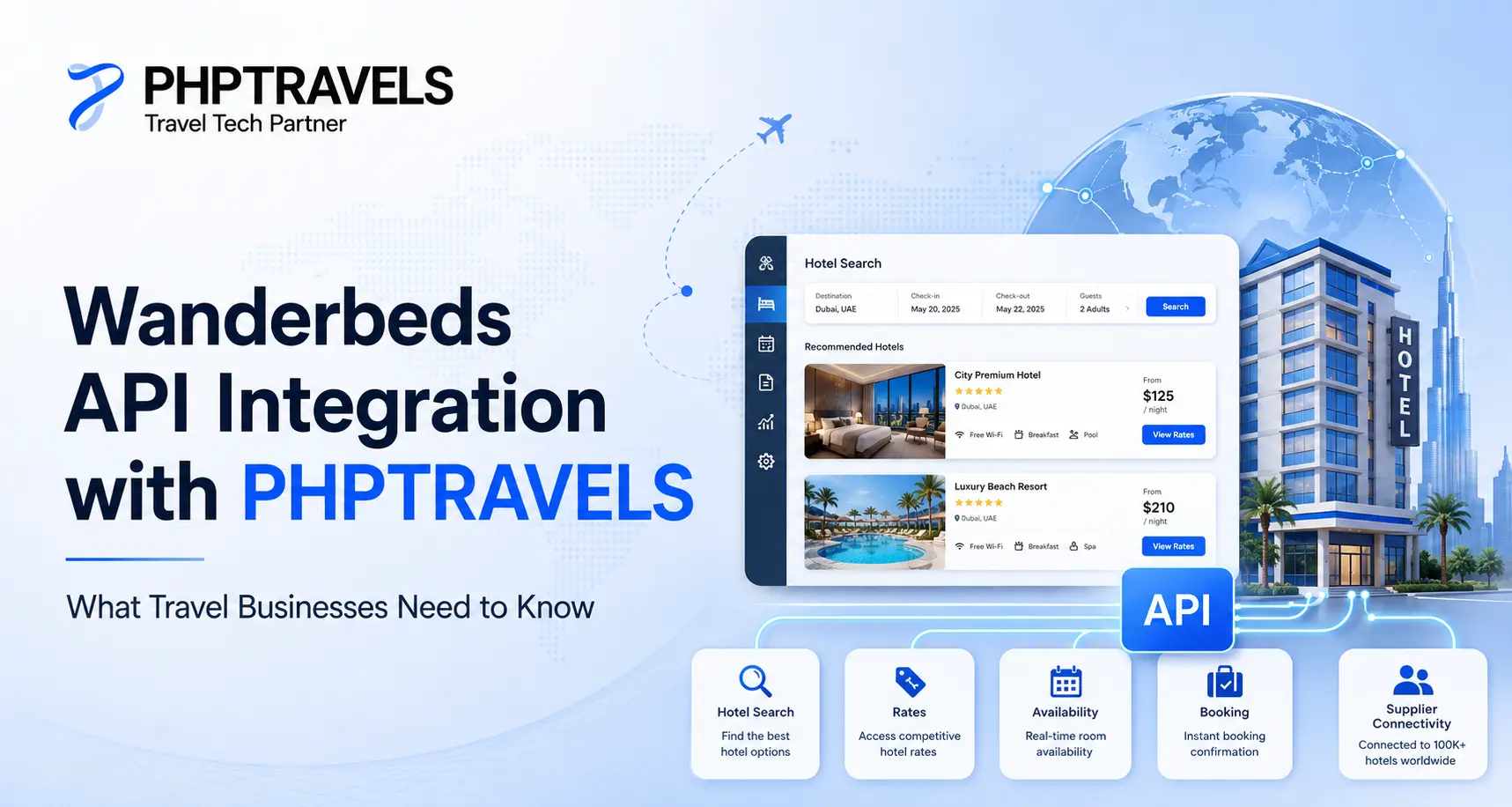
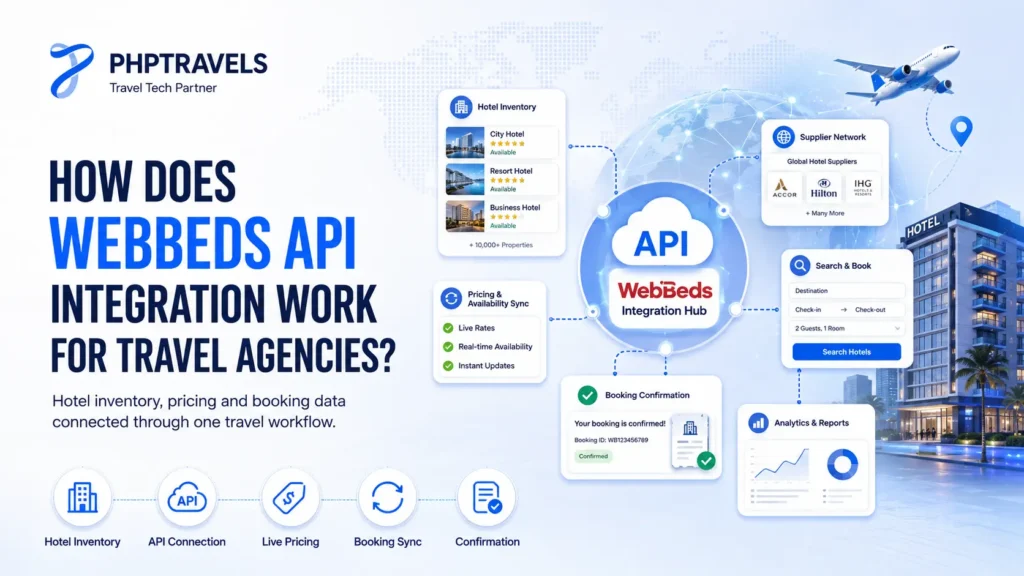
WebBeds API integration connects a travel booking platform with hotel inventory, live rates, booking conditions, confirmations, and post-booking services. It helps approved travel agencies manage the complete hotel reservation flow from one system.
WebBeds is a global B2B travel marketplace connecting hotels and other suppliers with travel buyers. Its official buyer information says its accommodation network reaches more than 190 destination countries. This guide explains how WebBeds hotel API integration works, what agencies should prepare, and how PHPTRAVELS plans to support it through a normalized connector.
What Is WebBeds API Integration?
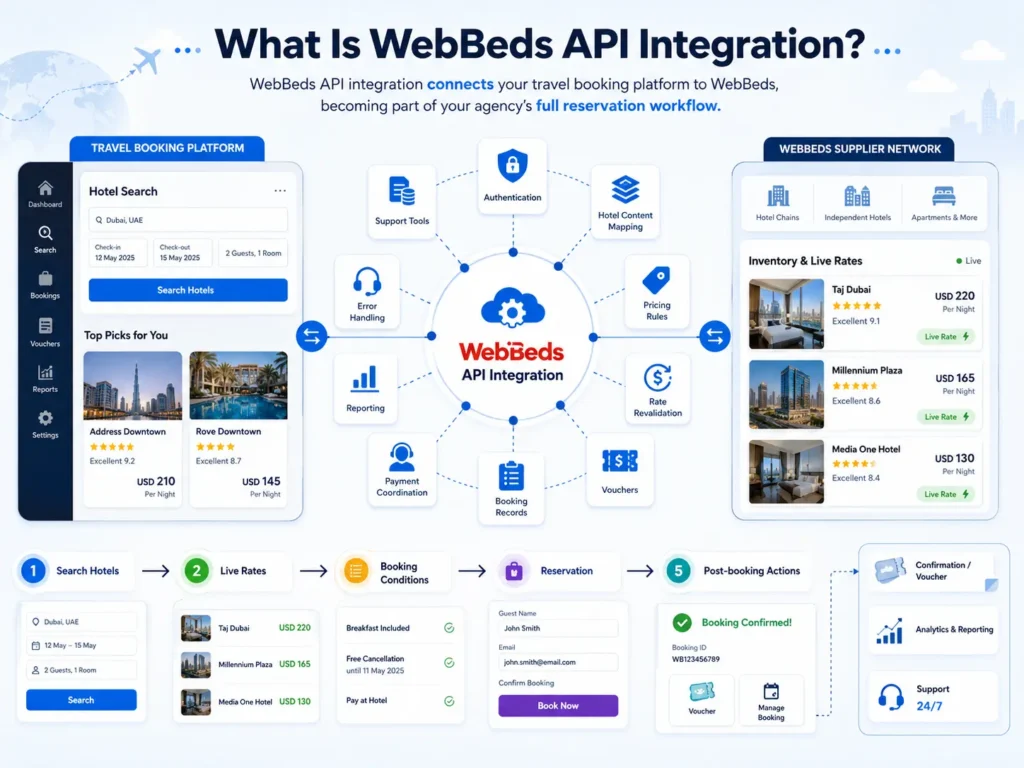
WebBeds API integration is a connection between a travel booking platform and WebBeds that allows approved travel businesses to search accommodation, retrieve available rates, check booking conditions, submit reservations, and manage post-booking actions through software.
The API is only one part of the complete setup. A production-ready connection also needs authentication, hotel-content mapping, pricing rules, rate revalidation, error handling, payment coordination, booking records, vouchers, reporting, and support tools.
This is why a hotel supplier connection should not be treated as a simple data feed. It becomes part of the agency’s complete reservation workflow.
Travel businesses that are new to connectivity can first read this plain-language guide to what API integration means. It explains how supplier systems exchange search, price, booking, cancellation, and reporting data.
Who Can Benefit From a WebBeds Hotel API?
A WebBeds connection may be useful for travel businesses that need B2B accommodation supply across several destinations. Common users include:
- Online travel agencies selling hotels directly to customers
- Retail agencies that want online hotel search and booking
- B2B wholesalers serving agents or sub-agents
- Destination management companies
- Tour operators building hotel-inclusive packages
- Corporate travel platforms
- White-label travel portals
The best fit depends on the agency’s agreement, markets, booking volume, and technical readiness. API access does not guarantee the best rate for every hotel, so compare coverage, terms, policies, support, and profitability.
Travel agencies, tour operators, OTAs, wholesalers, and destination management companies can explore WebBeds solutions for travel buyers to understand its available connectivity and accommodation distribution options.
How Does the WebBeds Booking Flow Work?
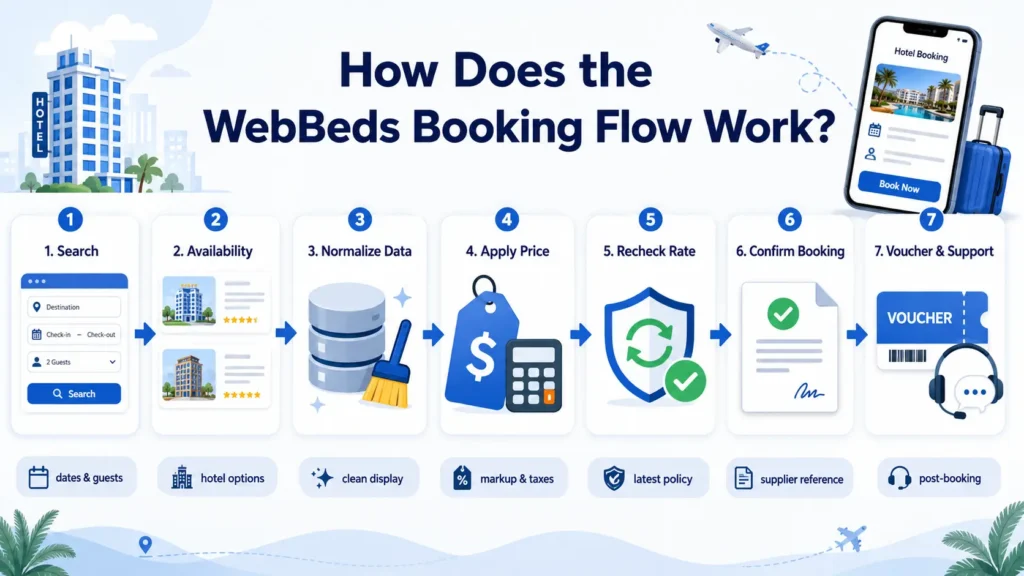
The usual flow is search, availability response, normalization, rate check, payment, booking confirmation, voucher generation, and post-booking support.
Here is how each stage works in practical terms.
1. How Is a Hotel Search Sent?
The traveler or agent enters a destination, check-in and check-out dates, room occupancy, guest ages, nationality or residency information when required, and a preferred currency.
The booking system validates the search before sending it to the supplier. Validation matters because incomplete occupancy data or unsupported date combinations can cause avoidable errors.
2. What Does the Supplier Return?
The supplier may return available hotels, room options, board basis, prices, taxes, cancellation terms, and other rate conditions. The platform then prepares this information for display.
A good integration does not simply place the raw response on the results page. It organizes the data so users can compare options without trying to understand supplier-specific codes.
3. Why Is Data Normalization Important?
Every hotel supplier can use different names, identifiers, room descriptions, policy structures, and error messages. A normalization layer converts this supplier-specific data into one consistent format.
Breakfast terms, refundable status, occupancy, and cancellation deadlines should appear consistently across suppliers. This is especially important in a multi-supplier hotel booking system. Normalization also improves reporting and makes new connections easier to add.
4. How Are Markups and Selling Prices Applied?
WebBeds supplies travel-trade inventory under agreed commercial terms. The booking platform must then apply the agency’s own pricing rules where permitted by the contract.
Depending on the business model, rules may use a percentage or fixed markup and vary by supplier, destination, agent level, customer group, channel, currency, or travel dates.
The system should calculate supplier cost, markup, taxes, fees, and final selling price in a clear order. Poorly ordered currency conversion or markup logic can create margin leakage.
For B2B distribution, a B2B booking engine can also manage agent access, credit limits, commissions, and separate pricing rules.
5. Why Must the Rate Be Checked Again?
A rate should be revalidated immediately before booking because hotel availability, price, and cancellation terms can change after the first search.
A search result is not always a guaranteed reservation. Another traveler may book the last room, the supplier may update a rate, or a cancellation deadline may move closer.
The pre-book or rate-check step confirms the latest conditions. When something changes, the platform should clearly show the new price or policy and ask the user to accept it before payment or final confirmation.
Skipping this step may increase failed bookings, price disputes, and support requests.
6. How Is the Reservation Confirmed?
After the traveler accepts the final terms and completes the required payment or credit process, the platform submits the booking request. A successful response should include a supplier booking reference and the confirmed reservation details.
The system should save the internal booking ID, supplier reference, room and guest details, supplier cost, selling price, currency, taxes, cancellation terms, payment status, timestamps, and technical logs. These records help support, finance, and technical teams investigate issues.
7. What Happens After Confirmation?
The platform normally creates a voucher and sends a confirmation to the traveler or agent. The booking should also appear in the appropriate dashboard.
Post-booking functions may include retrieving the reservation, checking status, cancelling within the policy, recording cancellation charges, issuing a refund where applicable, and updating reports.
Not every supplier or rate supports every type of amendment. The platform must show the actual rules attached to the confirmed booking rather than making a general promise.
What Technical Features Make the Integration Reliable?
A demo search can look successful while the production integration remains fragile. Real reliability appears when the system handles slow responses, changing prices, duplicate requests, invalid occupancy, sold-out rooms, and unclear supplier errors.
How Should Authentication and Credentials Be Protected?
API credentials should be stored securely on the server and never exposed in browser code. Test and production credentials should remain separate. Access should be limited by role, and sensitive actions should be logged.
Encrypted transport protects data in transit, while secure secret storage, access control, software updates, and monitoring protect the wider application.
How Should Timeouts and Temporary Errors Be Handled?
The booking engine should set sensible timeouts and return a clear message when a supplier is temporarily unavailable. Controlled retries may help with short-lived network errors, but booking requests must be handled carefully to avoid duplicate reservations.
Unique request references and idempotent booking logic can help the system recognize a repeated request. Technical teams should also be able to trace each supplier call using logs and correlation IDs.
How Should Hotel Content Be Managed?
Hotel names, addresses, images, descriptions, and amenities are relatively static. Rates, availability, and cancellation conditions are dynamic.
Static content can be synchronized and cached according to supplier rules, while dynamic data is requested at the correct stage. This improves speed without presenting stale prices as live offers. Hotel mapping is also needed because the same property may have different IDs across suppliers.
How Should Payments Connect With Bookings?
A travel platform must clearly coordinate payment status with supplier confirmation. The system should avoid showing a confirmed payment with no booking record or a confirmed supplier booking with an unresolved customer payment.
The right flow depends on the payment gateway, agency credit model, supplier terms, and whether the booking is refundable. Agencies planning multiple payment methods can review PHPTRAVELS’ approach to travel payment gateway integration.
What Should an Agency Prepare Before Requesting WebBeds Integration?
The agency should prepare its supplier agreement, API credentials, target markets, business model, pricing rules, payment flow, expected traffic, and support responsibilities.
A practical preparation checklist includes:
- Confirm commercial approval and request test access.
- Define destinations, customer types, and B2B or B2C channels.
- Document markup, tax, currency, and credit rules.
- Decide how payments, cancellations, and refunds will work.
- Confirm supplier, technical, and customer-support responsibilities.
- Plan normal, failure, launch-monitoring, and reconciliation tests.
Supplier approval and software integration are related but separate. PHPTRAVELS can build or configure the connector, but the travel business normally needs its own commercial relationship and authorized credentials from the supplier.
How Should WebBeds Integration Be Tested?
Testing should cover the full booking lifecycle, not only successful searches.
Important test cases include:
- One room and multiple rooms
- Adults and children with valid ages
- Different guest nationalities where relevant
- Refundable and non-refundable rates
- Price changes before booking
- A room selling out after search
- Supplier timeout
- Invalid guest details
- Payment success and payment failure
- Duplicate booking attempts
- Successful cancellation
- Cancellation with a charge
- Booking retrieval and voucher creation
- Currency and markup calculations
- User permissions for agents and administrators
The production launch should begin with monitoring, clear escalation contacts, and a reconciliation process. Early bookings should be reviewed carefully so mapping, pricing, and status updates can be verified under real conditions.
How Does PHPTRAVELS Approach WebBeds Integration?
PHPTRAVELS is currently building a normalized WebBeds connector. The planned goal is to let agencies and OTAs use WebBeds hotel search, availability, and booking functions through the same reservation workflow used for other connected suppliers.
Normalization means the WebBeds connection can fit into existing platform rules for markup, currency, users, bookings, and reporting rather than operating as a completely separate system.
Businesses can review the current WebBeds API integration status and contact the PHPTRAVELS team about rollout or early-access availability. Because the connector is under development, agencies should confirm the current feature scope and production status before planning a launch.
You can also explore the broader list of travel supplier integrations to understand how hotel, flight, tour, car, and payment connections fit into the platform.
Is WebBeds the Only Hotel Supplier an Agency Needs?
Not always. A supplier can be strong in many markets without offering the best commercial result for every search. Some agencies use one primary bedbank, while others combine bedbanks, GDS hotel content, OTA affiliate sources, channel managers, local wholesalers, and direct contracts.
A multi-supplier strategy may improve coverage and rate choice, but it also adds mapping, duplicate removal, reconciliation, and support complexity.
The better question is: “Which supplier mix produces reliable bookings and healthy margins for our markets and operating model?”
Agencies comparing options can use this travel XML API suppliers list as a starting point, then validate each supplier directly.
What Are the Main Benefits of a Well-Built WebBeds Connection?
A reliable connection can help an approved travel business:
- Search hotel inventory from its own branded platform
- Reduce manual checking across supplier portals
- Apply controlled pricing and agent rules
- Confirm reservations through a standard workflow
- Generate vouchers and maintain booking records
- Give support teams traceable supplier references
- Add WebBeds to a broader multi-supplier strategy
- Serve B2C and B2B channels from shared infrastructure
These benefits depend on correct implementation. An API does not replace commercial planning, customer service, reconciliation, security, or maintenance.
What Is the Next Step?
Start with the commercial and operational requirements, not only the API documentation. Confirm your supplier relationship, target markets, booking model, pricing rules, payment process, and support responsibilities.
Then review the current PHPTRAVELS WebBeds connector and request a technical discussion. A clear scope will help determine whether the planned integration fits your agency, what must be customized, and what needs to be tested before production.