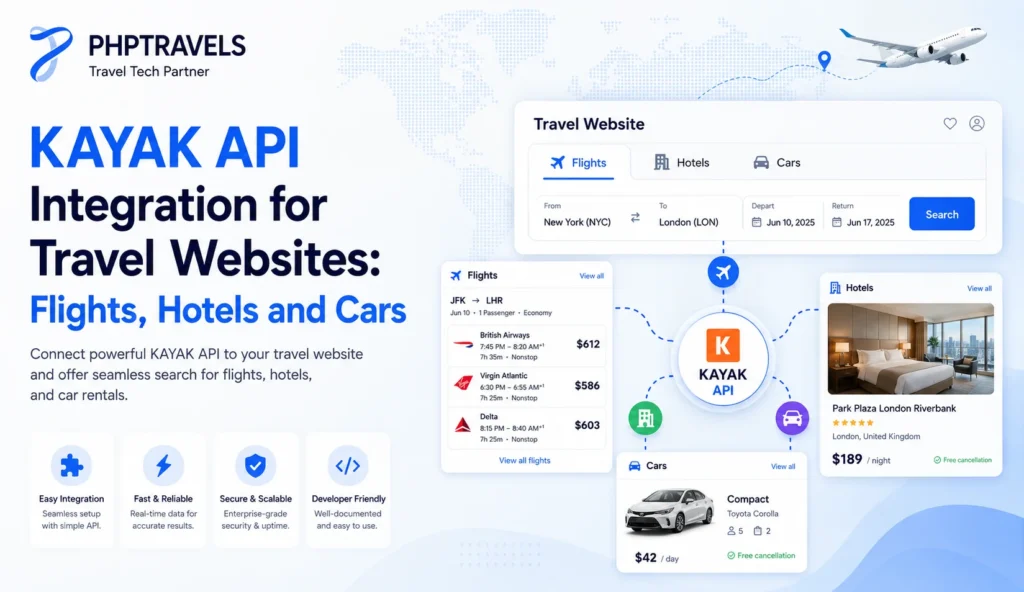
KAYAK API integration allows an approved travel publisher, startup or online travel business to add KAYAK-powered search experiences for flights, hotels and car rentals to a website or application.
The normal process is to apply with a clear use case, request sandbox access, build and test the connection, obtain production approval and then launch the approved API products. KAYAK also provides deeplinks, widgets, search boxes and white-label tools, so its API is part of a wider affiliate and metasearch ecosystem.
A publisher that only wants to redirect visitors may find the KAYAK Affiliate Program sufficient. A company that needs a customized search interface and structured travel data may require API integration.
What Is KAYAK API Integration?
KAYAK API integration is the technical connection between a travel website or app and approved KAYAK endpoints.
A user submits search information, such as a route, destination, dates, passengers or vehicle requirements. The website sends that request to KAYAK and displays the returned travel options inside its own search experience.
The exact fields, permitted data use, redirect flow, monetization model and production features depend on the API product and the partner approval. Businesses should confirm these details before designing their final checkout or booking journey.
The API supplies travel-search data, but the website still needs its own frontend, filters, analytics, tracking, security, error handling and conversion flow.
A wider travel API integration project may also require authentication, response mapping, caching, logging and production monitoring. PHPTRAVELS describes travel API integration as connecting search, pricing, booking and related operations through XML or JSON endpoints.
Which KAYAK APIs Can Travel Websites Use?
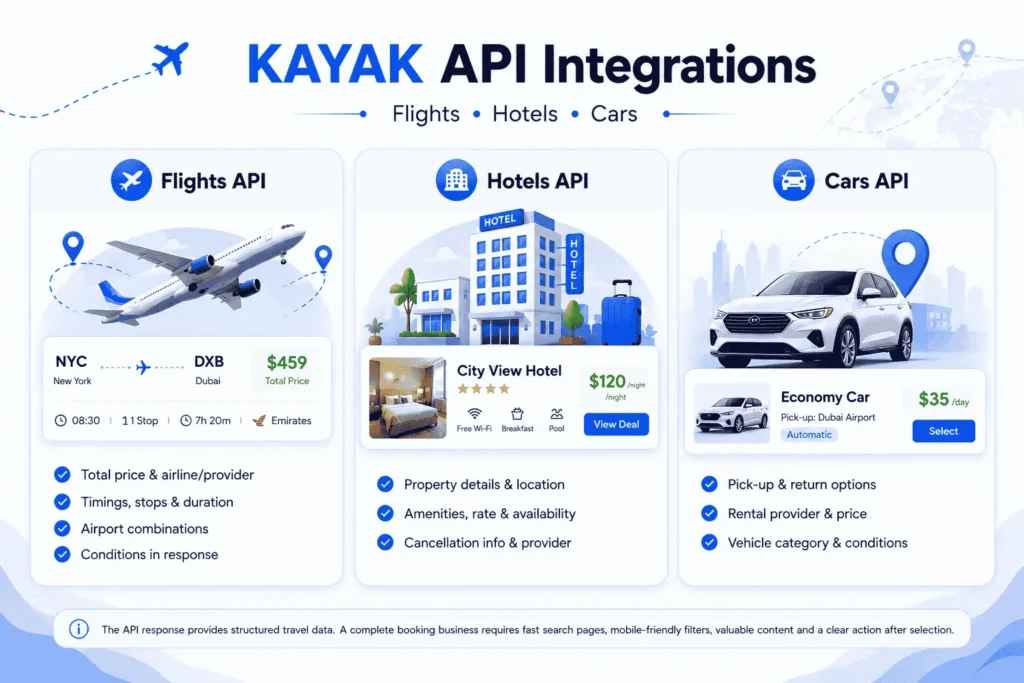
KAYAK promotes API products for flights, hotels, car rentals, travel data and advertising. Flights, hotels and cars are the main options for travel websites building consumer search experiences.
KAYAK Flights API
A KAYAK flights API connection can support airfare search and comparison.
A traveler enters an origin, destination, travel dates, passenger count and cabin preference. The website sends the search request and presents the available options in a structured results page.
A clear flight results page may show:
- Total displayed price
- Airline or travel provider
- Departure and arrival times
- Number of stops
- Flight duration
- Airport combinations
- Conditions included in the approved response
The API response does not create a complete flight-selling business by itself. The website still needs fast search pages, mobile-friendly filters, useful route content and a clear action after an offer is selected.
Businesses planning a broader air-travel product can review PHPTRAVELS flight module features and its flight booking software.
KAYAK Hotels API
A KAYAK hotels API can help a website display accommodation search results for selected destinations and dates.
Depending on the approved product, the experience may include property details, pricing, availability and an action that moves the user toward a partner offer. KAYAK officially presents its hotels API as one of the travel-search products available to approved API partners.
A useful hotel interface should provide more than hotel names and prices. It should help travelers understand:
- Property location
- Hotel category
- Available amenities
- Rate context
- Stay dates
- Cancellation information where available
- The provider offering the rate
Businesses building a larger accommodation product can combine the search experience with a structured hotel booking engine and relevant hotel module features.
KAYAK Cars API
A KAYAK car rental API can support vehicle comparison by pickup location, return location, dates, times and driver information.
Results may include the car category, rental provider, price, pickup information and other conditions supplied through the approved API. KAYAK lists car rentals alongside flights and hotels within its API offering.
Car-rental results should be normalized carefully because suppliers may describe similar vehicles and policies differently. Users should be able to compare important rental conditions instead of viewing only the lowest initial price.
A dedicated car rental system can provide the surrounding search forms, rental locations, booking records, markup rules and administration tools.
How Does KAYAK API Integration Work?
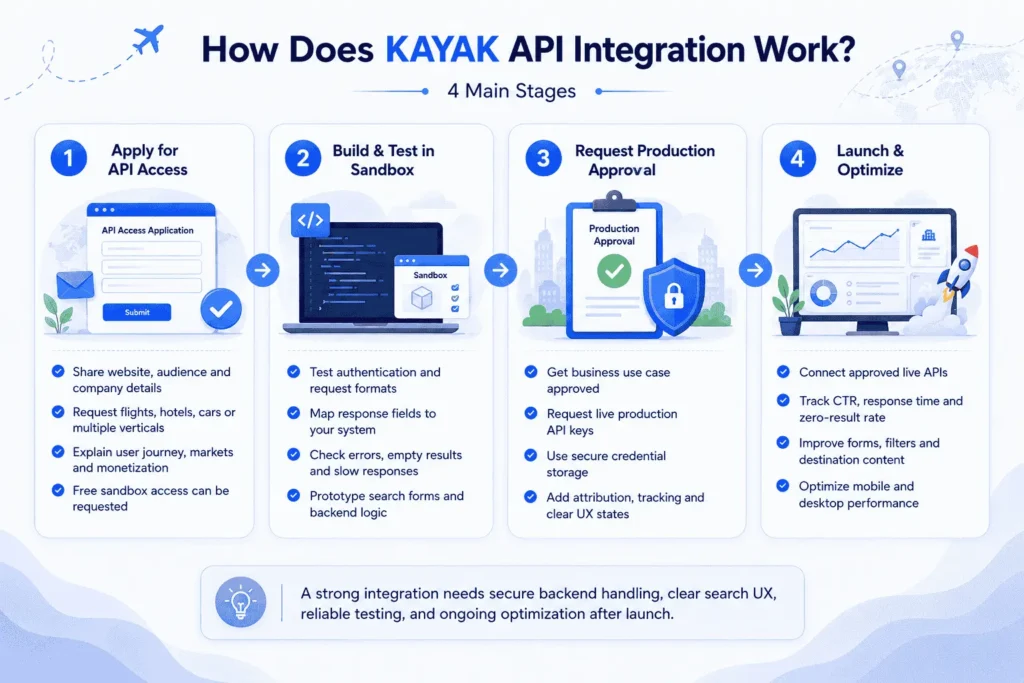
The KAYAK API integration process has four main stages.
1. Apply for API Access
The business submits information about its website, audience, traffic, company and intended API use.
KAYAK’s partner application also allows applicants to request free access to its sandbox APIs.
The application should clearly explain:
- Required verticals: flights, hotels, cars or multiple products
- Whether the product is a website, app, publisher or comparison tool
- Target countries and languages
- Expected user journey after an offer is selected
- Current website traffic or launch plan
- Intended monetization method
A specific use case is more useful than a general request for every available KAYAK product.
For example, a travel startup could explain that it needs flight-search results for users travelling between Europe and the Middle East, with users moving to an approved partner page after choosing an offer.
2. Build and Test in the Sandbox
Sandbox access allows developers to study authentication, request formats, response fields and error behaviour using test-style data.
This is where the first search form, backend service and results-mapping process should be built. KAYAK states that sandbox keys may be used to prototype its Flights, Hotels, Cars, Travel Data or Ads APIs before live approval.
Testing should cover both successful and unsuccessful requests, including:
- Missing search fields
- Invalid travel dates
- Empty results
- Unsupported destinations
- Slow responses
- Expired sessions
- Invalid authentication
- Temporary API errors
Testing only one successful request can produce an unreliable integration.
The development team should also transform the returned information into a consistent internal format before sending it to the frontend.
3. Request Production Approval
Sandbox access is not the same as permission to launch the integration publicly.
KAYAK explains that the business use case must be approved before the partner requests production API keys and connects to live API products. KAYAK may also work with the partner on documentation, implementation options and integration practices.
A production-ready implementation should include:
- Secure API credential storage
- Correct KAYAK attribution
- Approved tracking parameters
- Mobile-friendly search pages
- Acceptable response performance
- Clear loading states
- Empty-result handling
- Error messages
- Compliance with the approved user flow
The website should not expose secret API credentials inside browser-side JavaScript. Requests that require private credentials should normally pass through a secure backend service.
4. Launch and Optimize
After approval and production access, the website can connect the authorized APIs and begin measuring real performance.
Useful metrics may include:
- Search-form completion rate
- Results-page click-through rate
- Search response time
- Zero-result rate
- Mobile and desktop performance
- Most searched routes or destinations
- Referral or conversion performance
- Revenue data available through the partnership
What Does the Technical Search Flow Look Like?
A basic KAYAK API search flow may work as follows:
- The traveler enters search details.
- The website validates the request.
- The backend sends an authenticated API call.
- KAYAK returns results or a processing response.
- The backend validates and normalizes the permitted data.
- The frontend displays comparable offers.
- The user follows the approved click, referral or booking path.
- Tracking records the action for reporting.
For a multi-supplier platform, an adapter layer is better than placing KAYAK-specific fields throughout the frontend.
The adapter converts responses from different suppliers into one internal format. This makes it easier to add, remove or replace providers without rebuilding every search page.
PHPTRAVELS follows a similar multi-vertical approach by supporting flight, hotel, car and other travel API connections through centralized booking-system architecture.
Is KAYAK API the Same as the KAYAK Affiliate Program?
No. They are connected, but they are not the same product.
The KAYAK Affiliate Network is the wider partner ecosystem. It includes deeplinks, search boxes, widgets, white-label experiences and APIs.
A publisher can use a deeplink without developing a custom API connection. KAYAK deeplinks can send users to homepages, pre-filled search results, dateless destination pages or specific hotel pages while preserving affiliate attribution.
An API partner normally needs more technical work but can create a more customized search experience.
| Option | Best suited to | Development effort | Experience control |
|---|---|---|---|
| Deeplinks | Blogs and campaign pages | Low | Low |
| Search box or widget | Sites needing embedded search | Low to medium | Limited |
| KAYAK white label | Brands wanting a faster hosted experience | Medium | Moderate |
| KAYAK API | Apps and custom comparison websites | Higher | Higher within approval terms |
| Full booking platform | OTAs needing booking and operational control | Highest | Highest |
KAYAK’s white-label product provides a configurable interface for flights, stays, cars and packages. It can be embedded into a partner website and includes tracking options, localization and branded configuration.
A publisher focused on referral revenue may prefer affiliate tools. An OTA that needs its own supplier mix, markups, payments, booking records and post-booking service may require a full booking platform.
What Are the Benefits of KAYAK API Integration?
The main benefit is access to a travel-search ecosystem covering flights, hotels and cars through approved API products.
KAYAK presents its API as a way for travel businesses to access live pricing and availability while reducing the need to manage multiple individual supplier relationships for the search experience.
Potential benefits include:
- Access to multiple travel verticals
- Live pricing and availability where supported
- A customized search interface
- Sandbox access for prototyping
- A structured path from testing to production
- Monetization under the partner agreement
- Support for websites and applications
- The ability to combine search with SEO content
These benefits do not remove the need for product planning. Search speed, useful filters, accurate tracking and a clear conversion path still affect performance.
What Limitations Should Travel Businesses Consider?
KAYAK API access is approval-based.
A company should not assume that every API, market, response field or commercial feature will be available simply because sandbox access has been granted.
Businesses should also consider the following:
- Sandbox behaviour may differ from production.
- API terms may control data storage and reuse.
- Branding and attribution requirements must be followed.
- A referral model may provide limited checkout control.
- Revenue depends on relevant traffic and correct tracking.
- API changes require monitoring and maintenance.
- One provider may not cover every market or business requirement.
- Empty-result and error states need fallback handling.
Before development begins, the commercial and technical teams should agree on what the API will provide, what the website will control and where the user moves after selecting an offer.
Can KAYAK API Be Integrated with PHPTRAVELS?
A KAYAK API connection can be scoped for a PHPTRAVELS-based website when the business has approved access, valid credentials, documentation and a defined workflow.
The integration may connect the approved endpoints with:
- Flight, hotel or car search forms
- A secure backend service
- Results-page mapping
- Filters and sorting
- Affiliate tracking
- User click or booking actions
- Admin reporting
- API request logs
PHPTRAVELS already provides a broader architecture for flight, hotel, car, supplier and payment connections. Its integrations marketplace explains how supplier APIs and payment gateways fit into a modular travel platform. PHPTRAVELS also states that an integration not already listed can be requested for custom scoping.
Before development begins, confirm:
- Approved KAYAK API products
- Sandbox and production credentials
- Target markets, languages and currencies
- Search parameters and response fields
- Click-out or booking behaviour
- Tracking requirements
- Data-retention and caching rules
- Branding and compliance requirements
This prevents the development team from building functionality that is not available under the approved KAYAK account.
Who Should Consider KAYAK API Integration?
KAYAK API integration may suit:
- Travel publishers
- Flight comparison websites
- Hotel comparison websites
- Travel startups
- Destination platforms
- Loyalty products
- Mobile travel apps
- Established online travel businesses
A smaller publisher without development resources may be better served by deeplinks, widgets or a white-label product.
A full OTA may need KAYAK as only one part of a larger technology stack that also covers contracted suppliers, payments, booking records, customer management, ticketing and post-booking operations.
Final Takeaway
KAYAK API integration can help approved travel businesses build flight, hotel and car-search experiences through a structured sandbox-to-production process.
The strongest projects start with a precise use case, confirm the commercial flow, test carefully and only then prepare the live launch.
Businesses should not treat KAYAK API, affiliate links, white label and a complete booking engine as interchangeable products. Each option solves a different technical and operational need.
PHPTRAVELS can provide the wider website, booking modules, admin tools and integration architecture around an approved API project. Explore the PHPTRAVELS live demo or review travel booking software pricing before defining the final implementation scope.