API vs White Label Travel Portal is one of the most important technology comparisons for agencies launching an online travel business. Whether you are building an OTA, a B2B travel portal, or a booking platform for hotels and flights, choosing the right solution can affect your launch time, costs, customization, and future growth.
Both travel APIs and white label portals allow businesses to sell travel products online. However, they differ considerably in software ownership, supplier integrations, maintenance, scalability, branding, and development requirements.
In this guide, we compare API vs White Label Travel Portal solutions, explain their advantages and limitations, and help you select the right technology for your travel business.
What Is a Travel API?
A travel API (Application Programming Interface) connects your website directly with airlines, hotels, car rental companies, tour operators, and other travel suppliers. Instead of manually updating prices and availability, your booking engine retrieves real-time inventory automatically.
A modern travel API allows your website to display:
- Live hotel availability
- Real-time flight schedules
- Dynamic pricing
- Car rentals
- Airport transfers
- Activities and tours
- Instant booking confirmations
If you’re new to APIs, our guide on What Is API Integration explains how travel APIs connect booking platforms with global suppliers.
Businesses looking for multiple supplier connections can also explore our Travel APIs to understand available hotel, flight, and activity integrations.
What Is a White Label Travel Portal?
A white label travel portal is a ready-to-launch booking platform developed by a travel technology company and branded with your business identity.
Instead of building software from scratch, you receive a complete booking system where you can customize your logo, colors, domain name, and company details while the provider manages the technology.
Most white label travel portals include:
- Hotel booking
- Flight booking
- Tours
- Car rentals
- Payment gateways
- Booking management
- Customer accounts
If your goal is launching quickly without software development, a White Label Booking System can significantly reduce your time to market.
API vs White Label Travel Portal
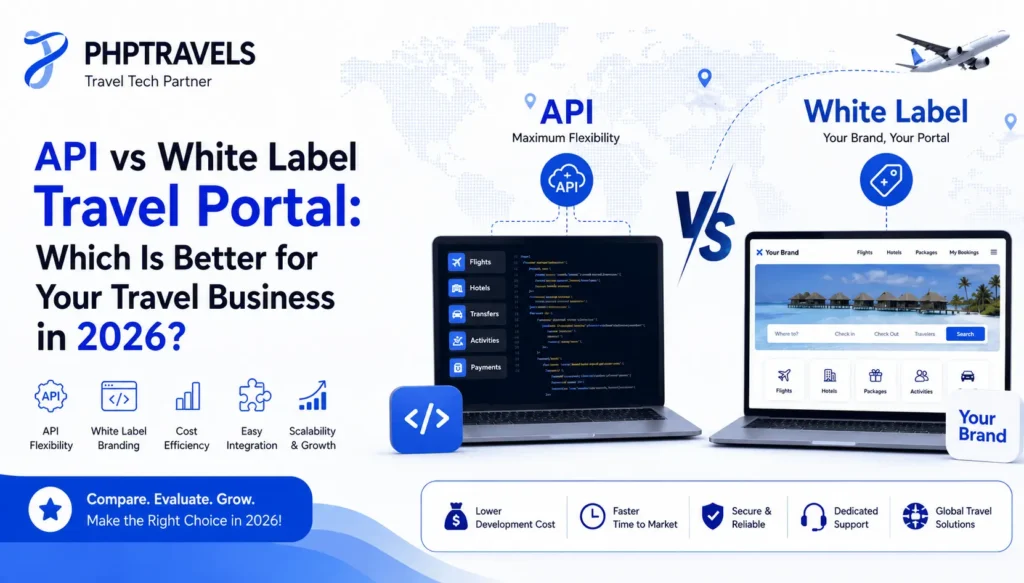
The API vs White Label Travel Portal comparison mainly comes down to control, launch speed, development resources, supplier access, and long-term scalability. The following table shows how the two solutions differ.
| Feature | Travel API | White Label Portal |
|---|---|---|
| Setup time | Longer | Faster |
| Customization | Full control | Limited or provider-based |
| Branding | Complete branding control | Logo, colors and domain |
| Development team | Required | Usually not required |
| Supplier connections | Multiple suppliers possible | Depends on provider |
| Maintenance | Managed by your team | Managed by provider |
| Initial investment | Higher | Lower |
| Scalability | Excellent | Good |
| Data control | High | Depends on provider |
| Best for | Established OTAs and custom platforms | Startups and travel agencies |
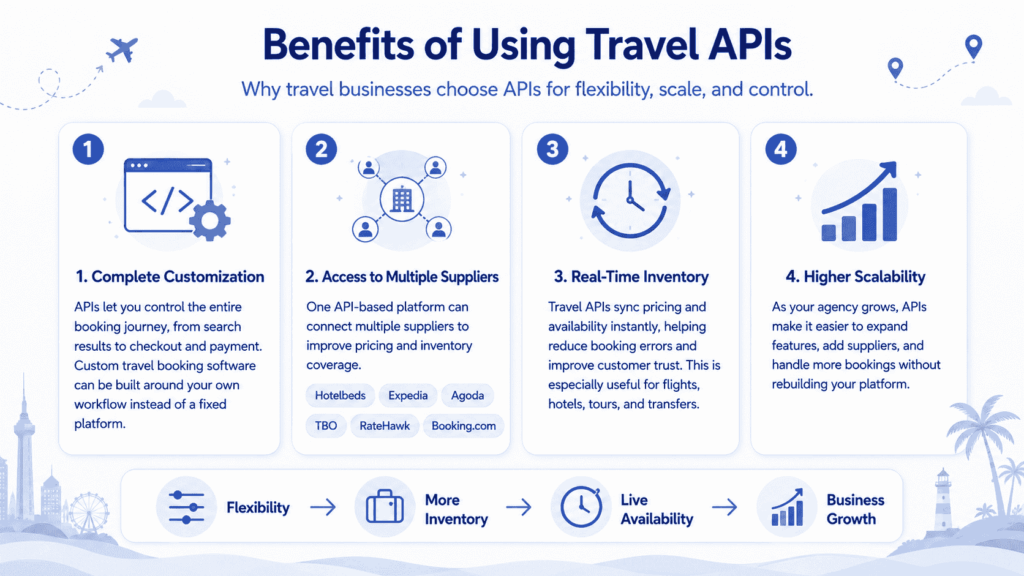
Benefits of Using Travel APIs
Travel APIs are designed for businesses that need flexibility, scalability, and complete control over their booking platform.
Complete Customization
Unlike white label solutions, APIs let you design every aspect of the customer journey—from search results to checkout and payment.
Businesses developing a custom Travel Booking Software often choose APIs because they can build features around their own workflow instead of adapting to a fixed platform.
Access to Multiple Suppliers
One of the biggest advantages of APIs is the ability to connect multiple travel suppliers.
For example, your platform can combine:
- Hotelbeds
- Expedia
- Agoda
- TBO
- RateHawk
- Booking.com
This creates better pricing and broader inventory for customers.
If you’re comparing suppliers, our Travel XML API Suppliers List provides an overview of popular providers available for integration.
Real-Time Inventory
Travel APIs synchronize pricing and availability instantly, reducing booking errors while improving customer trust.
This is especially valuable for businesses selling flights, hotels, tours, and transfers simultaneously.
Higher Scalability
As your agency grows, APIs allow you to add new suppliers, payment gateways, currencies, languages, and booking modules without replacing your entire system.
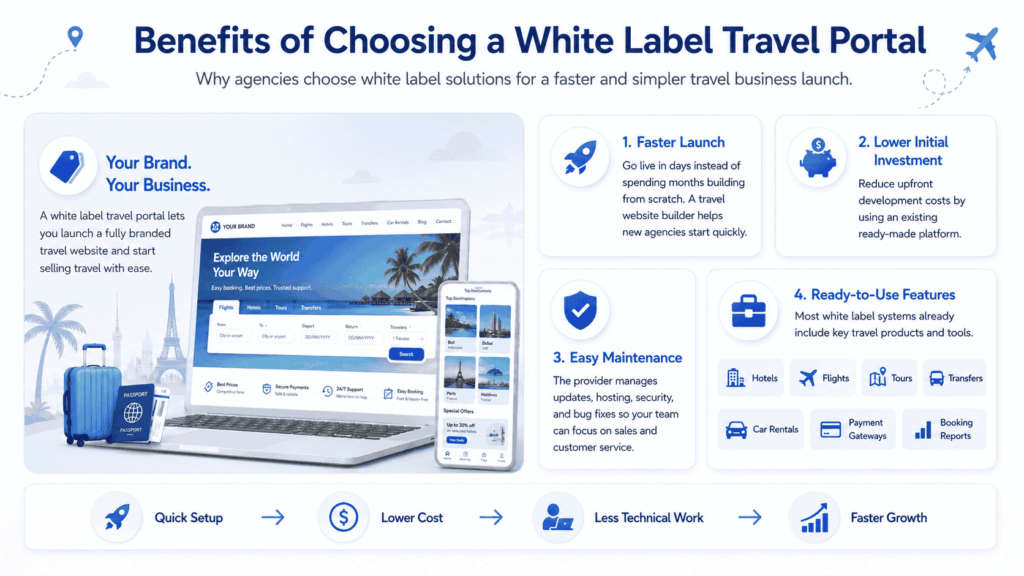
Benefits of Choosing a White Label Travel Portal
White label solutions are ideal for agencies that want to start selling travel products as quickly as possible.
Faster Launch
Instead of spending months building software, you can launch within days using an existing platform.
Agencies entering the market for the first time often choose a Travel Website Builder.
Lower Initial Investment
Since development work is already completed, businesses avoid the high upfront costs associated with custom software.
Easy Maintenance
The technology provider manages software updates, hosting, security, and bug fixes, allowing agencies to focus on sales and customer service.
Ready-to-Use Features
Most white label systems already include:
- Hotels
- Flights
- Tours
- Transfers
- Car rentals
- Payment gateways
- Booking reports
When Should You Choose a Travel API?
A travel API is the right choice if you:
- Need complete customization
- Want multiple supplier integrations
- Expect high booking volumes
- Have a development team
- Plan to expand internationally
- Need advanced automation
Businesses integrating providers like Amadeus, Sabre, or Travelport often choose APIs to gain direct access to global travel inventory.
When Should You Choose a White Label Travel Portal?
A white label portal is often the better choice if you:
- Are starting a travel agency
- Need to launch quickly
- Have a limited budget
- Don’t have developers
- Want a proven booking platform
Many startups begin with a white label solution and later migrate to API-based architecture as their business grows.
Can You Combine API and White Label Solutions?
Yes. The API vs White Label Travel Portal decision does not always require businesses to select only one solution. Many successful travel companies use a hybrid technology model.
Many successful travel businesses use a hybrid approach.
For example, they launch with a white label portal to enter the market quickly and later integrate additional APIs for hotels, flights, activities, or transfers as demand increases.
This approach offers both speed and scalability without rebuilding the platform from scratch.
Which Solution Is Better for Your Travel Business?
When evaluating API vs White Label Travel Portal options, consider your available budget, technical resources, expected booking volume, supplier requirements, and long-term expansion plans.
Growing OTAs often start with a white label platform before expanding into API-powered solutions as bookings increase.
Why Travel Businesses Choose PHPTravels
PHPTravels offers both API integration services and white label travel solutions, allowing agencies to choose the technology that matches their business stage.
With PHPTravels, you can:
- Connect multiple hotel and flight APIs
- Launch a branded white label travel portal
- Sell hotels, flights, tours, transfers, buses, ferries, and car rentals
- Manage B2B and B2C bookings
- Accept secure online payments
- Scale your platform with additional integrations over time
Whether you’re launching your first travel agency or upgrading an existing booking system, PHPTravels provides flexible technology that grows with your business.