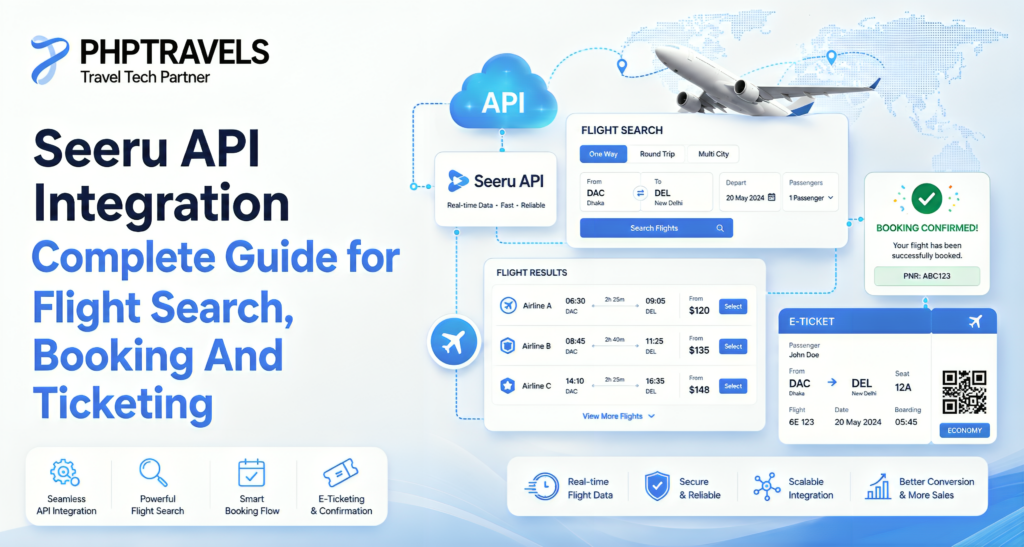
Seeru API integration connects Seeru flight inventory with a travel booking platform for search, fare validation, booking and ticketing workflows. PHPTRAVELS supports Seeru as a flight supplier within its multi-supplier booking architecture, allowing agencies to connect Seeru alongside other flight APIs while maintaining their own search interface, markup rules, payments, booking records and administration.
But connecting the API is only one part of the project.
A reliable flight booking website also needs search logic, pricing rules, passenger management, payment processing, booking records, ticketing workflows, error handling and synchronization between the supplier and your own database.
This guide explains how Seeru API integration works, what your booking platform needs around the API, common integration challenges and how travel businesses can prepare for a production-ready implementation.
What Is Seeru API Integration?
Seeru API integration is the process of connecting Seeru’s travel content and flight-booking services with an external website, OTA, B2B portal, corporate travel system or mobile application.
Seeru describes its business as a B2B and B2C travel marketplace supported by its own travel technology infrastructure. Its developer offering provides API access to flight content, while its public API documentation covers functions such as flight search, fare validation and ticket booking.
For a travel company, the API acts as the connection between the supplier layer and the customer-facing booking system.
If API technology is new to your team, our guide to what API integration is explains the concept in more detail.
What Can the Seeru Flights API Do?
The Seeru Flights API can support the main stages required to move a customer from flight search toward a confirmed flight booking.
Based on Seeru’s currently public developer information, its flight API supports flight search, fare validation and ticket booking, including one-way, round-trip and multi-city search scenarios.
In a practical travel booking system, the workflow may include:
- Searching flights for the requested route and dates
- Retrieving available itineraries
- Comparing flight and fare options
- Checking the selected fare again before booking
- Creating and storing the booking
- Retrieving booking or order information
- Issuing the flight ticket
- Retrieving ticket details
- Handling supported cancellation, refund or ticket servicing operations
The exact endpoints, parameters, airline coverage and enabled services can change by API version or commercial agreement. Developers should therefore use Seeru’s current documentation and their assigned sandbox account as the final technical reference.
Travel businesses comparing multiple suppliers can also review the PHPTRAVELS guide to travel API suppliers.
How Does Seeru API Integration Work?
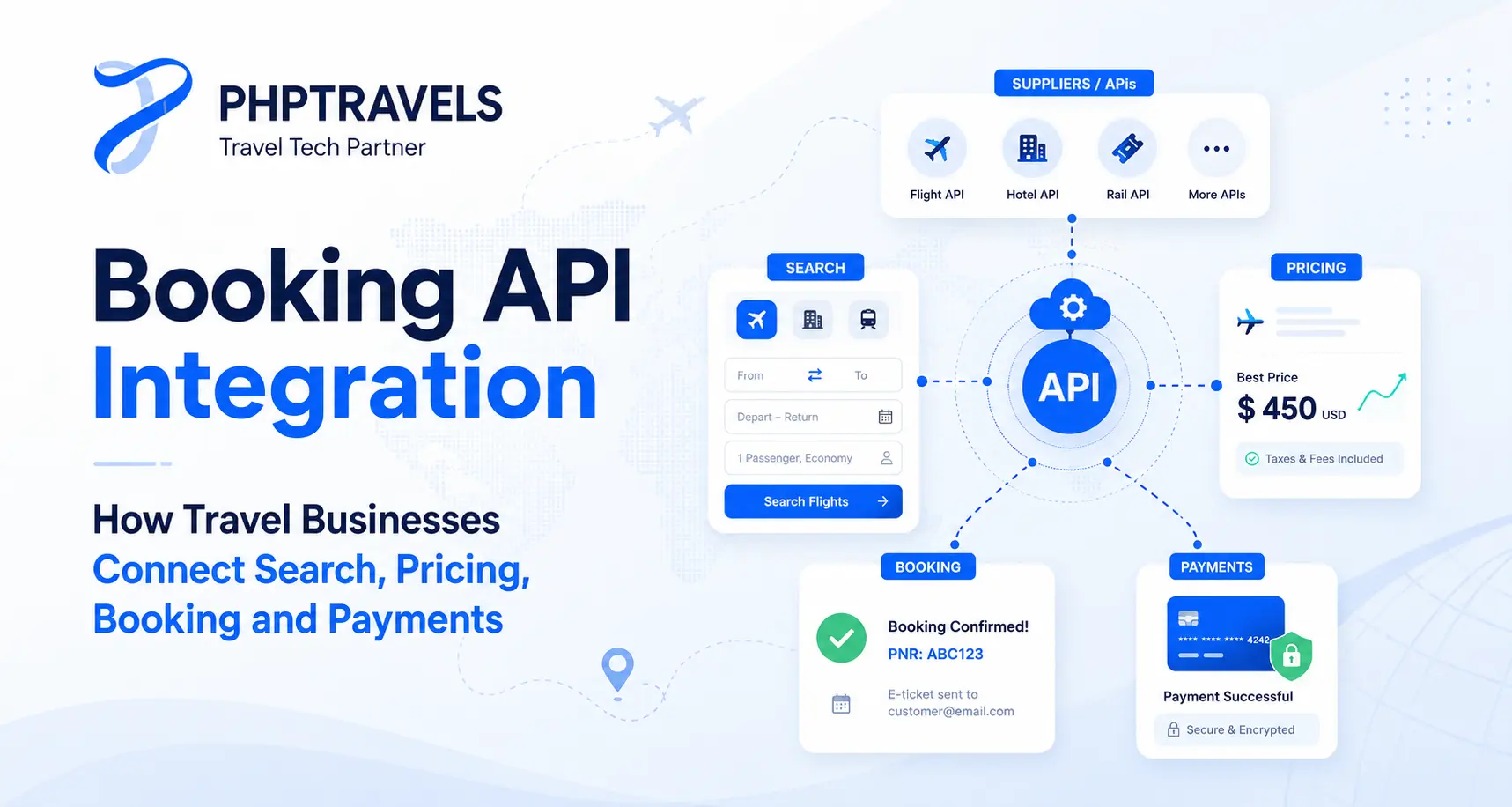
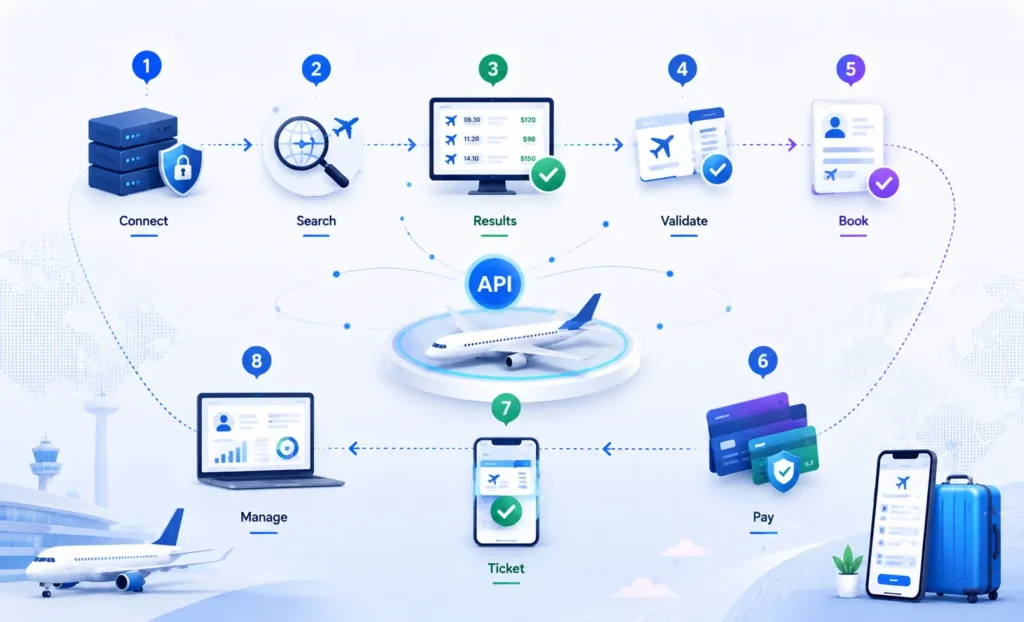
A typical Seeru API integration follows a search → validate → book → pay → ticket → manage workflow.
Understanding this sequence is important because a flight price returned during search should not automatically be treated as the final confirmed price.
1. Connect and Authenticate
Your backend first communicates with Seeru using the authentication method and credentials provided for your account.
Credentials should be stored securely on the server rather than exposed in frontend JavaScript or mobile application code.
2. Send the Flight Search
When a traveler enters an origin, destination, travel date and passenger details, your booking engine converts those selections into the format required by the Seeru API.
The API then searches the flight content available to your account.
3. Process and Display the Results
Raw supplier results are converted into a customer-friendly format.
Your platform may need to organize information such as:
- Airline
- Departure and arrival time
- Flight duration
- Stops
- Fare
- Baggage
- Cabin class
- Fare conditions
This is where a strong flight booking software platform becomes important. An API supplies travel data, while the booking engine controls how customers search, compare and purchase that inventory.
4. Revalidate the Selected Fare
Before the customer completes a booking, the selected fare should be checked again.
Airline availability and prices can change between the original search and checkout. Revalidation helps confirm that the itinerary is still available at the expected price.
5. Create the Booking
After successful validation, passenger information and the selected itinerary can be passed into the booking workflow.
Your own database should also save the corresponding customer, passenger, supplier reference and booking status.
6. Process Payment
Payment is normally part of your own booking platform and payment-gateway workflow rather than something the flight content API alone solves.
The system should know what to do when payment succeeds, fails, times out or requires additional verification.
7. Issue and Retrieve the Ticket
When payment and booking conditions are satisfied, the appropriate ticketing operation can be performed.
The system should then store the resulting ticket information and make the confirmed booking available to the customer and administrative team.
Does the Seeru API Replace a Complete Flight Booking Engine?
No. A flight API provides connectivity and booking operations, while the booking engine manages the complete user and business workflow around them.
This difference is one of the most important points to understand before starting development.
| Seeru / API Layer | Your Booking Platform |
|---|---|
| Flight content access | Search interface |
| Search operations | Filters and sorting |
| Fare validation operation | Pricing and markup rules |
| Booking operations | Passenger management |
| Order / ticket data | Payment processing |
| Supplier booking status | Local booking database |
| Supported servicing operations | Emails and notifications |
| API responses | Logs, monitoring and reporting |
PHPTRAVELS’ broader travel API integration architecture similarly separates supplier operations from the surrounding booking, payment, retry, logging and business workflows.
Before starting development, your technical team should review the official Seeru API documentation to understand the latest authentication requirements, flight search parameters, fare validation process, booking workflow, and available API endpoints. Using the current supplier documentation helps developers map Seeru’s responses correctly into the booking engine and reduces errors during testing and production deployment.
Why Would a Travel Agency Integrate the Seeru API?
The main benefit is the ability to make supplier flight content available through your own branded travel platform.
For an OTA or travel agency, this can support several business goals.
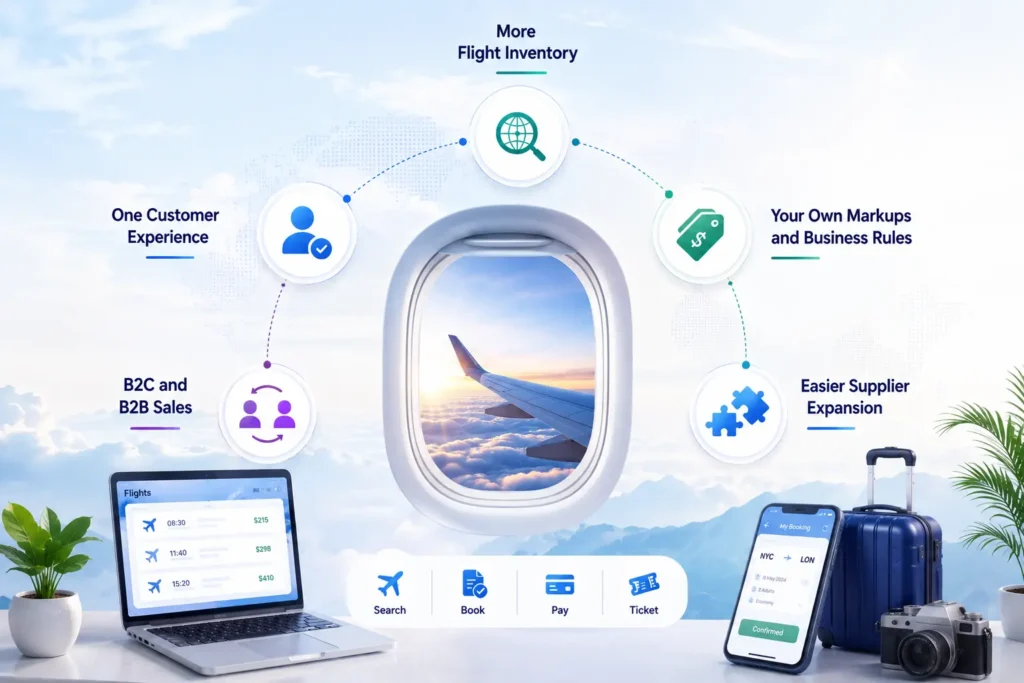
More Flight Inventory
Adding another supplier can expand the flight options available to customers, depending on the routes, airlines and content enabled for your account.
One Customer Experience
Customers can search and book without moving between different supplier websites.
B2C and B2B Sales
The same supplier connection can potentially feed different sales channels when your platform supports them, such as direct traveler bookings and agent-based B2B distribution.
Your Own Markups and Business Rules
Your platform can apply its own service charges, commissions, markups and selling rules around supplier content.
Easier Supplier Expansion
A well-designed system uses an abstraction or normalization layer. This makes it easier to connect Seeru alongside other travel APIs instead of rebuilding the entire frontend for every supplier.
Can Seeru Be Integrated Into an Existing OTA?
Yes, an existing OTA can potentially add Seeru as another flight supplier without rebuilding the complete platform, provided its architecture already supports external APIs.
A mature booking platform normally has reusable modules for:
- Authentication
- Search
- Supplier adapters
- Fare normalization
- Markups
- Passenger data
- Payments
- Booking storage
- Notifications
- Reporting
- Post-booking operations
In this situation, the development team mainly maps Seeru’s request and response structure into the existing supplier interface.
A new OTA is different. If there is no booking engine yet, developers must create all these surrounding components in addition to integrating the supplier.
PHPTRAVELS provides an API-ready flight module and supports flight-booking architectures built around GDS, NDC and supplier API connections.
What Technical Challenges Should Developers Expect?
The most important integration problems normally occur around changing fares, API delays, duplicate bookings, payment state and synchronization.
A production implementation should plan for these situations from the beginning.
Fare Changes
Never assume that an older search result is still bookable. Validate the price and availability before confirming the booking.
API Timeouts
Supplier APIs can occasionally respond slowly or fail temporarily. Use sensible timeout handling, logging and controlled retry rules.
Duplicate Booking Requests
Customers may click a booking button twice, or an automated retry may repeat a request. Your booking architecture should protect against accidental duplicate transactions.
Booking Succeeds but the Response Is Lost
One of the harder situations occurs when the supplier processes a booking but your application does not receive the final response.
The system should check the existing order or booking state before blindly creating another booking.
Payment and Ticketing Become Out of Sync
Payment success does not always mean ticket issuance has completed. Track states such as payment, booking and ticketing separately rather than storing everything under one generic “completed” status.
Post-Booking Updates
Cancellation, refund, exchange and ticket status changes should remain synchronized between the supplier and your platform.
Teams looking to improve implementation efficiency can also read our guide on how to reduce travel API integration time. This supporting topic is included in the current PHPTRAVELS blog sitemap.
Is Seeru API the Same as a Direct GDS Connection?
No. An API aggregator or travel technology provider and a direct GDS connection are different ways of accessing flight distribution content.
A direct GDS relationship gives a travel business access through the GDS’s own technology and commercial structure. An API provider can simplify connectivity by presenting relevant content through its own interface.
The best choice depends on your target airlines, markets, booking volume, commercial agreements and technical resources.
Do not assume that any single aggregator provides every airline or every fare. Confirm required carrier and route coverage before development.
For supplier evaluation, see our guide to finding the best flights API supplier, which appears alongside other flight API resources in the PHPTRAVELS sitemap.
What Should You Check Before Starting Seeru API Integration?
Confirm the commercial and technical requirements before writing production code.
Your preparation checklist should include:
- Active Seeru account
- API credentials
- Current API documentation
- Sandbox or testing access
- Required airline and market coverage
- Search requirements
- Fare validation flow
- Booking requirements
- Ticketing requirements
- Cancellation and refund requirements
- Payment gateway setup
- B2B or B2C requirements
- Currency and markup rules
- Logging and monitoring
- Production certification requirements, if applicable
This preparation prevents teams from discovering critical requirements after development has already started.
How Can PHPTRAVELS Fit Into a Seeru API Project?
PHPTRAVELS can provide the booking-system layer into which a flight supplier connection can be integrated, subject to technical review of the current Seeru documentation and credentials.
PHPTRAVELS already supports an architecture built around flight search, fare revalidation, booking, ticketing, payments, B2B/B2C portals, administration and supplier connectivity. Its flight platform also describes support for custom flight API connections.
This matters because integrating Seeru should not require building every component of an OTA from zero.
A travel business can start with the booking engine and then connect the suppliers needed for its specific market.
You can explore the full list of available PHPTRAVELS integrations or hire travel app developers when a supplier requires a customized workflow.
Actual Seeru integration scope should always be confirmed after reviewing the API documentation, account permissions and required booking operations.
Final Thoughts
Seeru API integration can give a travel business a practical way to connect flight content with its own booking website, B2B portal or OTA.
The key is to treat the project as more than an API connection. A production-ready system must combine flight search, fare validation, booking, payment, ticketing, database synchronization, error recovery and post-booking management into one reliable workflow.
With the right architecture, Seeru can become one supplier inside a broader multi-supplier travel platform rather than a standalone connection that is difficult to maintain or expand.
For agencies planning this type of setup, PHPTRAVELS provides the surrounding booking-engine infrastructure needed to connect travel APIs, manage customers and operate flight sales through a branded platform.