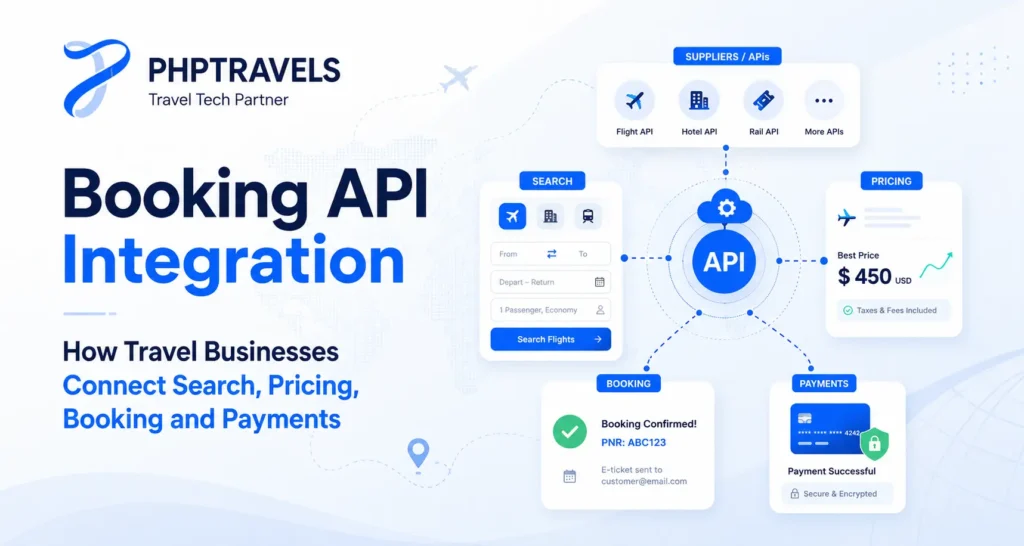
Booking API integration connects a travel website, mobile app, B2B portal, or booking engine with external suppliers so users can search live inventory, check current prices, make reservations, receive confirmations, and manage post-booking actions from one system. The real goal is not simply connecting an endpoint; it is creating a reliable booking flow from search to confirmation.
Travel businesses may sell flights, hotels, tours, transfers, cars, ferries, or other services from different suppliers. Each supplier can use different authentication, data structures, booking statuses, and cancellation rules. A well-designed integration hides that complexity from the customer and gives the business one consistent workflow.
What Is Booking API Integration?
Booking API integration is the technical connection between a booking platform and one or more external inventory or reservation providers. It lets systems exchange data automatically through API requests and responses instead of relying on manual searches, supplier extranets, emails, or repeated data entry.
In travel, the connection may link an OTA with a GDS, airline aggregator, hotel wholesaler, tour marketplace, car-rental supplier, payment gateway, or reservation system.
A typical booking API connection can support live availability, prices and rules, rate revalidation, reservation creation, confirmation, cancellations, refunds, vouchers, tickets, and booking-status updates.
For a broader technical overview, PHPTRAVELS also explains travel API integration across XML, JSON, hotels, flights, cars, tours, and payments.
How Does Booking API Integration Work?
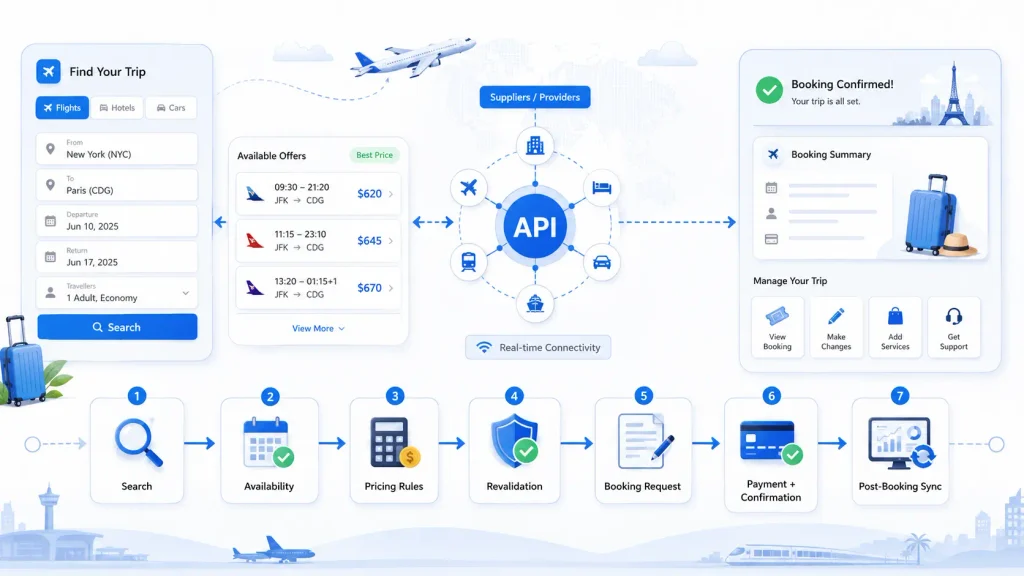
The easiest way to understand the process is to follow one reservation from search to confirmation.
1. Search
A traveler enters dates, destination, route, passenger count, room requirements, or other search criteria. The booking engine sends those parameters to the relevant supplier API.
2. Availability Response
The supplier returns bookable options such as fares, room rates, vehicles, activities, policies, taxes, and an offer reference. The platform converts the data into a format the website or app can display consistently.
3. Pricing Rules
Your system can apply markup, agent commission, service fees, taxes, discounts, or currency conversion before showing the selling price.
4. Revalidation
Travel prices and inventory can change quickly. Before the customer commits, the system should recheck the selected offer when the supplier supports price or rate verification.
5. Booking Request
The platform sends traveler or guest details and the selected offer reference. The supplier then confirms, rejects, or returns a pending status.
6. Payment and Confirmation
Payment processing is often separate from the inventory supplier. The platform needs clear logic for payment success with booking failure, delayed confirmation, or other incomplete states.
7. Post-Booking Synchronization
The integration should continue after confirmation by updating booking details, cancellations, refunds, and status changes across customer, agent, finance, and admin records.
A booking API integration is therefore successful when the complete transaction works reliably, not when a search endpoint simply returns results.
What Types of Booking APIs Can a Travel Business Integrate?
“Booking API” is a broad term covering multiple travel products.
Flight Booking APIs
Flight APIs can connect airlines, GDS platforms, NDC content, consolidators, or aggregators with a booking engine. Depending on the supplier, they may support search, fare rules, revalidation, booking, ticketing, baggage, seats, changes, and refunds.
Businesses focused on air sales can also explore PHPTRAVELS flight booking software.
Hotel Booking APIs
Hotel APIs can provide properties, rooms, availability, rates, cancellation policies, and reservation functions. Multi-supplier hotel setups also require careful property and room mapping.
For the hotel-specific implementation, see the PHPTRAVELS hotel booking system API.
Tours, Cars, and Transfers
Activity APIs can supply attractions, excursions, and timed tickets, while car-rental and transfer APIs can return vehicles, pickup rules, locations, prices, extras, and confirmations. These products can be sold individually or combined with flights and hotels.
Payment APIs
Payment gateways are not inventory APIs, but they are essential to the booking journey. The platform should connect payment status with the reservation record so confirmations, failures, refunds, and accounting actions can be traced.
See PHPTRAVELS travel payment gateway integration for more information about connecting payment processing with travel operations.
Booking API vs Travel API vs Booking Engine
These terms are related, but they are not identical.
| Term | Main Purpose | Example Role |
|---|---|---|
| Booking API | Reservation operations | Search, revalidate, book, cancel |
| Travel API | Travel data or operations | Flights, hotels, cars, content, pricing |
| Booking Engine | User-facing sales system | Search, checkout, accounts, vouchers |
| Integration Layer | Standardizes external APIs | Maps suppliers into one workflow |
The booking engine is what customers or agents use. APIs connect that engine to external services. The integration layer keeps multiple supplier connections manageable as the business grows.
Travel companies comparing connectivity options can review PHPTRAVELS travel APIs and its wider travel API integrations.
Why Booking API Integration Matters for Travel Agencies and OTAs
Manual supplier portals may work at low volume, but they become difficult to manage as an agency adds products, markets, agents, or suppliers.
Booking API integration can help a travel business:
- show live supplier inventory;
- reduce repetitive data entry;
- automate reservation workflows;
- apply markups and commissions consistently;
- connect B2C and B2B sales channels;
- centralize supplier and booking references;
- expand available travel inventory;
- reduce dependency on manual supplier extranets;
- create a more consistent booking experience.
A customer can search and book without knowing that several different suppliers may be working behind the scenes.
For B2B operations, agent pricing, credit limits, markups, and booking access can be controlled at platform level. A dedicated B2B booking engine can then sit on top of connected inventory.
What Makes a Booking API Integration Reliable?
Production reliability depends heavily on how the system handles changing data and incomplete transactions.
Normalize Supplier Data
Different suppliers may describe the same concept using different fields, formats, or status codes.
Instead of allowing every supplier’s structure to spread throughout the booking engine, external responses should be mapped into a consistent internal model. This makes future suppliers easier to add and existing connections easier to maintain.
Revalidate Before Booking
A search result is not always a guaranteed booking price.
Flights can change fare classes, hotel rooms can sell out, and dynamic rates can update between search and checkout. Where supported, use price-check, rate-check, or offer-refresh operations close to the final booking request.
Prevent Duplicate Transactions
Network failures create uncertainty. A request may time out even though the supplier successfully received it.
Immediately sending the same booking again can create duplicate reservations. Safe retry logic and idempotency, where supported, help protect the booking process from repeated transactions.
Keep Traceable Logs
Record request IDs, supplier booking references, timestamps, error messages, and booking-state changes.
Good logging helps operations teams determine what happened when a booking fails and makes supplier reconciliation much easier.
Support Delayed Updates
Not every supplier returns an instant final confirmation.
Some reservations or later changes may be processed asynchronously. Your system should therefore understand statuses such as pending, confirmed, failed, cancelled, and refunded instead of assuming every supplier response is final.
Webhooks or follow-up status requests can then update the booking when its state changes.
Monitor Limits and API Versions
Supplier APIs can enforce request limits and eventually change or retire endpoints.
Controlled retries, sensible caching, monitoring, and API-version tracking should be part of ongoing booking API maintenance rather than tasks performed only during initial development.
Common Booking API Integration Problems
| Problem | Possible Impact | Better Approach |
|---|---|---|
| Price changes after search | Checkout mismatch | Revalidate before booking |
| Supplier timeout | Unknown booking state | Check status before retrying |
| Duplicate request | Duplicate reservation | Use idempotent write logic |
| Payment succeeds, booking fails | Refund and support issue | Reconcile payment and booking states |
| Different supplier formats | Inconsistent results | Normalize supplier responses |
| Cancellation not synchronized | Wrong customer status | Use webhooks or scheduled checks |
| API throttling | Slow or failed searches | Cache safely and respect rate limits |
The objective is not to eliminate every possible supplier failure. External systems, networks, inventory, and prices will always change.
The goal is to detect problems quickly, avoid turning temporary errors into duplicate transactions, and give customers and operations teams a clear booking status.
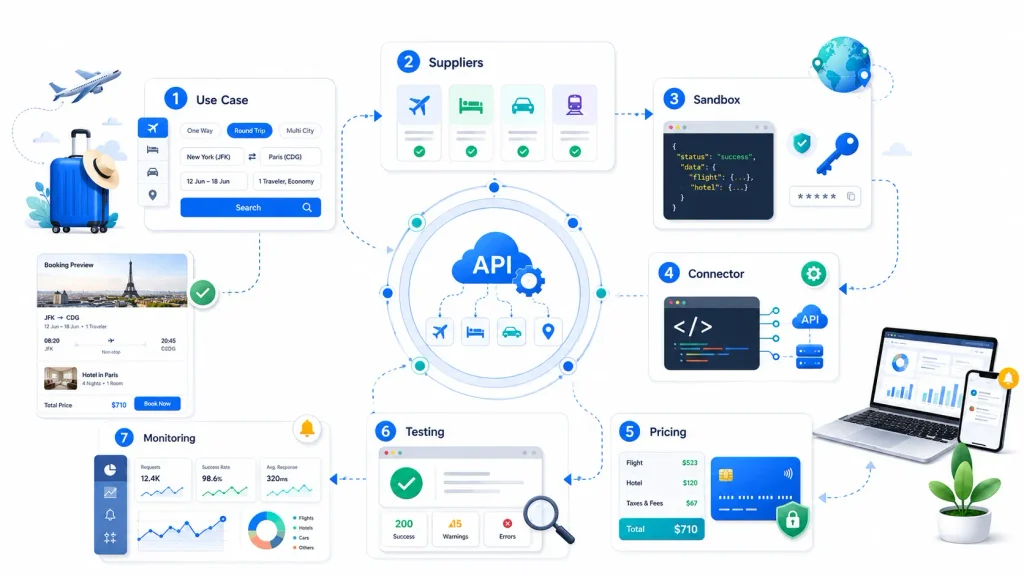
How to Implement Booking API Integration Step by Step
Step 1: Define the Use Case
Decide what you are selling, who will buy it, and which actions must happen online.
A B2C hotel website, B2B flight portal, corporate travel platform, and multi-product OTA all require different booking workflows.
Step 2: Select the Right Suppliers
Evaluate suppliers according to inventory coverage, target markets, booking capabilities, commercial agreements, documentation, support, and post-booking functionality.
Having more suppliers does not automatically create a better booking platform. Relevant inventory and dependable transaction support matter more.
Step 3: Obtain Test Credentials
Most suppliers require a partner account, commercial agreement, technical approval, or onboarding process before production access.
Begin with sandbox credentials and confirm exactly which operations your account can use.
Step 4: Build or Configure the Connector
The connection must handle authentication, request formatting, response mapping, error handling, and logging.
Businesses using pre-built travel technology may already have the required connector available.
If a supplier is not supported, a custom API integration can connect the supplier’s documentation and booking workflow with the platform.
Step 5: Configure Pricing and Checkout
Supplier prices usually need additional business logic before reaching the customer.
Configure markup, commissions, taxes, service fees, currencies, agent rules, discounts, and credit controls according to your sales model.
Step 6: Test Failure Scenarios
Do not test only successful searches and bookings.
Test price changes, unavailable inventory, incorrect traveler details, payment failures, supplier timeouts, cancellations, and repeated requests.
A successful sandbox search does not prove that a booking integration is ready for production.
Step 7: Monitor Production
Once live, monitor supplier response times, API errors, booking failures, pending reservations, payment mismatches, and supplier-specific issues.
Build a Custom Integration or Use a Pre-Built Platform?
Custom booking API development provides maximum control.
It can make sense when a business has unusual requirements, proprietary workflows, an internal engineering team, or suppliers that cannot be supported through existing connectors.
However, the development team must then maintain authentication, supplier mapping, booking states, error handling, payment coordination, monitoring, logs, and future supplier API changes.
A pre-built travel technology platform can reduce that workload by providing a common booking engine and existing supplier connections.
PHPTRAVELS provides integrations across multiple travel categories in a self-hosted environment. Businesses evaluating the broader setup can explore its travel booking software or test the available PHPTRAVELS demo.
The right approach depends on how unique your workflow is, how quickly you need to launch, and whether maintaining supplier integrations should remain an internal engineering responsibility.
Key Takeaway
Booking API integration turns external travel inventory into a usable reservation experience.
A production-ready implementation should do more than display supplier search results. It should normalize data, verify prices, prevent duplicate transactions, coordinate payments, record confirmations, support post-booking changes, and make failures easy to identify.
For agencies and OTAs, the strongest architecture is one that allows suppliers to be added or replaced without rebuilding the complete booking engine.
Conclusion
Booking API integration gives travel businesses a practical way to connect live supplier inventory with their own digital sales channels.
The business value comes from automation and scalability, while the technical challenge is maintaining a trustworthy transaction across search, pricing, checkout, payment, confirmation, and post-booking changes.
Start with the complete booking lifecycle, not the supplier logo list.
Define the actions customers and agents need, choose suppliers that fit your target market, test real failure scenarios, and use an architecture that keeps supplier-specific logic away from the core booking experience.