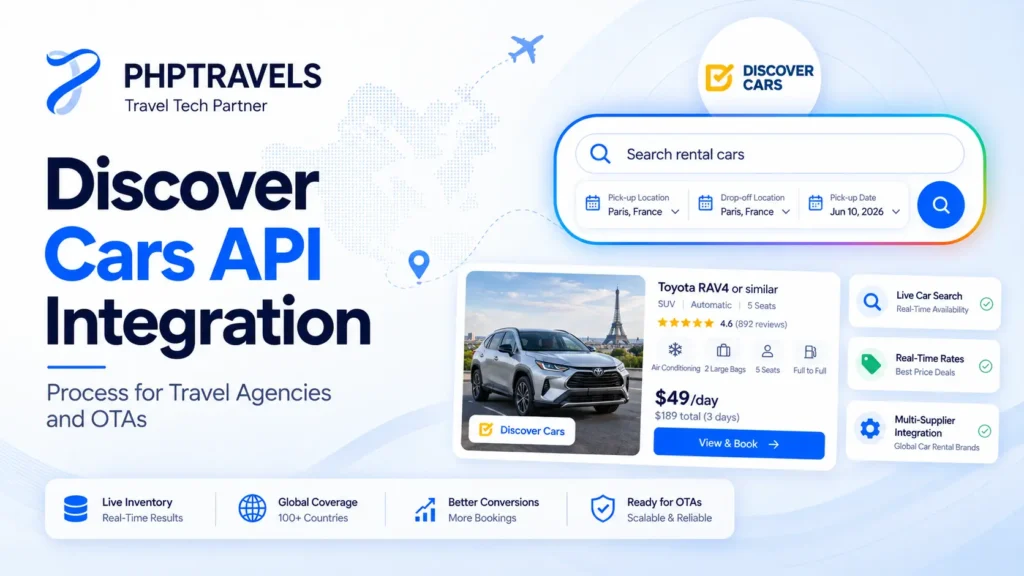
Travel agencies and online travel agencies (OTAs) can add car rentals without building and maintaining global rental inventory from scratch. A Discover Cars API integration connects car-rental content with a travel website so customers can search rental options as part of the same digital journey.
Quick answer:
Discover Cars API integration connects an OTA or travel booking platform with Discover Cars through an API-based workflow. It can help travel businesses surface car-rental inventory, pricing and availability inside their booking environment, subject to the supplier’s API access and commercial agreement. PHPTRAVELS lists Discover Cars as a supported car integration.
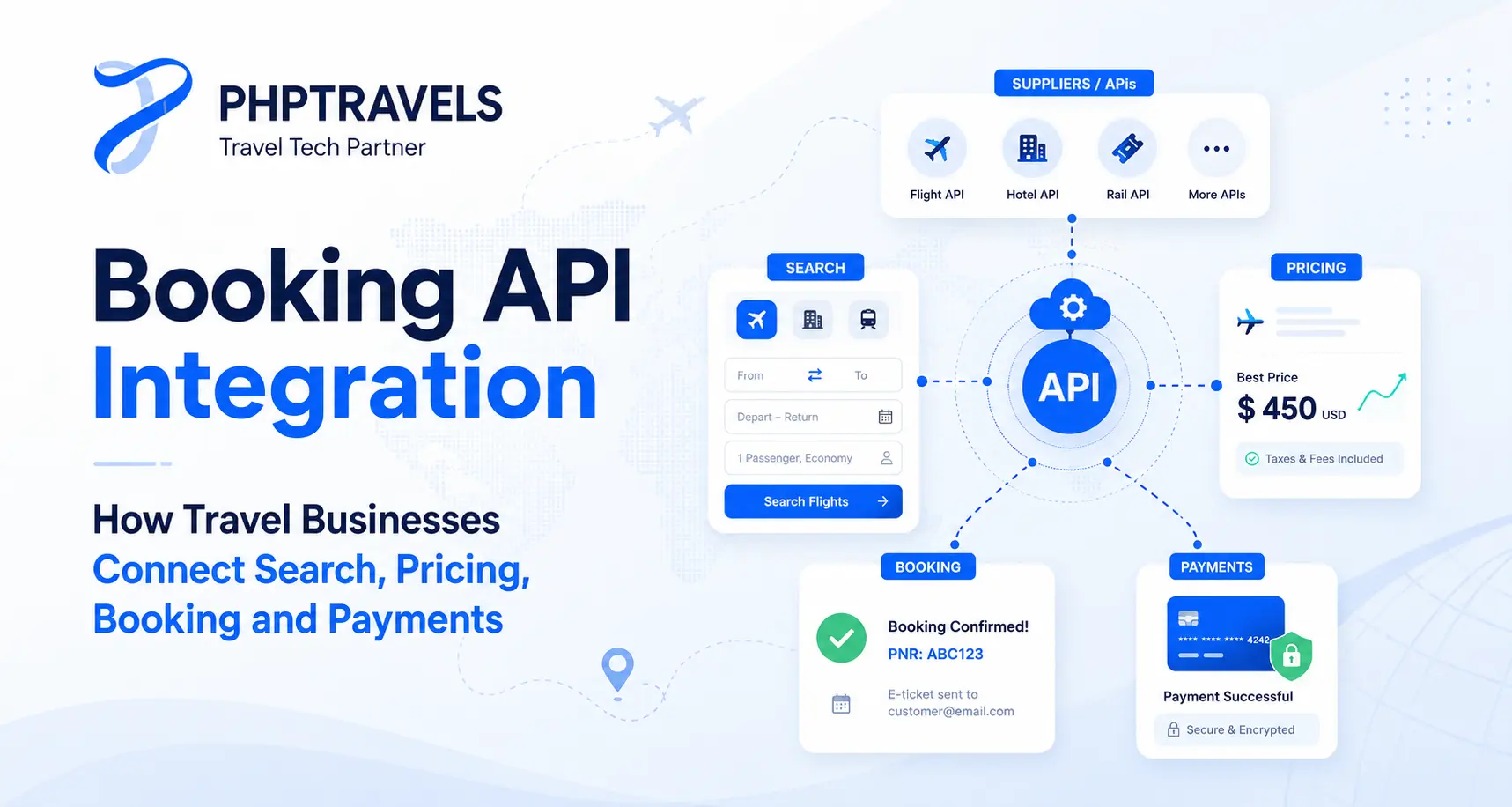
PHPTRAVELS connects supplier APIs to a broader travel booking software stack covering hotels, flights, tours, cars, payments and back-office workflows.
What Is Discover Cars API Integration?
Discover Cars API integration is the technical connection between a travel website and Discover Cars that allows structured rental-car data to move between the two systems.
Discover Cars publicly provides an XML API option for online travel agencies. In practice, an API connection allows a travel platform to request supplier-side information and present relevant car-rental options through its own customer journey. Exact data, booking actions and post-booking functions depend on the API access granted under the business’s Discover Cars agreement.
PHPTRAVELS to what API integration means in travel explains authentication, request mapping, booking, logging and reconciliation.
Discover Cars API integration in one sentence
It allows a travel business to connect car-rental supply to its website so customers can search and move through a rental booking flow without the agency manually maintaining every car, rate and availability record.
How Does a Discover Cars API Integration Work?
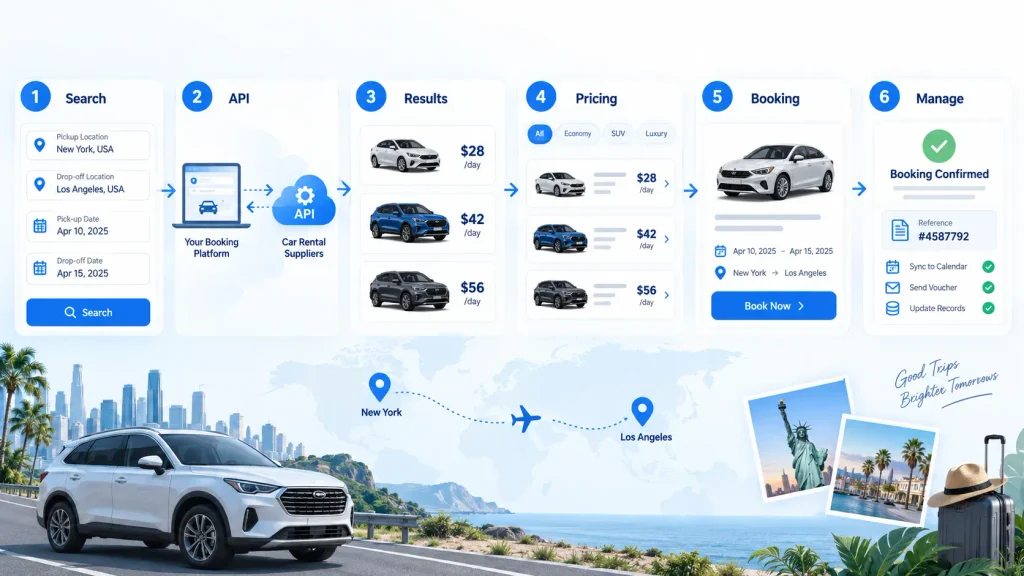
A typical car-rental API workflow can be understood in six stages:
- Customer search: The traveler enters pickup location, drop-off location, rental dates and other required details.
- API request: The booking platform sends the relevant request to the connected supplier.
- Supplier response: Available rental options, rates and applicable information are returned according to the supplier API.
- Pricing and display: The platform presents results and can apply configured rules such as currency or markup where supported.
- Booking workflow: The customer selects an option and proceeds through the booking or handoff flow defined by the integration.
- Booking management: References, confirmations, logs and supported post-booking actions are stored or synchronized for operations.
This is the same core principle used across modern travel API integrations: supplier data is connected to a consistent customer-facing and administrative workflow instead of being handled manually.
Why Travel Agencies Add Car Rentals to Their Booking Platform
A traveler booking a flight or hotel may also need transportation, creating another opportunity for the agency to serve the customer and generate revenue.
Car-rental integration can help an agency:
- expand its product range without operating its own vehicle fleet;
- offer another service during the same trip-planning journey;
- reduce manual searching and quotation work;
- use supplier connectivity instead of static rental listings;
- apply business pricing rules through a central platform;
- manage rental activity alongside other travel bookings; and
- support B2C, B2B or mixed distribution models.
For agencies developing this revenue stream, the PHPTRAVELS guide on how to sell car rentals online provides additional commercial and operational context.
Key Capabilities to Look for in a Car Rental API Integration
The value comes from the quality of the search, pricing, booking and support workflow not simply connecting an API.
Live Search and Availability
Travelers expect rental results to reflect current supply. API-based search reduces dependence on manually maintained inventory and helps the booking platform request current information from the provider.
Pickup and Drop-Off Location Handling
Car rentals are location-sensitive. Airports, city locations, terminals and different return points should be represented clearly to avoid confusion during booking.
Pricing Clarity
Customers should understand the rate presented and important rental conditions. On the agency side, the platform may also need markup, currency, tax or pricing controls.
Booking References and Confirmations
A production workflow needs traceable booking records. Support teams should be able to connect a customer reservation with its supplier reference and confirmation information.
Cancellations, Refunds and Servicing
Agencies should plan for what happens after booking: changes, cancellations, refunds, supplier errors and customer-support requests. Available actions depend on the supplier API and agreement.
Logs and Reconciliation
API logs help teams investigate failed searches, booking errors and timeouts. Reconciliation tools also help finance and support teams follow transactions and booking status.
Agencies often need more than a search widget. PHPTRAVELS’ car rental system combines booking functionality with rental operations, integrations and reporting.
Discover Cars API Integration with PHPTRAVELS
PHPTRAVELS lists Discover Cars among its supported car integrations. Its integrations marketplace also includes CarTrawler, Mozio and KiwiTaxi in the cars category.
For a PHPTRAVELS-based implementation, the general connection flow is:
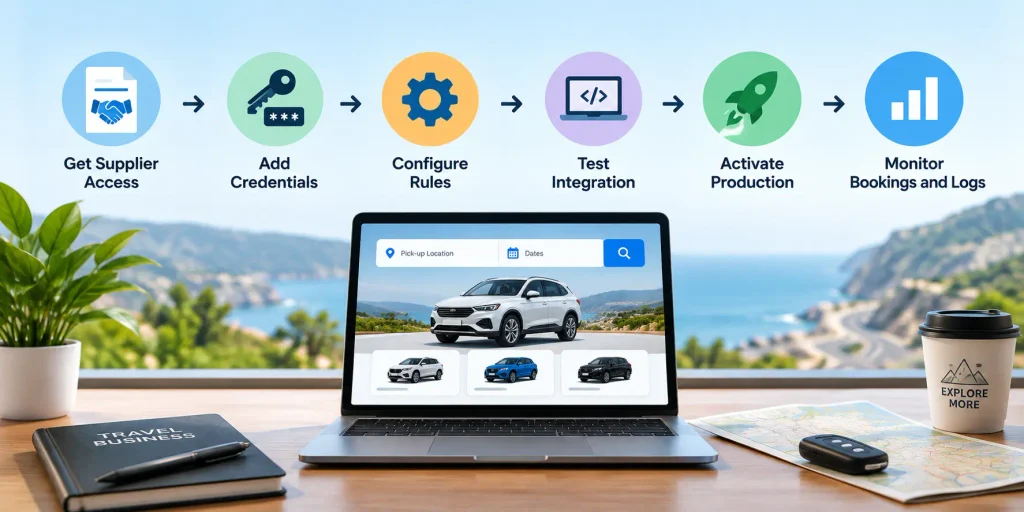
Step 1: Obtain Discover Cars Partner/API Access
The travel business first establishes the required relationship with Discover Cars and obtains credentials or access details for its account. PHPTRAVELS provides the technical connector, while supplier contracts, commercial terms and credentials come from the supplier.
Step 2: Add the Credentials in PHPTRAVELS
Once access is available, credentials can be configured in the relevant integration area of the admin environment. This avoids building an entire connector from zero for an already-supported integration.
Step 3: Configure Currency and Markup Rules
Travel agencies often need to control how supplier rates are presented. PHPTRAVELS supports centralized currency and markup rules across supplier integrations, helping agencies maintain a consistent selling strategy.
Step 4: Test the Search and Booking Journey
Before launch, test common customer scenarios and edge cases. Check pickup and drop-off searches, rate display, availability changes, invalid inputs, booking confirmation and supplier failures.
Step 5: Move to Production
After successful testing, production access can be enabled according to the supplier setup. Real customer searches can then use the connected inventory within the live booking workflow.
Step 6: Monitor Bookings and Post-Booking Activity
Operational teams need booking records, supplier references and logs when resolving changes, cancellations, refunds or synchronization issues.
Businesses that want to understand the wider connectivity layer can also review the PHPTRAVELS travel APIs resource.
What Do You Need Before Integrating Discover Cars?
Prepare the commercial, technical and operational requirements before launch. You will typically need:
- an active travel website or booking platform;
- an approved relationship with Discover Cars;
- API or XML credentials supplied for your account;
- test or sandbox access where available;
- a defined currency and markup strategy;
- a customer checkout or booking-handoff plan;
- payment workflows where relevant;
- cancellation and customer-service procedures; and
- technical testing before production.
An API automates data exchange, but the travel business still needs clear ownership of supplier support, customer support and reconciliation.
Discover Cars API vs Building Your Own Car Rental Inventory
Travel companies can connect external rental supply or build and manage their own inventory. The right option depends on the business model.
| Area | Discover Cars API Integration | Own Rental Inventory |
|---|---|---|
| Inventory Source | External supplier network | Your fleet or contracted inventory |
| Availability | Retrieved through integration | Managed internally |
| Geographic Expansion | Faster where supplier coverage exists | Requires fleet or contracts |
| Development | API connection and workflow setup | Full inventory and operations stack |
| Rate Management | Supplier rates plus platform rules | Fully managed by your business |
| Fleet Operations | Usually supplier-side | Your responsibility |
| Best Fit | OTAs and agencies expanding rental content | Rental operators managing vehicles |
Some businesses use both models: their own fleet in core markets and supplier inventory elsewhere.
The PHPTRAVELS cars module features are relevant for businesses that need deeper fleet, availability, multi-location and operational controls in addition to supplier connectivity.
Discover Cars vs Other Car Rental API Options
No single car API fits every company. Selection should depend on target markets, commercial terms, inventory needs, API access and customer experience.
PHPTRAVELS supports multiple car-related integrations, so agencies can evaluate alternatives instead of designing their entire platform around one provider. Businesses comparing rental suppliers can also review the CarTrawler API integration.
When comparing providers, assess:
- geographic coverage in your target destinations;
- vehicle and supplier availability;
- commercial and commission structure;
- API documentation and onboarding requirements;
- supported booking and servicing actions;
- cancellation and refund workflows;
- response performance and reliability; and
- support available to your team.
This supplier-first evaluation is more useful than choosing an API based only on brand recognition.
Can Discover Cars Be Used in B2C and B2B Travel Websites?
Car-rental supply can be relevant to both retail and agent-distribution models, provided the supplier agreement and integration setup support the intended workflow.
In a B2C travel website, customers search and book travel products through a consumer-facing interface. Car rentals can sit alongside hotels, flights, tours or transfers as another trip component.
In a B2B travel model, authorized agents may search inventory and sell products under agency-defined pricing and account rules. PHPTRAVELS’ B2B travel portal is designed around agent access, markups, commissions, supplier connectivity, vouchers, invoices and reporting.
For companies serving both channels, one platform can simplify supplier configuration, pricing governance and booking records.
Best Practices for a Production-Ready Discover Cars Integration
A reliable implementation focuses on the complete workflow, not only the connection.
Test price changes. Rental prices or availability can change between search and booking, so the customer journey should handle changes clearly.
Keep location data consistent. Airport, city and depot mapping should be validated so travelers understand where vehicles are collected and returned.
Show important rental information. Driver requirements, rental policies and applicable fees should be surfaced according to the data supplied by the provider.
Design for API failures. Timeouts and temporary supplier errors happen. Log failures and show understandable customer messages instead of raw API errors.
Protect credentials. Supplier keys and tokens should be stored securely and never exposed in the public frontend.
Plan post-booking support. Your team needs supplier references and booking history when a traveler requests help.
Measure performance. Track searches, conversion, failed requests, cancellations and supplier performance so the integration can improve over time.
Why Use PHPTRAVELS for Discover Cars API Integration?
PHPTRAVELS has been building travel booking technology since 2012, giving the platform more than a decade of experience serving travel agencies, tour operators and OTAs. Rather than treating car rentals as a standalone feature, PHPTRAVELS brings cars, hotels, flights, tours, payments and administrative workflows together within a wider booking ecosystem.
The platform recently reached another major milestone with the launch of PHPTRAVELS Version 10 in February 2026. Version 10 introduced a ground-up architectural rewrite, expanded supplier connectivity, advanced B2B and B2C pricing controls, and a more centralized integration framework. Discover Cars is included among its supported car-rental integrations, helping travel businesses add car inventory within the same platform they use to manage other travel products.
It can suit OTAs, agencies, B2B wholesalers, DMCs, tour operators and startups.
If you are evaluating the platform, explore the PHPTRAVELS live demo to review the booking and administration experience before planning your integration.
Build a Car Rental Booking Experience with PHPTRAVELS
Discover Cars API integration can help travel agencies and OTAs add car rentals to a broader travel-booking strategy without manually maintaining every rental option.
A strong implementation combines supplier connectivity with pricing, reliable search, booking records and post-booking support.
PHPTRAVELS already supports Discover Cars within its supplier integration ecosystem, making it a practical option for businesses that want car-rental connectivity as part of a multi-product platform.