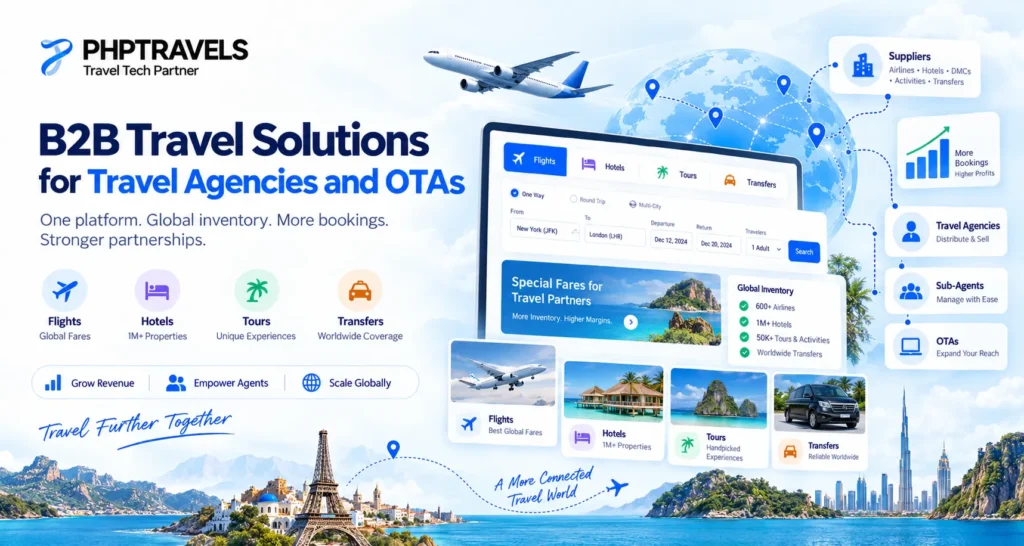
B2B travel solutions are software platforms that help travel agencies, OTAs, tour operators, wholesalers, consolidators, and corporate travel teams sell and manage travel products through business-to-business channels. Instead of handling supplier searches, agent requests, markups, confirmations, payments, invoices, and reports in separate tools, a B2B travel solution connects these workflows in one system.
For a growing agency, the biggest value is control. Agents and sub-agents can book under assigned pricing rules while the main agency keeps visibility over margins, supplier costs, commissions, and settlements.
If your business is building a reseller network, a B2B travel portal can provide the agent-facing layer, while the wider B2B travel technology stack manages inventory, pricing, finance, integrations, and reporting behind it.
What Is a B2B Travel Solution?
A B2B travel solution is a booking, distribution, and management system designed for transactions between travel businesses. Typical users include retail travel agents, sub-agents, OTAs, destination management companies, tour operators, wholesalers, consolidators, and travel management companies.
Unlike a consumer booking website, where a traveler searches and pays directly, a B2B system normally works with business rules. An agency may give different agents different markups, commissions, currencies, credit limits, payment options, booking permissions, or access to specific suppliers.
That is why “B2B travel solution” is broader than “booking engine.” A booking engine handles search and reservation, while the full solution can also include agent management, supplier connectivity, finance, documents, reporting, and white-label distribution.
For additional background, read how B2B works in the travel industry.
See PHPTravels Flight Booking API in action View Demo →How B2B Travel Solutions Work
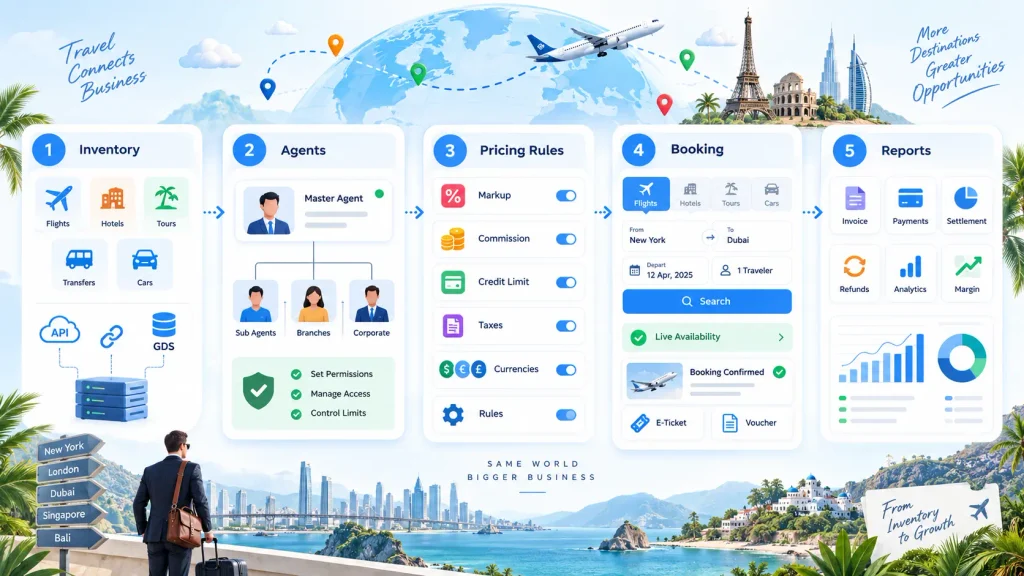
Most B2B travel platforms follow a straightforward operational flow:
- Connect inventory. The agency connects hotel, flight, tour, transfer, car, or other suppliers through APIs, GDS connections, XML feeds, direct contracts, or manually managed inventory.
- Create agent access. The administrator creates accounts for agents, sub-agents, branches, or corporate partners and assigns permissions.
- Set commercial rules. Markups, commissions, service fees, credit limits, currencies, taxes, and payment rules are configured by agent, product, market, or supplier.
- Search and book. Authorized agents search available inventory, view the rate offered to them, confirm bookings, and generate customer documents.
- Track and reconcile. The back office monitors supplier cost, selling price, margin, payment status, invoices, vouchers, cancellations, refunds, and agent settlements.
This turns manual requests into a controlled distribution workflow. A dedicated B2B booking engine is useful when agents need self-service access to live inventory and pricing.
Core Features of Modern B2B Travel Solutions
The best feature set depends on the business model, but most agencies should evaluate the following capabilities.
1. Real-Time Travel Inventory
A B2B platform should be able to combine the inventory an agency actually sells. That may include flights, hotels, tours, activities, transfers, cars, or contracted products.
Real-time availability helps agents respond faster and reduces manual confirmation work. It also gives resellers a more consistent experience because products from different suppliers can be searched through the same booking environment.
2. Supplier and Travel API Integrations
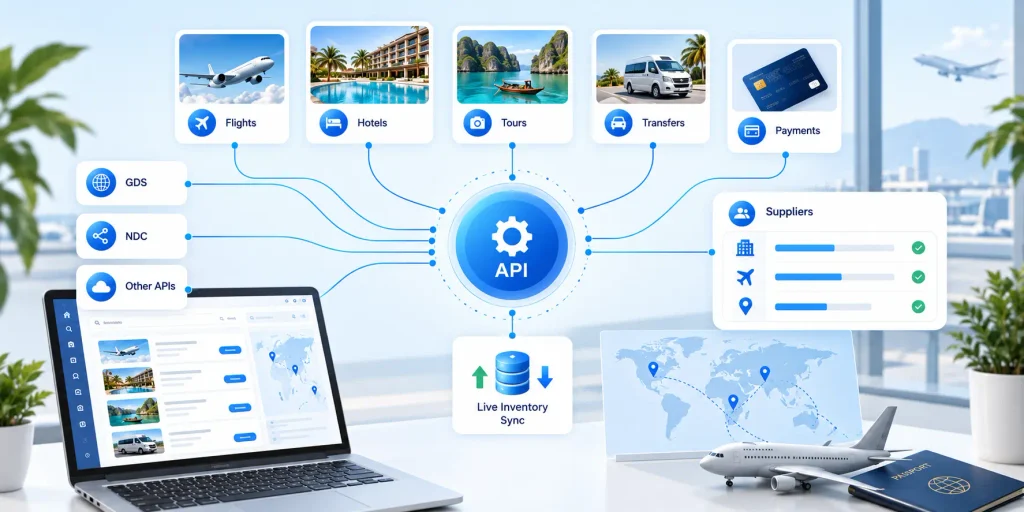
Supplier connectivity is central to B2B travel technology. Airlines, GDSs, bedbanks, hotel suppliers, activity providers, and other distributors may expose inventory through different APIs or data formats.
A useful platform should normalize this content into a consistent search and booking experience.
Agencies comparing connectivity options can review available travel API integrations and decide which suppliers match their target markets, commercial agreements, and product mix.
3. Agent and Sub-Agent Management
A scalable B2B travel business needs more than a shared login. Administrators should be able to create agent accounts, assign roles, manage branches, control permissions, set credit exposure, and review activity.
This supports reseller growth without giving every partner the same commercial terms.
For example, a high-volume agent may receive different markup, commission, credit, or payment conditions from a newly registered reseller.
4. Markups, Commissions, and Pricing Control
Pricing control is one of the main differences between B2B and B2C travel systems.
Agencies may need fixed markups, percentage markups, supplier-specific rules, agent-tier pricing, service fees, or commission models. These controls should be applied consistently so agents see the correct selling price without manual recalculation.
Good pricing control also makes it easier for managers to understand the difference between supplier cost, agent price, customer price, commission, and actual margin.
5. White-Label Distribution
A white-label B2B portal gives partners branded access while keeping booking and management centralized. Branding can include the agency name, logo, domain, and documents.
This model is useful for wholesalers and agencies that want to expand their reseller network without operating every partner booking manually.
If white-label distribution is part of your growth strategy, this guide to choosing B2B travel portal software can help you evaluate the operational requirements.
6. Payments, Credit, Invoices, and Vouchers
B2B bookings often involve more than instant card payments.
Agents may book against a credit balance, pay by bank transfer, use an online payment gateway, or operate under agreed settlement terms. The platform should keep payments, supplier cost, invoices, vouchers, and booking status connected to the same transaction.
Keeping financial information tied to the booking record makes reconciliation easier for both operations and finance teams.
7. Reporting and Back-Office Visibility
Useful reporting should show agent sales, supplier margins, credit exposure, product performance, and unpaid or unsettled bookings.
A central dashboard helps managers make decisions from booking data instead of manually assembled spreadsheets.
That visibility becomes increasingly important as an agency adds more agents, suppliers, currencies, branches, and products.
See PHPTravels View Demo →B2B Travel Solution vs Portal vs Booking Engine
These terms are related, but they are not identical.
| Term | Main purpose | Typical users |
|---|---|---|
| B2B travel solution | End-to-end technology for distribution, bookings, pricing, agents, finance, integrations, and reporting | Agencies, OTAs, wholesalers, tour operators, DMCs and TMCs |
| B2B travel portal | Branded login area where agents or resellers search and manage bookings | Agents, sub-agents and reseller partners |
| B2B booking engine | Search, pricing, availability, and reservation workflow | Agents and booking teams |
| B2B travel management solution | Broader operational control including policies, approvals, reporting, and corporate workflows | Travel managers and corporate travel teams |
Benefits for Travel Agencies, OTAs, and Tour Operators
A well-configured B2B travel solution can improve operations in several important ways.
Faster response times: Agents can search available inventory themselves instead of waiting for a back-office employee to check every request.
Consistent pricing: Markup and commission rules can be applied automatically, reducing pricing inconsistency across agents and branches.
Centralized supplier access: Multiple inventory sources can be presented through one booking workflow rather than separate supplier dashboards.
Scalable distribution: New agents and sub-agents can be onboarded with assigned rules and permissions without rebuilding the process for every partner.
Better financial visibility: Booking value, supplier cost, agent pricing, payment status, and settlement can be tracked together.
More professional partner service: Automated confirmations, invoices, and vouchers make the reseller experience more structured.
For agencies specifically evaluating commercial software, B2B travel booking software brings booking and agent-management functions into one platform.
How B2B Travel Solutions Help Travel Managers
The search for “B2B travel solutions travel manager” reflects a slightly different need from reseller distribution.
A travel manager is typically focused on control, visibility, policy, approvals, traveler support, and reporting.
For corporate or managed travel, useful capabilities may include employee or traveler profiles, approval workflows, cost centers, policy rules, preferred suppliers, booking records, reporting, and payment controls.
In that use case, corporate travel management software may be more appropriate than a pure reseller portal.
The important distinction is intent: a travel agency may use B2B technology to distribute inventory to agents, while a corporate travel manager may use related technology to control how employees buy and manage business travel.
API Integrations and Supplier Connectivity
No B2B platform creates inventory by itself. It needs access to suppliers, contracted rates, aggregators, GDS or NDC content, or other travel APIs.
Examples can include airline distribution systems, hotel bedbanks, hotel APIs, tours and activities providers, transfer suppliers, and payment gateways.
The right mix depends on where you sell, which products you specialize in, your supplier agreements, and the commercial terms available to your agency.
Before integrating a supplier, evaluate more than the brand name. Review geographic coverage, rate competitiveness, cancellation policies, booking and refund workflows, support quality, API documentation, response speed, commercial requirements, and whether the supplier supports the products your customers actually buy.
This is also where a travel agency CRM can add value by connecting booking activity with customer and partner records instead of leaving sales and service data in separate systems.
How to Choose the Right B2B Travel Solution
Start with your business model, not the longest feature list.
Ask these questions before selecting a platform:
- Who will use it? Retail agents, sub-agents, corporate clients, internal staff, or a combination?
- What will you sell? Flights, hotels, tours, transfers, cars, packages, or niche inventory?
- Which suppliers must be connected? List required APIs, GDSs, bedbanks, direct contracts, and payment providers.
- How will agents pay? Online payment, deposit, credit balance, bank transfer, or postpaid settlement?
- How will pricing work? Define markups, commissions, service fees, taxes, and agent tiers.
- Do you need white-label portals? Decide whether partners need your branding or their own branded storefront.
- What reporting matters? Specify sales, margin, supplier, branch, agent, credit, cancellation, and settlement reports.
- Can the platform scale? Check whether it can support more agents, markets, currencies, products, and integrations.
- What customization is required? Separate essential workflow changes from nice-to-have design changes.
- Who owns and supports the technology? Understand hosting, updates, source-code access, documentation, implementation, and support before signing.
A demo should be treated as an operational test, not simply a design preview.
Create an agent, assign a markup, search inventory, make a test booking, generate a voucher, record a payment, cancel a booking, and check the resulting report. That provides a much clearer picture of how the platform would work in day-to-day operations.
B2B Travel Technology Trends for 2026 and Beyond
The strongest direction in B2B travel technology is not one futuristic feature. It is better automation across the complete booking lifecycle.
AI can support search, customer service, itinerary assistance, content generation, internal knowledge, and data analysis, but it works best when connected to reliable inventory and clear business rules.
APIs and modern distribution models remain important because agencies need access to live content from multiple suppliers. Better analytics can also help managers understand margins, agent performance, booking behavior, and supplier results faster.
Workflow consolidation is another major trend. Agencies want fewer disconnected dashboards and more unified processes for search, booking, payments, documents, CRM, and reporting.
The practical goal is simple: reduce manual work while keeping commercial control.
Why PHPTRAVELS Fits the B2B Travel Technology Model
PHPTRAVELS is designed for travel agencies, OTAs, tour operators, and related travel businesses that want booking technology with B2B and B2C capabilities.
Agencies can evaluate its B2B travel portal, booking engine, supplier integration options, agent workflows, and wider travel-management capabilities according to their own business model.
The best way to judge fit is to compare your required suppliers, products, pricing rules, payment workflow, agent structure, reporting needs, branding, and customization requirements against a working setup.
View the live demo to test the booking workflow, or talk to the PHPTRAVELS team about your B2B travel requirements.
Conclusion
B2B travel solutions help agencies move from manual, fragmented operations to structured travel distribution. The most valuable systems combine live inventory, supplier connectivity, agent access, pricing control, payments, documents, and reporting without making the business dependent on separate workflows for every booking.
For travel agencies and OTAs, the right question is not simply which platform has the most features. It is which solution fits your suppliers, markets, agents, commercial rules, and growth model.