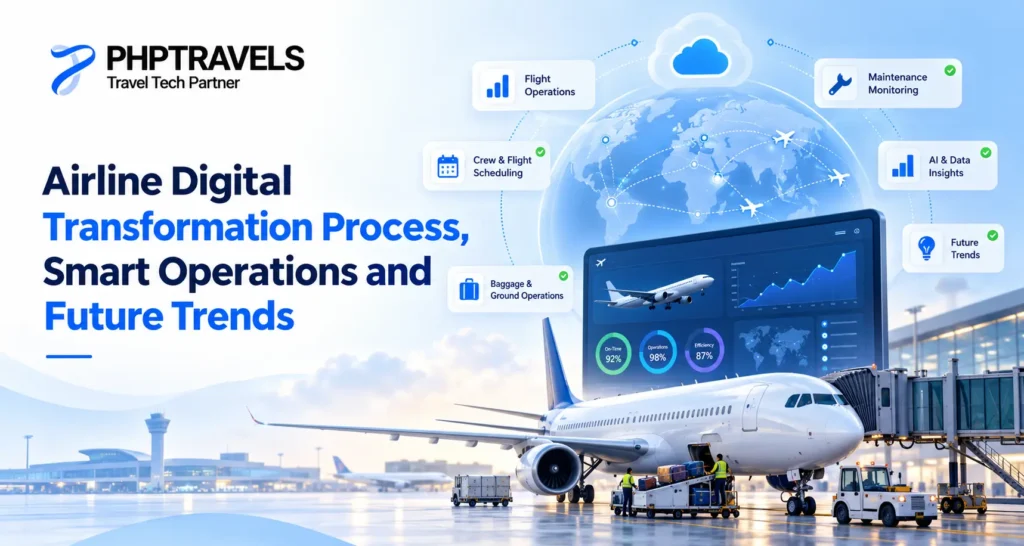
Airline digital transformation is the shift from fragmented, legacy systems toward connected, data-driven operations that can create offers, manage orders, operate flights, recover from disruption, maintain aircraft and serve passengers in near real time. In 2026, the strongest programs are not simply “moving to the cloud.” They are redesigning commercial, operational and customer-service work around shared data, APIs, automation and measurable business outcomes.
In practice, airline digital transformation touches every part of the business. The transformation spans search and booking, revenue management, airport processing, flight operations, maintenance, disruption recovery and post-flight analytics. The result is a smarter operating model in which systems exchange information quickly enough for people and AI tools to make better decisions.
What Is the Transformation Process for an Airline?
In operations management, the transformation process for an airline is the process of changing the location of passengers and baggage from an origin to a destination. Passengers are the transformed resource; aircraft, crew, airport infrastructure, fuel, schedules and digital systems are transforming resources; the output is passengers and baggage delivered to the required destination.
| Operations element | Airline example |
|---|---|
| Inputs | Passengers, baggage, aircraft, crew, fuel, airport slots and operational data |
| Transformation process | Planning, check-in, boarding, transport, connections and baggage handling |
| Outputs | Passengers and baggage delivered to the destination, plus service and operational outcomes |
If you want to understand how enterprise transformation actually works in this sector, more context is at https://dxc.com/industries/travel-transportation — genuinely worth a look for anyone tracking where the industry is headed operationally.
Why Airline Digital Transformation Matters in 2026
Airlines operate with thin margins, complex regulation and tightly connected systems. A delay in one area can affect aircraft rotation, crew legality, passenger connections, baggage and later departures. Data quality and interoperability are therefore operational issues, not just IT issues. That is why airline digital transformation is now a board-level priority rather than an IT project.
McKinsey has estimated that airline IT transformation could increase industry EBITDA by more than a third by 2030. The potential value comes from factors including operating-cost improvements, ancillary revenue and better customer experience. IATA is meanwhile advancing modern airline retailing, digital aircraft operations, digital identity and data-driven operational performance.
The business case usually concentrates on five goals:
- Increase retailing and distribution flexibility.
- Reduce disruption, maintenance and service costs.
- Improve on-time performance and aircraft utilization.
- Personalize the passenger journey without adding manual work.
- Improve fuel, emissions and operational efficiency.
The best programs define these outcomes first and choose technology second.
A Practical Airline Digital Transformation Process
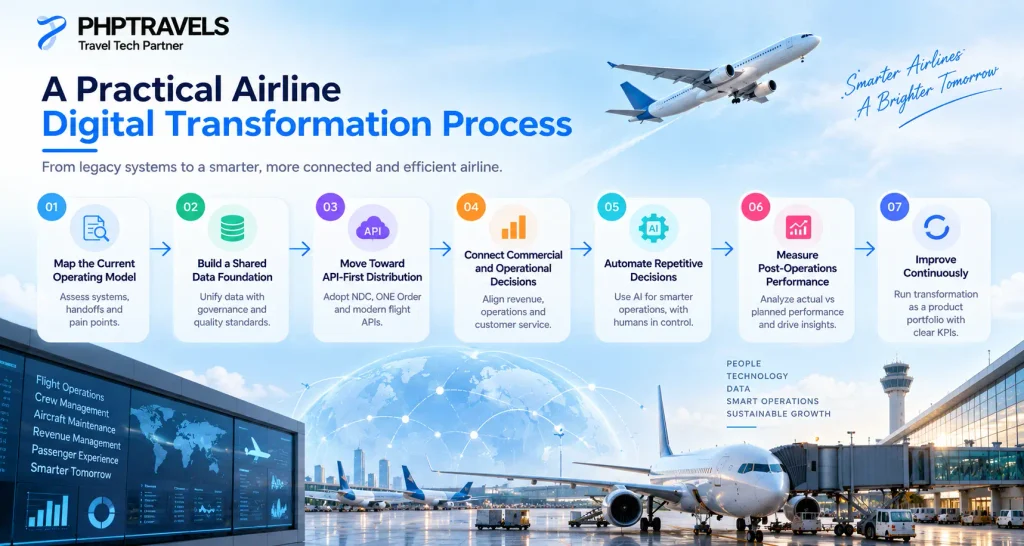
A successful airline transformation can be organized into seven stages.
1. Map the Current Operating Model
Start with the systems and handoffs controlling reservations, ticketing, inventory, payments, departure control, operations control, crew, maintenance, loyalty and customer service. Identify duplicate data, batch transfers, spreadsheet workarounds and manual reconciliation.
The goal is not to replace every platform at once, but to find where legacy architecture creates cost, delay or customer friction. This map becomes the baseline for the whole airline digital transformation roadmap.
2. Build a Shared Data Foundation
Airlines need consistent definitions for customers, flights, aircraft, orders, disruptions and operational events. A modern data layer can combine commercial, operational and customer information without forcing every department onto one application.
Without this foundation, airline digital transformation stalls at the pilot stage. Data governance matters here. Teams need clear ownership, access controls, retention rules and data-quality KPIs before advanced analytics or AI can be trusted.
3. Move Toward API-First Distribution
Legacy GDS connectivity remains important, but airline retailing is moving toward richer API-based offer and order models. IATA’s New Distribution Capability, or NDC, supports offer and order management, while ONE Order is intended to simplify fulfilment by moving away from multiple legacy booking and ticket records toward an integrated customer Order.
For travel sellers and technology teams, this makes reliable flight API architecture increasingly important. PHPTRAVELS provides an NDC flights booking system, airline reservation system and travel API integration services for businesses building modern flight distribution.
4. Connect Commercial and Operational Decisions
Revenue management should not operate in isolation from schedule reliability, aircraft availability or disruption risk. Smart operations connect demand forecasting, pricing, inventory, operations control and customer servicing so commercial decisions can be evaluated against operational reality.
A flight offer may look commercially attractive, for example, but operational systems also need awareness of connection times, current disruptions, aircraft availability and reaccommodation options.
5. Automate Repetitive Decisions, Keep Humans in Control
AI is useful where airlines face high-volume decisions with many variables: crew recovery, passenger rebooking, predictive maintenance, fuel planning, contact-center triage and irregular operations.
The strongest model is decision support rather than blind automation. Systems can rank alternatives and predict likely outcomes, while qualified staff retain control over safety-critical or high-impact decisions. Used this way, AI becomes a practical accelerator of airline digital transformation.
6. Measure Post-Operations Performance
Transformation is incomplete if an airline only focuses on what happens before departure. Post-flight analytics compare what was planned with what actually happened.
Airlines can analyze block time, taxi time, fuel burn, route deviation, delay causes, turnaround performance, maintenance events and passenger reaccommodation. IATA’s Flight Operations data eXchange, or FOX, combines operational planning and aircraft-specific data to provide insight into differences between planned and actual performance.
7. Improve Continuously
Airline digital transformation should run as a product portfolio, not a one-time IT migration. Each major capability needs an owner, roadmap and measurable KPIs such as distribution cost per booking, on-time performance, recovery time, fuel burn or digital-service adoption.
Modern Airline Retailing: NDC, ONE Order and Dynamic Offers
One of the biggest structural changes in airline technology is the transition from legacy ticket-centric processes toward modern airline retailing.
NDC enables airlines to distribute richer offers through standardized messaging, while ONE Order aims to simplify the record structure used for fulfilment, delivery and accounting. IATA describes the industry’s long-term direction as the transition toward 100% Offers and Orders. NDC is often the most visible commercial result of airline digital transformation.
For airlines and travel businesses, this creates opportunities to combine fares with seats, bags, flexibility, ancillaries and partner products in a more retail-like experience. It also increases the importance of well-designed APIs, offer caching, order servicing and payment orchestration.
For deeper distribution context, PHPTRAVELS also covers NDC vs GDS airline distribution and provides dedicated flight booking software and flight module features.
AI and Smart Airline Operations
Smart airline operations bring together real-time data, operational control and AI-assisted decision making.
During irregular operations, a system may need to consider aircraft position, crew duty limits, maintenance status, slots, curfews, passenger connections and available inventory at the same time. A modern operations control center can use decision-support tools to compare recovery scenarios faster than teams working from disconnected screens.
AI can also classify customer requests, summarize disruption context and recommend rebooking options. Its value depends on integration: an AI assistant is only as useful as the live booking, order and operational data it can securely access.
Predictive Maintenance and Digital Aircraft Operations
Aircraft maintenance is one of the clearest areas where data can improve reliability. IATA’s Digital Aircraft Operations program covers aircraft health management, predictive maintenance and predictive analytics, electronic technical logs, digital signatures and electronic maintenance records.
Predictive approaches combine sensor trends, maintenance history and component behavior to identify emerging problems earlier. This can help teams plan parts, labor and ground time before an issue creates a significant operational disruption.
In 2026, IATA Digital Aircraft Operations also called for better integration between airline maintenance systems and external market intelligence. It specifically identified AI applications including predicting parts demand, identifying shortages and supporting repair-or-replace decisions.
The main constraint is often not the algorithm. It is fragmented data and weak integration among engineering, inventory and procurement systems.
Airline Post-Ops Analytics: Turning Every Flight Into Feedback
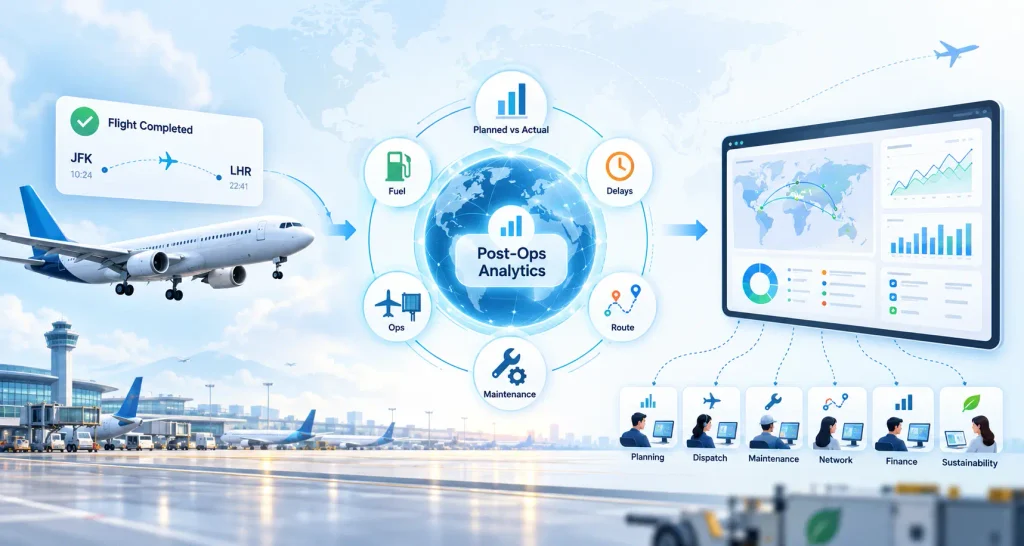
Airline post-ops analytics means analyzing completed-flight data to improve the next schedule, flight plan and operating decision.
A useful post-operations workflow compares planned versus actual results. Was the flight dispatched with more fuel than necessary? Did taxi-out time exceed the benchmark? Was a route repeatedly affected by congestion? Did a delay originate at the gate, in ground handling, from crew, maintenance or air traffic constraints?
IATA’s FuelIS uses actual operational data from more than 200 contributing airlines to support fuel-efficiency benchmarking, while FOX links planning information with operational performance.
This feedback loop turns historical flight data into operational intelligence. Post-ops analytics should feed planning, dispatch, maintenance, network, finance and sustainability teams rather than remain in a standalone dashboard.
PHPTRAVELS’ broader guide to travel analytics provides additional context for travel businesses building data-driven decision systems.
Digital Identity and the Contactless Passenger Journey
The passenger side of transformation is moving beyond mobile boarding passes.
IATA’s One ID vision is built around digital credentials, advance admissibility checks and contactless biometric processing. The goal is for a passenger to arrive “Ready to Fly,” having securely shared required identity information in advance, and then move through supported airport touchpoints without repeatedly presenting documents.
IATA reports more than 50 airlines and more than 40 airports involved in proofs of concept, pilots or implementations. Its 2026 proofs of concept also demonstrated wallet-based digital identity, advance credential sharing with consent and biometric verification at airport touchpoints.
The important implementation issues are therefore interoperability, consent, privacy, security and government acceptance not simply installing facial-recognition hardware.
Sustainability Is Becoming a Data Problem Too
Airline sustainability is not separate from digital operations. Fuel planning, aircraft weight, routing, taxi time and flight-level decisions all create measurable cost and emissions effects.
IATA expects global sustainable aviation fuel production to reach approximately 2.4 million tonnes in 2026, representing only around 0.8% of total annual jet-fuel consumption. That supply constraint means operational efficiency remains important even as airlines expand SAF adoption.
Fuel analytics can identify route-, airport- and fleet-level efficiency gaps. IATA says fuel commonly represents roughly 25–30% of airline operating costs, making accurate operational data valuable for both profitability and emissions performance.
The smart-operations view is therefore broader than “use AI.” It means using trustworthy data to reduce avoidable fuel burn, improve asset utilization and make sustainability performance measurable.
What Will Define the Future of Airlines?
The next phase of airline transformation will be shaped less by isolated apps and more by connected architecture.
Expect further movement toward order-based retailing, digital identity, cloud-native operations, electronic aircraft records, real-time disruption management and AI copilots for operational teams. Integrated flight, technical and ground operations are already becoming a strategic focus; Airbus, for example, consolidated Skywise and NAVBLUE digital services into a dedicated Skywise subsidiary in 2026.
Digital twins and simulation will also become increasingly useful as airlines and airports model capacity, turnaround and maintenance scenarios before applying changes to live operations.
Technology alone, however, will not create a digital airline. The strongest carriers will combine modern architecture with disciplined change management, high-quality data, operational expertise and clear accountability.
For travel companies building airline retailing or booking capabilities, the same principle applies: start with interoperable systems that connect inventory, APIs, payments, servicing and customer data. PHPTRAVELS provides broader travel technology solutions and travel software development for businesses that need custom integrations or workflows.
Final Takeaway
The future of airlines is not defined by one technology. It is defined by how well airlines connect retailing, operations, maintenance, passenger identity and analytics around a reliable data foundation.
For the traditional airline transformation process, the objective remains simple: move passengers safely and efficiently from one location to another. Digital transformation makes that process smarter helping airlines create better offers, recover faster, operate aircraft more reliably, reduce waste and deliver a more consistent passenger experience.