If you sell flights, the debate around NDC vs GDS is no longer optional.
Travel agencies, OTAs, tour operators, and B2B agent networks are all facing the same question: should they depend on traditional GDS content, connect to airline NDC APIs, or use a platform that brings both into one booking flow?
The answer is not as simple as “GDS is old” and “NDC is new.”
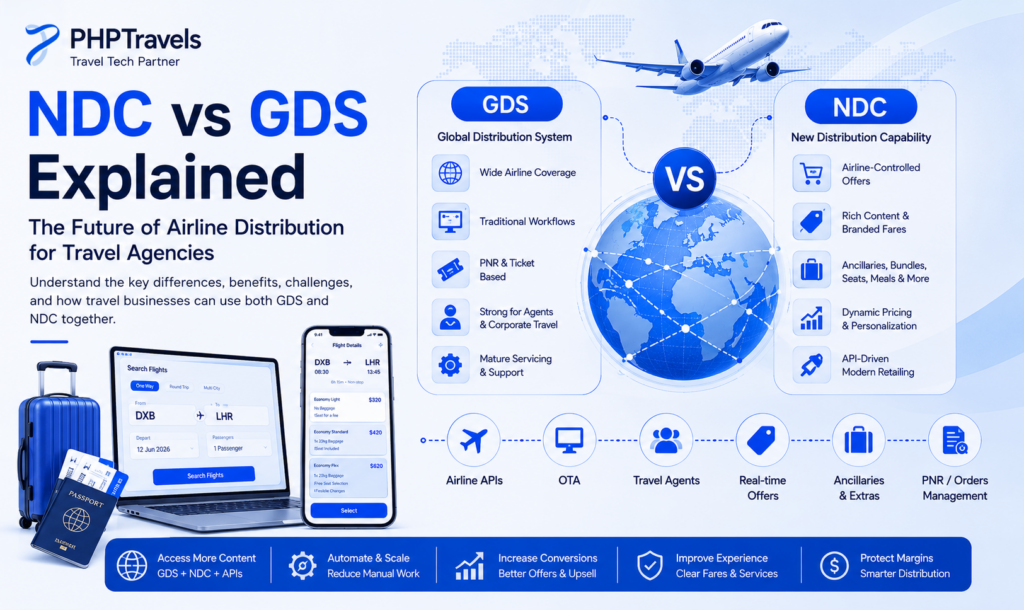
The GDS still powers a large part of global travel distribution because it gives agents access to broad airline content, ticketing workflows, and servicing tools. NDC, on the other hand, gives airlines more control over their offers, pricing, ancillaries, bundles, and branded fares.
For travel businesses, the real challenge is not choosing one over the other. The real challenge is managing GDS, NDC, and direct airline APIs together without creating operational chaos.
This guide explains what GDS and NDC mean, how they work, where they differ, and how travel agencies can prepare for the future of airline distribution.
Quick Summary
GDS stands for Global Distribution System. It connects airlines, travel agents, OTAs, and corporate booking tools through a centralized distribution network.
NDC stands for New Distribution Capability. It is an IATA-supported data standard that helps airlines distribute richer flight offers, ancillaries, and branded content through modern APIs. IATA describes NDC as a way to address distribution limitations around product differentiation, access to rich air content, and transparent shopping.
GDS is strong for global reach, standard workflows, ticketing, PNR servicing, and corporate travel.
NDC is strong for dynamic offers, branded fares, seat selection, baggage, meals, upgrades, and airline-controlled retailing.
NDC will not replace GDS immediately. IATA’s Offers and Orders vision for 2030 is about making full modern retailing capabilities available, not forcing the entire industry to switch at once.
Most travel agencies will operate in a hybrid distribution model where GDS, NDC, low-cost carrier APIs, and direct supplier connections work side by side.
What Is GDS in Airline Distribution?
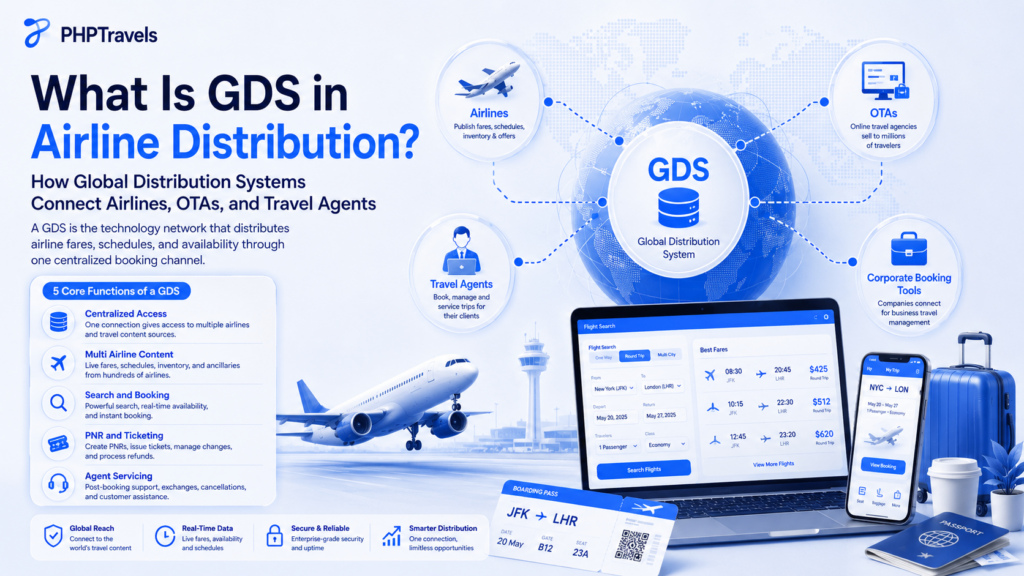
A GDS, or Global Distribution System, is a travel technology network that allows travel sellers to search, compare, book, and service flights from multiple airlines through one system.
The major GDS companies include:
Amadeus
Sabre
Travelport
For decades, the GDS has been the backbone of indirect airline distribution. Instead of connecting to every airline individually, a travel agency connects to a GDS and receives access to large-scale airline content through one interface.
Travelport explains the GDS process in three simple stages: search, book, and service. An agent searches for a route, the GDS confirms availability and booking options, and the same environment can support changes, cancellations, or rebooking.
That is why GDS remains important for travel agencies. It is not only about finding flights. It is also about managing the booking after the sale.
How GDS Works
The traditional GDS process usually works like this:
Airlines file schedules, fares, fare rules, and availability.
The GDS collects and organizes this content.
Travel agents or OTAs search flights through a connected system.
The booking creates a PNR, or Passenger Name Record.
Ticketing, changes, refunds, cancellations, and queues are handled through established GDS workflows.
This model is structured and reliable. It works well for agencies that need access to multiple airlines, corporate travel content, ticketing control, and post-booking servicing.
But the traditional GDS model was not originally built for modern e-commerce-style airline retailing.
That is where NDC enters the picture.
What Is NDC in Airline Distribution?
NDC, or New Distribution Capability, is a modern airline distribution standard developed by IATA.
NDC allows airlines to distribute richer, more flexible offers through APIs. Instead of showing only basic fare and schedule data, NDC can display branded fares, baggage, seats, meals, Wi-Fi, lounge access, refund conditions, and bundled products.
Amadeus describes NDC as technical standards developed by IATA to bring new retailing capabilities to travel distribution, with more transparent and dynamic airline product selling.
In simple terms:
GDS was built for distribution.
NDC was built for airline retailing.
With NDC, the airline has more control over the offer. The airline can decide what to sell, how to package it, what extras to include, and how to display the value of each fare.
How NDC Works
The NDC booking process is more API-driven than traditional GDS distribution.
A traveler or agent searches for a flight.
The search request goes to the airline, NDC aggregator, or NDC-enabled platform.
The airline creates an offer in real time.
The offer may include fare, baggage, seat options, branded fare family, ancillaries, refund rules, and conditions.
The customer or agent selects the offer.
The booking is created as an order or reservation, depending on the airline and technology setup.
Servicing is handled through the airline, aggregator, or connected platform.
This gives airlines more retailing flexibility. It also gives travel sellers access to content that may not always be available in traditional GDS displays.
NDC vs GDS: The Main Difference
The main difference between NDC and GDS is offer control.
In the traditional GDS model, airlines file fares and rules into a standardized distribution environment. The GDS aggregates and displays those fares to travel sellers.
In the NDC model, the airline creates the offer directly and sends it through an API. This allows the airline to include more product detail, richer content, and personalized or dynamic pricing.
For example, a traditional GDS display may show several economy fares.
An NDC offer can show:
Economy Light with no baggage
Economy Standard with one checked bag
Economy Flex with seat selection and free changes
Business fare with lounge access and priority boarding
This helps travelers compare value, not just price.
For agencies, this can improve conversion. But it also creates new technical and operational challenges.
NDC vs GDS Comparison Table
| Feature | GDS | NDC |
|---|---|---|
| Full form | Global Distribution System | New Distribution Capability |
| Main purpose | Airline distribution | Airline retailing |
| Offer control | GDS-standardized display | Airline-controlled offers |
| Content type | Filed fares, schedules, availability | Dynamic offers, branded fares, ancillaries |
| Ancillary sales | Available but often limited | Stronger support for seats, bags, meals, upgrades |
| Pricing | Mostly filed and structured fares | More dynamic and flexible pricing |
| Booking record | PNR and ticket-based workflow | Offer and order-based workflow |
| Servicing | Mature workflows for agents | Depends on airline and NDC maturity |
| Best for | Agencies, TMCs, corporate travel, multi-airline sales | Rich airline content, direct offers, upselling |
| Limitation | Less flexible retailing | Inconsistent servicing across airlines |
| Future role | Still important in hybrid distribution | Growing part of modern airline retailing |
Why Airlines Are Moving Toward NDC
Airlines want to sell flights more like modern retailers.
On an airline website, customers can often see branded fare families, baggage options, seats, meals, upgrades, loyalty offers, and bundles. But in older indirect distribution channels, much of this content can become simplified or difficult to display.
NDC helps airlines solve this problem.
It allows airlines to:
Control how offers are created
Display branded fares more clearly
Sell ancillaries through indirect channels
Create dynamic or personalized offers
Reduce dependency on static fare filing
Improve product differentiation
Speed up time-to-market for new products
IATA includes NDC within its broader airline retailing program, alongside Dynamic Offers and ONE Order, as part of the transition toward modern Offers and Orders.
This is why airlines are investing heavily in NDC.
They do not only want to sell a seat. They want to sell the full travel experience.
Why Travel Agencies Still Need GDS
Even with NDC growth, the GDS remains important.
Travel agencies still need:
Broad airline coverage
Reliable booking workflows
PNR management
Ticketing control
Refunds and reissues
Corporate travel support
Queue management
Back-office integration
Multi-airline comparison
Agent productivity tools
For many agencies, the GDS is deeply connected to daily operations. Staff are trained on it. Corporate contracts depend on it. Mid-office and back-office systems often connect to it.
This is why NDC will not remove the GDS overnight.
Instead, the industry is moving into a hybrid phase.
Some fares come from GDS.
Some offers come from NDC.
Some low-cost carrier content comes through direct APIs.
Some content comes through aggregators.
The travel agency needs one platform that can normalize all of this into a single workflow.
The Problem With Managing NDC and GDS Separately
The biggest mistake travel businesses make is treating every supplier connection as a separate system.
One supplier has a GDS workflow.
Another supplier has an NDC API.
Another has a direct airline API.
Another sends content through an aggregator.
At low volume, this can be managed manually.
At scale, it becomes expensive.
Common problems include:
Duplicate booking workflows
Different cancellation rules
Different refund processes
Different fare displays
Different baggage formats
Different ticketing logic
Manual markup calculation
PNR and order mismatch
Complicated reconciliation
Staff switching between systems
This is where operational cost increases.
The agency may get access to more content, but without a proper platform, the team spends more time fixing bookings, checking rules, and handling customer issues manually.
NDC Benefits for Travel Agencies
NDC can be very powerful when implemented properly.
For travel agencies and OTAs, NDC can help with:
1. Access to Richer Airline Content
NDC allows agencies to show more than just fare and schedule.
Customers can see bags, seats, meals, upgrades, branded fare families, and conditions more clearly.
This improves transparency and helps customers choose the right fare.
2. Better Upselling Opportunities
When ancillaries are visible during booking, agencies can sell more value-added services.
Instead of only earning from the base fare, the agency can support additional products like baggage, preferred seats, or flexible fares.
3. Airline Website Content in Agency Channels
Some airlines make special offers or richer bundles available through NDC.
This helps agencies stay competitive with airline direct channels.
4. Better Customer Experience
Travelers want to know what they are buying.
NDC can show whether baggage is included, whether the ticket is refundable, and what extras are available before payment.
This reduces confusion and post-booking complaints.
5. More Modern Flight Retailing
NDC brings flight selling closer to e-commerce.
The booking process becomes less about displaying a fare code and more about showing a complete travel product.
GDS Benefits for Travel Agencies
GDS remains valuable because it solves problems that are still critical for agents.
1. Broad Market Access
A GDS gives agents access to a large network of airline content through one system.
This is important for agencies selling international routes, complex itineraries, or corporate travel.
2. Mature Ticketing and Servicing
GDS workflows for ticketing, reissues, refunds, voids, and cancellations are well established.
This matters because flight selling does not end when payment is made.
3. Corporate Travel Support
Many corporate travel programs still depend on GDS workflows, profiles, policies, and reporting.
4. Agent Productivity
Experienced agents can work quickly inside GDS-connected environments.
For high-volume agencies, speed matters.
5. Back-Office Compatibility
Many accounting, reconciliation, and reporting systems are already built around GDS workflows.
This makes GDS difficult to replace fully in the short term.
NDC Challenges Travel Agencies Should Understand
NDC is powerful, but it is not always simple.
The main challenges include:
1. Inconsistent Airline Implementation
Not every airline supports NDC in the same way.
One airline may support search and booking.
Another may support ancillaries.
Another may have limited servicing.
Another may require manual handling for changes or refunds.
This creates operational complexity.
2. Servicing Gaps
Booking through NDC is one thing. Servicing that booking later can be more difficult.
Agencies need to check whether the connection supports:
Cancellations
Refunds
Changes
Reissues
Schedule changes
Seat updates
Baggage changes
Split passengers
Void requests
If servicing is weak, agents may still need manual airline support.
3. Integration Cost
NDC APIs require technical integration, certification, testing, and maintenance.
For smaller agencies, connecting directly to multiple airlines may not be practical.
4. Content Normalization
Every supplier may return data differently.
A strong platform must normalize fares, bags, seats, rules, markups, commissions, and currencies into one structure.
5. Agent Training
NDC introduces new terminology and workflows.
Agents may need to understand offers, orders, branded fares, ancillaries, and airline-specific rules.
Will NDC Replace GDS?
Not immediately.
NDC is growing, but GDS is still deeply connected to airline distribution, corporate travel, ticketing, and agency servicing.
The more realistic future is hybrid airline distribution.
This means travel agencies will use:
GDS for broad airline content and servicing
NDC for rich airline offers and ancillaries
Direct airline APIs for selected carriers
LCC APIs for low-cost carrier content
Aggregators for faster multi-source access
IATA’s modern retailing direction is clearly moving toward Offers and Orders, but its own 2030 vision does not mean the whole industry becomes fully converted by that date. It means the full capabilities based on open standards should be available for airlines that want to move in that direction.
For agencies, the practical answer is clear:
Do not build your business around one channel only.
Build around a platform that can support all channels.
NDC, GDS, and ONE Order
To understand the future of airline distribution, it helps to understand ONE Order.
Today, airline bookings may involve different records:
PNR
E-ticket
EMD for ancillaries
Payment records
Supplier references
This creates fragmentation.
ONE Order is designed to simplify this by moving toward a single order record. IATA describes ONE Order as a key enabler of the industry transition to modern airline retailing with 100% Offers and Orders.
In simple terms:
NDC improves shopping and offer creation.
ONE Order improves fulfillment and order management.
Together, they aim to make airline distribution more like modern retail.
But this transition will take time.
What NDC vs GDS Means for OTAs
For OTAs, the NDC vs GDS decision directly affects conversion, pricing, and content quality.
An OTA needs:
Fast search results
Accurate availability
Competitive fares
Clear baggage display
Branded fare comparison
Seat and ancillary upsell
Multi-currency pricing
Payment gateway support
Cancellation and refund automation
Supplier reconciliation
If an OTA connects only to GDS, it may miss some airline-controlled NDC content.
If it connects only to NDC, it may struggle with broad coverage and servicing.
The best approach is usually a hybrid flight booking engine that can combine GDS, NDC, and airline APIs into one customer experience.
What NDC vs GDS Means for B2B Travel Agents
For B2B travel businesses, the challenge is even bigger.
A B2B flight platform must manage:
Sub-agents
Agent wallets
Credit limits
Markup rules
Commission rules
Multi-currency fares
Supplier rules
Ticketing permissions
Invoices
Statements
Refund tracking
PNR servicing
Booking reports
When GDS and NDC content are mixed, pricing and servicing must be controlled properly.
For example, one agent may receive one markup on GDS fares and another markup on NDC offers. Another agent may have a wallet balance but no credit limit. A corporate account may need negotiated pricing in a specific currency.
Without automation, this becomes manual work.
That is why B2B agencies need a system that can apply business rules automatically across every flight source.
Manual vs Automated Flight Distribution
Many travel agencies start manually.
They check fares in one system.
They confirm baggage in another.
They calculate markup in Excel.
They issue tickets through a supplier portal.
They send invoices manually.
They track refunds through email.
This works at the beginning.
But as volume increases, manual workflows become expensive.
The cost appears in different ways:
More staff required
More booking errors
Slow customer support
Missed schedule changes
Wrong markup calculation
Refund delays
Reconciliation problems
Lost profit margins
Automation changes this.
A proper flight booking platform can automate:
Search
Booking
Markup
Commission
Currency conversion
Ticketing flow
Voucher generation
Agent wallet deduction
Invoice creation
PNR tracking
Reporting
Supplier reconciliation
This is where technology protects margin.
How to Choose Between NDC and GDS
A travel agency should not ask only, “Should we use NDC or GDS?”
The better question is:
Which content sources do we need, and how will we manage them in one workflow?
Before choosing, check these points:
Do you need international airline coverage?
Do you sell B2C, B2B, or both?
Do you need agent wallet and credit limits?
Do you need multi-currency pricing?
Do you need branded fare display?
Do you need baggage and seat upselling?
Do you need automated ticketing?
Do you need refund and reissue handling?
Do you need back-office reconciliation?
Do you need direct airline or LCC APIs?
If your agency sells simple routes with low volume, one supplier may be enough.
If you sell flights seriously, you need a platform that supports hybrid distribution.
Where PHPTRAVELS Fits in NDC and GDS Distribution
PHPTRAVELS helps travel agencies, OTAs, and B2B travel businesses manage modern flight distribution from one platform.
Instead of building separate systems for GDS, NDC, airline APIs, hotels, tours, cars, and CMS content, PHPTRAVELS provides a complete web application that can be customized around your business model.
For flight distribution, PHPTRAVELS supports key GDS and flight supplier integrations such as:
Travelport
Amadeus
Duffel
TBO
For hotel distribution, PHPTRAVELS supports integrations such as Hotelbeds and Agoda. For tours and activities, it supports Tiqets and Viator, including affiliate and merchant models.
The platform supports:
B2C flight booking
B2B agent portal
Multi-language
Multi-currency
Markup management
Agent management
Wallet and balance system
CMS pages and blog
Cars transfer module
Payment gateway integration
Open-source code customization
This is important because the future of airline distribution is not one supplier or one API.
The future is connected, hybrid, and automated.
PHPTRAVELS gives travel businesses a foundation to manage GDS, NDC, and supplier content inside one travel booking system.
NDC vs GDS: Which Is Better?
Neither is better in every situation.
GDS is better when the agency needs broad airline coverage, mature servicing, ticketing control, corporate travel workflows, and established agent operations.
NDC is better when the agency needs richer airline content, branded fares, ancillaries, dynamic offers, and airline-controlled retailing.
For most travel businesses, the best answer is:
Use both.
A modern travel agency should not depend only on one content source. It should build a booking system that can connect multiple suppliers and present them in one clean search, booking, and servicing flow.
Future of Airline Distribution
The future of airline distribution will be shaped by three major changes.
1. More Airline-Controlled Offers
Airlines will continue moving toward direct offer creation, dynamic pricing, branded fares, and personalized bundles.
2. More Hybrid Distribution
GDS, NDC, direct APIs, low-cost carrier APIs, and aggregators will continue to work together.
Travel agencies will need systems that can normalize all content sources.
3. More Automation
Manual workflows will become too expensive.
Agencies that automate search, booking, ticketing, payments, refunds, and reconciliation will scale faster than agencies depending on manual operations.
Google also confirms that traditional SEO best practices remain relevant for AI-powered search experiences because AI features in Google Search are rooted in the core Search ranking and quality systems.
For travel companies publishing content, this means pages should be clear, structured, helpful, and easy for both users and AI systems to understand.
Frequently Asked Questions
What is the difference between NDC and GDS?
GDS is a global distribution network that allows travel agents and OTAs to search, book, and service flights from multiple airlines. NDC is an IATA-supported standard that allows airlines to create and distribute richer, real-time offers through APIs, including branded fares, baggage, seats, meals, and other ancillaries.
Is NDC replacing GDS?
NDC is not replacing GDS immediately. The industry is moving toward a hybrid model where GDS, NDC, direct airline APIs, low-cost carrier APIs, and aggregators work together. Travel agencies should prepare for multi-source flight distribution.
Why do airlines prefer NDC?
Airlines prefer NDC because it gives them more control over pricing, offers, branded fares, ancillaries, and product display. It allows airlines to sell flights more like modern retailers instead of only distributing static fares.
Why do travel agencies still use GDS?
Travel agencies still use GDS because it provides broad airline coverage, mature ticketing workflows, PNR servicing, corporate travel support, queue management, and back-office compatibility.
Is NDC better than GDS?
NDC is better for rich airline content, ancillaries, branded fares, and dynamic offers. GDS is better for broad distribution, servicing, and established agency workflows. Most agencies benefit from using both.
What is an NDC API?
An NDC API is a technical connection that allows travel sellers, aggregators, or booking platforms to request airline offers, book flights, sell ancillaries, and manage orders using the NDC standard.
Can travel agencies use both NDC and GDS?
Yes. Many modern travel agencies use both NDC and GDS. This allows them to access broad market content through the GDS while also selling richer airline offers through NDC.
What is the best flight booking system for NDC and GDS?
The best flight booking system is one that can connect GDS, NDC, direct airline APIs, and aggregators while managing search, booking, markup, payment, ticketing, agent wallets, invoices, and reporting in one platform.
Does PHPTRAVELS support flight supplier integrations?
Yes. PHPTRAVELS supports key flight supplier integrations including Travelport, Amadeus, Duffel, and TBO, along with B2C and B2B travel booking workflows.
What should travel agencies prepare for in the future?
Travel agencies should prepare for hybrid airline distribution. This means using GDS, NDC, direct APIs, automation, multi-currency pricing, agent management, and back-office reconciliation in one connected platform.