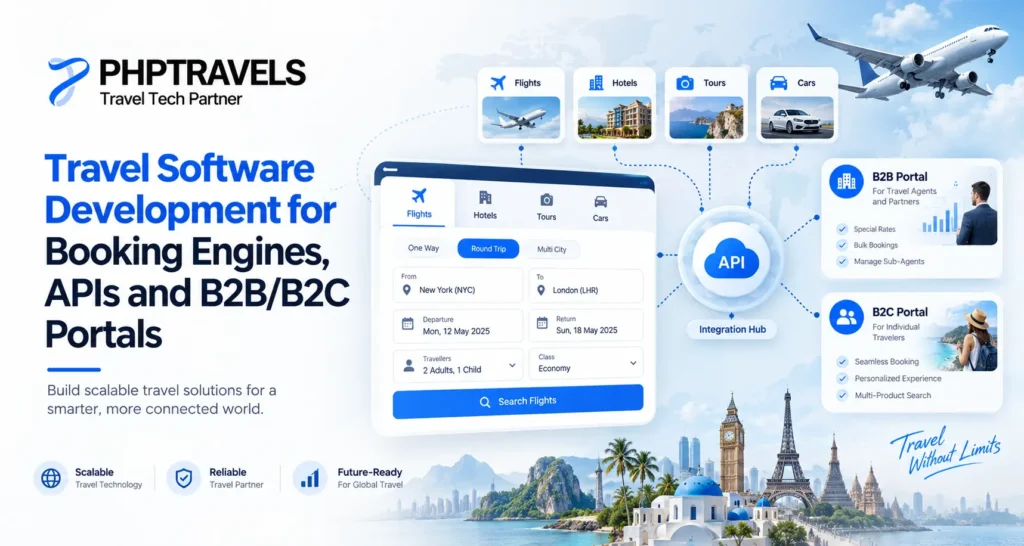
Travel software development is the process of building and connecting the technology that powers online travel sales. A modern platform usually combines a booking engine, supplier or GDS APIs, pricing rules, payments, customer and agent portals, booking management, and reporting in one connected workflow.
For agencies, OTAs, tour operators, DMCs, and corporate travel teams, the goal is not simply to build a website. The platform must connect live inventory, pricing, payments, confirmations, and back-office operations.
That is why effective travel booking engine development starts with architecture and workflow, not only design. The goal is to create a system that can connect multiple suppliers, support B2B and B2C sales, automate routine operations, and scale as booking volume grows.
Quick Answer: What Does Travel Software Development Include?
Travel software development can include:
- Online booking engines for flights, hotels, tours, cars, transfers, and other travel products
- Supplier API, XML, REST, GDS, and NDC integrations
- B2C customer booking websites
- B2B agent and sub-agent portals
- Markups, commissions, credit limits, and wallet management
- Multi-currency and multi-language support
- Payment gateway integration
- Booking, cancellation, refund, voucher, and invoice workflows
- CRM, reporting, analytics, and back-office automation
- White-label or fully custom travel platforms
Businesses that need these capabilities can explore custom travel software development or compare them with ready-to-use travel booking software.
What Is a Travel Booking Engine?
A travel booking engine is the transaction layer that lets users search availability, compare options, select a product, enter traveler details, pay, and receive a booking confirmation.
The booking engine does not usually create travel inventory itself. It connects to one or more inventory sources such as GDS platforms, bedbanks, airlines, tour suppliers, car rental providers, or the travel company’s own contracted inventory.
A typical booking flow looks like this:
- Search request: The traveler or agent enters dates, destination, route, passengers, or other criteria.
- Supplier search: The platform sends requests to connected suppliers or internal inventory.
- Normalization: Results from different sources are converted into a consistent format.
- Pricing rules: Markups, commissions, taxes, discounts, and currency rules are applied.
- Selection and recheck: Availability and price may be verified again before payment.
- Payment and booking: The system processes payment or agent credit and submits the reservation.
- Confirmation: Booking records, invoices, vouchers, notifications, and reports are generated.
This connected flow is what separates a true booking platform from a basic website with enquiry forms.
Core Components of Modern Travel Software
A scalable travel platform is easier to manage when its major functions are separated but connected through clear data flows.
| Component | Main Purpose |
|---|---|
| Booking Engine | Search, availability, pricing, checkout, booking and confirmation |
| Supplier Integration Layer | Connect GDS, airlines, hotels, tours, cars and other inventory providers |
| Pricing Engine | Apply markups, commissions, discounts, taxes and commercial rules |
| B2C Portal | Let travelers search and book directly |
| B2B Portal | Give agents and sub-agents controlled access to inventory and pricing |
| Payment Layer | Handle gateways, wallets, deposits, credit and transaction status |
| Back Office | Manage reservations, customers, invoices, vouchers and operations |
| Reporting | Track bookings, sales, margins, agents, suppliers and performance |
For companies selling inventory from several sources, a dedicated booking inventory system can help centralize availability and booking data.
Travel API and GDS Integration
Supplier connectivity is one of the most important parts of travel software development. Travel businesses may connect with GDS providers such as Amadeus, Sabre, or Travelport, as well as hotel suppliers, airline APIs, tour providers, transfer companies, and local inventory partners.
The technical task is more than sending an API request. Different suppliers can use different field names, rate structures, cancellation rules, currencies, response formats, and booking states. A well-designed integration layer maps those differences into a consistent experience for customers and agents.
A practical integration process normally covers:
- Authentication and supplier credentials
- Search and availability requests
- Mapping hotels, rooms, fares, vehicles, or activities
- Price and availability revalidation
- Booking creation and supplier confirmation
- Cancellation and refund requests
- Error handling and failed-booking recovery
- Logs and monitoring for supplier responses
- Post-booking updates and reporting
Travel companies evaluating connectivity can review available travel APIs and supplier integrations and the broader API integration options.
B2C vs B2B Travel Portals
B2C and B2B portals may use the same supplier inventory, but the commercial workflow is different.
B2C Travel Portal
A B2C portal is designed for direct customers. Its priorities include fast search, clear pricing, mobile-friendly checkout, secure payments, booking confirmation, account access, and customer communication.
The user normally sees the final selling price after the platform applies its markup, tax, fee, or promotional rules.
B2B Travel Portal
A B2B portal is designed for travel agents, resellers, sub-agents, corporate buyers, or distribution partners. It needs more commercial controls, including agent-specific pricing, commissions, credit limits, wallet balances, invoices, booking visibility, and role-based permissions.
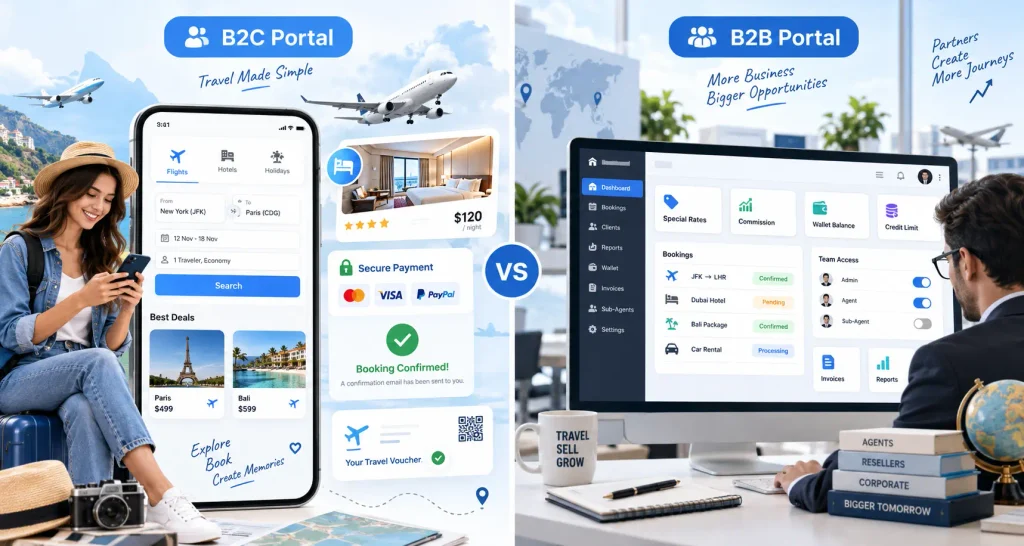
A dedicated B2B travel portal can also support multiple agent levels and distribution models that would be unnecessary in a normal consumer checkout.
| Area | B2C | B2B |
|---|---|---|
| Main User | Traveler | Agent, reseller or corporate account |
| Pricing | Retail selling price | Net rates, markups or commissions |
| Payments | Card or online gateway | Wallet, credit, deposit or gateway |
| Access | Public search or customer account | Controlled agent login |
| Documents | Customer invoice and voucher | Agent/customer documents and statements |
| Controls | Promotions and checkout rules | Credit, commissions, roles and account limits |
Many travel companies eventually run both channels from the same platform so inventory and booking records remain centralized.
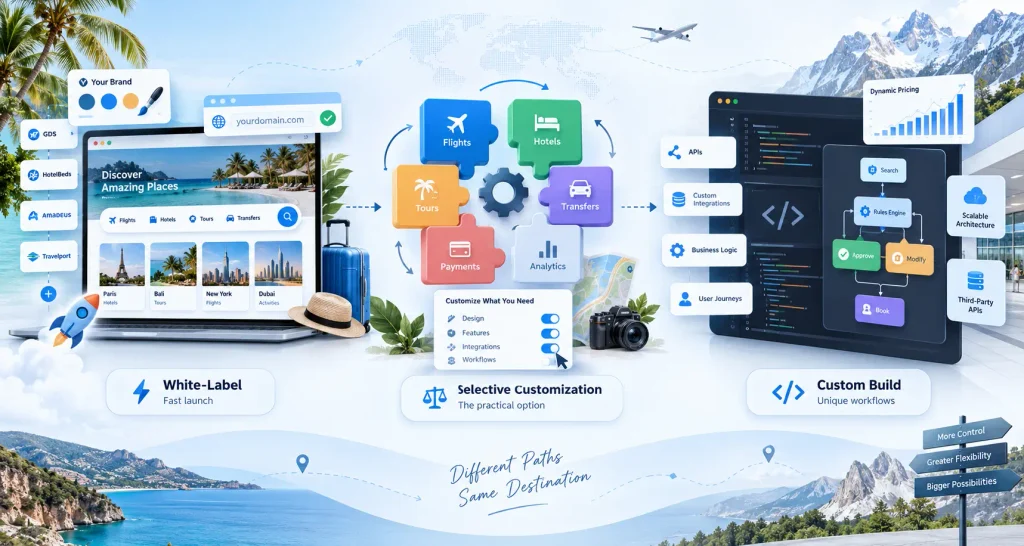
White-Label vs Custom Travel Software Development
A white-label booking system and a custom-built platform solve different business problems.
A white-label booking system is useful when speed to market matters. The core modules already exist, while the business applies its own branding, domain, supplier connections, and commercial settings.
Custom development is more appropriate when the company has unique booking logic, complex supplier combinations, specialized approval workflows, unusual pricing rules, proprietary integrations, or a user journey that cannot be handled efficiently by a standard platform.
A third option is often the most practical: start with proven travel modules and customize only the workflows that create a real competitive or operational advantage. This can reduce unnecessary development while preserving flexibility.
Architecture Features That Matter as Booking Volume Grows
Good travel software should be designed for real booking conditions, including slow suppliers, temporary API failures, changing prices, payment exceptions, and peak search traffic.
Important architecture decisions include:
API-first design. Booking, customer, payment, and supplier functions can be exposed through controlled APIs so web portals, mobile apps, and partner channels can use the same business logic.
Modular services. Flights, hotels, tours, cars, payments, CRM, and reporting should be organized so one module can evolve without forcing a complete rebuild.
Caching with revalidation. Search results may be cached for speed, but price and availability should be checked at the correct stage before confirmation.
Queue-based background tasks. Emails, vouchers, reporting updates, and non-critical processing can be separated from the main checkout flow where appropriate.
Logging and monitoring. Supplier errors, payment failures, and booking-status changes should be traceable so operations teams can investigate issues quickly.
Security and permissions. Role-based access, secure payment handling, protected credentials, audit logs, and controlled admin permissions are essential for systems handling customer and booking data.
Features to Prioritize in a Travel Booking Platform
Not every business needs every feature on day one. Prioritize the functions that support your actual sales model and supplier contracts.
For most agencies and OTAs, a strong first phase includes real-time search, booking management, supplier integration, payments, markup controls, notifications, invoices, vouchers, and basic reporting.
B2B businesses usually need agent accounts, wallets, credit limits, commission rules, sub-agent management, and account statements earlier in the project. Consumer-focused businesses may prioritize mobile performance, filtering, conversion-focused checkout, promotions, and customer self-service.
Companies selling flights may also need dedicated flight booking software, while hotel-focused businesses can use a specialized hotel booking engine for room search and reservation workflows.
Travel Software Development Process
A structured development process reduces rework and makes integrations easier to test.
1. Define the Business Model
Identify whether the platform will serve B2C customers, B2B agents, corporate users, or a combination. Define products, markets, currencies, languages, markups, commissions, and payment methods.
2. Confirm Suppliers and APIs
List each GDS, airline, hotel supplier, tour provider, car supplier, transfer provider, and payment gateway. Confirm that commercial contracts and API access are available before treating an integration as part of the launch scope.
3. Map the Booking Workflow
Document what happens from search to confirmation, including price checks, traveler details, payment, failed transactions, cancellation, refund, voucher, and notification flows.
4. Design the Platform Architecture
Choose how the booking engine, supplier layer, portal, admin panel, payment services, CRM, and reporting components exchange data.
5. Build and Integrate
Develop the customer and agent experiences, connect supplier APIs, add pricing rules, configure payments, and implement back-office workflows.
6. Test Real Scenarios
Test successful bookings as well as timeouts, unavailable inventory, changed prices, declined payments, duplicate requests, cancellations, refunds, and supplier errors.
7. Launch, Monitor and Improve
After launch, monitor search performance, supplier response quality, booking failures, conversion points, support issues, and operational bottlenecks. Development should continue based on real usage rather than assumptions.
What Affects Travel Software Development Cost and Timeline?
There is no reliable single price for travel software development because scope varies significantly.
The biggest cost and timeline drivers are usually the number and complexity of supplier integrations, booking modules, B2B/B2C requirements, custom pricing rules, payment methods, mobile apps, migration requirements, design complexity, reporting needs, and post-booking workflows.
A single-product portal with one supplier is much simpler than a multi-product OTA using several GDS and API sources with agent networks, corporate approvals, multiple currencies, and custom accounting connections.
For that reason, the best project estimate begins with a defined supplier list and workflow map rather than a generic feature count.
Build a Connected Travel Platform with PHPTRAVELS
PHPTRAVELS supports travel businesses that need booking engines, supplier integrations, B2B and B2C portals, payments, back-office tools, and custom workflows in one travel technology environment.
Depending on the project, businesses can start with existing modules and extend them through travel software development, connect preferred suppliers, and configure commercial rules around their own operating model.
You can also explore the live demo to review the platform workflow or check PHPTRAVELS pricing when comparing deployment options.
Conclusion
Travel software development is most valuable when it connects the full booking lifecycle rather than treating the website, supplier APIs, payments, agents, and back office as separate systems.
For agencies and OTAs, the strongest platform is one that can search reliable inventory, normalize supplier data, apply commercial rules, support B2B and B2C users, process bookings and payments, and keep operational records synchronized after confirmation.
Start by defining your suppliers, users, booking flow, and commercial rules. Then choose the combination of ready-made modules, integrations, and custom development that supports your current operation while leaving room to scale.