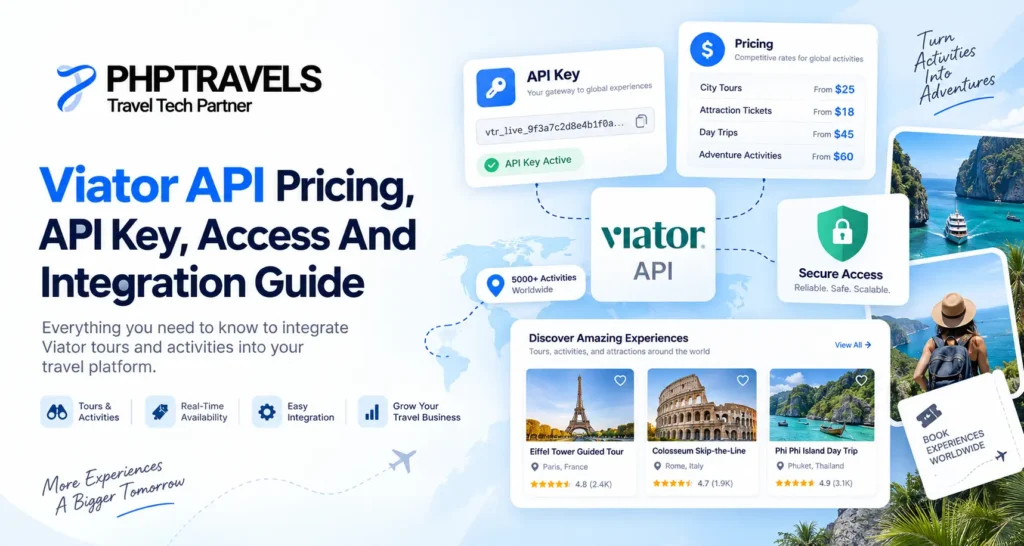
The Viator API lets travel websites, online travel agencies (OTAs), apps and booking platforms connect to Viator’s large catalog of tours, activities and experiences. Depending on your access level, you can display product content and availability, redirect travelers to Viator for checkout, or build a booking experience that keeps customers on your website.
Viator currently promotes an inventory of hundreds of thousands of experiences across thousands of destinations worldwide.
The key question is not simply, “Does Viator have an API?” but which Viator API access level fits your business model. Basic Affiliate API access is designed for quick self-service implementation, while Full, Full + Booking and Merchant access involve additional approval, qualification or certification.
If you want a ready-made technical implementation, PHPTRAVELS also supports Viator API integration inside a broader travel booking system.
Quick Answer: How Does the Viator API Work?
A traveler searches for an experience on your website. Your platform sends a request to the Viator Partner API, receives matching products, pricing and availability data, and displays the results in your own interface. What happens at checkout depends on your partner type.
With Basic or Full Affiliate Access, travelers are generally referred to Viator to complete the transaction. With Full + Booking Access, eligible affiliates can use booking functionality and payment solutions that keep the transaction on their site. Merchant partners can access all Partner API endpoints under a different commercial model.
What Is the Viator API?
The Viator API is a set of application programming interfaces that allows travel systems and affiliate partners to exchange travel-product data with Viator.
It can be used to build destination pages, search results, product pages, availability checks and, for partners with the required access, booking and cancellation workflows. The API gives travel companies a technical way to merchandise Viator experiences without manually maintaining every tour or activity in their own database.
For an OTA, the practical benefit is inventory expansion. Instead of manually adding each tour, a platform can connect the API to its front end and use Viator data alongside hotels, flights, transfers or other travel products.
Businesses building a broader distribution stack can also review how travel APIs work inside booking platforms.
Viator API Access Levels in 2026
Viator does not use one identical access model for every partner. The main Partner API options are:
| Access level | Approval | Checkout | Typical use |
|---|---|---|---|
| Basic Affiliate | Self-service | On Viator | Fast product merchandising |
| Full Affiliate | Approval + certification | On Viator | Richer content and deeper integration |
| Full + Booking Affiliate | Approval + certification | On partner site | Custom booking flow |
| Merchant | Qualification + certification | On partner site | End-to-end commerce |
One important correction to many older Viator API guides is that Basic Affiliate API access is not restricted to manually approved enterprise partners.
Viator states that affiliate accounts receive Basic Access immediately, with no prior approval or minimum requirements. Partners can later request Full or Full + Booking Access, which require approval and certification.
For businesses comparing API-led selling with other models, PHPTRAVELS also explains how travel businesses can sell tours online.
How to Get a Viator API Key
Getting a Viator API key depends on the integration type, but Basic Affiliate Access has a straightforward starting path.
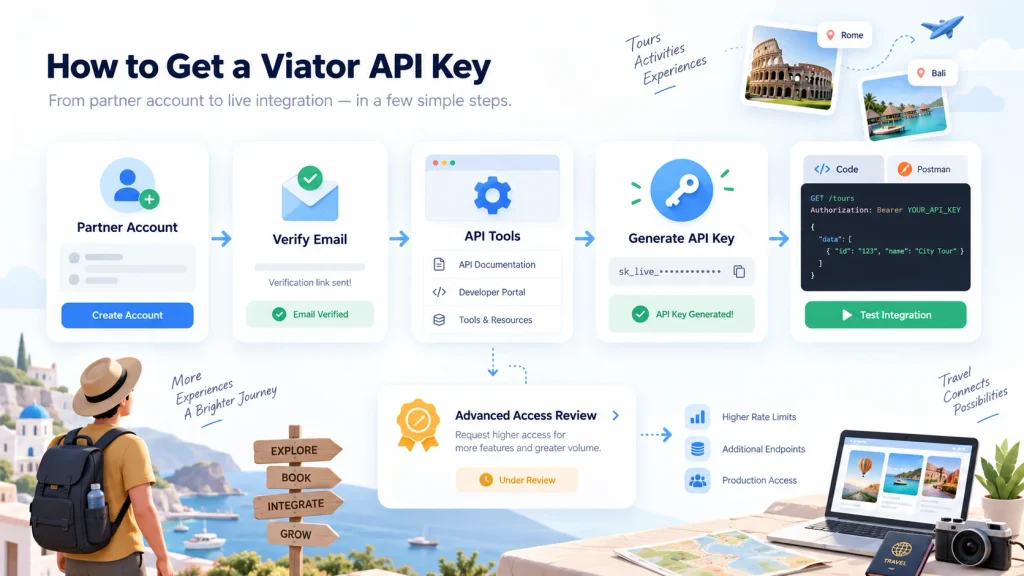
Create a Viator Partner Program affiliate account. Once the account is active, Basic API access is available by default. Viator’s Basic Access implementation guide says partners can generate an API key from the account dashboard under Tools → Affiliate API → Start your development after verifying their email address.
The API key is then used to authenticate requests. Viator also provides Postman collections that developers can use while testing the integration.
If your project needs Full, Full + Booking or Merchant capabilities, expect additional review. Full and Full + Booking partners must be approved and complete certification before going live. Merchant applicants follow a separate qualification, development and certification process.
The API key is only one part of the project. You still need product ingestion, caching, search UX, error handling, booking logic and secure production deployment.
PHPTRAVELS’ travel API integration services cover that wider implementation layer.
Viator API Pricing: How Much Does the API Cost?
For the Affiliate API, Viator says there is no signup cost and no cost to obtain additional API access. The API therefore does not follow the normal SaaS model where developers pay a monthly API subscription.
Instead, the commercial model is connected to bookings and commissions.
Viator publicly advertises an 8% commission on completed bookings through its standard affiliate program. Affiliate referrals also use a 30-day attribution window: when someone follows an eligible affiliate link, bookings made within that attribution period can generate commission.
For API partners specifically, Viator’s Affiliate API information describes partners as receiving the applicable standard commission rate on qualifying bookings. Because commercial terms can depend on the program or contract, businesses should confirm the exact rate shown in their own Partner Dashboard or agreement rather than assuming every advanced API relationship has identical terms.
Merchant API economics are different. Viator states that there is no setup fee for Merchant partners, but a deposit is required before live bookings. The deposit is based on expected sales and is determined during qualification.
If your primary goal is affiliate monetization rather than building an API-first OTA, read the PHPTRAVELS guide on earning with the Viator affiliate program.
Viator API Documentation and Common Endpoints
The official Viator API documentation covers authentication, endpoint access, product content, availability, booking, cancellations, testing and partner-specific implementation requirements.
The exact endpoints available depend on your access level. Common Partner API functions include:
- Product search for finding tours and activities using destinations and filters.
- Product details for retrieving information about an individual experience.
- Availability schedules for dates, product options and pricing.
- Real-time availability checks for eligible access levels.
- Booking hold and booking endpoints for Full + Booking affiliates and Merchant partners.
- Booking status and cancellation endpoints for transactional integrations.
- Destinations, locations, exchange rates, attractions and reviews for richer product merchandising.
For example, Viator documents /availability/check for real-time price and availability checks, while booking-enabled partners can use booking-hold and booking endpoints as part of the checkout flow.
Viator’s Partner API uses REST-style requests and JSON. The documentation also includes sandbox environments and Postman collections so developers can test before sending production traffic. Viator specifically states that testing should be performed in the sandbox rather than against production endpoints.
A stable integration also needs a reliable connection between supplier data, website search, checkout and your own booking records. A structured travel booking software platform can reduce the amount of custom development required around the API itself.
Viator Partner API vs Viator Supplier API
The term “Viator supplier API” refers to a different integration from the standard Viator Partner API, and understanding this distinction is important.
The Viator Partner API is primarily for affiliates, OTAs, travel platforms and merchants that want to display and sell Viator inventory to travelers.
The Viator Supplier API, now documented as the Viator Reservation System API, is intended for tour operators and authorized reservation-system providers that need their own booking system to communicate with Viator. Its workflows include availability and pricing synchronization, reservations, bookings, amendments, cancellations and product mapping.
Viator’s current Supplier API documentation states that access is restricted to registered Viator operators and authorized reservation-system providers following technical evaluation and formal approval.
For new Supplier API integrations, JSON is the supported format. XML remains available for certain legacy integrations but is deprecated and scheduled for eventual retirement.
So, if you want to sell Viator experiences to travelers, you are normally looking for the Partner API.
If you are a tour operator or reservation-system provider trying to connect your own inventory, availability and bookings with Viator, the Supplier API is the relevant integration.
How to Integrate the Viator API Step by Step
A practical Viator API integration can be planned in six stages.
- Choose the correct partner model. Decide whether Basic Affiliate, Full Affiliate, Full + Booking or Merchant access matches your checkout and customer-experience requirements.
- Create your account and obtain credentials. Generate an API key for Basic Affiliate development or complete the necessary qualification process for more advanced access.
- Build product discovery. Connect destinations, product search and product-detail functionality so travelers can find relevant tours and activities. Follow Viator’s caching requirements rather than making unnecessary real-time requests.
- Add availability and pricing. Use the endpoints permitted by your access level to show schedules and current prices. Booking-enabled integrations should perform the required real-time availability check before checkout.
- Implement the checkout or referral flow. Basic and Full Affiliate integrations normally send travelers to Viator to complete the transaction. Full + Booking and Merchant integrations can support more integrated transaction flows.
- Test, certify and monitor. Test in Viator’s sandbox, handle API errors and timeouts, verify booking status correctly and complete certification where your access type requires it.
For agencies that want tours alongside other travel modules, a tour management system can provide the surrounding back-office functionality for managing products, bookings and operations.
Who Should Use the Viator Developer API?
The Viator Partner API is best suited to businesses with a clear distribution or booking use case, including:
- Online travel agencies and travel marketplaces
- Travel booking websites and mobile applications
- Destination and “things to do” platforms
- Airlines, loyalty programs and e-commerce brands adding experiences
- Travel technology providers building multi-supplier booking systems
- Travel agencies that want a deeper branded tours-and-activities experience
A small content or affiliate website may not need Full + Booking access. Basic Affiliate Access can be enough when the objective is to show relevant experiences and refer travelers to Viator.
A larger OTA that wants customers to remain on its website throughout checkout may have a stronger reason to pursue Full + Booking or Merchant access.
Travel agencies that do not need a custom API implementation can also compare the simpler advisor model in PHPTRAVELS’ guide to Viator for travel agents.
Conclusion
In 2026, the Viator API offers several paths into the tours-and-activities market. Basic Affiliate Access provides a fast way to begin using product content, while Full and Full + Booking support deeper integrations. Merchant access is designed for businesses that require greater control over the commerce relationship, while the separate Supplier API serves tour operators and reservation-system providers.
For most travel businesses, the best approach is to select the commercial model first and then design the technical integration around product search, availability, checkout, booking status and post-booking workflows.
If you want to connect Viator to an existing OTA or build a new multi-supplier travel platform, PHPTRAVELS can help with the integration layer, booking flow and surrounding travel technology needed to turn the API into a usable customer experience.