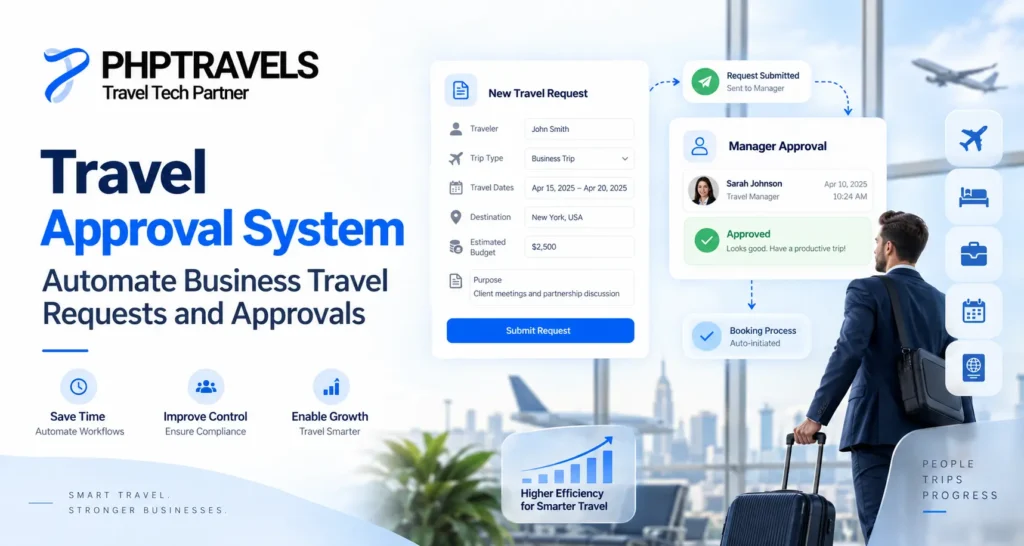
The Travel Approval System & Software gives companies a controlled way to review business trips before money is committed. Instead of relying on email chains, spreadsheets, chat messages, and manual follow-ups, travel approval software routes each request to the right approver, checks the trip against company policy, records the decision, and connects the approved request with booking and expense processes.
For finance, HR, travel managers, and department heads, the value is visibility. They can see why an employee needs to travel, the estimated cost, whether the request follows policy, who approved it, and what happens next. Employees also get a clearer process because they know what information is required and where the request stands.
A well-designed travel approval workflow can sit inside a wider business travel management system, allowing requests, approvals, bookings, policy controls, and reporting to work together.
What Is a Travel Approval System & Software?
A Travel Approval System & Software is software that manages the process of requesting, reviewing, approving, rejecting, or escalating business travel before or during booking. It acts as a travel request management tool for employees and approvers while giving finance and travel teams a consistent record of each decision.
The system usually collects trip details such as traveler name, department, destination, dates, business purpose, estimated fare, hotel budget, project or cost center, and any policy exception. It then applies company rules and sends the request to the correct manager, finance approver, travel desk, or other stakeholder.
Travel Approval System & Software is different from a simple booking engine. A booking engine helps a user search and reserve travel. An approval system controls whether the trip should proceed, under what conditions, and who is authorized to approve it. In a connected setup, both functions work together so an approved request flows into booking.
Companies that need broader control across travelers, departments, and suppliers can connect approvals with corporate travel management software.
Why Companies Use Travel Approval Software
Manual approval processes create friction because information is scattered. An employee may send a flight screenshot in chat, explain the trip by email, wait for a manager response, and then forward the approval to finance. If the fare changes or the trip falls outside policy, the process may start again.
Travel Approval System & Software standardizes this sequence. Required fields can be enforced, and approval rules can change based on cost, department, destination, traveler type, or policy status.
This helps reduce unauthorized bookings, slow approval cycles, inconsistent policy decisions, and weak audit trails. It also separates routine requests from exceptions. A low-cost domestic trip may need one manager approval, while an international or out-of-policy trip may require finance, HR, or senior management review.
The result is a repeatable business process that can be measured and improved.
How a Corporate Travel Approval Workflow Works
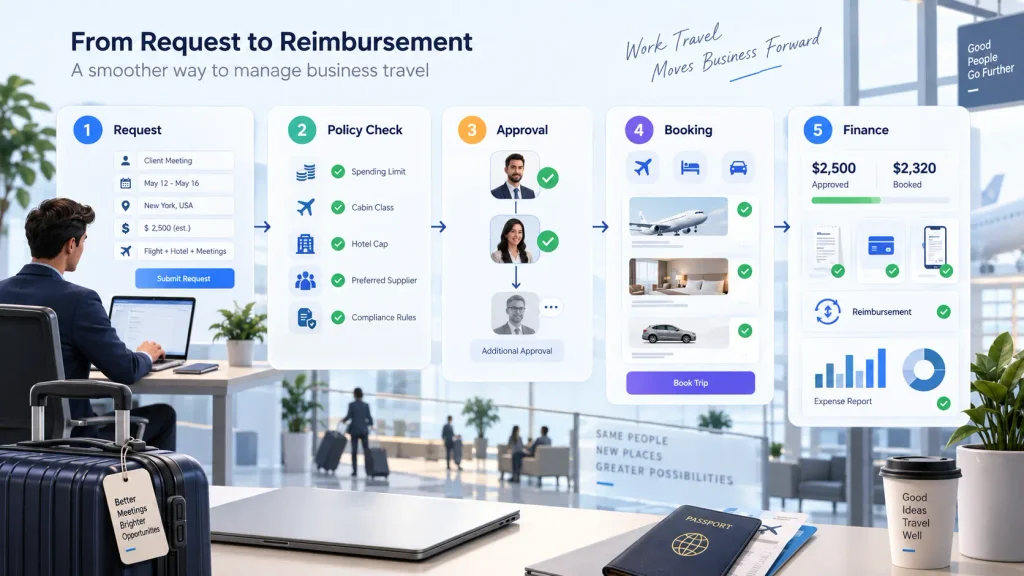
A corporate travel approval workflow begins when an employee creates a business travel request containing the purpose, dates, destination, estimated cost, itinerary, cost center, and any information required by company policy.
The software evaluates the request against configured rules such as spending limits, cabin class, hotel rate caps, preferred suppliers, advance-purchase rules, destination restrictions, project budgets, or traveler roles.
If the request is within policy, it can be routed to the designated approver. If it exceeds a threshold or requires an exception, the system can add another approval level. Multi-level workflows are especially useful for larger organizations.
After approval, the request can move to booking authorization. In a connected environment, approved travelers continue to a booking flow using company-approved inventory and supplier connections. Companies can review available travel integrations when planning how approval and booking processes should connect.
The approval record should remain attached to the trip. Finance teams can compare the approved amount with the booked amount and later connect the trip to expense reporting. Travel expense management software can extend the workflow into receipts, reimbursements, and finance reporting.
Key Features to Look for in Travel Approval Software
The most useful Travel Approval System & Software solutions are configurable rather than fixed. Different companies have different reporting lines, budgets, policies, and risk requirements, so the software should adapt to the organization.
Important capabilities include multi-level approvals, role-based permissions, policy checks, approval thresholds, escalation rules, delegation, mobile-friendly approvals, notifications, audit history, cost-center mapping, and integration options.
A strong system should make exceptions visible. If a requested hotel exceeds the nightly limit, the approver should see the policy rule, requested amount, and reason for the exception before deciding.
For global teams, the system should support different business units, currencies, branches, approval chains, and local policy rules without losing central reporting. This matters when global travel management systems use approval workflows across several countries or departments.
Travel Approval App vs Web-Based Approval Portal
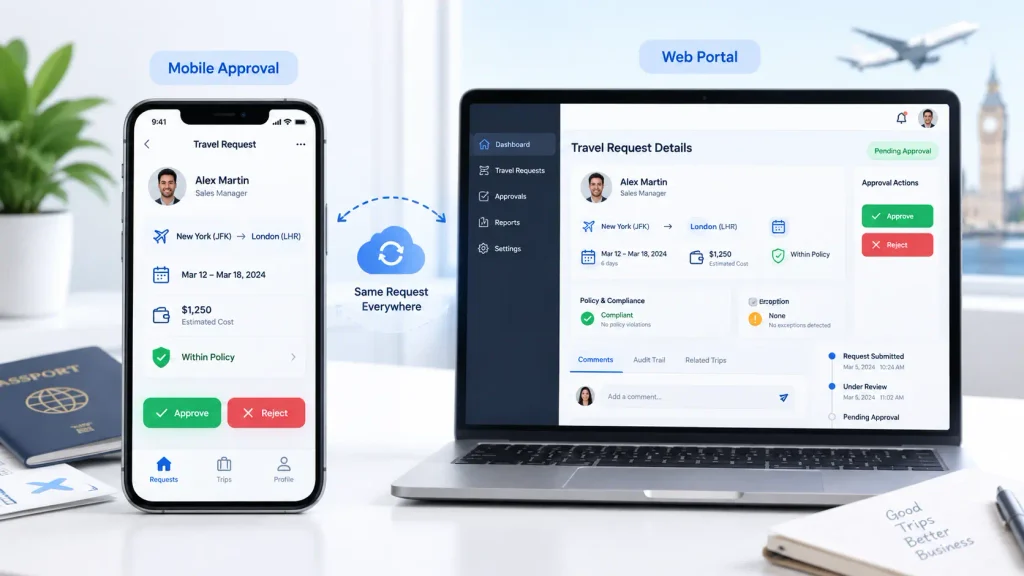
The query “travel approval app” usually reflects a simple need: managers want to approve or reject requests without being tied to a desktop.
A mobile-friendly travel approval app or responsive portal should show the essential decision data clearly: traveler, route, dates, business purpose, estimated cost, policy status, exception reason, and approval deadline.
Mobile access is most useful when it is part of the same workflow as the desktop system. Managers can act quickly while the decision, comments, timestamps, and audit trail stay in the central platform.
How Global Travel Management Systems Handle Approval Workflows
Global travel programs are more complicated because one approval rule rarely works for every office. A company may allow different hotel limits by city, different cabin classes by flight duration, or different approval levels by legal entity.
A scalable Travel Approval System & Software should support rule-based routing by country, branch, department, employee grade, trip cost, project code, or policy exception. This provides local flexibility while preserving group-level oversight.
Global programs also need a consistent source of truth. When approvals happen separately in email, chat, booking tools, and finance systems, it becomes difficult to reconstruct why a trip was approved. Centralizing the approval record improves reporting and policy review.
A travel booking software platform can sit alongside approval, supplier, and finance integrations as part of a wider corporate travel stack.
Business Travel Request Software for Finance, HR, and Managers
Business travel request software affects several teams, not only travelers. Finance needs cost visibility before purchase and may want requests linked to departments, budgets, projects, or client codes. HR may care about traveler profiles, permissions, destination rules, or employee status. Managers need enough context to decide without reviewing policy documents manually.
Travel teams need to see which requests are pending, approved, rejected, or waiting for changes. They also need delegation or escalation when an approver is unavailable.
A good travel request management tool connects these roles through one workflow while preserving the permissions each team needs.
Steps to Secure Internal Approval for a New Corporate Travel Provider
When a company is considering a new corporate travel provider, the internal approval process should be treated as a business case rather than only a software purchase.
Start by documenting the current process and its problems. Show where approvals are delayed, where policy is difficult to enforce, how many tools are involved, and which teams perform manual work. Then define requirements for the new provider, including booking content, approval workflows, integrations, reporting, support, security review, and implementation responsibilities.
Involve the right stakeholders early. Finance, procurement, HR, IT, security, travel operations, and frequent travelers may evaluate different parts of the solution. Use clear acceptance criteria so each team knows what it is approving.
A demo or pilot can test real scenarios: an in-policy trip, an out-of-policy request, a multi-level approval, a delegated approval, and a booking that changes after authorization.
Finally, compare the proposed operating model with the current one. The strongest internal case explains how the platform will reduce manual steps, improve control, and create better travel data.
Integrating Travel Approvals With Booking and Supplier APIs
Approval automation becomes more useful when connected with live travel content and booking systems. If an approved request cannot move smoothly into booking, employees may still leave the managed process and book elsewhere.
Travel integrations can connect the approval layer with GDSs, supplier APIs, payment services, and internal systems. PHPTRAVELS supports travel technology integrations including Amadeus, Sabre, and Travelport.
For companies evaluating specific connections, see Amadeus API integration, Sabre API integration, and Travelport API integration.
The objective is continuity: request, policy check, approval, booking, payment, and reporting should pass data forward without unnecessary re-entry.
How to Measure Travel Approval Workflow Performance
A Travel Approval System & Software should be measured after implementation. Useful metrics include average approval time, percentage of requests approved within target service levels, number of policy exceptions, percentage of bookings made after approval, approval-to-booking conversion, rework, and manual interventions.
Finance can also track planned versus booked cost and the percentage of trips linked correctly to a department or cost center. Travel managers can review common exception reasons to determine whether policy needs adjustment or clearer communication.
The best process is not the one that approves everything quickly. It routes routine requests efficiently while giving higher-risk or higher-cost trips the right level of review.
Choosing a Travel Approval System
When comparing a Travel Approval System & Software, start with the workflow rather than the feature list. Map how a request should move through your organization, identify who can approve what, define policy exceptions, and decide what should happen after approval.
Then test whether the system supports your real structure. Ask whether approval levels are configurable, whether rules can be changed without development work, whether managers can delegate approvals, whether the audit trail is complete, and whether the platform connects with your booking and finance environment.
Also review deployment and ownership requirements. Some organizations prefer a hosted service, while others want more control over customization, integrations, or source code.
For a broader comparison beyond approvals, see the guide to choosing corporate travel management software.
Conclusion
A Travel Approval System & Software turns business travel from a collection of messages and manual checks into a controlled workflow. Employees submit structured requests, policies are evaluated consistently, the correct managers review exceptions, and approved trips can move into booking with a clear decision record.
For growing companies, governance matters as much as booking. A consistent approval record helps finance review planned spend, managers assess exceptions, and travel teams follow up on pending decisions without relying on disconnected messages.
A Travel Approval System & Software can enhance transparency throughout the process for expanding enterprises. Financial departments can anticipate expenditures prior to making reservations, while managers gain improved context for their approvals. Additionally, travel teams can minimize the need for follow-up tasks, and the organization benefits from maintaining a dependable audit trail.
If you are planning a connected approval and booking workflow, explore PHPTRAVELS corporate travel management software or review a live demo.