At 8:40 on a Monday morning, a corporate traveler asks an agency for a flight that is not showing in the same way it did last month. The preferred airline has a richer bundle, a different seat map and an offer that may only be available through a newer distribution connection. The agency may technically “have NDC somewhere in its supplier list. Yet the agent still cannot search it confidently, compare it with the traditional GDS result, ticket it under the right policy and service it later.
That gap explains the real state of NDC for travel agencies. The standard is gaining ground, but adoption is uneven. One widely cited industry benchmark puts NDC at roughly 24% of indirect airline sales; meanwhile, many corporate travel programs still report zero NDC bookings. The lesson is not to panic or to dismiss NDC. It is to ready the booking stack so your agency can choose the right content, workflow and supplier at the right time.
1. The Agency That “Had NDC” but Still Couldn’t Sell It
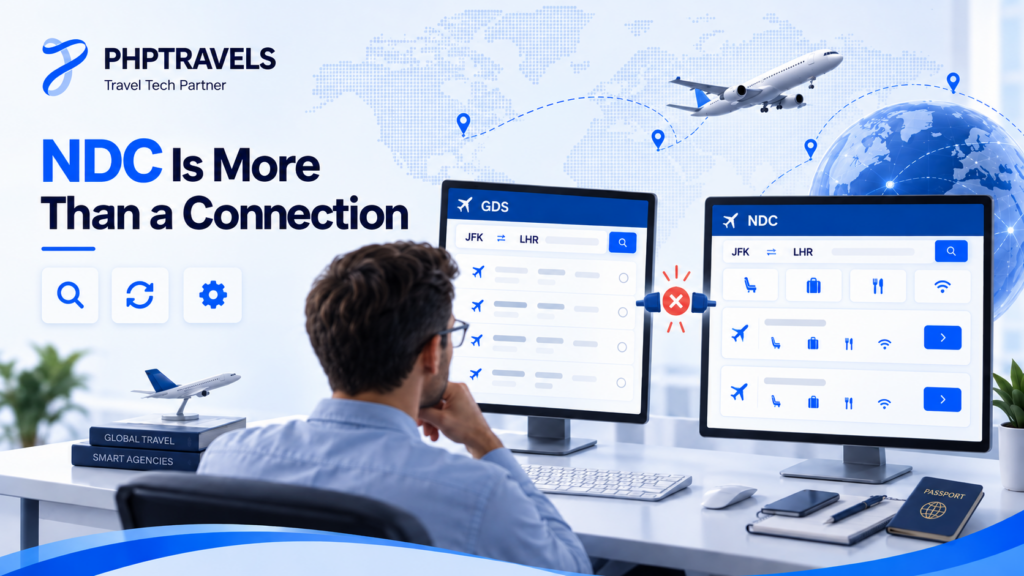
Consider a mid-sized agency that signed an airline connection and announced that it was NDC-ready. In practice, the connection lived in a separate portal. For NDC for travel agencies, that separation creates friction: the agent had to re-key traveler details, the fare rules looked different, and the servicing team could not see the same record in the agency’s normal workflow. Search was possible; a dependable sale was not.
This is a common implementation trap for NDC for travel agencies. NDC is not a feature toggle. It changes how offers are created, compared, booked, paid for and serviced. A modern offer may include branded bundles, paid seats, bags, meals or other ancillaries. Those options can be valuable, but only if the agency can present them clearly, apply its commercial rules and retrieve the booking when a customer calls.
The agency in our story did not need more hype. It needed one controlled workflow connecting search, revalidation, ticketing, reporting and after-sales service. That is the starting point for any serious NDC plan. Before asking which airline connection to add, ask whether your booking software can make the connection operationally useful.
If you want to see how a travel platform can support a broader flight-sales workflow, explore the PHPTRAVELS flight booking software overview, then request a demo around your own use case.
2. What NDC Actually Is, and What It Is Not
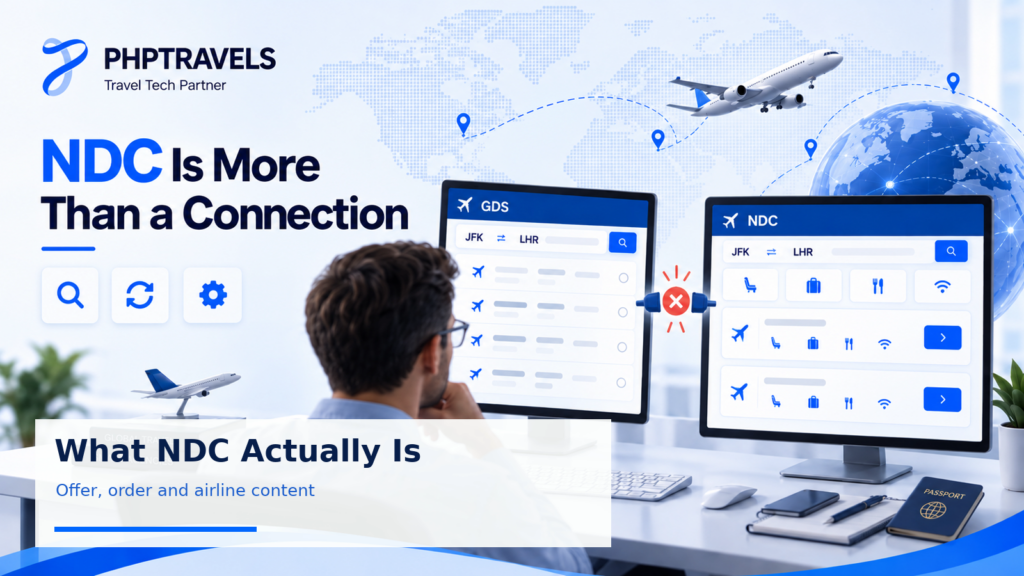
New Distribution Capability, or NDC, is an airline distribution standard associated with richer, more flexible offer and order data. For NDC for travel agencies, it can represent a branded fare, a seat, a bag, a meal, a policy or a tailored bundle more directly than a simple legacy fare display.
For an agency, NDC is best understood as an additional content and transaction pathway. It can sit alongside a GDS connection, airline direct content or other authorized sources. NDC does not replace every GDS workflow, and it does not automatically make every airline offer available to every seller.
NDC is also not free inventory. A software licence is not an airline contract, an accreditation, a payment arrangement or permission to ticket. Each agency must establish the relevant commercial relationship and maintain its own credentials. Depending on the market and supplier, that may involve Amadeus, Sabre, Travelport and/or direct airline NDC access.
The practical distinction is important: NDC can improve the way offers are distributed, but the agency remains responsible for sourcing, validating, selling and servicing them lawfully and accurately. Treat it as part of a distribution strategy, not as a shortcut around supplier obligations.
3. Why NDC Adoption Still Lags Across Travel Agencies
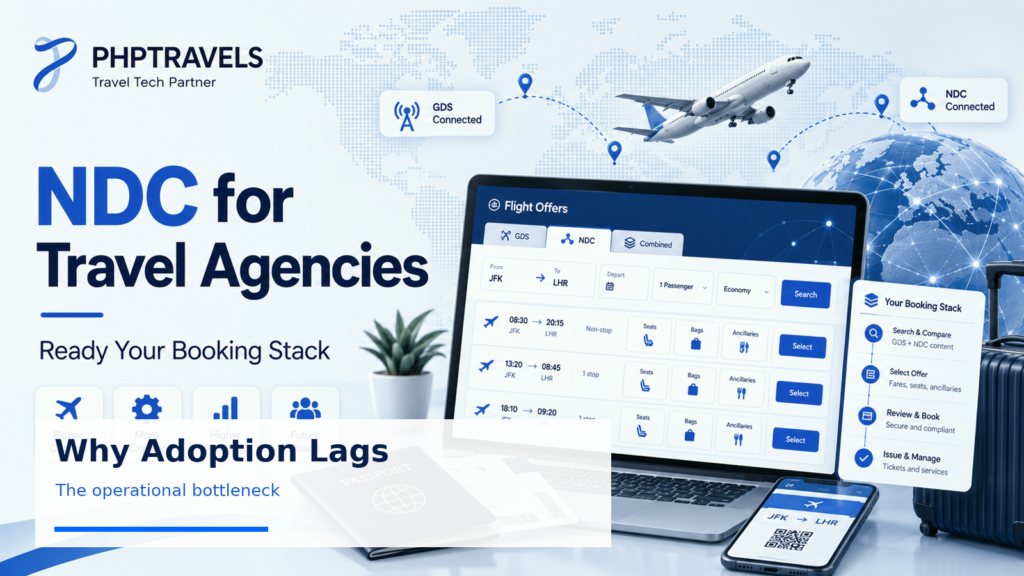
The headline percentage can make adoption look simple. The operational reality is not. A directional figure of about 24% of indirect airline sales shows meaningful progress, but it does not mean that every market, airline, route, corporate account or agency has the same level of access. Content coverage is fragmented, and some programs still record no NDC bookings at all. For NDC for travel agencies, readiness means measuring the workflow rather than repeating a headline.
Why? First, agencies must evaluate commercial value. For NDC for travel agencies, an airline may offer attractive ancillary content, but the margin, payment terms and change rules need to work for the agency and its customers. Second, the workflow can be harder than a familiar GDS process. Offer IDs expire, prices need revalidation, and order servicing may require different actions.
Third, corporate travel has policy and duty-of-care requirements. A richer offer is not useful if it cannot be reported, approved, exchanged or refunded in the way a client expects. Fourth, skills and incentives lag. Agents may avoid a new path when it adds clicks or creates uncertainty during a busy service call. NDC for travel agencies succeeds when the policy path is as clear as the offer path.
Finally, integration budgets are finite. NDC for travel agencies must fit the existing operating model, not just a supplier roadmap. An agency may have legacy booking, accounting, CRM and back-office systems that were never designed for order-based content. The sensible response is not to force every booking through NDC immediately. It is to measure where NDC improves the customer proposition and build a reliable path for those use cases.
4. What Agencies Need in an NDC-Ready Booking Stack
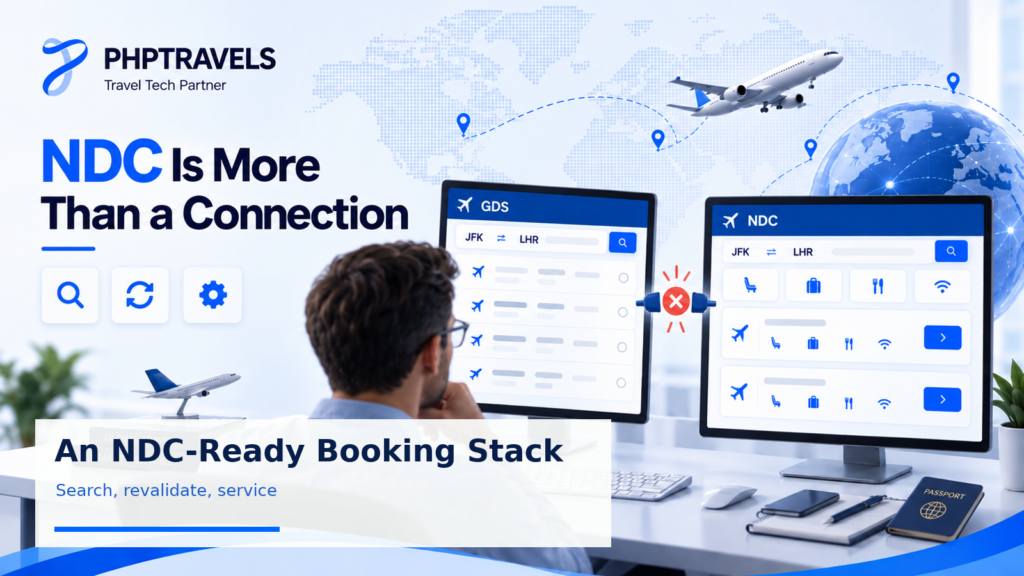
An NDC-ready stack should give agents choice without giving them chaos. At minimum, assess these capabilities:
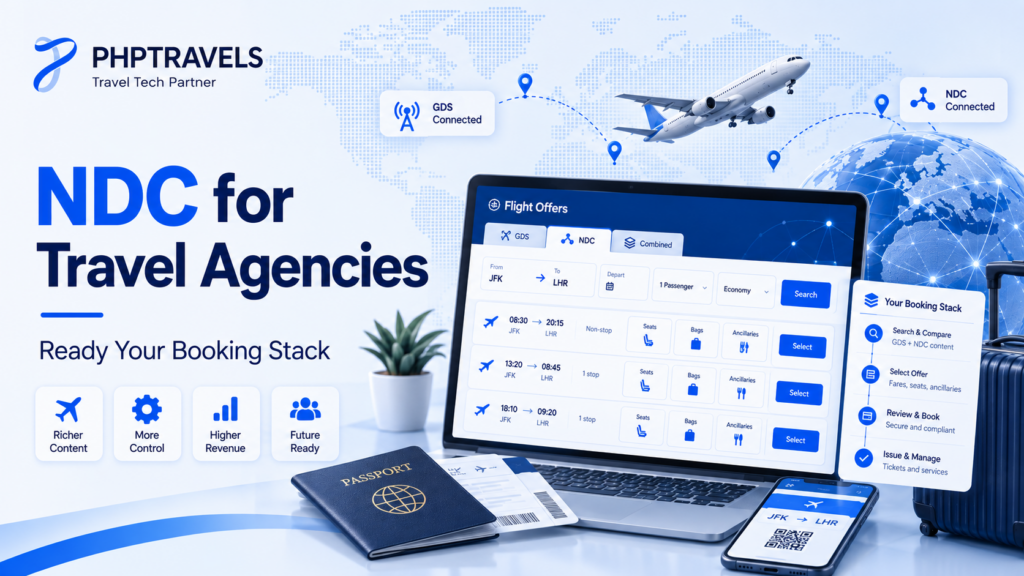
- Unified search and comparison: show GDS and NDC content with clear source, rules, baggage and ancillary information.
- Offer lifecycle controls: store offer references, revalidate price and availability, and handle expiry without misleading the traveler.
- Booking and payment discipline: keep supplier credentials server-side, record transaction states and prevent duplicate booking or charging.
Security and governance matter as much as the interface. Your agency should know who can access each supplier, which credentials are active, what happens when a supplier times out and how a failed payment is reconciled. It should also document the customer-facing explanation when two sources show different products or rules.
This is why an NDC project is a booking-stack project. Review your current connections and roadmap on the PHPTRAVELS integrations page, and use the comparison page to frame the capabilities you need before committing to a deployment.
5. Why Agencies Should Move Now Without Buying Into FOMO
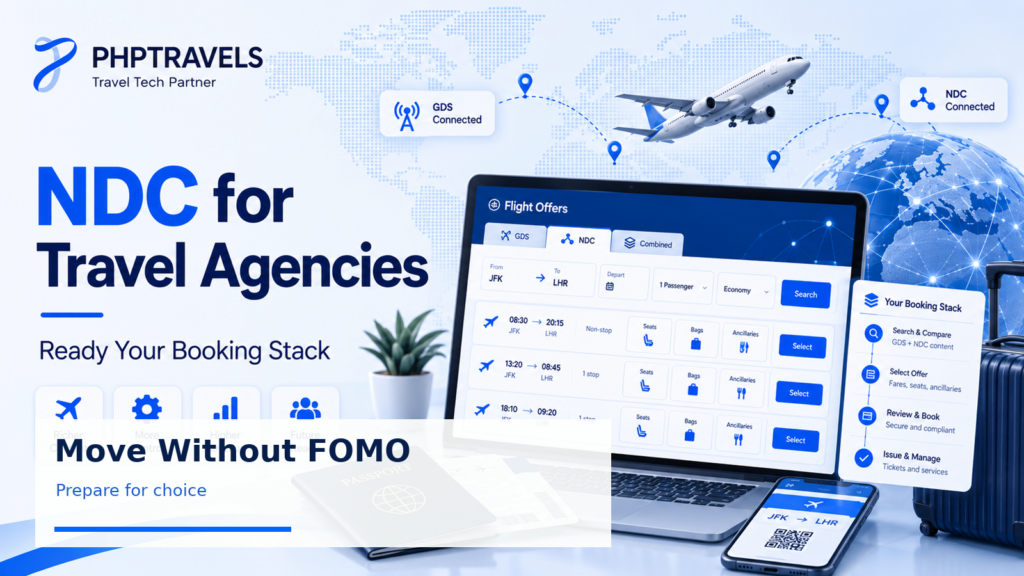
There is a rational reason to move now: airlines, GDS providers and large online agencies are investing in richer distribution, and their learning curves are getting steeper. Waiting until a major account demands a specific bundle can leave an agency trying to redesign search, contracting, reporting and servicing under pressure.
That does not mean buying every connector or promising that NDC will replace the GDS next quarter. FOMO creates bad technology decisions. A better approach is option value. Map the airlines and corporate accounts that matter, identify content gaps, run one measurable pilot and make sure the underlying platform can add approved sources without a full rebuild.
Watch for practical signals: more requests for branded fares, more airline-specific ancillaries, declining value in a single legacy path, or a client asking why a direct offer is missing. If competitors can respond faster because they already have a flexible stack, the cost of waiting is not just technical. It may be lost relevance with agents and travelers.
Prepare for choice, not a cliff edge. A platform that handles both established GDS workflows and authorized NDC connections lets your team adopt at the speed of commercial evidence. Book a PHPTRAVELS demo to discuss a phased approach rather than a fear-driven migration.
6. Where PHPTRAVELS Fits—Honestly
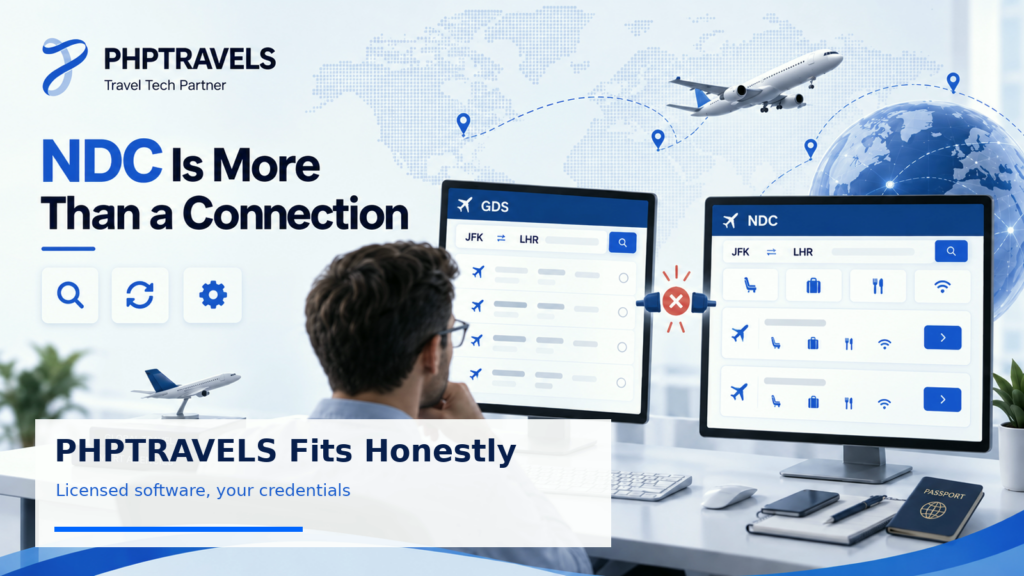
PHPTRAVELS is commercial licensed travel booking software with source included. It can be evaluated as the application layer for an agency that wants to organize flight selling, portals, workflows and integrations around its own commercial relationships. For NDC for travel agencies, this means a practical software foundation rather than an inventory promise. That is useful, but it is not a promise that the software supplies airline inventory by itself.
Buyers need their own Amadeus, Sabre, Travelport and/or airline NDC credentials, contracts and permissions. They remain responsible for supplier onboarding, payment arrangements, accreditation, compliance and the terms attached to each connection. PHPTRAVELS does not provide free inventory, and purchasing the licence does not automatically grant third-party access.
The honest fit is therefore flexible infrastructure and an implementation conversation. Your team can define which content should be exposed to agents or customers, which markets need a GDS fallback, how markups are applied and where human approval is required. Before buying, bring your supplier list and servicing requirements to a demo. For commercial licensing details, visit PHPTRAVELS pricing and ask the sales team to confirm scope for your deployment.
7. A Practical 90-Day NDC Readiness Plan
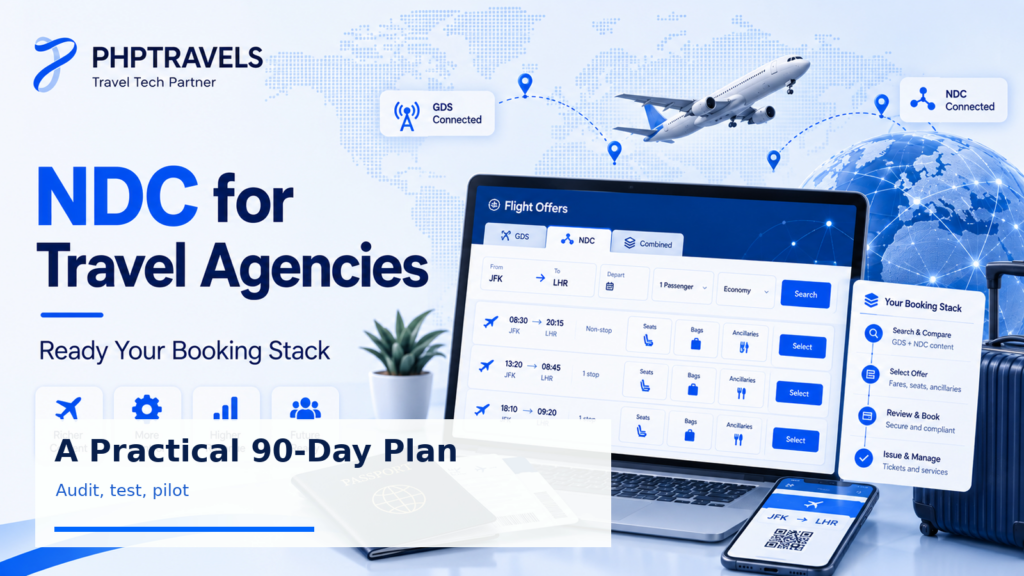
Days 1–30: establish the baseline. List your airline, GDS and other supplier relationships; confirm credentials and contractual permissions; document your current search-to-service journey; and interview agents about friction. Choose one customer or market segment where richer content could create measurable value.
Days 31–60: design and test. Define the offer fields you must display, the revalidation rule, markup logic, payment states and exception paths. Test the selected connection with realistic changes, cancellations and failed responses. Confirm that bookings reach reporting, accounting and customer communications. Train a small group of agents and capture time-to-quote, conversion and service effort.
Days 61–90: pilot and decide. Release the workflow to a controlled audience, monitor acceptance and post-booking cases, and compare results with the existing path. Keep a clear fallback. At day 90, decide whether to expand, adjust the supplier mix or stop the use case. Readiness is a repeatable operating habit, not a one-time badge.
Need help turning that plan into a product shortlist? Schedule a PHPTRAVELS demo, review licensing options, and involve the people who will actually service the order—not only the team that connects the API.
8. NDC for Travel Agencies: FAQ
Is NDC replacing the GDS?
Not in one step. NDC is an additional distribution pathway, and many agencies will need GDS plus NDC capability so they can match content to the customer, market and supplier.
Why can an agency have NDC access but no NDC bookings?
Access may exist without a usable workflow. Gaps in search, policy, payment, reporting, agent confidence or after-sales servicing can keep bookings at zero.
Does PHPTRAVELS include airline credentials or free inventory?
No. PHPTRAVELS is commercial licensed software with source included. The buyer brings its own supplier contracts, credentials and permissions, including any Amadeus, Sabre, Travelport or airline NDC access.
What should an agency do first?
Map its current booking and servicing journey, choose one evidence-based pilot, verify the required integrations, and test the
complete lifecycle before scaling. Request a demo or review pricing information to start that conversation.
For standards context, read the official IATA NDC guidance and review the NDC certification resources before planning a connection.