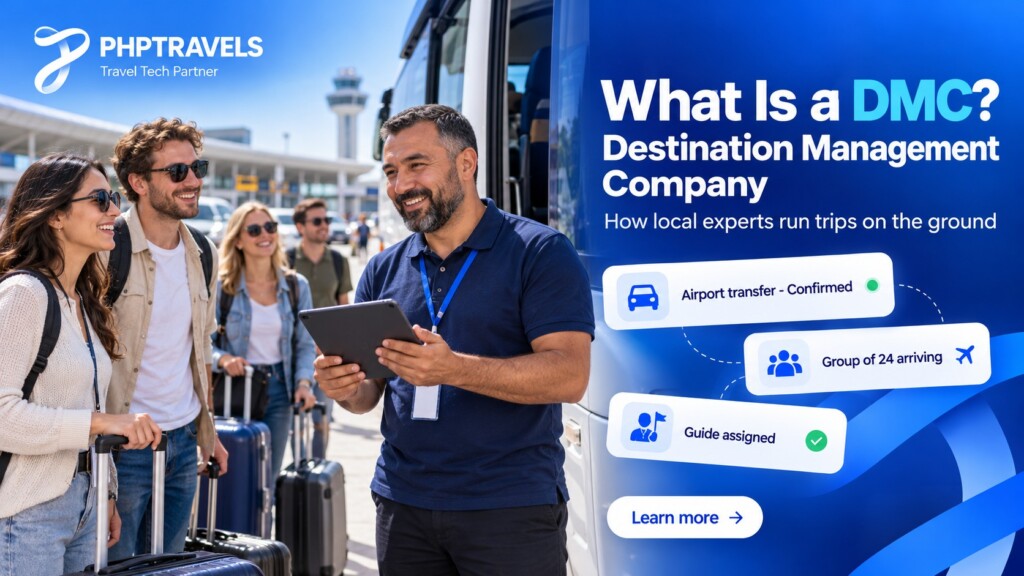
A destination management company (DMC) is a local business that designs and runs travel services on the ground in its own destination: airport transfers, hotels, guided tours, excursions, events and the logistics that tie them together. Travel agencies, tour operators and event planners in other countries hire a DMC so they do not have to find, contract and supervise dozens of local suppliers themselves.
If you run an agency, a DMC is often the difference between selling a destination you know from brochures and selling one you can actually deliver. This guide explains what a DMC does, how it differs from a tour operator, a travel agency and a tourism board, how the B2B workflow and pricing work in practice, how to vet a partner, and what software a DMC needs to run without spreadsheet chaos.
- Who it is: a ground specialist based in one destination, with local staff, contracts and vehicles or vehicle partners.
- Who buys from it: foreign travel agencies, outbound tour operators, MICE and incentive planners, corporates and sometimes online travel agencies.
- How it sells: mostly B2B, at net rates that the buyer marks up.
- What it is not: a destination marketing organisation (a tourism board) or a retail travel agency.
What is a destination management company (DMC)?

The Association of Destination Management Executives International (ADMEI) defines a DMC as a professional services company possessing extensive local knowledge, expertise and resources, specializing in the design and implementation of events, activities, tours, transportation and program logistics. Two words in that definition matter most for agencies: design and implementation. A DMC does not just resell a hotel room or a city tour. It builds the programme and then makes it happen on the day.
ADMEI compares the role to a design-and-build construction firm: the DMC is both the architect who draws up the programme and the general contractor who hires the sub-contractors, handles permits and insurance, manages the money and supervises on site (ADMEI, “The Evolving DMC”). That is why a good DMC quote looks more like a project budget than a price list.
Outside travel the acronym has other meanings, but in the travel trade DMC almost always means this kind of company. You will also hear related labels:
- Ground handler or ground agent: often a narrower role focused on transfers, meet-and-greet and basic logistics.
- Inbound tour operator: a company that packages its own country for foreign buyers. Many DMCs are also inbound tour operators, and the terms are often used interchangeably.
- Local partner or receptive operator: common wording in contracts and in North American usage.
A simple example: an agency in Lahore sells a five-day Baku trip to a family group. The agency does not sign a contract with a coach company in Azerbaijan, hire a guide who speaks the group’s language or reserve a restaurant for the group dinner. Its DMC partner in Baku does all of that, sends the agency one net price, and is the team that meets the group at the airport.
What does a destination management company do?
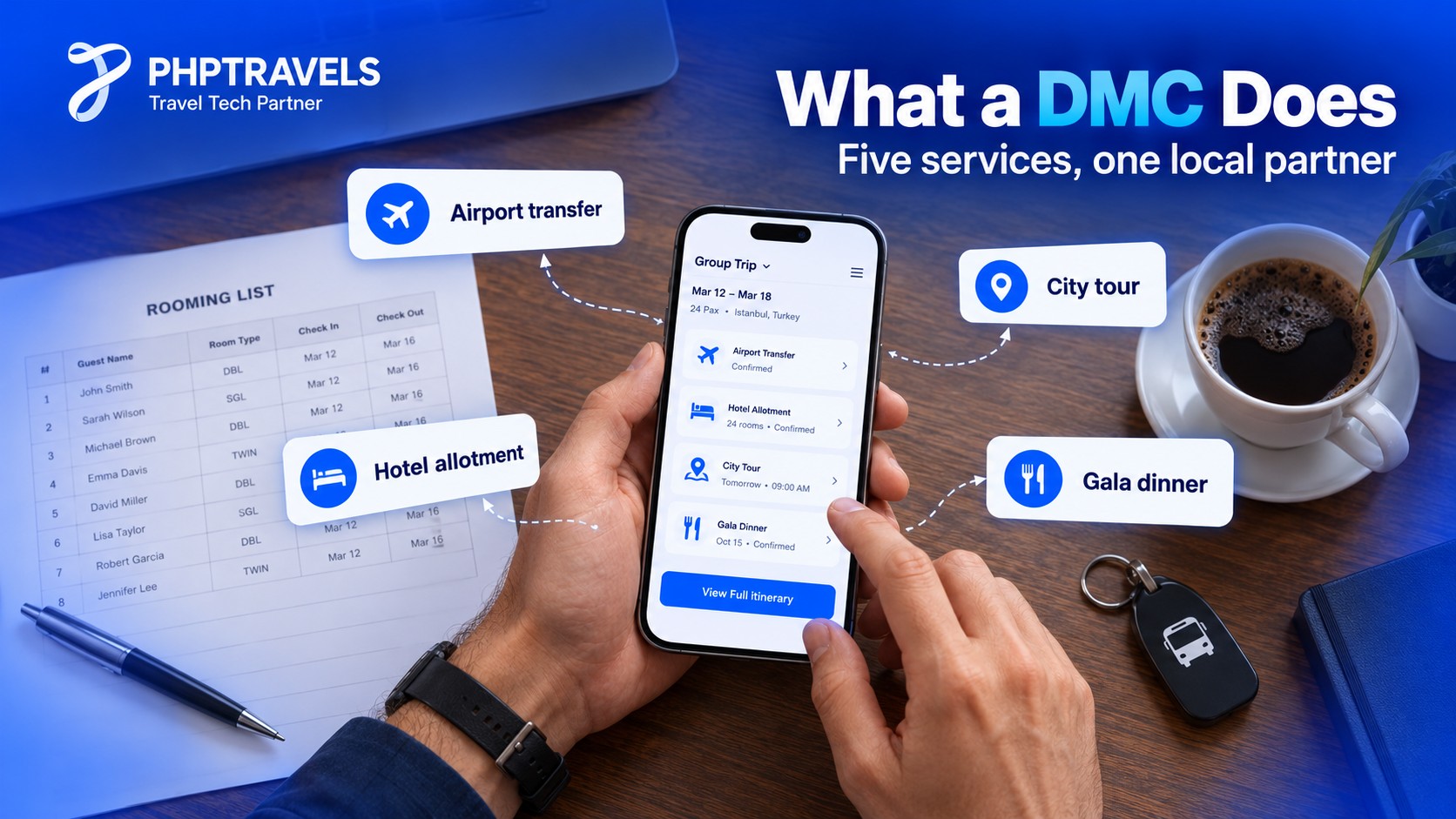
The exact menu varies by destination and company size, but most DMCs combine some or all of these services:
- Transfers and transport: airport meet-and-greet, private cars, minivans and coaches, usually priced per vehicle and per transfer or per hour.
- Hotel contracting: seasonal contracts, allotments (rooms held for the DMC until a release date) and group rates. This overlaps with what travel wholesalers and bedbanks offer, but a DMC usually knows the individual properties personally.
- Tours, excursions and tickets: city tours, day trips, entrance tickets, activities and experiences, often with child and group rates.
- Guides and tour managers: licensed local guides by language, plus tour leaders who stay with a group for the whole programme.
- Events and MICE: venues, gala dinners, conference logistics, team-building and incentive trips. ADMEI describes DMCs as being at the core of the meetings, incentives, conferences and exhibitions industry; our guide to MICE travel covers that segment in more depth.
- Programme logistics: rooming lists, run-of-show schedules, permits, staffing, signage, and a 24/7 emergency line while the group is in the country.
ADMEI uses this mix as a membership test: to qualify as a DMC member, a company must provide tours and transportation plus at least two of event management, activities and programme logistics. A company that only sells airport transfers is a useful supplier, but by that standard it is not a full DMC.
How do DMCs make money?
Most DMC income comes from the margin between what it pays local suppliers and the net rate it quotes to the buyer. Hotels often carry a thinner margin than excursions or private services, because hotel prices are easy for the buyer to compare. On events and incentive programmes, DMCs commonly add a management or handling fee for planning time and on-site staff. Some also charge per-person service fees on FIT (individual) bookings, where the work per traveller is higher than on a group.
DMC vs tour operator, travel agency and DMO
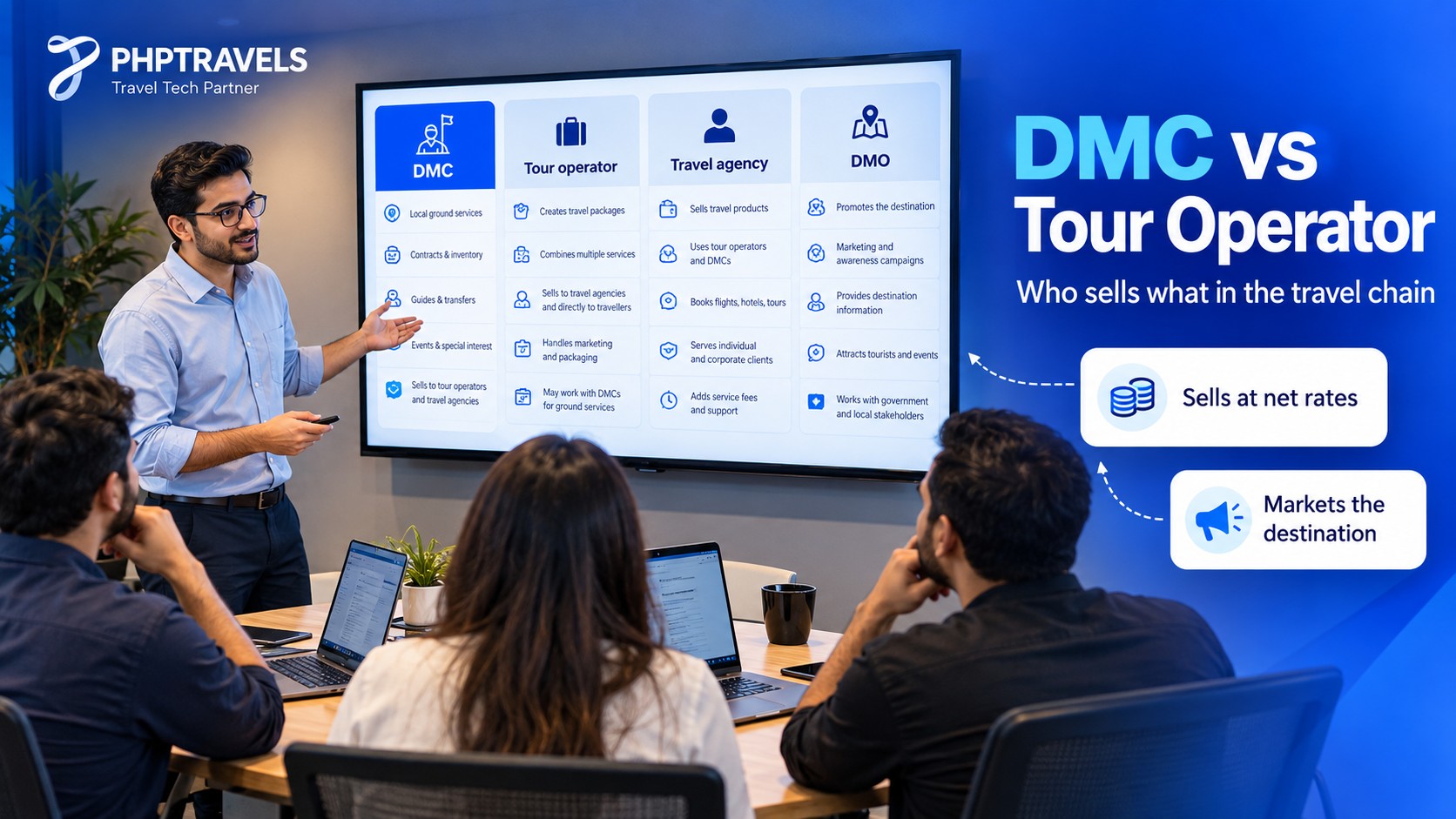
These roles sit at different points of the distribution chain, and one company can play more than one of them. The table shows the usual split.
| Role | Main customer | What it sells | Where it is based |
|---|---|---|---|
| Destination management company (DMC) | Foreign agencies, tour operators, event planners | Ground services and full programmes in one destination, at net rates | In the destination |
| Tour operator | Travellers, directly or through agencies | Packages that combine transport, stays and activities, often across several destinations | Usually in the source market |
| Travel agency | Travellers and corporate clients | Flights, hotels and packages bought from airlines, wholesalers, tour operators and DMCs | In the source market |
| Travel wholesaler or bedbank | Agencies and online travel agencies | Hotel rooms and other inventory at scale, often through an API | Global or regional |
| DMO (tourism board) | Travellers, trade and investors | Nothing directly; it markets and coordinates the destination | In the destination |
The DMC and DMO pairing causes the most confusion because the acronyms differ by one letter. UN Tourism defines a destination management or marketing organisation as the leading organisational entity that facilitates tourism partnerships towards a collective destination vision, with roles such as tourism policy, strategic planning, promotion and convention bureau work. A DMO runs familiarisation trips and trade shows; a DMC books the coach.
The tour operator and DMC line is blurrier. An outbound tour operator in Karachi or London may buy the land part of every package from DMCs and add the flights itself. Meanwhile, many DMCs also sell their own fixed-departure tours to agents. When you evaluate a partner, ask which services it contracts directly and which it subcontracts, rather than relying on the label. For a wider view of how these players connect, see how B2B travel works.
How travel agencies work with a DMC
Working with a DMC is a B2B relationship with a fairly standard rhythm. For a group or tailor-made trip it usually runs like this:
- Brief: the agency sends dates, number of travellers, hotel category, budget per person, interests and any special needs such as halal meals, accessibility or a language-specific guide.
- Proposal and costing: the DMC replies with a day-by-day itinerary, named or sample hotels, inclusions and exclusions, a net price per person by group size, and how long the quote is valid.
- Confirmation and deposit: the agency confirms, signs the terms and pays a deposit so the DMC can secure rooms and vehicles.
- Final numbers: the rooming list and passenger names go to the DMC before the hotel release dates, because unsold allotment rooms go back to the hotel after that point.
- Vouchers and service orders: the DMC issues vouchers for the travellers and service orders for each supplier.
- Delivery: the DMC meets the group, runs the programme and handles problems on the ground through its emergency line.
- Final invoice and reconciliation: extras, no-shows and last-minute changes are settled against the deposit.
On the DMC side, that net quote is built from dozens of local contracts with hotels, coach companies, guides, restaurants and venues, a back-office workflow described in Travels Tech’s overview of DMC contracting and ground operations. The agency sees one price, but the DMC is managing every line underneath it.
Worked example: how group size changes a DMC quote
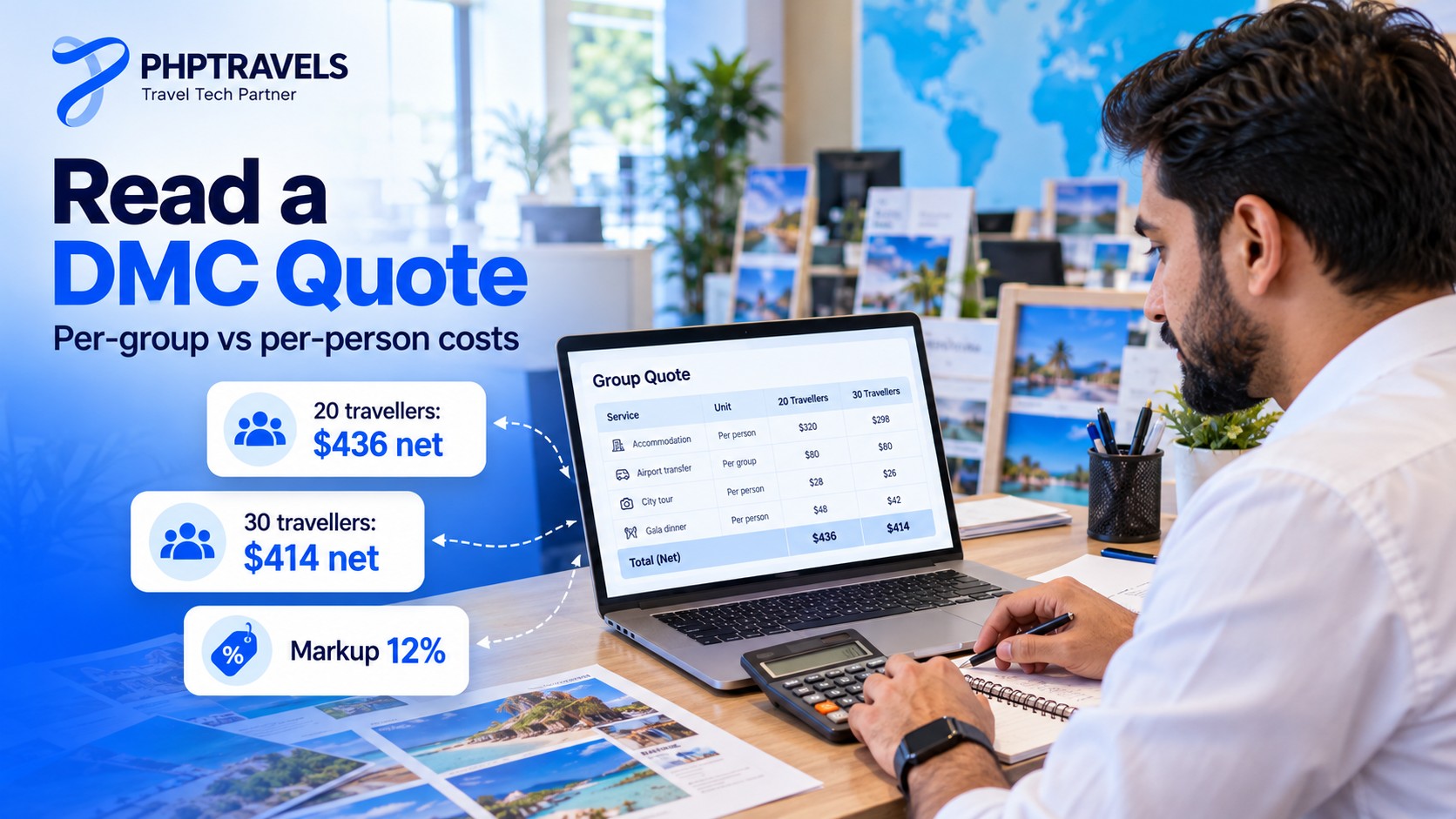
DMC services are priced in two ways. Some costs are per group (a coach, a guide, an airport transfer vehicle) and are split across everyone travelling. Others are per person (a hotel bed, an entrance ticket, a dinner). The figures below are illustrative, not market rates, for a four-night programme quoted in US dollars:
| Cost line | Priced per | 20 travellers | 30 travellers |
|---|---|---|---|
| Arrival and departure transfers (2 × $150) | Group | $300 total | $300 total |
| Coach for two touring days (2 × $350) | Group | $700 total | $700 total |
| Licensed guide for two days (2 × $160) | Group | $320 total | $320 total |
| Per-group costs shared per person | $1,320 ÷ 20 = $66 | $1,320 ÷ 30 = $44 | |
| Hotel, 4 nights twin share | Person | $260 | $260 |
| Entrance tickets | Person | $40 | $40 |
| Two group dinners | Person | $70 | $70 |
| DMC net rate per person | $436 | $414 | |
| Agency sell price with a 12% markup | $488 | $464 |
Two practical lessons follow. First, always ask for a price grid by group size, because the per-group lines make small groups noticeably more expensive per head. Second, if you sell in a different currency from the DMC quote, for example in Pakistani rupees or Indian rupees against a dollar or euro quote, build in a currency buffer or lock the rate when you take the client’s deposit. Our guides to markup management and B2B travel payments cover both sides of that calculation.
Who is responsible when something goes wrong?
The DMC delivers the services, but your agency may still carry the legal responsibility toward the traveller. Under the EU Package Travel Directive, the organiser of a package is responsible for the performance of the travel services in the package, whether it performs them itself or other providers do. If your business sells travellers in the EU a trip that combines a flight with DMC ground services, you are likely the organiser. The directive was amended by Directive (EU) 2026/1024, which entered into force on 28 May 2026; member states have 28 months to transpose it and the new rules then apply six months later, according to the European Commission. Rules elsewhere differ, so check your own market’s regulator and make sure your DMC contract covers indemnity, insurance and what happens when a supplier fails.
How to choose a destination management company
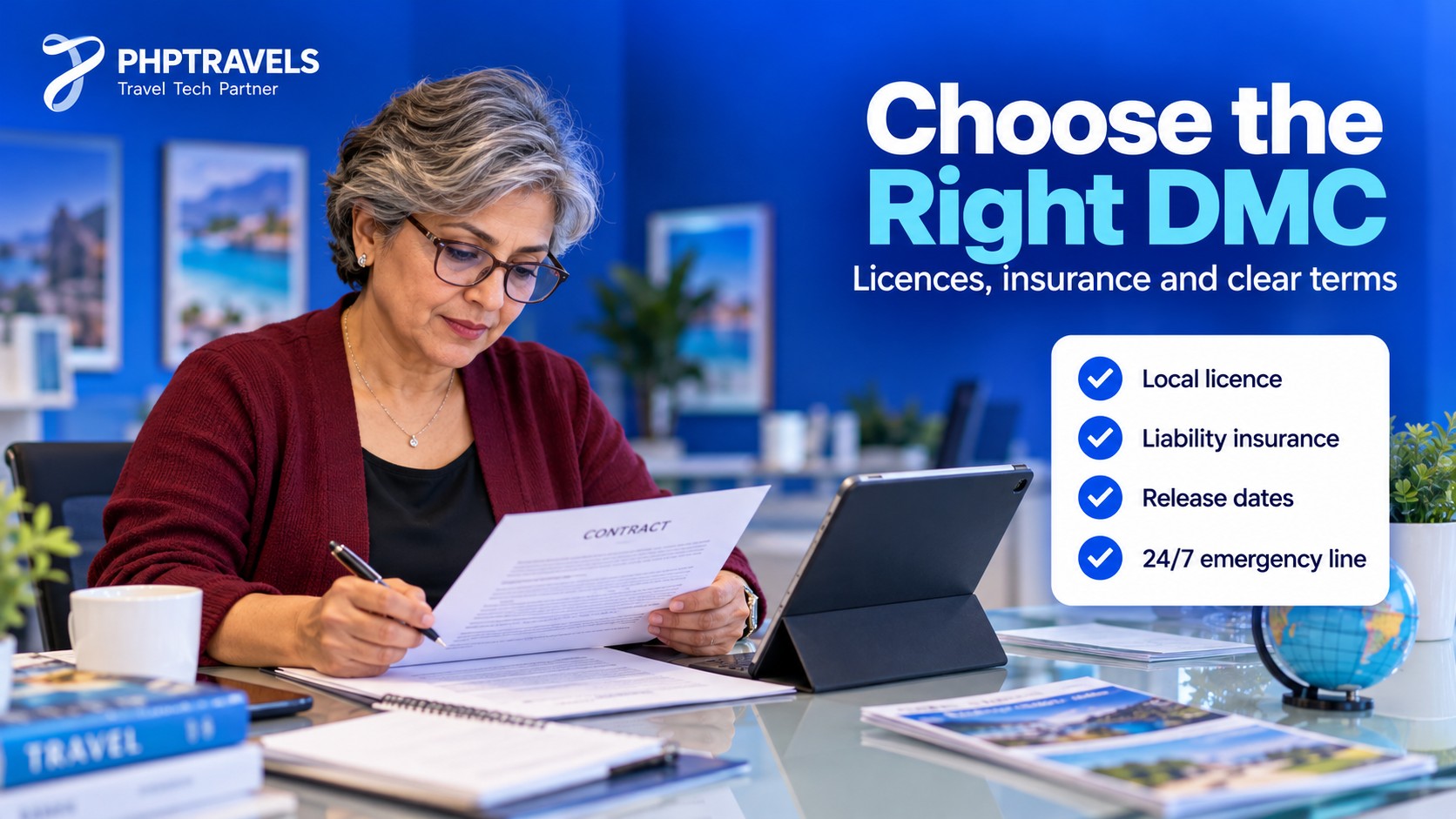
A strong DMC protects your reputation in a country where you have no staff. A weak one leaves you explaining a missed airport pickup at 2 a.m. These checks separate the two:
- Licences and registration: ask for the business licences the local authorities require. ADMEI asks for the same documents from its members.
- Liability insurance: ADMEI’s membership rules ask for a certificate showing at least $1 million (or equivalent) of general liability cover, or a letter explaining why it is not carried. Use that as a minimum benchmark and ask to see the certificate.
- Credentials and local standing: ADMEI membership or its Accredited Destination Management Company (ADMC) designation, and membership of the local tourism board, convention bureau or chamber of commerce. Individual staff may hold ADMEI’s Destination Management Certified Professional (DMCP) credential or the Certified Meeting Professional (CMP) credential run by the Events Industry Council.
- What they own versus subcontract: own vehicles or partner fleets, staff guides or freelancers, direct hotel contracts or wholesaler rooms. None is wrong, but you should know who is accountable.
- Proposal quality: a clear list of inclusions and exclusions, named hotels or clearly marked alternatives, a price grid by group size and a stated quote validity.
- Contract terms: deposit and balance dates, the cancellation scale, rooming-list and release deadlines, currency, force majeure and how refunds flow back to you.
- On-trip support: a named operations contact, a 24/7 emergency number and an escalation path that does not depend on one person’s mobile phone.
- References: other agencies in your source market, ideally ones selling to the same type of traveller.
Watch for simple red flags too. ADMEI requires member DMCs to use a website and email addresses on their own company domain rather than free webmail, which is a sensible test for any partner. Before you commit a large group, send a small FIT booking and see how the DMC handles confirmation, vouchers and a change request.
Software that runs a modern DMC (and where PHPTRAVELS fits)
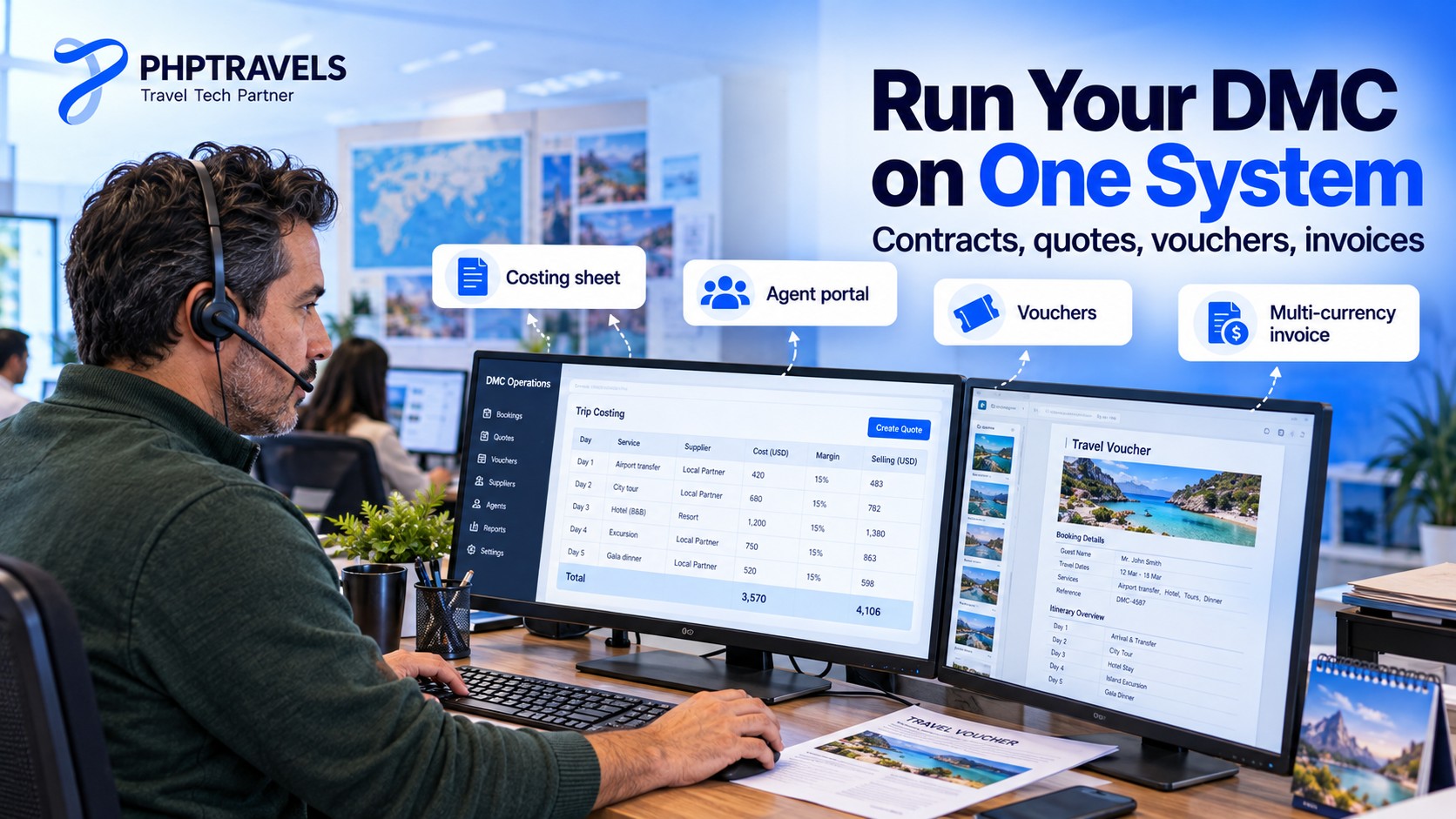
Most DMC errors are data errors: a rate typed differently in the contract sheet, the quote and the invoice, or a name change that never reached the coach company. The software a DMC uses, often called a destination management system, exists to keep one record from enquiry to supplier payment. A capable system should handle:
- Supplier contracts: seasons, allotments, release periods, stop-sales and policies for hotels, transfers and excursions.
- Costing sheets: per-group and per-person lines, a margin per line and automatic price-per-person recalculation as group size changes, as in the example above.
- Quote to booking to voucher: one file that becomes the quotation, the confirmed booking, the traveller vouchers and the supplier service orders.
- B2B distribution: an agent portal where partner agencies can book at their own net rates, plus an API for larger partners.
- Multi-currency finance: invoices in the buyer’s currency and supplier payables in local currency.
PHPTRAVELS offers a destination management system for DMCs built on these ideas: group costing sheets, direct supplier contracts, an agent portal and API, and multi-currency invoices, in a self-hosted platform with source code and a one-time licence. Its Tours, Stays and Cars modules cover the ground services, manual inventory lets you load your own contracted products, and the flights module is there for the agents who ask for air. It connects to supplier APIs, but you still bring your own supplier contracts and credentials; the software does not come with inventory. You can see the moving parts in the live demo and build an estimate on the pricing configurator.
Smaller ground operators that mainly sell fixed tour packages sometimes start with a package builder rather than a full DMC system; TravelBookingPortal’s tour operator software page, for example, centres on a visual itinerary builder with group and FIT support. If your work is closer to that model, our tour operator software and group travel booking guides are a better starting point.
Starting a DMC? Build the contracts before the website
New DMCs often begin with a booking website and few supplier agreements. The order should be the other way round: register the business and arrange insurance, contract a reliable core of hotels, transport and guides, then win two or three sending agencies in markets that already travel to your destination. Software becomes valuable once those contracts exist, because it turns them into quotes your agents can trust and book without waiting for an email.
A destination management company is the partner that turns a destination on your brochure into a trip that actually runs. Choose one with real local contracts, clear terms and proper insurance, understand how its per-group and per-person pricing works, and keep the whole file in one system on both sides. If you run a DMC or plan to sell ground services to agents, book a PHPTRAVELS demo to see how the costing, B2B portal and invoicing fit your operation.